From the free course Environmental Science (Ha and Schleiger) on Lykke
Foundations and the Scientific Method
Key concepts: Scientific Method · Interdisciplinary Study · Sustainability · Environmental Ethics
An introduction to the interdisciplinary nature of environmental science and the application of the scientific method to environmental inquiry.
Foundations and the Scientific Method
Environmental science is the systematic study of our environment and our proper place in it. Far from being a narrow specialty, it represents a "meta-discipline"—a complex, interdisciplinary nexus where biology, chemistry, physics, and geology intersect with the social, political, and ethical dimensions of human existence. At its core, environmental science seeks to understand the mechanics of the natural world, identify the impacts of human activity, and develop scalable, sustainable solutions for the future.
The Epistemology of Environmental Science
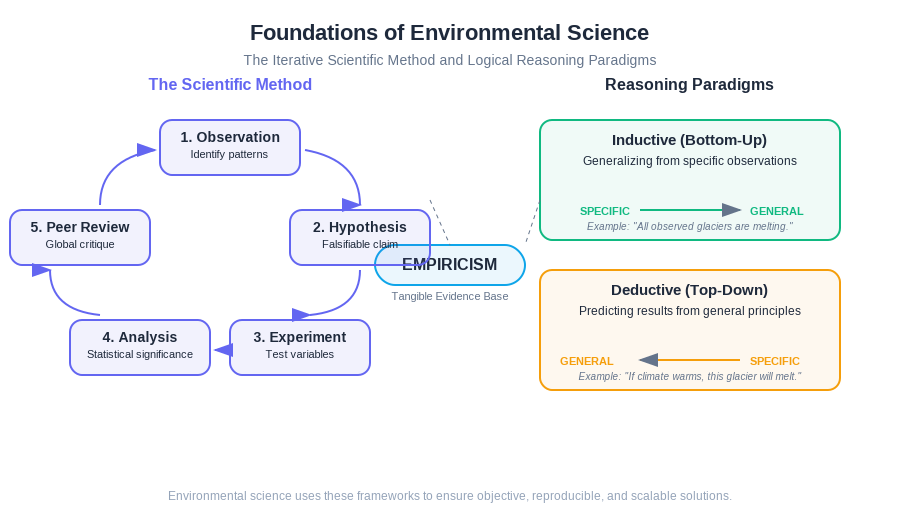
The foundation of environmental science is built upon Empiricism. We rely on the observation of real, tangible phenomena to understand the world. This distinguishes scientific inquiry from other forms of knowledge, such as aesthetics or theology, which may rely on subjective experience or revelation.
The Scientific Method: An Iterative Framework
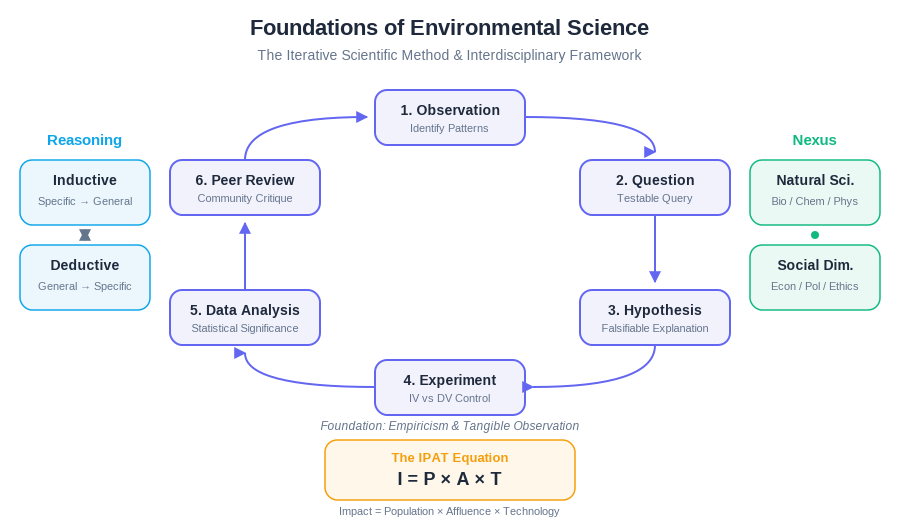
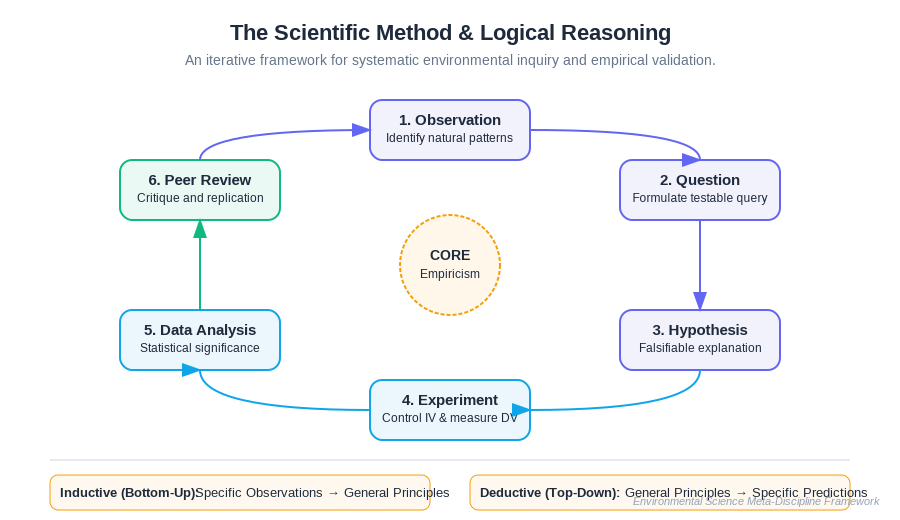
The Scientific Method is the standardized protocol used to minimize bias and maximize the reliability of our findings. It is not a linear checklist but a cyclical process of refinement.
- Observation: Identifying a pattern or a phenomenon in the natural world (e.g., "The population of amphibians in this wetland is declining").
- Question: Formulating a specific, testable query based on the observation.
- Hypothesis: Proposing a tentative explanation. A valid hypothesis must be falsifiable—it must be possible to prove it wrong.
- Experimentation: Designing a controlled test to gather data. This involves identifying the Independent Variable (the factor being manipulated) and the Dependent Variable (the factor being measured).
- Data Analysis: Using statistical tools to determine if the results are significant or merely the result of chance.
- Conclusion and Peer Review: Sharing findings with the global scientific community for rigorous critique and replication.
Definition: The Null Hypothesis ($H_0$) In environmental modeling, the Null Hypothesis typically states that there is no significant relationship between two variables. The goal of the researcher is often to "reject the null" in favor of an Alternative Hypothesis ($H_a$), providing evidence for a specific causal link.
Reasoning Paradigms
Scientists utilize two primary modes of logical reasoning to arrive at conclusions:
| Reasoning Type | Direction | Description | Example |
|---|---|---|---|
| Inductive | Bottom-Up | Generalizing from specific observations to broader principles. | Observing that many specific species of birds migrate south suggests a general rule of avian behavior. |
| Deductive | Top-Down | Applying a general principle to predict specific results. | If climate change causes warming, we predict that glaciers in specific regions will retreat. |
Quantitative Analysis in Environmental Science
To move beyond qualitative observation, environmental scientists utilize computational tools to model ecosystems and analyze data.
Interdisciplinary Study and the "Wicked Problem"
Environmental science is inherently interdisciplinary. A single problem, such as the acidification of the oceans, cannot be solved by a biologist alone. It requires:
- Chemists to understand the $CO_2$ absorption rates.
- Oceanographers to map current shifts.
- Economists to calculate the impact on the fishing industry.
- Political Scientists to draft international treaties (like the Paris Agreement).
The IPAT Equation
One of the most critical conceptual frameworks for understanding human impact is the IPAT Equation, which quantifies how different factors contribute to environmental degradation.
I = P \times A \times T
Where:
- $I$ = Environmental Impact
- $P$ = Population (The number of people in a given area)
- $A$ = Affluence (The average consumption per person)
- $T$ = Technology (The resource intensity or efficiency of the technology used)
Sustainability: The Operational Goal
Sustainability is the "North Star" of environmental science. It is most famously defined by the Brundtland Commission (1987) as:
"Meeting the needs of the present without compromising the ability of future generations to meet their own needs."
The Triple Bottom Line
Modern sustainability is viewed through the lens of the Triple Bottom Line (TBL). For a solution to be truly sustainable, it must be viable across three distinct dimensions:
| Dimension | Focus | Key Metrics |
|---|---|---|
| Environmental | Planetary Health | Carbon footprint, biodiversity index, waste reduction. |
| Social | Human Equity | Labor rights, community health, environmental justice. |
| Economic | Financial Viability | Profitability, cost-benefit analysis, resource efficiency. |
Resource Management and the Tragedy of the Commons
A central challenge to sustainability is the Tragedy of the Commons, a concept popularized by Garrett Hardin. It describes a situation where individual users, acting independently according to their own self-interest, behave contrary to the common good of all users by depleting a shared resource through their collective action.
Common examples include:
- Overfishing in international waters.
- Atmospheric pollution.
- Groundwater depletion in shared aquifers.
Environmental Ethics and Philosophy
How we treat the environment depends heavily on our underlying ethical framework. Environmental ethics is the branch of philosophy that studies the moral relationship of human beings to the environment.
Major Ethical Frameworks
| Framework | Core Value | Perspective |
|---|---|---|
| Anthropocentrism | Human-centered | Nature is a resource intended for human use. Protection is only necessary if it benefits humans. |
| Biocentrism | Life-centered | All living things have intrinsic value, regardless of their utility to humans. |
| Ecocentrism | Ecosystem-centered | The entire ecosystem (including non-living components like water and soil) has value. The health of the system is paramount. |
The Land Ethic
Aldo Leopold’s "Land Ethic" is a cornerstone of modern ecocentrism. He argued that we should stop viewing land as a commodity and start viewing it as a community to which we belong. This shift from "conqueror" to "plain member and citizen" of the biotic community is a fundamental requirement for long-term sustainability.
Data Management in Environmental Research
Modern environmental science relies on massive datasets generated by sensor networks, satellites, and field observations. Managing this data requires robust database structures.
Applied Methodology: Experimental Design
When designing an environmental study, researchers must account for the inherent variability of natural systems.
Key Components of Experimental Design
- Control Group: A baseline group that does not receive the experimental treatment, used for comparison.
- Replication: Performing the experiment multiple times to ensure results aren't a fluke.
- Randomization: Assigning subjects to groups randomly to eliminate selection bias.
- Blind Studies: In some cases, researchers or subjects do not know which group is which to prevent observer bias.
Common Pitfalls in Environmental Science
- Correlation vs. Causation: Just because two variables (e.g., temperature and CO2) rise together doesn't mean one causes the other without a proven mechanism.
- Scale Mismatch: Applying data from a small-scale lab experiment to a global ecosystem without accounting for emergent properties.
- Confirmation Bias: Only seeking out data that supports a pre-existing hypothesis.
Summary of Human-Environment Interaction
The interaction between humans and the environment is a feedback loop. Our activities (agriculture, industry, urbanization) alter the environment, and those alterations (climate change, resource scarcity, pollution) in turn affect human health, economic stability, and social structures.
Environmental science provides the tools to quantify these interactions. By applying the Scientific Method, adhering to Sustainability principles, and navigating the complexities of Environmental Ethics, we can move toward a future where human progress does not come at the expense of the planetary systems that support us.
Source Materials
Study Environmental Science (Ha and Schleiger) on Lykke
This course page is free to open: signed out, you can read its first two sections, and signing in, on any plan, opens the rest. The free Lykke Chrome extension syncs your own Canvas courses, so ChatGPT, Claude and Muse can answer from your classes and deadlines. It only reads Canvas.
Add the free extensionSign in to open every sectionAll sections of Environmental Science (Ha and Schleiger) · Browse more course pages