From the free course Environmental Science (Ha and Schleiger) on Lykke
Human Impacts and Environmental Health
Key concepts: Environmental Impacts · Pollution · Human Population · Toxicology
A deep dive into how human population growth, industrialization, and pollution affect the global environment.
Human Impacts and Environmental Health
Overview
Humanity has entered the Anthropocene, a proposed geological epoch defined by the significant global impact of human activities on Earth's ecosystems. Unlike previous eras where change was driven by orbital mechanics or volcanic activity, the current shift is driven by the rapid expansion of the Human Population, the industrialization of resource extraction, and the resulting discharge of synthetic compounds into the biosphere.
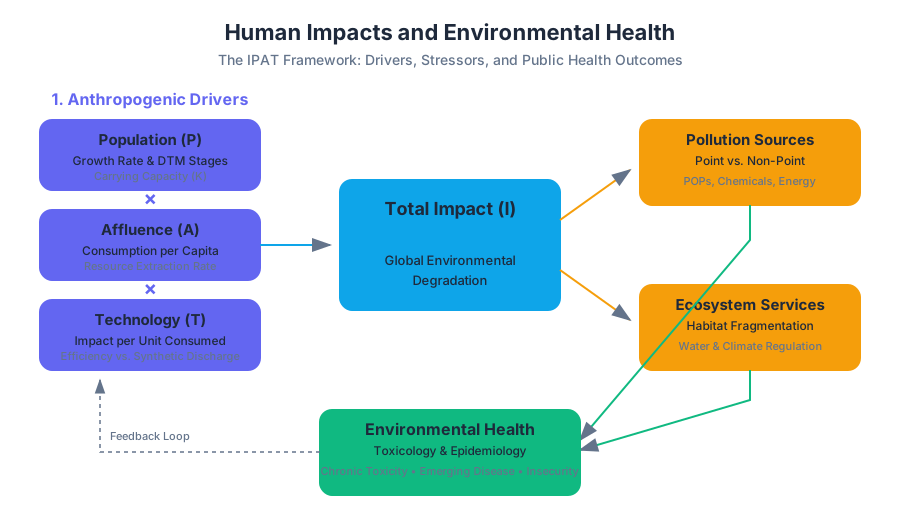
The study of human impacts and environmental health is an interdisciplinary synthesis of Ecology, Toxicology, and Epidemiology. It seeks to quantify how anthropogenic stressors—ranging from chemical pollutants to habitat fragmentation—alter the chemical and biological integrity of the environment and, by extension, human physiological well-being. This relationship is not unidirectional; as we degrade the ecosystem services (such as water purification and climate regulation) upon which we depend, we introduce new risks to public health, including chronic toxicity, emerging infectious diseases, and nutritional insecurity.
Human Population Dynamics
The fundamental driver of environmental impact is the scale and rate of human population growth. For most of human history, the population grew at a negligible rate, constrained by high infant mortality and limited food production. However, the Industrial and Green Revolutions triggered an exponential growth phase, characterized by a constant percentage increase over time.
The Demographic Transition Model (DTM)
The Demographic Transition Model (DTM) describes the historical shift from high birth and death rates to low birth and death rates as a country develops from a pre-industrial to an industrialized economic system.
| Stage | Description | Birth Rate | Death Rate | Population Growth |
|---|---|---|---|---|
| Stage 1: Pre-Industrial | Minimal technology; high disease burden. | High | High | Stable/Slow |
| Stage 2: Transitional | Improved sanitation and food supply. | High | Falling Rapidly | Rapid Increase |
| Stage 3: Industrial | Urbanization; increased education/contraception. | Falling | Falling Slowly | Slowing Increase |
| Stage 4: Post-Industrial | High standard of living; female empowerment. | Low | Low | Stable/Zero Growth |
| Stage 5: Declining | Aging population; sub-replacement fertility. | Very Low | Low | Slow Decrease |
Carrying Capacity and the Verhulst Equation
In ecology, the Carrying Capacity ($K$) is the maximum population size of a species that an environment can sustain indefinitely. While some argue that human ingenuity (technology) can infinitely expand $K$, others point to the finite nature of planetary boundaries.
Quantifying Impact: The IPAT Equation
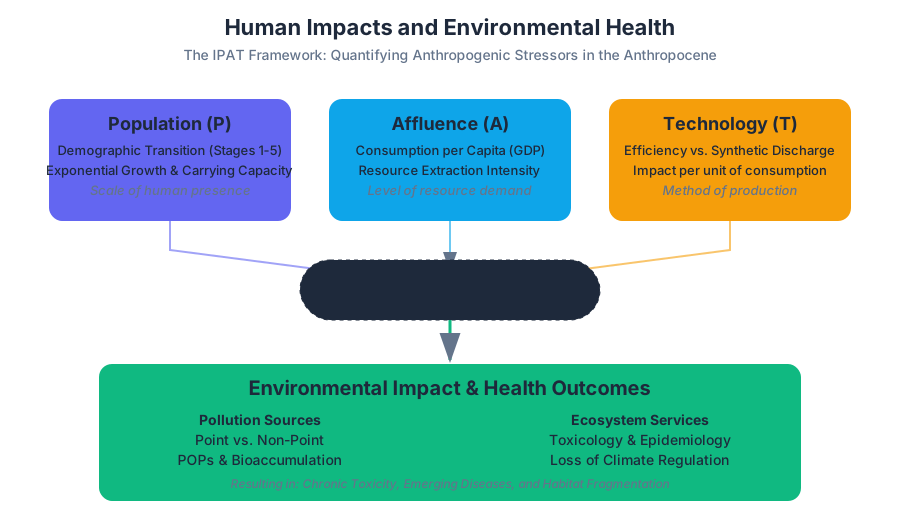
To move beyond simple headcounts, environmental scientists use the IPAT Equation to conceptualize how different factors contribute to environmental degradation.
The IPAT Equation: $I = P \times A \times T$
Where:
- $I$ (Impact): The total environmental degradation (e.g., CO2 emissions, tons of waste).
- $P$ (Population): The number of people in a given area.
- $A$ (Affluence): The average consumption per person (often measured as GDP per capita).
- $T$ (Technology): The impact per unit of consumption (can be negative if technology increases efficiency, or positive if it introduces new pollutants).
Variations of IPAT
A modern variation is the STIRPAT model (Stochastic Impacts by Regression on Population, Affluence, and Technology), which allows for statistical testing of the relative weights of each factor.
Environmental Pollution
Pollution is the introduction of contaminants into the natural environment that cause adverse change. These contaminants can be chemical substances or energy, such as noise, heat, or light.
Classification by Source
- Point Source: Pollution originating from a single, identifiable location (e.g., a factory discharge pipe or a leaking underground storage tank).
- Non-point Source: Diffuse pollution that does not have a single point of origin (e.g., agricultural runoff carrying fertilizers and pesticides from thousands of acres into a river system).
Major Pollutant Categories
| Category | Examples | Primary Environmental Impact |
|---|---|---|
| Persistent Organic Pollutants (POPs) | DDT, PCBs, Dioxins | Bioaccumulation; endocrine disruption. |
| Heavy Metals | Lead (Pb), Mercury (Hg), Cadmium (Cd) | Neurotoxicity; kidney damage; soil sterility. |
| Nutrients | Nitrates ($NO_3^-$), Phosphates ($PO_4^{3-}$) | Eutrophication: Algal blooms leading to "dead zones" (hypoxia). |
| Particulate Matter (PM) | $PM_{2.5}$, $PM_{10}$ | Respiratory disease; reduced visibility; climate forcing. |
| Xenobiotics | Microplastics, Pharmaceuticals | Disruption of microbial communities; reproductive failure in wildlife. |
Toxicology: The Science of Poisons
Toxicology is the study of the adverse effects of chemical, physical, or biological agents on living organisms and the ecosystem. In the context of environmental health, we focus on Ecotoxicology, which examines the impact of toxins at the population and ecosystem levels.
Dose-Response Relationships
The core tenet of toxicology, established by Paracelsus, is that "the dose makes the poison." Scientists use Dose-Response Curves to determine the potency of a substance.
- $LD_{50}$ (Lethal Dose 50%): The dose of a substance required to kill 50% of a test population.
- $ED_{50}$ (Effective Dose 50%): The dose that produces a specific biological effect in 50% of the population.
- Threshold Dose: The maximum dose that has no observable adverse effect (NOAEL).
The Hill Equation is often used to model the sigmoidal shape of these curves:
f(D) = \frac{E_{max} \cdot D^n}{ED_{50}^n + D^n}
Where $D$ is the dose, $E_{max}$ is the maximum response, and $n$ is the Hill coefficient (steepness).
Bioaccumulation and Biomagnification
One of the most dangerous aspects of environmental toxins is their ability to concentrate as they move through the food web.
- Bioaccumulation: The increase in concentration of a substance in a single organism over time (e.g., a fish absorbing mercury from water faster than it can excrete it).
- Biomagnification: The increase in concentration of a substance as it moves up the trophic levels (e.g., an osprey having much higher DDT levels than the fish it eats).
Environmental Health and Risk Assessment
Environmental health focuses on identifying and mitigating Environmental Hazards, which are categorized into four types:
- Physical: Natural disasters, UV radiation, noise.
- Chemical: Synthetic chemicals, lead, asbestos.
- Biological: Pathogens (viruses, bacteria, parasites).
- Cultural/Lifestyle: Smoking, diet, poverty-related lack of sanitation.
The Risk Assessment Pipeline
To manage these hazards, regulatory agencies (like the EPA or WHO) follow a structured Risk Assessment process:
- Hazard Identification: Determining if a substance causes adverse health effects.
- Dose-Response Assessment: Quantifying the relationship between dose and effect.
- Exposure Assessment: Estimating how often and how much of the substance people are in contact with.
- Risk Characterization: Combining the previous steps to estimate the probability of harm to the population.
Querying Toxicological Data
Professionals often interact with databases like the TOXNET or IRIS (Integrated Risk Information System).
Common Pitfalls and Misconceptions
- Correlation vs. Causation in Epidemiology: Just because a disease cluster exists near a factory does not prove the factory caused it. Researchers must control for confounding variables (e.g., smoking, age, socioeconomic status).
- The "Natural is Safe" Fallacy: Many of the most potent toxins are natural (e.g., botulinum toxin, arsenic, aflatoxins). "Synthetic" does not automatically mean "more dangerous."
- Synergistic Effects: Most toxicological tests involve a single chemical. In the real world, humans are exposed to a "chemical soup." Synergism occurs when the combined effect of two chemicals is greater than the sum of their individual effects (e.g., asbestos exposure and smoking exponentially increasing lung cancer risk).
Synthesis: Sustainability and the Scientific Method
Addressing human impacts requires the rigorous application of the Scientific Method. We observe environmental degradation, form hypotheses about the causative agents (e.g., "Is $PM_{2.5}$ causing the observed increase in asthma?"), conduct controlled experiments or longitudinal cohort studies, and refine our models.
Sustainability is the ultimate goal: meeting the needs of the present without compromising the ability of future generations to meet their own needs. This requires a transition from a Linear Economy (Take -> Make -> Waste) to a Circular Economy, where waste is treated as a resource and human impacts are kept within the regenerative capacity of the Earth.
References & Further Reading
- Ha, M., & Schleiger, R. (2023). Environmental Science.
- Millennium Ecosystem Assessment (2005). Ecosystems and Human Well-being.
- Casarett & Doull's Toxicology: The Basic Science of Poisons.
- Rockström, J., et al. (2009). Planetary Boundaries: Exploring the Safe Operating Space for Humanity.
Source Materials
Study Environmental Science (Ha and Schleiger) on Lykke
This course page is free to open: signed out, you can read its first two sections, and signing in, on any plan, opens the rest. The free Lykke Chrome extension syncs your own Canvas courses, so ChatGPT, Claude and Muse can answer from your classes and deadlines. It only reads Canvas.
Add the free extensionSign in to open every sectionAll sections of Environmental Science (Ha and Schleiger) · Browse more course pages