From the free course Environmental Science (Ha and Schleiger) on Lykke
Energy Resources and Sustainable Futures
Key concepts: Renewable Energy · Non-renewable Energy · Sustainability · Resource Management
Evaluates current energy systems and the transition toward renewable resources and sustainable management.
Energy Resources and Sustainable Futures
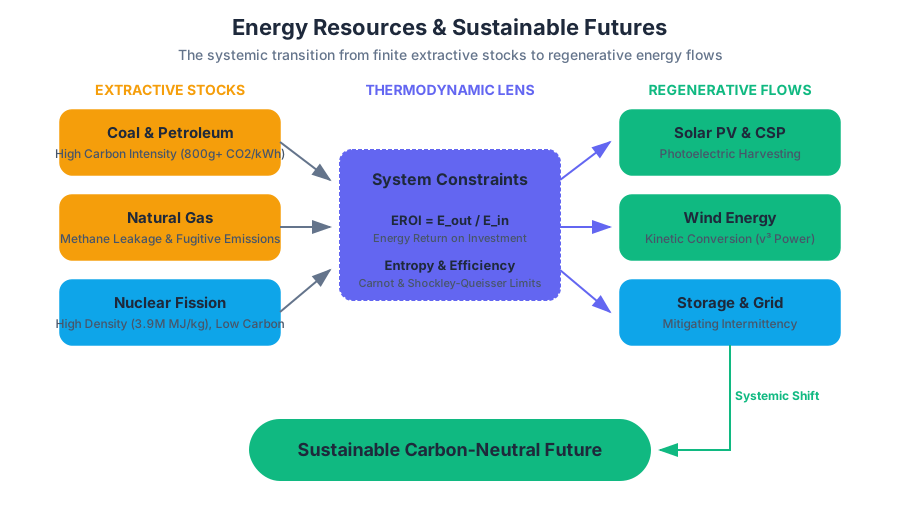
Energy is the fundamental currency of the universe. In the context of human civilization, it is the primary driver of economic development, technological progress, and social well-being. However, the methods by which we extract, transform, and consume energy are inextricably linked to the health of our planet. This section explores the transition from a high-carbon, extractive energy model to a sustainable, regenerative framework. We will examine the technical mechanics of energy sources, the thermodynamic constraints of resource management, and the systemic shifts required for a carbon-neutral future.
The Thermodynamics of Energy Systems
To understand energy resources, one must first understand the laws that govern them. Energy is never "created" or "destroyed" (First Law of Thermodynamics), but in every transformation, some energy is degraded into a less useful form, typically low-grade heat (Second Law of Thermodynamics).
The Entropy Constraint: In any energy conversion system, the total entropy of an isolated system can never decrease over time. For energy resource management, this means that "100% efficiency" is physically impossible, and every energy source has a theoretical maximum efficiency (e.g., the Carnot Limit for heat engines or the Shockley-Queisser Limit for solar cells).
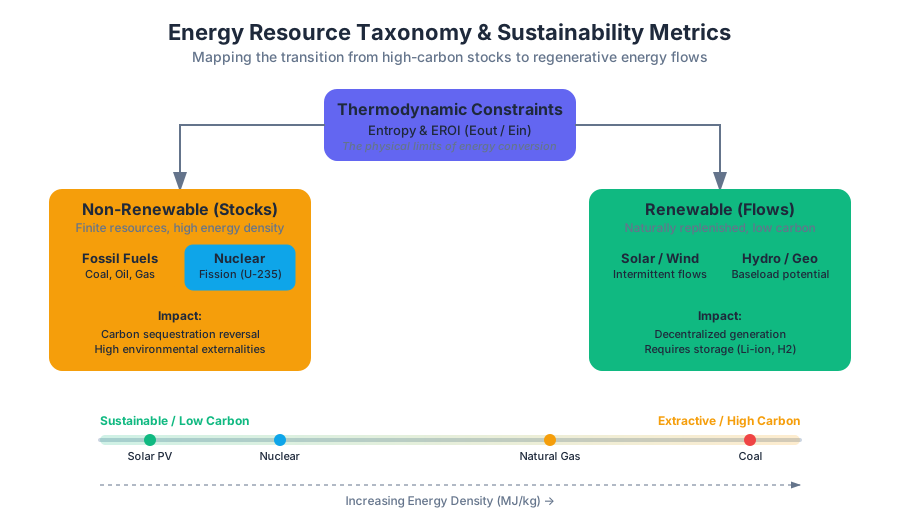
The viability of an energy resource is often measured by its Energy Return on Investment (EROI). This is the ratio of the amount of usable energy delivered from a particular energy resource to the amount of energy used to obtain that energy resource.
$$EROI = \frac{E_{out}}{E_{in}}$$
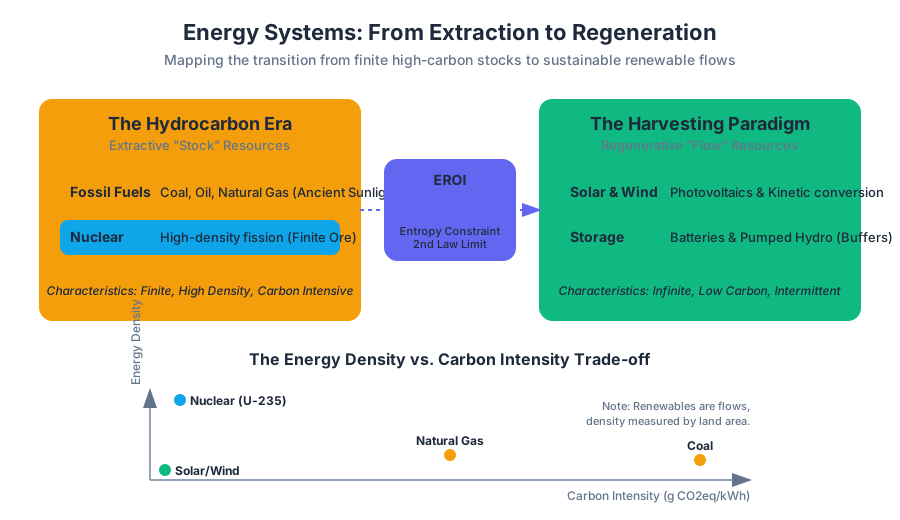
Comparison of Energy Density and Carbon Intensity
| Fuel Source | Energy Density (MJ/kg) | Carbon Intensity (g CO2eq/kWh) | Primary Use Case |
|---|---|---|---|
| Coal (Anthracite) | 24–35 | 820–1000 | Electricity Generation |
| Crude Oil | 42–47 | 650–900 | Transportation, Petrochemicals |
| Natural Gas | 50–55 | 400–500 | Heating, Peak Electricity |
| Uranium-235 | 3,900,000 | 12–110 | Baseload Electricity |
| Lithium-ion Battery | 0.5–0.9 | N/A (Storage) | Mobile Electronics, EVs |
Non-renewable Energy: The Hydrocarbon Era
Non-renewable energy refers to resources that exist in finite amounts and are consumed much faster than they are replenished by natural processes. These primarily include fossil fuels—coal, oil, and natural gas—and nuclear fuels.
Fossil Fuels and the Carbon Cycle
Fossil fuels are essentially "ancient sunlight" stored in the form of chemical bonds within organic matter that has undergone high pressure and temperature over millions of years. When we burn these fuels, we are re-introducing carbon into the atmosphere that was sequestered during the Carboniferous period, leading to a rapid increase in atmospheric $CO_2$.
- Coal: Formed from terrestrial plant matter in anaerobic swamp conditions. It is the most carbon-intensive fuel and a major source of sulfur dioxide ($SO_2$) and mercury.
- Petroleum (Oil): Derived from marine microorganisms. Its versatility in liquid form makes it the backbone of global logistics.
- Natural Gas: Primarily methane ($CH_4$). While it burns cleaner than coal, methane leakage during extraction (fugitive emissions) is a potent driver of short-term global warming.
Nuclear Energy: The High-Density Outlier
Nuclear energy occupies a unique space. It is non-renewable (based on finite uranium ore) but produces virtually no greenhouse gases during operation. It relies on Nuclear Fission, where the nucleus of a heavy atom (like U-235) is split into smaller nuclei, releasing a massive amount of binding energy.
Renewable Energy: The Harvesting Paradigm
Renewable energy is derived from natural processes that are replenished at a rate equal to or faster than the rate at which they are consumed. Unlike fossil fuels, which are "stocks" of energy, renewables are "flows."
Solar Energy
Solar power utilizes the Photoelectric Effect to convert photons directly into electrons (Photovoltaics, PV) or uses mirrors to concentrate thermal energy (Concentrated Solar Power, CSP).
- Photovoltaics (PV): Semiconductor materials (usually Silicon) create a p-n junction that generates direct current (DC) when exposed to light.
- Capacity Factor: Solar typically has a lower capacity factor (15-25%) because it is diurnal and weather-dependent.
Wind Energy
Wind turbines convert the kinetic energy of moving air into mechanical energy, then electricity. The power available in the wind is proportional to the cube of the wind speed ($v^3$).
Betz's Law: No turbine can capture more than 59.3% of the kinetic energy in wind. This is the theoretical maximum efficiency for a wind turbine.
P_{wind} = \frac{1}{2} \rho A v^3 C_p
Where:
- $P$ = Power (Watts)
- $\rho$ = Air density ($kg/m^3$)
- $A$ = Swept area of blades ($m^2$)
- $v$ = Wind velocity ($m/s$)
- $C_p$ = Power coefficient (Max 0.593)
Hydroelectric and Geothermal
- Hydroelectric: Uses the gravitational potential energy of water. It is highly efficient and provides dispatchable power (can be turned on/off quickly), but it faces geographical limits and ecological impacts on river systems.
- Geothermal: Taps into the internal heat of the Earth. It provides reliable baseload power but is restricted to tectonically active regions.
Comparison of Renewable Technologies
| Technology | LCOE ($/MWh) | Land Use (m²/MWh) | Dispatchability | Scalability |
|---|---|---|---|---|
| Utility Solar PV | $30 - $45 | High | Low (Intermittent) | Very High |
| Onshore Wind | $25 - $50 | Medium | Low (Intermittent) | High |
| Geothermal | $60 - $100 | Low | High (Baseload) | Low (Site specific) |
| Hydropower | $40 - $80 | Very High | High (Storage) | Medium |
Sustainability and Resource Management
Sustainability is the practice of meeting the needs of the present without compromising the ability of future generations to meet their own needs. In energy, this requires a transition from a linear "take-make-waste" model to a Circular Economy.
The Triple Bottom Line
Sustainable resource management evaluates decisions based on three pillars:
- Environmental: Minimizing ecological footprint and carbon emissions.
- Social: Ensuring energy justice, public health, and equitable access.
- Economic: Ensuring long-term financial viability and internalizing "externalities" (like the cost of pollution).
Critical Minerals and the Green Transition
The shift to renewables is a shift from a fuel-intensive system to a material-intensive system. Building wind turbines, solar panels, and EV batteries requires significant amounts of "critical minerals."
| Mineral | Primary Use | Sustainability Concern |
|---|---|---|
| Lithium | Battery Anodes | Water scarcity in extraction regions (e.g., Chile) |
| Cobalt | Battery Cathodes | Human rights and ethical mining (e.g., DRC) |
| Copper | Wiring/Grid | Massive volume required for electrification |
| Neodymium | Wind Turbine Magnets | High environmental cost of Rare Earth processing |
Resource Management Strategies
- Decoupling: Increasing economic output while decreasing environmental impact.
- Life Cycle Assessment (LCA): Evaluating the environmental impact of a product from "cradle to grave" (extraction to disposal).
- Demand-Side Management (DSM): Using technology to shift consumer energy use to off-peak hours or reduce overall consumption.
Challenges in the Energy Transition
Intermittency and the "Duck Curve"
Solar and wind are intermittent. The Duck Curve is a graph of net load (total demand minus solar/wind generation) that shows a drastic drop in midday demand followed by a sharp ramp-up at sunset. Solving this requires:
- Energy Storage: Batteries, Pumped Hydro, or Green Hydrogen.
- Grid Modernization: Smart grids that can balance supply and demand in real-time.
- Interconnection: High-voltage DC (HVDC) lines to move power from windy/sunny areas to load centers.
Common Pitfalls and Misconceptions
- The "Natural Gas as a Bridge" Fallacy: While gas emits less $CO_2$ than coal, the methane leaks and the "lock-in" of fossil fuel infrastructure can delay the transition to true zero-carbon sources.
- Nuclear Waste: While the volume of high-level nuclear waste is small, the political and long-term storage challenges remain significant.
- Energy Efficiency Paradox (Jevons Paradox): Increases in efficiency often lead to lower costs, which can paradoxically increase total consumption.
Modeling and Data
Managing a sustainable future requires rigorous data tracking. We must monitor resource depletion rates, carbon intensity, and recycling efficiency.
Summary of Strategies for a Sustainable Future
- Electrify Everything: Transition transportation and heating from combustion to electricity.
- Decarbonize the Grid: Replace fossil fuel plants with a mix of wind, solar, nuclear, and storage.
- Circular Material Flows: Design products for modularity and 100% recyclability to reduce mining pressure.
- Policy and Carbon Pricing: Internalize the cost of carbon through taxes or cap-and-trade systems to incentivize clean investment.
Source Materials
Study Environmental Science (Ha and Schleiger) on Lykke
This course page is free to open: signed out, you can read its first two sections, and signing in, on any plan, opens the rest. The free Lykke Chrome extension syncs your own Canvas courses, so ChatGPT, Claude and Muse can answer from your classes and deadlines. It only reads Canvas.
Add the free extensionSign in to open every sectionAll sections of Environmental Science (Ha and Schleiger) · Browse more course pages