From the free course Criminology and Criminal Justice on Lykke
Juvenile Justice
Key concepts: Parens Patriae · Waiver Mechanisms · Superpredator Narrative · School-to-Prison Pipeline · In re Gault
The specialized system for handling minor offenders, its history, and the shift between rehabilitative and punitive models.
Juvenile Justice: The Architecture of Rehabilitation and Retribution
The juvenile justice system represents a specialized branch of the American legal framework designed to address the unique legal and developmental status of minors. Unlike the adult criminal system, which focuses heavily on retribution and public safety, the juvenile system was historically founded on the principle of rehabilitation—the idea that youth are more malleable and capable of reform than adults. However, this system has undergone significant shifts, oscillating between a protective, paternalistic model and a more punitive "get tough" approach driven by political narratives and social panics.
The Philosophical Foundation: Parens Patriae
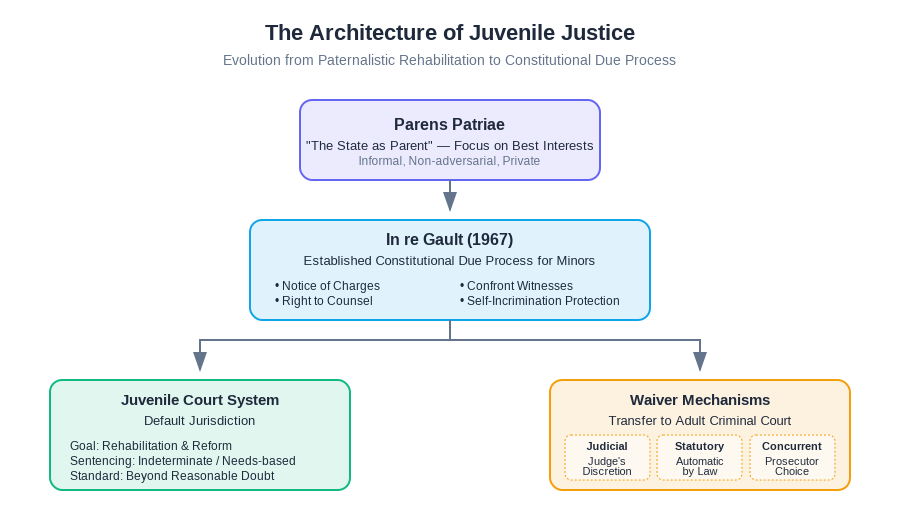
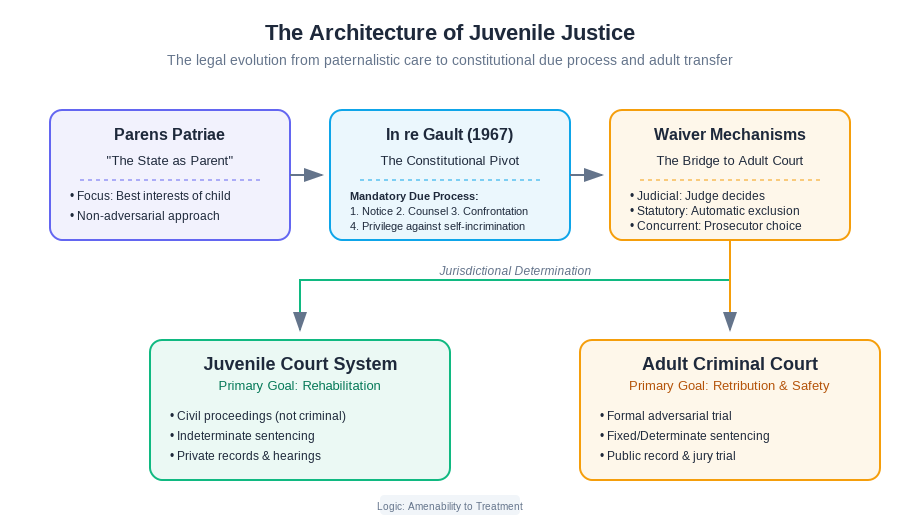
The bedrock of the juvenile court is the Latin doctrine of Parens Patriae, which translates to "the state as parent." This concept grants the government the legal authority to intervene in the lives of children when their parents are unable or unwilling to provide proper care or supervision.
Definition: Parens Patriae A legal doctrine that gives the state the power to act as a guardian for those who are unable to care for themselves, such as children or the disabled. In juvenile justice, this shifts the court's focus from "guilt vs. innocence" to "the best interests of the child."
Evolution of the Doctrine
In the late 19th century, the "Child Savers" movement argued that children should not be housed in adult jails or subjected to the harshness of adult criminal proceedings. This led to the creation of the first juvenile court in Cook County, Illinois, in 1899. The original system was intentionally informal:
- Non-adversarial: Judges acted as counselors rather than arbiters of law.
- Private: Proceedings were closed to the public to prevent stigmatization.
- Indeterminate Sentencing: Youth were held until they were "rehabilitated," not for a fixed term.
The Constitutional Pivot: In re Gault (1967)
For the first half of the 20th century, the informality of the juvenile court meant that youth had almost no constitutional rights. Because the court was "helping" the child, the Supreme Court initially ruled that due process was unnecessary. This changed with the landmark case In re Gault.
The Case of Gerald Gault
Fifteen-year-old Gerald Gault was committed to a state industrial school for six years after allegedly making a lewd phone call. An adult would have received a maximum fine of $50 or two months in jail. Gault was denied a lawyer, was not informed of his rights, and the complaining witness never appeared.
The Ruling and Its Impact
The Supreme Court ruled that "under our Constitution, the condition of being a boy does not justify a [denial of rights]." The decision established that in any proceeding where incarceration is a possibility, juveniles are entitled to:
- Notice of charges.
- Right to counsel.
- Right to confront and cross-examine witnesses.
- Privilege against self-incrimination.
| Right | Adult Court | Juvenile Court (Post-Gault) |
|---|---|---|
| Notice of Charges | Required (6th Amendment) | Required |
| Right to Counsel | Required (Gideon v. Wainwright) | Required |
| Trial by Jury | Required | Not Required (McKeiver v. Pennsylvania) |
| Standard of Proof | Beyond a Reasonable Doubt | Beyond a Reasonable Doubt (In re Winship) |
| Double Jeopardy | Protection Applies | Protection Applies (Breed v. Jones) |
Waiver Mechanisms: The Bridge to Adult Court
While the juvenile system is the default for minors, certain circumstances allow or require a youth to be "waived" or transferred to adult criminal court. This process effectively strips the youth of their juvenile status and subjects them to adult penalties, including life without parole (though restricted by later rulings).
Types of Waivers
Waiver mechanisms vary by state and represent a critical point of police and prosecutorial discretion.
- Judicial Waiver: The most common form. A juvenile court judge holds a hearing to determine if the youth is "amenable to treatment" within the juvenile system. Factors include the seriousness of the offense and the youth's prior record.
- Statutory Exclusion (Legislative Waiver): State laws automatically require certain serious crimes (e.g., murder, armed robbery) to be tried in adult court, bypassing the juvenile judge entirely.
- Concurrent Jurisdiction (Prosecutorial Waiver): The prosecutor has the discretion to file the case in either juvenile or adult court.
The Superpredator Narrative and the "Get Tough" Era
In the 1990s, a moral panic gripped the United States, fueled by the Superpredator Narrative. Coined by political scientist John DiIulio, the term described a supposed new generation of "radically impulsive, ruthlessly amoral" youth who would cause a bloodbath of violent crime.
The Myth vs. Reality
The narrative was based on flawed demographic projections. While the youth population was increasing, the predicted crime wave never materialized. Instead, juvenile crime rates began a precipitous decline that continues today. However, the political response was swift and punitive:
- States lowered the age for adult transfers.
- Mandatory minimum sentences were applied to youth.
- The focus shifted from "best interests of the child" to "public safety and accountability."
The School-to-Prison Pipeline
The School-to-Prison Pipeline refers to the systemic trend where children are funneled out of public schools and into the juvenile and adult criminal justice systems. This is often the result of "Zero Tolerance" policies and an increased police presence in schools.
Key Drivers of the Pipeline
- Zero Tolerance Policies: Mandating harsh punishments (suspension/expulsion) for minor infractions, which disproportionately affect students of color and those with disabilities.
- School Resource Officers (SROs): The presence of police in hallways leads to the criminalization of behavior that was previously handled by school administrators (e.g., "disturbing a school assembly" becoming a misdemeanor arrest).
- Disproportionate Minority Contact (DMC): Statistics consistently show that youth of color are more likely to be arrested, detained, and waived to adult court than white youth for the same offenses.
Measuring the Pipeline
We can quantify the "Relative Rate Index" (RRI) to identify disparities at various stages of the justice funnel.
\text{RRI} = \frac{\text{Rate of Minority Youth (at stage } X\text{)}}{\text{Rate of White Youth (at stage } X\text{)}}
- An RRI > 1.0 indicates that minority youth are overrepresented at that stage.
- An RRI < 1.0 indicates underrepresentation.
Developmental Neuroscience and Legal Culpability
Modern juvenile justice is currently shifting back toward a rehabilitative model, driven by breakthroughs in Developmental Neuroscience. Research using fMRI technology has demonstrated that the adolescent brain is fundamentally different from the adult brain.
The Prefrontal Cortex vs. The Amygdala
- The Amygdala: Responsible for immediate emotional responses (fear, aggression). It is fully developed in adolescence.
- The Prefrontal Cortex: Responsible for impulse control, weighing consequences, and long-term planning. This part of the brain does not fully mature until the mid-20s.
Key Insight: Diminished Culpability Because their brains are not fully developed, juveniles are more susceptible to peer pressure, more impulsive, and less able to appreciate the long-term consequences of their actions. This makes them "less blameworthy" than adults.
Supreme Court Realignment
This scientific consensus led to a series of landmark rulings that curtailed the harshest punishments for youth:
- Roper v. Simmons (2005): Outlawed the death penalty for crimes committed under age 18.
- Graham v. Florida (2010): Outlawed Life Without Parole (LWOP) for non-homicide offenses.
- Miller v. Alabama (2012): Outlawed mandatory LWOP for homicide offenses; the judge must consider the "hallmarks of youth."
The Juvenile Justice Process: A Comparison
The terminology in juvenile court is intentionally different from adult court to reduce the "stigma of criminality."
| Process Stage | Adult Term | Juvenile Term |
|---|---|---|
| Initiation | Arrest | Taken into Custody |
| Charging Document | Indictment / Information | Petition |
| Pre-trial Detention | Jail | Detention Center |
| Trial | Trial | Adjudicatory Hearing |
| Verdict | Conviction | Adjudication |
| Sentencing | Sentencing | Disposition |
| Incarceration | Prison | Commitment / Placement |
The Juvenile Justice Funnel
Similar to the "Crime Funnel" in the adult system, the juvenile system filters out cases at various stages through diversion.
Common Pitfalls and Misconceptions
- The "Adult Crime, Adult Time" Fallacy: This slogan ignores the constitutional and neurobiological differences between youth and adults. Research shows that youth transferred to adult prisons have higher recidivism rates than those kept in the juvenile system.
- Confusing Status Offenses with Delinquency:
- Delinquent Acts: Crimes that would be illegal regardless of age (e.g., theft, assault).
- Status Offenses: Acts that are only illegal because of the person's age (e.g., truancy, running away, curfew violations).
- The Privacy Myth: While juvenile records are "sealed," they are not "expunged" automatically. They can still be seen by law enforcement, the military, and some employers, and can be used to enhance sentences if the person offends as an adult.
Summary of Competing Perspectives
The tension in juvenile justice arises from three competing goals:
- Retribution: Holding the youth accountable for the harm caused.
- Rehabilitation: Addressing the underlying causes of the behavior (trauma, substance abuse, education).
- Incapacitation: Protecting the public from dangerous individuals.
Modern policy is increasingly moving toward Restorative Justice, which focuses on repairing the harm to the victim and the community through mediation and restitution, rather than purely punitive measures.
Source Materials
Study Criminology and Criminal Justice on Lykke
This course page is free to open: signed out, you can read its first two sections, and signing in, on any plan, opens the rest. The free Lykke Chrome extension syncs your own Canvas courses, so ChatGPT, Claude and Muse can answer from your classes and deadlines. It only reads Canvas.
Add the free extensionSign in to open every sectionAll sections of Criminology and Criminal Justice · Browse more course pages