From the free course Criminology and Criminal Justice on Lykke
Urban Inequality and Social Disparities
Key concepts: Broken Windows Theory · Housing Discrimination · Urban Jails · Banishment of the Indigent · Systemic Disparities
Analysis of how race, class, and geography intersect with the criminal justice system, particularly in urban environments.
Urban Inequality and Social Disparities
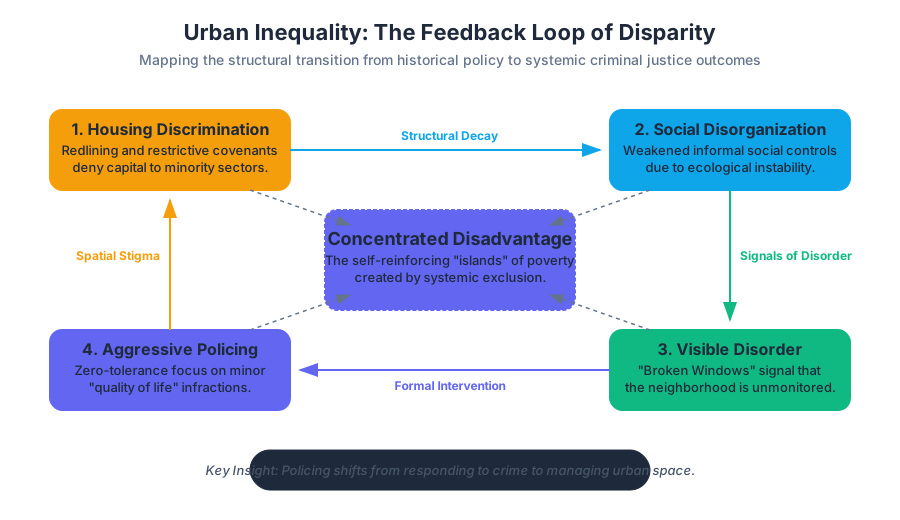
Urban inequality is not merely a byproduct of economic variance; it is a structural feature of the modern metropolitan landscape, reinforced by decades of policy, policing strategies, and judicial architecture. In the study of criminology and criminal justice, the spatial distribution of crime is rarely random. Instead, it follows patterns of concentrated disadvantage, where historical housing discrimination, aggressive order-maintenance policing, and the criminalization of poverty converge to create a "feedback loop" of systemic disparity.
The Theoretical Framework: Social Disorganization and Broken Windows
To understand why certain urban sectors experience higher rates of police intervention and incarceration, we must first examine the transition from Social Disorganization Theory to the Broken Windows Theory.
Social Disorganization Theory
Originating from the Chicago School of sociology, this theory posits that crime is a function of a neighborhood's ecological characteristics rather than the inherent qualities of the individuals living there. High rates of residential mobility, ethnic heterogeneity, and low socioeconomic status weaken the Social Contract and informal social controls (like neighbors watching out for one another), leading to increased deviance.
Broken Windows Theory
Introduced by James Q. Wilson and George L. Kelling in 1982, Broken Windows Theory suggests that visible signs of disorder—such as literal broken windows, graffiti, and public intoxication—signal that a neighborhood is "unmonitored." This perceived lack of control encourages more serious criminal activity.
Key Insight: Broken Windows shifted the focus of law enforcement from responding to serious crimes (Part I offenses in the UCR) to aggressively policing minor "quality of life" infractions (Mala Prohibita), under the assumption that preventing small crimes prevents large ones.
| Feature | Social Disorganization | Broken Windows |
|---|---|---|
| Primary Driver | Structural decay and lack of social cohesion. | Visible disorder and "signal" crimes. |
| Locus of Control | Informal (community, family, peers). | Formal (police intervention, citations). |
| Policy Outcome | Urban renewal and economic investment. | "Zero-Tolerance" policing and order maintenance. |
| Criticism | Can lead to "victim-blaming" of poor areas. | Often results in racial profiling and over-policing. |
Implementation of Spatial Analysis in Criminology
Modern criminology uses spatial data to map these disparities.
Housing Discrimination and the Architecture of Segregation
Systemic disparities in the American criminal justice system cannot be decoupled from Housing Discrimination. Historical practices like Redlining—the systematic denial of mortgages and investment in minority neighborhoods—created "islands" of poverty.
The Legacy of Redlining
The Home Owners' Loan Corporation (HOLC) maps of the 1930s categorized neighborhoods by "risk." Areas with high minority populations were colored red ("Hazardous"), leading to a lack of capital. This lack of investment directly correlates with the "Social Disorganization" discussed earlier.
Concentrated Disadvantage
When poverty is geographically concentrated, the "Dark Figure of Crime" (unreported crime) often fluctuates wildly. In highly policed "redlined" areas, police presence is high, meaning more crimes are discovered and recorded in the Uniform Crime Reports (UCR). Conversely, in affluent areas, the same behaviors might be handled through informal social controls or private security, never entering official statistics.
| Historical Policy | Mechanism of Inequality | Modern Criminal Justice Impact |
|---|---|---|
| Redlining | Denial of capital/mortgages. | Concentrated poverty; lack of tax base for schools. |
| Restrictive Covenants | Legal bans on selling to minorities. | Forced segregation into high-density urban cores. |
| Urban Renewal | Destruction of "slums" for highways. | Displacement and destruction of informal social networks. |
| Exclusionary Zoning | Minimum lot sizes/ban on multi-family. | Prevents low-income mobility to low-crime areas. |
Banishment of the Indigent and the "War on the Poor"
A critical component of urban inequality is the Banishment of the Indigent. This refers to legal and architectural strategies designed to remove homeless or extremely poor individuals from public view.
Criminalizing Status
While the Supreme Court has ruled that one cannot be punished for a "status" (like being an addict), cities circumvent this by criminalizing actions that are inseparable from that status.
- Anti-Camping Ordinances: Prohibiting sleeping in public.
- Sit-Lie Laws: Prohibiting sitting on sidewalks.
- Aggressive Panhandling Bans: Restricting the solicitation of funds.
These are examples of Mala Prohibita (crimes because they are prohibited by law) rather than Mala in Se (crimes that are inherently evil).
The Mathematical Representation of the Poverty Trap
The "Poverty Trap" in the legal system can be modeled as a recursive function where the cost of a minor infraction $C_i$ grows over time due to an inability to pay, eventually leading to incarceration $I$.
\begin{aligned}
& \text{Let } F_0 \text{ be the initial fine.} \\
& \text{Let } r \text{ be the interest/late fee rate.} \\
& \text{Let } P \text{ be the probability of a "Failure to Appear" (FTA) warrant.} \\
& \text{Total Debt } D_t = F_0(1+r)^t + \text{Legal Fees} \\
& \text{Incarceration Risk } R = \int_{0}^{t} P(D_t) dt
\end{aligned}
Urban Jails: The Revolving Door
Unlike prisons, which house those convicted of felonies, Urban Jails serve as the intake point for the entire system. They are the "front door" of the Crime Funnel. In many cities, jails have become the largest mental health providers and homeless shelters by default.
The "Million Dollar Blocks" Phenomenon
Researchers have identified specific city blocks where the state spends over $1 million annually to incarcerate residents of that single block. This concentration of "justice spending" highlights the inefficiency of the current model: the money is spent on the back end (punishment) rather than the front end (prevention/housing).
Systemic Disparities in Pre-Trial Detention
Urban inequality is most visible in the bail system. Those with financial means can "buy" their freedom while awaiting trial (Consensus View of justice as a fair process), while the indigent remain in jail (Conflict View of justice as a tool for class control).
Data and Measurement: The UCR vs. NIBRS in Urban Contexts
How we measure crime in cities changes our perception of inequality. The FBI's Uniform Crime Reports (UCR) traditionally used the "Hierarchy Rule," only recording the most serious crime in an incident. This often masked the complexity of urban crime.
The transition to the National Incident-Based Reporting System (NIBRS) provides a more granular look:
- No Hierarchy Rule: All offenses in an incident are recorded.
- Contextual Data: Includes information on the relationship between victim and offender.
- Expanded Categories: Better tracking of white-collar crime vs. street crime.
Synthesis: The Wedding Cake Model of Urban Justice
The Wedding Cake Model of criminal justice, developed by Samuel Walker, explains why public perception of urban crime is often skewed:
- Top Layer (Celebrated Cases): Rare, high-profile cases that get media attention.
- Second Layer (Serious Felonies): Violent crimes that receive full judicial attention.
- Third Layer (Lesser Felonies): Cases often settled through plea bargains.
- Bottom Layer (Misdemeanors): The vast majority of urban cases—public intoxication, minor theft, "Broken Windows" infractions.
In the bottom layer, the "process is the punishment." For a resident of a disadvantaged urban area, the time spent in jail, the lost wages, and the accumulated fines for a misdemeanor can be more devastating than the actual legal sentence.
Common Pitfalls and Misconceptions
- Misconception: Broken Windows "Fixed" New York. While crime dropped in NYC during the 1990s, it dropped in almost every major American city during that time, including those that did not adopt Broken Windows policing.
- Pitfall: Confusing Correlation with Causation. High crime in a poor neighborhood does not mean poverty causes crime directly; rather, the lack of social cohesion and formal over-policing create the statistical profile of a high-crime area.
- The "Dark Figure" Bias: Assuming that low-crime suburbs are actually low-crime. Often, it is simply a matter of Police Discretion—officers in affluent areas are more likely to give "warnings" or "escort someone home," whereas officers in urban cores are incentivized to make arrests.
Source Materials
- 6: Urban Inequality- Banishing the Indigent
- Chapter 5: Criminological Theory
- Chapter 6: Policing
- Criminology (Lumen)
- 5: Class, Race, Gender and Criminal Justice- Understanding Disparities in the System
- 9: Social Status, Social Forces, and Social Inequality
- Introduction to the American Criminal Justice System (Burke et al.)
- Save as PDF
Study Criminology and Criminal Justice on Lykke
This course page is free to open: signed out, you can read its first two sections, and signing in, on any plan, opens the rest. The free Lykke Chrome extension syncs your own Canvas courses, so ChatGPT, Claude and Muse can answer from your classes and deadlines. It only reads Canvas.
Add the free extensionSign in to open every sectionAll sections of Criminology and Criminal Justice · Browse more course pages