From the free course Criminology and Criminal Justice on Lykke
The Judicial System
Key concepts: Dual Court System · Jurisdiction · Courtroom Workgroup · Principle of Orality · Writ of Certiorari
An examination of the dual court system, the roles of courtroom actors, and the stages of a criminal trial.
The Judicial System
The judicial system serves as the critical "middle pillar" of the American criminal justice apparatus, situated between the initial contact of law enforcement and the eventual implementation of correctional mandates. It is a complex, multi-layered architecture designed to balance the state's interest in public safety with the individual's right to due process. Unlike the executive branch (police) or the legislative branch (lawmakers), the judiciary operates through a reactive and adjudicative framework, interpreting law and applying it to specific controversies.
The Dual Court System: Federalism in Practice
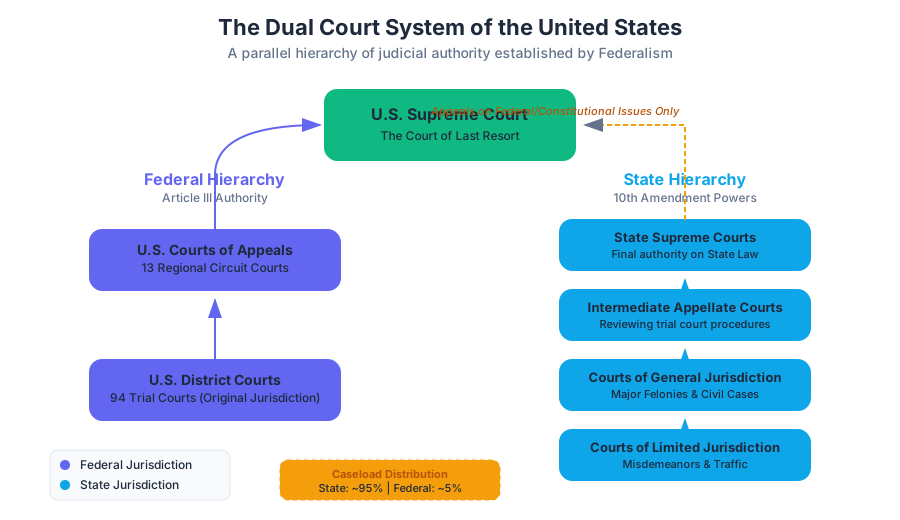
The United States utilizes a Dual Court System, a structural manifestation of federalism where two independent judicial hierarchies—state and federal—operate simultaneously. This division is rooted in the 10th Amendment, which reserves powers not delegated to the federal government to the states.
The State Hierarchy
The vast majority of criminal cases (approximately 90-95%) are handled at the state level. While structures vary by state, they generally follow a four-tier model:
- Courts of Limited Jurisdiction: Handle minor offenses, traffic violations, and initial appearances (e.g., Municipal or Justice of the Peace courts).
- Courts of General Jurisdiction: Trial courts for serious crimes (felonies) and major civil disputes (e.g., Superior or District courts).
- Intermediate Appellate Courts: Review decisions from trial courts to ensure legal procedures were followed.
- State Supreme Courts: The court of last resort for state law issues.
The Federal Hierarchy
Established by Article III of the Constitution, the federal system addresses crimes involving federal laws, constitutional issues, or disputes between states.
- U.S. District Courts: The primary trial courts of the federal system (94 districts).
- U.S. Courts of Appeals: Organized into 13 circuits, these courts review district court decisions.
- U.S. Supreme Court (SCOTUS): The ultimate arbiter of federal law and the Constitution.
| Feature | State Court System | Federal Court System |
|---|---|---|
| Source of Authority | State Constitution / Statutes | U.S. Constitution / Federal Law |
| Caseload Volume | High (Millions of cases annually) | Low (Thousands of cases annually) |
| Subject Matter | Crimes against state law (Robbery, Murder, Theft) | Crimes against federal law (Drug trafficking across borders, Tax evasion) |
| Judicial Selection | Election or Appointment (varies by state) | Presidential Appointment / Senate Confirmation |
| Final Authority | State Supreme Court (unless federal issue) | U.S. Supreme Court |
The Mechanics of Jurisdiction
Jurisdiction is the legal authority of a court to hear and decide a case. Without proper jurisdiction, a court’s judgment is void. It is not a singular concept but a multi-dimensional requirement.
Dimensions of Jurisdiction
- Geographic Jurisdiction: The court's authority over a specific physical area (e.g., a county or a federal district).
- Subject Matter Jurisdiction: The authority to hear specific types of cases (e.g., Family Court vs. Criminal Court).
- Personal Jurisdiction: The court’s power over the individuals involved in the lawsuit.
- Hierarchical Jurisdiction: Distinguishes between Original Jurisdiction (the power to hear a case for the first time) and Appellate Jurisdiction (the power to review a lower court's decision).
Key Insight: Jurisdiction is often concurrent, meaning both state and federal courts might have the authority to prosecute the same act (e.g., a bank robbery). Under the Dual Sovereignty Doctrine, this does not violate the Double Jeopardy clause of the 5th Amendment.
The Courtroom Workgroup: A Sociological Perspective
While the public perceives the courtroom as a site of pure adversarial combat, sociologists and legal scholars identify it as a Courtroom Workgroup. This concept suggests that the judge, prosecutor, and defense attorney are not merely opponents but colleagues who must interact daily to process cases efficiently.
Core Members and Their Dynamics
- The Prosecutor: Arguably the most powerful actor due to Prosecutorial Discretion. They decide which charges to file and whether to offer a plea bargain.
- The Defense Attorney: Tasked with protecting the defendant's rights. In reality, they often negotiate with the prosecutor to reach "the going rate"—the standard sentence for a specific crime in that jurisdiction.
- The Judge: Acts as the "referee" and ultimate legal authority. While they oversee the trial, their role in the workgroup is often to facilitate settlements (plea bargains) to prevent docket congestion.
| Actor | Primary Goal | Source of Power | Conflict Point |
|---|---|---|---|
| Prosecutor | Secure conviction / Justice | Discretionary charging | Due process requirements |
| Defense | Protect rights / Minimize penalty | 6th Amendment mandate | Lack of resources (Public Defenders) |
| Judge | Ensure legal procedure / Efficiency | Statutory authority | Mandatory minimum sentences |
The Principle of Orality and Trial Dynamics
The American trial system is governed by the Principle of Orality. This principle dictates that all evidence must be presented "live" and in open court. It is a rejection of the "inquisitorial" systems where judges might decide cases based solely on written dossiers.
Why Orality Matters
- Confrontation Clause: The 6th Amendment grants the defendant the right to confront their accusers.
- Demeanor Evidence: Juries and judges can assess the credibility of a witness by observing their body language and tone.
- Public Scrutiny: Oral proceedings ensure the public can witness the administration of justice, preventing "star chamber" secrecy.
The Adversarial vs. Consensus Reality
The system is designed as an Adversarial System, where the truth emerges from the clash of two opposing sides. However, the Wedding Cake Model of justice shows that most cases do not reach this stage.
- Layer 1 (Celebrated Cases): Receive full adversarial trials.
- Layer 4 (Misdemeanors): Handled like an assembly line with little formal procedure.
P(Conviction) = \frac{\sum (E_{physical} \cdot w_1) + \sum (E_{testimonial} \cdot w_2)}{R_{procedural}}
Where $E$ represents evidence types, $w$ represents their weighted impact on a jury, and $R$ represents the procedural "friction" (defense motions, suppressed evidence).
The Appellate Process and the Writ of Certiorari
The right to appeal is a fundamental safeguard, but it is not a "retrial." Appeals focus exclusively on Legal Error (e.g., a judge allowed inadmissible evidence) rather than Factual Error (e.g., the jury was wrong about who committed the crime).
The U.S. Supreme Court Gatekeeping
The SCOTUS is a court of discretionary jurisdiction. It does not have to hear every case appealed to it. The mechanism for requesting a review is the Writ of Certiorari.
- Petition: The losing party files a petition for cert.
- The Rule of Four: If four of the nine justices agree the case has significant constitutional merit, the writ is granted.
- The Docket: Out of ~7,000 petitions annually, only about 70-80 are granted cert.
Sentencing: The Bridge to Corrections
Once guilt is established—either through trial or the more common plea bargain—the system moves to the sentencing phase. This is where the theoretical goals of the justice system (Retribution, Deterrence, Incapacitation, Rehabilitation) are put into practice.
Sentencing Models
- Indeterminate Sentencing: A range of time (e.g., 5-10 years). This gives the parole board discretion based on the inmate's rehabilitation.
- Determinate Sentencing: A fixed term (e.g., 8 years). This reduces disparity but limits the incentive for rehabilitation.
- Mandatory Minimums: Statutes that require a specific minimum sentence for certain crimes (often drug-related), significantly stripping judges of their discretion.
Common Pitfalls in Sentencing
- Sentencing Disparity: Similar crimes committed by similar defendants resulting in vastly different sentences due to judicial bias or jurisdictional differences.
- The Trial Penalty: Defendants who exercise their right to a trial often receive significantly harsher sentences than those who accept a plea bargain.
Synthesis: The Crime Funnel and Judicial Reality
The judicial system is often described as a Crime Funnel. While thousands of crimes are committed, only a fraction result in arrest, fewer in charging, and a tiny percentage in a full trial. The "workgroup" ensures the funnel flows, but this efficiency often comes at the cost of the adversarial ideal.
Summary of Key Definitions
- Stare Decisis: "To stand by things decided." The principle of following legal precedent.
- Mala in se: Acts that are inherently evil (e.g., murder).
- Mala prohibita: Acts that are wrong only because they are prohibited (e.g., gambling laws).
- Writ of Certiorari: An order by a higher court directing a lower court to send the record of a case for review.
Conclusion
The American judicial system is a masterpiece of procedural complexity. It functions not as a single machine, but as a collection of local bureaucracies (workgroups) operating within a rigid constitutional framework. Understanding the tension between the Principle of Orality (the ideal) and the Courtroom Workgroup (the reality) is essential for any deep-dive into criminology. Whether through the granting of a Writ of Certiorari at the highest level or a plea bargain in a municipal court, the judiciary remains the definitive site where the abstract power of the law meets the concrete reality of human behavior.

Source Materials
- Chapter 7: Courts
- Introduction to the American Criminal Justice System (Burke et al.)
- 5: Class, Race, Gender and Criminal Justice- Understanding Disparities in the System
- Mental Disorders and the Criminal Justice System (Nichol)
- Chapter 2: Mental Disorders in the Criminal Justice System
- Save as PDF
- Save as PDF
- Save as PDF
Study Criminology and Criminal Justice on Lykke
This course page is free to open: signed out, you can read its first two sections, and signing in, on any plan, opens the rest. The free Lykke Chrome extension syncs your own Canvas courses, so ChatGPT, Claude and Muse can answer from your classes and deadlines. It only reads Canvas.
Add the free extensionSign in to open every sectionAll sections of Criminology and Criminal Justice · Browse more course pages