From the free course Criminology and Criminal Justice on Lykke
Systemic Wars: Drugs and Poverty
Key concepts: War on Drugs · War on Poverty · Mass Incarceration · Black Youth · Social Control
The impact of the 'War on Drugs' and the 'War on Poverty' on the American criminal justice landscape.
Systemic Wars: Drugs and Poverty
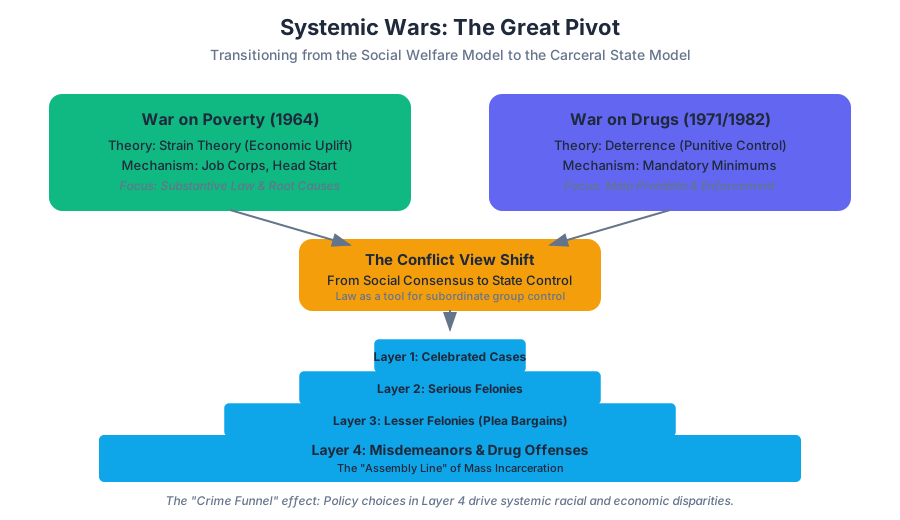
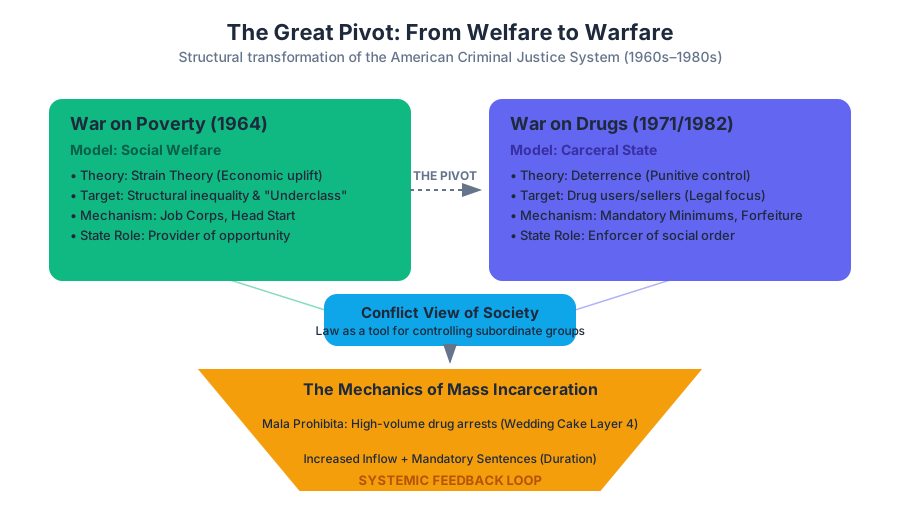
The late 20th century in the United States was defined by two competing state-led "wars": the War on Poverty, launched in the 1960s, and the War on Drugs, which gained aggressive momentum in the 1970s and 80s. While the former sought to address the root causes of social deviance through economic uplift, the latter shifted the state's apparatus toward punitive social control. This transition represents a fundamental pivot in American governance—from a social welfare model to a carceral state model.
The "Systemic Wars" are not merely historical periods but represent a structural transformation of the criminal justice system. By analyzing these through the lens of Conflict Theory, Social Disorganization, and the Wedding Cake Model, we can see how policy decisions created a feedback loop that disproportionately targeted Black youth and institutionalized mass incarceration.
The Great Pivot: From Welfare to Warfare
The mid-1960s "Great Society" programs aimed to eliminate poverty by addressing structural inequalities. However, as civil unrest grew and economic conditions shifted, the political consensus moved toward a Conflict View of society. In this view, the law is not a product of social agreement (the Consensus View) but a tool used by those in power to control subordinate groups.
Comparing the "Wars"
The following table contrasts the ideological and operational differences between the two systemic approaches to social stability.
| Feature | War on Poverty (1964) | War on Drugs (1971/1982) |
|---|---|---|
| Primary Mechanism | Social Welfare / Economic Integration | Criminal Justice / Incarceration |
| Target Population | The "Underclass" (Economic focus) | Drug Users/Sellers (Legal focus) |
| Core Philosophy | Strain Theory: Reduce crime by providing legitimate means to success. | Deterrence Theory: Increase the "cost" of crime through severe punishment. |
| Key Legislation | Economic Opportunity Act of 1964 | Comprehensive Crime Control Act of 1984 |
| Systemic Output | Job Corps, Head Start, Community Action | Mandatory Minimums, Civil Asset Forfeiture |
| Role of State | Provider of services and opportunities. | Enforcer of social norms and order. |
Key Insight: The transition from the War on Poverty to the War on Drugs represents a shift from addressing Substantive Law (the "why" of behavior) to a hyper-focus on Procedural Law and enforcement of Mala Prohibita offenses (acts that are crimes only because they are prohibited by statute).
The Mechanics of Mass Incarceration
Mass incarceration is the systemic result of policy choices that increased both the "inflow" of individuals into the justice system and the "duration" of their stay. This can be visualized through the Crime Funnel, where the wide mouth represents the "Dark Figure of Crime" (unreported acts) and the narrow end represents those actually serving time.
The Wedding Cake Model and Drug Offenses
Criminologist Samuel Walker’s Wedding Cake Model explains how the system treats cases differently based on their perceived importance.
- Layer 1: Celebrated Cases — High-profile trials that receive immense media attention.
- Layer 2: Serious Felonies — Violent crimes committed by experienced offenders.
- Layer 3: Lesser Felonies — Non-violent crimes, often involving plea bargains.
- Layer 4: Misdemeanors — The "assembly line" of the system, where the vast majority of drug-related arrests occur.
The War on Drugs effectively flooded Layer 4 and Layer 3, turning the criminal justice system into a high-throughput processing plant. Because drug offenses are often Mala Prohibita, police discretion plays a massive role in who enters the funnel.
The War on Drugs: A Policy of Social Control
The War on Drugs was fueled by Moral Panics—intense public fear often stoked by media portrayals of "folk devils" (e.g., the "crack mother" or the "superpredator"). These panics led to the adoption of policies that bypassed Evidence-Based Practices in favor of political expediency.
Sentencing Disparities: Crack vs. Powder Cocaine
One of the most cited examples of systemic inequality is the 100-to-1 sentencing ratio established by the Anti-Drug Abuse Act of 1986.
| Substance | Amount for 5-Year Mandatory Minimum | Demographic Association (Historical) |
|---|---|---|
| Powder Cocaine | 500 grams | Affluent, White |
| Crack Cocaine | 5 grams | Lower-income, Black |
| Ratio | 100 : 1 | Systemic Bias |
This disparity is a classic example of Conflict Theory in action: the law was structured to penalize the form of the drug most common in marginalized communities while remaining relatively lenient toward the form used by the powerful.
Impact on Black Youth and the School-to-Prison Pipeline
The intersection of poverty and drug policy has had a devastating impact on Black Youth. This is often explained through Social Reaction Theory (Labeling Theory). When the state labels a young person as a "delinquent" or "criminal" early on—often for minor drug offenses—it creates a self-fulfilling prophecy.
Theoretical Frameworks of Impact
- Social Disorganization Theory: High rates of incarceration remove adult males from the community, weakening informal social controls (family, church, neighborhood) and leading to more crime.
- Differential Association: Youth in high-incarceration areas are more likely to be exposed to criminal definitions and techniques, as the "criminal" label becomes a normalized status.
- Strain Theory: As legitimate economic opportunities vanish (the failure of the War on Poverty), the "drug economy" becomes a rational choice for survival.
Theorem of Systemic Exclusion: As the density of criminal labeling increases within a demographic, the utility of the "criminal" label as a social deterrent decreases, while its utility as a barrier to legal employment increases.
Mathematical Representation of Deterrence
The War on Drugs relied on the Rational Choice Theory of deterrence. The effectiveness of a legal sanction ($D$) is traditionally defined as a function of Certainty ($C$), Severity ($S$), and Celerity (speed, $W$).
D = f(C, S, W)
In the context of systemic wars, the state maximized $S$ (Severity) via mandatory minimums but failed to maintain $C$ (Certainty) due to the "Dark Figure of Crime," leading to an inefficient system that incarcerated many for long periods without actually deterring the behavior.
Measuring the "Dark Figure": UCR vs. NIBRS
To understand the scope of these systemic wars, we must look at how crime is measured. The Uniform Crime Reports (UCR) and the National Incident-Based Reporting System (NIBRS) provide the "official" statistics, but they often miss the Dark Figure of Crime.
| Feature | UCR (Summary Reporting) | NIBRS (Incident-Based) |
|---|---|---|
| Hierarchy Rule | Only the most serious crime in an incident is reported. | All crimes in an incident are reported. |
| Detail Level | Low (Aggregated totals). | High (Context, victim-offender relationship). |
| Drug Data | Limited to arrests. | Includes drug types, quantities, and locations. |
| Bias Potential | High (Police discretion in reporting). | Moderate (More granular, but still police-dependent). |
Policy Evaluation and Evidence-Based Reform
The failure of the War on Drugs to "win" (i.e., eliminate drug use) has led to a shift toward Evidence-Based Practices. Policy evaluation now focuses on Cost-Benefit Analysis and reducing Recidivism rather than just increasing "toughness."
Common Pitfalls in Drug Policy
- Displacement: Cracking down on one drug (e.g., heroin) often leads to the rise of a more dangerous substitute (e.g., fentanyl).
- Net Widening: Increasing police presence in schools to stop drugs often results in more youth being arrested for minor behavioral issues.
- The Prohibition Effect: Like the 1920s Alcohol Prohibition, drug prohibition creates high-profit margins for organized crime, leading to increased systemic violence.
Conclusion: The Legacy of Systemic Warfare
The War on Drugs and the retreat from the War on Poverty created a "perfect storm" for mass incarceration. By redefining social problems (poverty, addiction) as criminal problems, the United States built a system that prioritizes Social Control over social health. Understanding this history is crucial for any student of criminology or practitioner in the justice system, as the "path dependency" of these 20th-century policies continues to shape the 21st-century legal landscape.
Administrative Evaluation via CLI
In a modern policy environment, tools are used to simulate the impact of legislative changes (e.g., the FIRST STEP Act).
- War on Drugs: A policy initiative aimed at reducing the illegal drug trade through increased enforcement and mandatory sentencing.
- War on Poverty: A set of 1960s social welfare programs intended to address the root causes of crime through economic support.
- Conflict View: The perspective that the law is a tool used by the ruling class to maintain power and control the "have-nots."
- Mala Prohibita: Acts that are considered crimes because they are prohibited by law, not necessarily because they are inherently evil.
- Dark Figure of Crime: The volume of crime that goes unreported to the police and is never captured in official statistics.
- Labeling Theory: The theory that being labeled a "criminal" by the state leads to further deviance and social exclusion.
- Social Disorganization: The breakdown of communal institutions (family, school) that leads to a loss of social control and higher crime rates.
- How does the Conflict View differ from the Consensus View in the context of drug laws?
- Answer: The Consensus View suggests drug laws reflect a shared social agreement that drugs are harmful. The Conflict View argues drug laws are used by those in power to target and control specific marginalized populations.
- What is the "Hierarchy Rule" in UCR reporting, and how does it affect drug crime statistics?
- Answer: The Hierarchy Rule only records the most serious offense in an incident. If a robbery and a drug possession occur together, only the robbery is counted, potentially undercounting the prevalence of drug-related activity.
- Describe the feedback loop between Social Disorganization and Mass Incarceration.
- Answer: Mass incarceration removes individuals (mostly men) from a community, which weakens family structures and informal social controls. This "disorganization" then leads to higher crime rates, which triggers more policing and incarceration.
- Why are drug offenses often categorized as "Layer 4" in the Wedding Cake Model?
- Answer: Because they are high-volume, often involve minor possession, and are typically handled through routine processing or plea bargains rather than full trials.
- What was the primary criminological theory behind the War on Poverty?
- Answer: Strain Theory—the idea that if you provide people with the means to achieve the "American Dream" (jobs, education), they will not feel the "strain" that leads to criminal behavior.
Systemic Wars: Drugs and Poverty - Summary Guide
- Historical Context: Understand the shift from 1960s social welfare (Johnson) to 1970s/80s punitive control (Nixon/Reagan).
- Key Theoretical Lens: Conflict Theory is the primary framework for explaining why drug laws disproportionately affect the poor and minorities.
- Data Sources: Be able to distinguish between UCR (official summary), NIBRS (incident-based), and Victimization Surveys (capturing the "Dark Figure").
- The Carceral State: Recognize that mandatory minimums and the 100:1 crack/powder ratio were specific policy "levers" that drove mass incarceration.
- Impact on Youth: Focus on the "School-to-Prison Pipeline" and how Labeling Theory explains the long-term recidivism of youth arrested for drug crimes.
- Modern Reform: Note the shift toward Evidence-Based Practices and the use of cost-benefit analysis to justify decriminalization or sentencing reform.
Source Materials
Study Criminology and Criminal Justice on Lykke
This course page is free to open: signed out, you can read its first two sections, and signing in, on any plan, opens the rest. The free Lykke Chrome extension syncs your own Canvas courses, so ChatGPT, Claude and Muse can answer from your classes and deadlines. It only reads Canvas.
Add the free extensionSign in to open every sectionAll sections of Criminology and Criminal Justice · Browse more course pages