From the free course Criminology and Criminal Justice on Lykke
Sociological Imagination and Research Methods
Key concepts: Sociological Imagination · Social Status · Empirical Data · Research Methods · Social Forces
The application of sociological perspectives and empirical research methods to the study of crime.
Sociological Imagination and Research Methods
The study of criminology and criminal justice is often misconstrued as a simple investigation into "why individuals break the law." However, a rigorous analysis requires moving beyond the individual to examine the systemic architecture of society. To understand crime, one must apply the Sociological Imagination, utilizing empirical research methods to decode the complex interplay between social forces, legal frameworks, and human behavior.
The Sociological Imagination: The Macro-Micro Interface
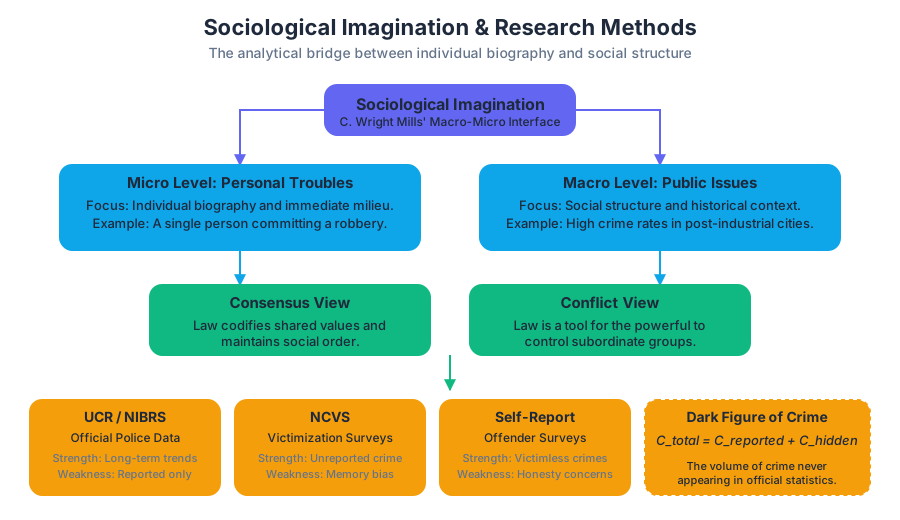
At the core of modern criminological inquiry is the Sociological Imagination, a concept pioneered by C. Wright Mills. It is defined as the vivid awareness of the relationship between personal experience and the wider society.
Definition: The Sociological Imagination is the analytical capacity to shift from one perspective to another—from the political to the psychological; from the examination of a single family to the critical assessment of the national budgets of the world; from the theological school to the military establishment.
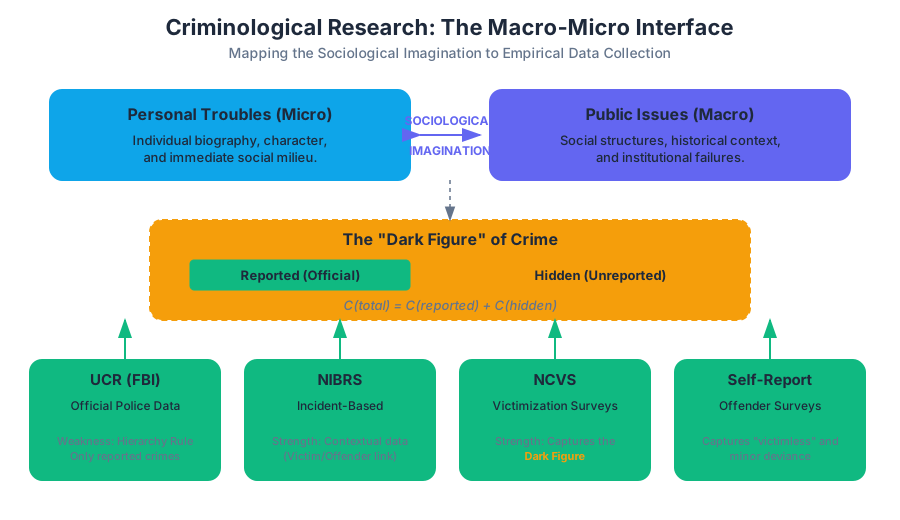
In the context of criminal justice, this means distinguishing between Personal Troubles and Public Issues. If one person commits a robbery, it may be a personal trouble (a lapse in character or a specific desperate need). However, if robbery rates spike across an entire urban corridor following a factory closure, it becomes a public issue rooted in the social structure.
Social Status and Social Forces
An individual’s Social Status—their position within the social hierarchy based on race, class, gender, and age—functions as a set of variables that influence their interaction with the law. Social Forces are the external pressures (economic shifts, cultural norms, institutional biases) that shape individual behavior.
| Concept | Level of Analysis | Focus |
|---|---|---|
| Personal Trouble | Micro | Individual biography, character, immediate milieu. |
| Public Issue | Macro | Social structure, historical context, institutional failure. |
| Social Status | Individual/Group | Intersectionality of race, class, gender, and power. |
| Social Forces | Environmental | Economic trends, legislative shifts, technological change. |
Competing Perspectives: Consensus vs. Conflict
How a society defines "crime" is not a neutral process. Criminologists generally operate under one of two competing frameworks: the Consensus View or the Conflict View.
- Consensus View: This perspective assumes that the majority of citizens share similar values and agree on what behaviors should be prohibited. Law is seen as a mechanism to codify these shared norms and maintain social order.
- Conflict View: This perspective argues that society is a collection of diverse groups in constant conflict. The law is not a reflection of shared values, but a tool used by those in power (the "ruling class") to protect their interests and control subordinate groups.
Empirical Research and Data Collection
To move beyond philosophical debate, criminology relies on Empirical Data—information acquired by observation or experimentation. In the United States, the "data stack" for measuring crime consists of three primary pillars, each with distinct strengths and weaknesses.
The "Dark Figure of Crime"
A critical concept in research methodology is the Dark Figure of Crime. This refers to the volume of crime that is never reported to the police and, consequently, never appears in official statistics.
Theorem of the Dark Figure: $C_{total} = C_{reported} + C_{hidden}$, where $C_{hidden}$ represents the "Dark Figure" influenced by police discretion, victim fear, and social stigma.
Primary Data Sources
| Source | Method | Strengths | Weaknesses |
|---|---|---|---|
| Uniform Crime Reports (UCR) | Official police data (FBI) | Long-term trends, national scope. | Only includes reported crimes; "Hierarchy Rule" (only most serious crime in an incident is recorded). |
| NIBRS | Incident-based reporting | Detailed context (weapon, location, victim-offender relationship). | Not yet universally adopted by all precincts; complex data entry. |
| NCVS | Victimization surveys | Captures the "Dark Figure"; bypasses police reporting. | Relies on victim memory; excludes "victimless" crimes (drug use, gambling). |
| Self-Report Surveys | Offender surveys | Captures "victimless" crimes and minor deviance. | Honesty concerns; usually limited to adolescent populations. |
The Legal Framework: Actus Reus and Mens Rea
Research methods often focus on the occurrence of crime, but the legal system focuses on the elements of a crime. For an act to be prosecuted, the state must generally prove two components:
- Actus Reus (The Guilty Act): A voluntary physical act or a failure to act when a legal duty exists.
- Mens Rea (The Guilty Mind): The mental state or intent at the time of the act.
Classifications of Offenses
- Mala in se: Acts that are inherently evil (e.g., murder, rape).
- Mala prohibita: Acts that are crimes only because they are prohibited by statute (e.g., public intoxication, speeding).
Modeling the System: The Wedding Cake and the Funnel
The American criminal justice system does not treat all cases equally. Two models describe this disparity:
1. The Wedding Cake Model
Developed by Samuel Walker, this model illustrates how the system prioritizes cases:
- Layer 1: Celebrated Cases (Media-heavy, full process).
- Layer 2: Serious Felonies (Violent crimes, experienced offenders).
- Layer 3: Lesser Felonies (Non-violent, first-time offenders).
- Layer 4: Misdemeanors (The vast majority of cases, handled via assembly-line justice).
2. The Crime Funnel
The Crime Funnel represents the attrition of cases as they move through the system. For every 1,000 serious crimes committed, only a fraction result in an arrest, and an even smaller fraction result in a prison sentence.
Criminological Theory as Analytical Frameworks
Theories are the "logic" of criminology. They provide the "why" that links empirical data to social forces.
Rational Choice Theory
Rooted in Classical Criminology, this theory posits that offenders weigh the costs and benefits of a crime. If the Certainty, Severity, and Celerity (Swiftness) of punishment outweigh the gain, the individual will be deterred.
Social Disorganization Theory
Developed by the Chicago School, this theory argues that crime is a product of environmental factors (poverty, residential mobility, ethnic heterogeneity) rather than individual pathology.
Strain Theory
Robert Merton’s theory suggests that crime occurs when there is a "disconnect" between societal goals (e.g., financial success) and the legitimate means to achieve them.
Policy Evaluation and Evidence-Based Practices
The ultimate goal of research methods is to inform Criminal Justice Policy. Modern policy-making has shifted toward Evidence-Based Practices (EBP), which require that interventions be backed by rigorous scientific evaluation rather than political intuition or Moral Panics.
Moral Panics and Folk Devils
A Moral Panic is a feeling of fear spread among a large number of people that some evil threatens the well-being of society. The "threat" is often personified as a Folk Devil.
- Example: The "Superpredator" myth of the 1990s led to harsh sentencing laws for juveniles that were later found to be based on flawed data.
Policy Evaluation Workflow
- Agenda Setting: Identifying a problem (e.g., rising retail theft).
- Policy Formulation: Designing an intervention (e.g., increased patrol).
- Implementation: Executing the plan.
- Evaluation: Using empirical data to see if the policy worked.
Common Pitfalls in Criminological Research
- Correlation vs. Causation: Just because ice cream sales and murder rates both rise in the summer does not mean ice cream causes murder (the confounding variable is heat).
- Ecological Fallacy: Applying group-level data to an individual (e.g., assuming a person from a "high-crime neighborhood" is a criminal).
- Sampling Bias: Relying only on prison populations to study "criminals," which ignores those who were never caught or those who committed white-collar crimes.
Summary of Key Interconnections
The Sociological Imagination allows us to see that Social Status and Social Forces are the hidden drivers behind the Empirical Data we collect. By using Research Methods like the UCR or NCVS, we can test Criminological Theories (like Strain or Rational Choice). These tests inform Criminal Justice Policy, which must be balanced against the legal requirements of Actus Reus and Mens Rea. Without this integrated approach, the justice system risks operating on bias rather than evidence, failing to address the root causes of deviance in society.
Source Materials
Study Criminology and Criminal Justice on Lykke
This course page is free to open: signed out, you can read its first two sections, and signing in, on any plan, opens the rest. The free Lykke Chrome extension syncs your own Canvas courses, so ChatGPT, Claude and Muse can answer from your classes and deadlines. It only reads Canvas.
Add the free extensionSign in to open every sectionAll sections of Criminology and Criminal Justice · Browse more course pages