From the free course Criminology and Criminal Justice on Lykke
Policing and Law Enforcement
Key concepts: Peelian Principles · Policing Eras · Police Discretion · Community Policing · Accountability
The history, evolution, and modern challenges of policing in the United States.
Policing and Law Enforcement
Policing serves as the primary interface between the state’s legal apparatus and the citizenry. Often described as the "front door" of the criminal justice system, law enforcement agencies are tasked with the dual, often conflicting, mandates of maintaining social order and protecting individual constitutional rights. This tension is governed by a complex framework of historical precedents, evolving operational philosophies, and the exercise of high-level administrative and individual discretion.
The Foundations of Modern Policing
The evolution of policing is a transition from informal, communal self-policing to highly structured, professionalized state bureaucracies. This transition was not merely organizational but philosophical, moving from the concept of "might makes right" to the "rule of law."
Historical Lineage: From Kin to Cohorts
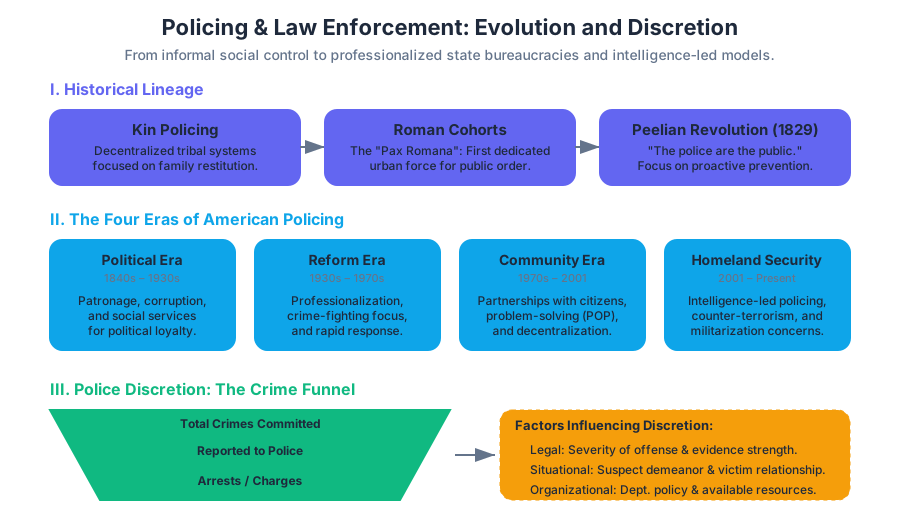
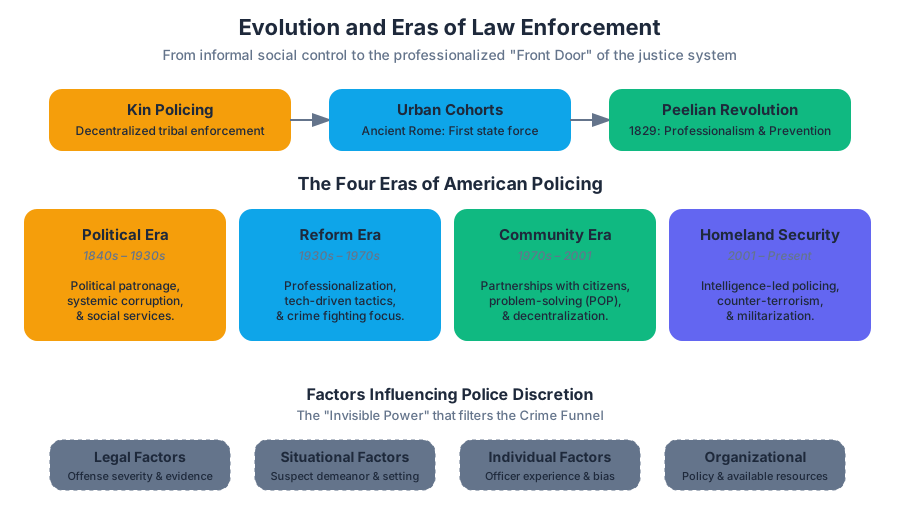
Before formal departments existed, societies relied on Kin Policing, a decentralized system where families or tribes were responsible for enforcing norms. This often resulted in "blood feuds," where the "justice" was as much about vengeance as it was about restitution.
The first move toward professionalization occurred in ancient Rome with the Urban Cohorts and Vigiles, established by Augustus. These were the first instances of a dedicated force tasked with maintaining the Pax Romana (Roman Peace) within city limits, focusing on fire prevention and petty crime.
The Peelian Revolution
The watershed moment for modern law enforcement was the Metropolitan Police Act of 1829, championed by Sir Robert Peel. Peel is widely regarded as the "Father of Modern Policing" for establishing the first organized, professional police force in London. His "Peelian Principles" shifted the focus from reactive punishment to proactive prevention.
The Peelian Principle of Legitimacy: "The police are the public and the public are the police; the police being only members of the public who are paid to give full-time attention to duties which are incumbent on every citizen in the interests of community welfare and existence."
| Principle Category | Core Mandate | Modern Application |
|---|---|---|
| Prevention | To prevent crime and disorder as an alternative to their repression by military force. | Proactive patrolling and crime prevention programs. |
| Approval | To recognize always that the power of the police to fulfill their functions is dependent on public approval. | Community policing and public relations. |
| Cooperation | To recognize always that to secure and maintain the respect and approval of the public means also the securing of the willing cooperation of the public. | Witness participation and tip lines. |
| Proportionality | To use physical force only when the exercise of persuasion, advice, and warning is found to be insufficient. | Use of Force continuums and de-escalation. |
The Four Eras of American Policing
American policing did not evolve in a vacuum; it was shaped by the unique socio-political landscape of the United States, moving through four distinct developmental stages.
1. The Political Era (1840s–1930s)
During this era, police departments were extensions of local political "machines." Officers were appointed based on political loyalty rather than merit. Corruption was systemic, with the police providing social services (housing, food) to voters while engaging in "graft" (bribery) and protecting illegal vice operations for political patrons.
2. The Reform (Professional) Era (1930s–1970s)
Driven by the desire to eliminate political influence, this era focused on professionalization. August Vollmer and O.W. Wilson advocated for civil service exams, specialized units, and the use of technology (radios, cars). The police mission narrowed to "crime fighting," and the relationship with the public became distant and reactive.
3. The Community Era (1970s–2001)
Following the civil unrest of the 1960s, it became clear that the "professional" model had alienated the public. The Community Era emphasized building ties with citizens to solve the underlying causes of crime. This era introduced Community-Oriented Policing (COP) and Problem-Oriented Policing (POP).
4. The Homeland Security Era (2001–Present)
Triggered by the 9/11 attacks, this era is characterized by the integration of local policing with national intelligence. It emphasizes "intelligence-led policing," terrorism prevention, and the acquisition of military-grade equipment, leading to ongoing debates regarding the "militarization" of domestic law enforcement.
Police Discretion: The Invisible Power
Police Discretion is the authority of an officer to choose between various courses of action (or inaction) based on their professional judgment. While laws are written as absolute (e.g., "thou shalt not speed"), their enforcement is highly selective.
Factors Influencing Discretion
Discretion is not arbitrary; it is influenced by a hierarchy of variables:
- Legal Factors: The severity of the offense and the strength of the evidence (e.g., Actus Reus and Mens Rea).
- Situational Factors: The demeanor of the suspect, the presence of witnesses, and the relationship between the victim and the offender.
- Individual Factors: The officer's experience, education, and personal biases.
- Organizational Factors: Departmental policy, quotas (official or unofficial), and available resources.
The "Crime Funnel" and Discretion
Discretion acts as the primary filter in the Crime Funnel. For every 1,000 crimes committed, only a fraction result in arrest, and even fewer in conviction. The police decide which cases enter the "funnel" and which are diverted through warnings or informal resolutions.
P(Arrest) = \frac{C_{reported} \times E_{sufficiency} \times D_{officer}}{C_{total}}
Where $C$ represents crime volume, $E$ represents evidence, and $D$ represents the discretion coefficient.
Operational Models and Problem Solving
Modern policing relies on structured frameworks to move beyond "random patrol" toward targeted intervention.
The SARA Model
The SARA Model is the gold standard for Problem-Oriented Policing. It provides a recursive loop for identifying and neutralizing recurring crime patterns.
| Phase | Action | Objective |
|---|---|---|
| Scanning | Identifying recurring problems and their consequences. | Problem identification. |
| Analysis | Identifying the conditions that precede and accompany the problem. | Understanding the "Why." |
| Response | Developing and implementing a tailored intervention. | Execution of strategy. |
| Assessment | Evaluating the effectiveness of the response. | Quality control and iteration. |
Accountability and Misconduct
As the state’s agents of force, police are subject to intense scrutiny. Misconduct is generally categorized by the motivation and the level of activity.
Meat Eaters vs. Grass Eaters
The Knapp Commission (1972) famously distinguished between two types of corrupt officers:
- Grass Eaters: Officers who do not actively seek out bribes but will accept them if offered (e.g., a free meal or a small "tip" to overlook a traffic violation). They are more numerous and create a culture of "quiet" corruption.
- Meat Eaters: Officers who aggressively misuse their power for personal gain (e.g., shaking down drug dealers, stealing evidence, or orchestrating protection rackets).
Mechanisms of Accountability
- Internal Affairs (IA): A specialized unit within the department that investigates allegations of officer misconduct.
- Civilian Oversight Boards: External bodies that review police actions to ensure transparency.
- Body-Worn Cameras (BWC): Technology designed to provide an objective record of encounters, though its effectiveness depends on strict activation policies.
Measuring Police Performance
How do we know if policing is "working"? Traditionally, departments relied on Official Statistics like the Uniform Crime Reports (UCR). However, these metrics are flawed.
The Dark Figure of Crime
The Dark Figure of Crime represents the volume of crime that is never reported to the police and thus never appears in official statistics. To bridge this gap, criminologists use Victimization Studies (like the NCVS) and Self-Report Statistics.
Common Pitfalls and Misconceptions
- The "CSI Effect": The public often believes that policing is primarily about high-tech forensics. In reality, the vast majority of police work is administrative, social service-oriented, or involves routine patrol.
- The "Bad Apple" Fallacy: Focusing solely on individual "meat eaters" often ignores systemic organizational issues (the "rotten orchard") that allow misconduct to flourish.
- Correlation vs. Causation in Crime Rates: Falling crime rates are often credited to specific police policies (e.g., "Broken Windows"), but they may actually be driven by broader demographic shifts, economic changes, or even environmental factors (like the removal of lead from gasoline).
Source Materials
Study Criminology and Criminal Justice on Lykke
This course page is free to open: signed out, you can read its first two sections, and signing in, on any plan, opens the rest. The free Lykke Chrome extension syncs your own Canvas courses, so ChatGPT, Claude and Muse can answer from your classes and deadlines. It only reads Canvas.
Add the free extensionSign in to open every sectionAll sections of Criminology and Criminal Justice · Browse more course pages