From the free course Criminology and Criminal Justice on Lykke
Foundations of Crime and Criminology
Key concepts: Deviance · Consensus vs. Conflict View · Wedding Cake Model · Dark Figure of Crime · Uniform Crime Reports (UCR)
Introduction to the definitions of crime and deviance, the structure of the criminal justice system, and the methodologies used to track criminal activity.
Foundations of Crime and Criminology
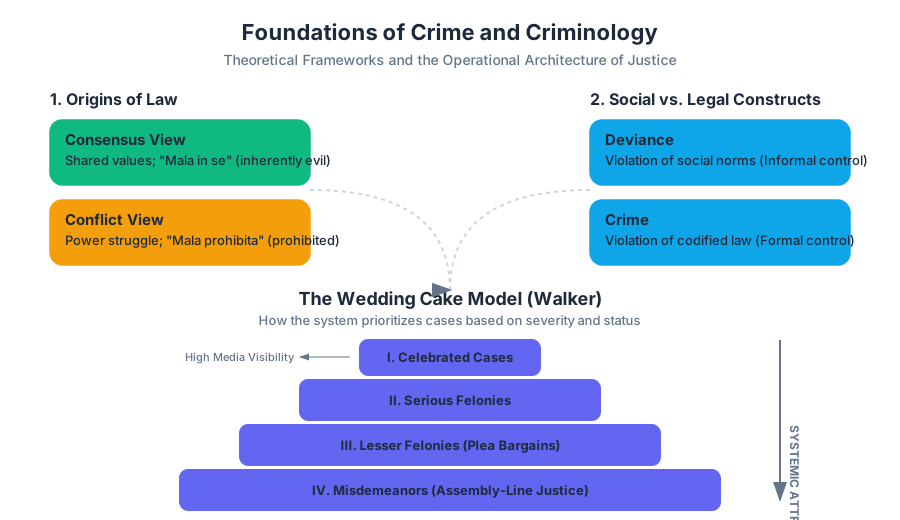
The study of crime and criminology is not merely a cataloging of illegal acts, but a rigorous analysis of the intersection between human behavior, social norms, and institutional power. To understand the American criminal justice system, one must first master the distinction between deviance (a sociological concept) and crime (a legal construct), and then examine the competing philosophical frameworks—Consensus versus Conflict—that dictate how laws are written and enforced.
This section provides a high-level architectural overview of the system’s foundations, moving from abstract definitions of rule-breaking to the concrete metrics used to track societal health, such as the Uniform Crime Reports (UCR) and the National Incident-Based Reporting System (NIBRS). We will also analyze the systemic "leakage" of cases through the Crime Funnel and the hierarchical prioritization of justice via the Wedding Cake Model.
Deviance, Norms, and the Social Construction of Crime
At its core, deviance is any behavior, belief, or condition that violates significant social norms in the society or group in which it occurs. While often conflated with crime, deviance is a much broader category. A person may be deviant without being a criminal (e.g., having extreme facial tattoos in a corporate environment), or a criminal without being perceived as deviant (e.g., speeding on a highway where everyone else is doing the same).
Definition: The Four Conditions of Deviance (Goode) According to sociologist Erich Goode, for a behavior to be considered deviant, four conditions must be met:
- A norm must exist.
- Someone must violate that norm.
- An audience must be present to witness or learn of the violation.
- The violation must elicit a negative reaction from that audience.
The Spectrum of Social Control
Societies maintain order through social control, which functions on two levels:
- Informal Social Control: The use of "nods, smiles, and frowns" to encourage conformity. This is the primary regulator of deviance.
- Formal Social Control: The legal system, police, and courts. This is reserved for behaviors categorized as crimes.
| Feature | Deviance | Crime |
|---|---|---|
| Definition | Violation of social norms | Violation of codified law |
| Sanction | Social stigma, ostracization | Fines, imprisonment, death |
| Enforcement | Peers, family, community | State-authorized agents (Police) |
| Documentation | Anecdotal/Sociological | Official records (UCR/NIBRS) |
| Scope | Broad (includes fashion, speech) | Narrow (defined by statute) |
Competing Perspectives: Consensus vs. Conflict
How does a behavior move from being "merely deviant" to being "criminal"? Criminologists generally subscribe to one of two competing views on the origins of law.
The Consensus View
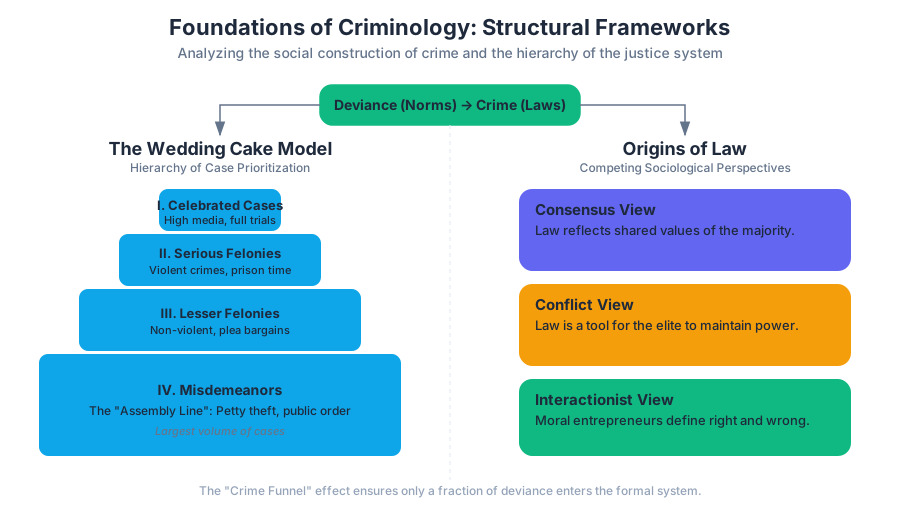
The Consensus View posits that the law is a reflection of the shared values and beliefs of the majority of society. In this model, the legal system functions as a social glue, protecting the common good. It assumes a "social contract" where citizens give up certain freedoms in exchange for the state's protection.
- Key Logic: Laws are created to prohibit behaviors that the vast majority of people find repugnant (e.g., murder, theft).
- Mala in se: Crimes that are "evil in themselves" (inherently wrong).
The Conflict View
The Conflict View, heavily influenced by Marxist and Weberian sociology, argues that the law is a tool used by the ruling class to maintain their position of power and control the "have-nots." In this perspective, the criminal justice system is not a neutral arbiter but an instrument of oppression.
- Key Logic: Laws are created to protect the property and interests of the elite, while criminalizing the survival behaviors of the poor.
- Mala prohibita: Crimes that are "wrong because they are prohibited" (e.g., gambling, drug use, loitering).
The Interactionist View
A third, middle-ground perspective suggests that "moral entrepreneurs" (individuals or groups with social power) define what is right and wrong based on their own subjective perceptions, which then become codified into law through political influence.
The Operational Architecture: The Wedding Cake Model
Developed by Samuel Walker, the Wedding Cake Model provides a realistic alternative to the "assembly line" view of justice. It explains why the system treats different cases with vastly different levels of resources and scrutiny.
Layer 1: Celebrated Cases
The smallest, top layer consists of cases that garner intense media attention (e.g., O.J. Simpson, high-profile white-collar crimes). These cases involve full-blown jury trials, expensive defense teams, and complex forensic analysis. They distort public perception because they are the least representative of how the system actually functions.
Layer 2: Serious Felonies
These are "heavy" crimes: violent acts (rape, robbery, aggravated assault) committed by experienced offenders. Prosecutors are unlikely to offer lenient plea bargains here, and these cases often result in significant prison time.
Layer 3: Lesser Felonies
These are often non-violent crimes or felonies committed by first-time offenders. They are frequently filtered out of the system via plea bargaining, where the charge is reduced to a misdemeanor in exchange for a guilty plea.
Layer 4: Misdemeanors
The massive base of the cake. This layer represents the high volume of "garbage" cases: public intoxication, petty theft, shoplifting, and disorderly conduct. These are handled with "assembly-line justice," often resolved in minutes with fines or probation.
The Crime Funnel and Systemic Attrition
The Crime Funnel (or Funnel of Justice) illustrates the process of attrition. For every 1,000 serious crimes committed, only a tiny fraction results in an individual being incarcerated. This "leakage" occurs at every stage: detection, reporting, investigation, arrest, charging, and sentencing.
Mathematical Representation of Attrition
We can model the probability of a crime resulting in a prison sentence ($P_s$) as a product of conditional probabilities at each gate of the funnel.
P_s = P(Reported | Committed) \times P(Arrest | Reported) \times P(Charged | Arrest) \times P(Convicted | Charged) \times P(Sentenced | Convicted)
If each stage has a 50% success rate (which is generous for many crime types), the final probability of a committed crime resulting in a sentence is $0.5^5$, or roughly 3.1%.
Measuring Crime: UCR vs. NIBRS
To manage the system, we must measure it. However, crime data is notoriously difficult to collect accurately. The two primary tools used by the FBI are the Uniform Crime Reports (UCR) and the National Incident-Based Reporting System (NIBRS).
The Uniform Crime Reports (UCR)
Established in 1930, the UCR is a summary-based reporting system. It tracks "Part I Index Crimes" (Murder, Rape, Robbery, Aggravated Assault, Burglary, Larceny, Motor Vehicle Theft, and Arson).
- The Hierarchy Rule: A major flaw of the UCR. If multiple crimes occur in a single incident (e.g., a robbery that turns into a murder), only the most serious crime is reported.
- Data Granularity: Low. It provides counts but lacks detail on the relationship between victim and offender.
National Incident-Based Reporting System (NIBRS)
NIBRS is the modern successor to the UCR. It was designed to provide a more "high-fidelity" view of crime.
- No Hierarchy Rule: Every offense within an incident is recorded.
- Detailed Parameters: It captures data on victims, offenders, property, and arrests for 52 specific offenses.
| Feature | UCR (Summary Reporting) | NIBRS (Incident-Based) |
|---|---|---|
| Unit of Analysis | Aggregate counts per agency | Individual crime incidents |
| Hierarchy Rule | Yes (only most serious crime) | No (all crimes recorded) |
| Victim/Offender Data | Limited | Extensive (age, sex, race, relationship) |
| Offense Categories | 8 Part I Index Crimes | 52 Group A Offenses |
| Complexity | Low (easier for small agencies) | High (requires robust IT infrastructure) |
The Dark Figure of Crime
Regardless of the reporting system used, all official statistics suffer from the Dark Figure of Crime. This refers to the volume of crime that is never reported to the police and, therefore, never enters the official record.
Why Crime Goes Unreported:
- Fear of Reprisal: The victim fears the offender will retaliate.
- Distrust of Police: The victim believes the police cannot or will not help.
- Self-Incrimination: The victim was engaged in illegal activity when the crime occurred.
- Private Matter: The victim views the incident as a personal or family issue.
To estimate this "Dark Figure," researchers use the National Crime Victimization Survey (NCVS), which asks a representative sample of U.S. households about their experiences with crime, regardless of whether they reported it.
Victimology and Typologies
Modern criminology has shifted from a pure focus on the offender to an inclusion of Victimology. Understanding who is victimized and why is crucial for policy development.
Benjamin Mendelsohn’s Victim Typology
Mendelsohn, the "father of victimology," categorized victims based on their level of "guilt" or responsibility for the incident.
| Typology | Description | Example |
|---|---|---|
| Completely Innocent | No provocative behavior; victimized by chance. | A child or someone unconscious. |
| Victim with Minor Guilt | Victimized due to ignorance or inadvertent risk. | Walking alone in a high-crime area at 3 AM. |
| Voluntary Victim | Equally guilty as the offender. | Participating in a suicide pact or a "fair fight." |
| Victim More Guilty | Provokes the offender into committing the crime. | A person who starts a bar fight and loses. |
| Most Guilty Victim | Initially the offender, but becomes the victim. | A burglar shot by a homeowner in self-defense. |
| Simulating Victim | Fakes a crime to frame someone or collect insurance. | Filing a false police report for a stolen car. |
Summary of Theoretical Frameworks
To conclude this foundational overview, we must recognize that the "facts" of crime are always filtered through theoretical lenses.
- Rational Choice Theory: Crime is a calculated decision. To stop it, we must increase the costs (punishment) and decrease the benefits.
- Positivism: Crime is caused by internal or external factors (biology, psychology, sociology) rather than free will.
- Social Disorganization: Crime is a product of the environment (poverty, broken homes, lack of social cohesion) rather than individual pathology.
- Labeling Theory: The system creates "criminals" by applying labels to deviant behavior, which then becomes a self-fulfilling prophecy.
Source Materials
Study Criminology and Criminal Justice on Lykke
This course page is free to open: signed out, you can read its first two sections, and signing in, on any plan, opens the rest. The free Lykke Chrome extension syncs your own Canvas courses, so ChatGPT, Claude and Muse can answer from your classes and deadlines. It only reads Canvas.
Add the free extensionSign in to open every sectionAll sections of Criminology and Criminal Justice · Browse more course pages