From the free course Criminology and Criminal Justice on Lykke
Criminological Theory
Key concepts: Rational Choice Theory · Positivism · Social Disorganization · Deterrence · Social Contract
A deep dive into the various schools of thought that attempt to explain why individuals commit crimes.
Criminological Theory
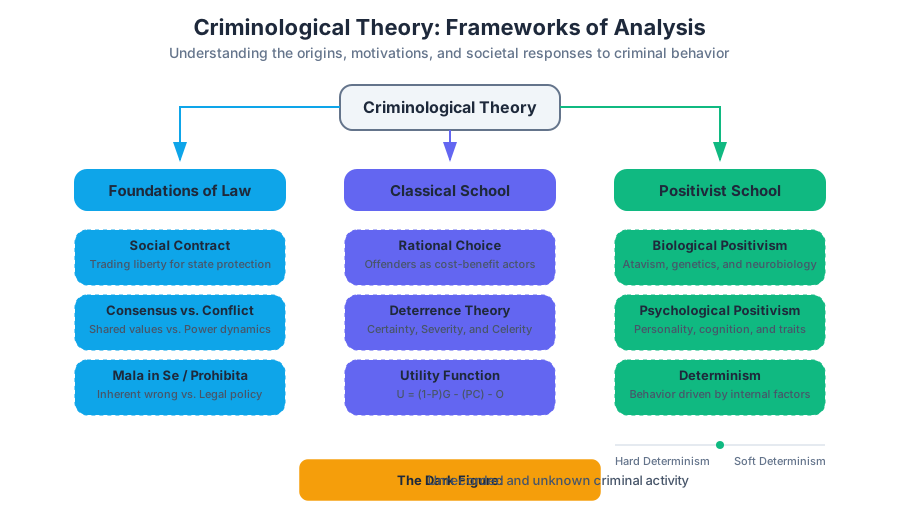
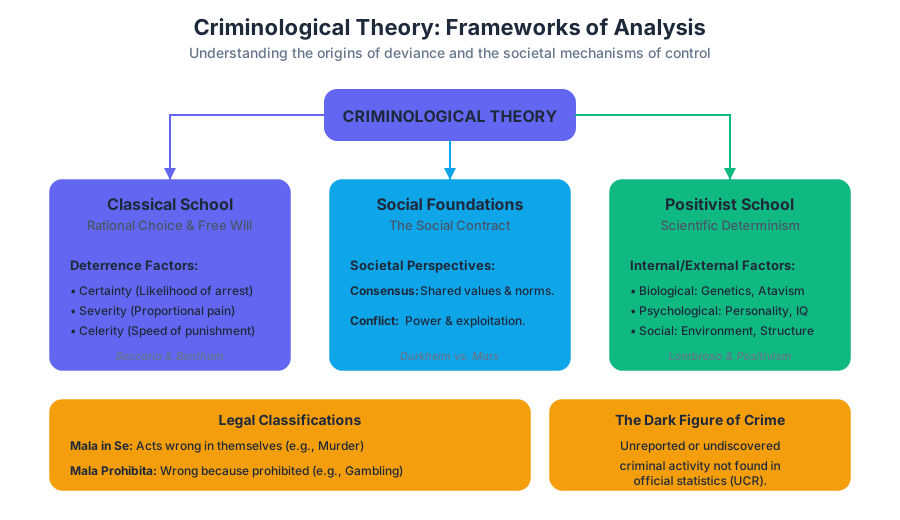
Criminological theory serves as the analytical backbone of the criminal justice system, providing the frameworks necessary to understand why individuals violate social norms and how society should respond. Rather than a monolithic explanation, the field is a synthesis of sociology, psychology, biology, and economics. It moves beyond the simple "good vs. evil" dichotomy to examine the structural, situational, and individual variables that precipitate criminal behavior.
Foundations: The Social Contract and the Nature of Law
Before analyzing specific theories of crime, one must understand the legal and social environment in which crime is defined. The Social Contract is the foundational political philosophy suggesting that individuals surrender a portion of their natural liberty to a central authority in exchange for the protection of their remaining rights and the maintenance of social order.
Consensus vs. Conflict Perspectives
The definition of what constitutes a "crime" depends heavily on one's theoretical lens regarding the nature of society.
| Feature | Consensus View | Conflict View |
|---|---|---|
| Origin of Law | Reflects the shared values and norms of the majority. | Created by those in power to protect their interests. |
| Social Order | Maintained through cooperation and shared morality. | Maintained through coercion and exploitation. |
| Function of Crime | Deviance defines the boundaries of acceptable behavior. | Crime is a label used to suppress marginalized groups. |
| Key Proponents | Durkheim, Parsons | Marx, Dahrendorf, Quinney |
Legal Classifications: Mala in Se and Mala Prohibita
Laws are generally categorized by their perceived inherent wrongness:
- Mala in se: Acts that are "wrong in themselves" (e.g., murder, theft). These are universally condemned across cultures and eras.
- Mala prohibita: Acts that are "wrong because they are prohibited" (e.g., drug possession, gambling, public intoxication). these reflect current social policy rather than universal morality.
Definition: The Dark Figure of Crime The Dark Figure of Crime refers to the volume of criminal activity that remains unknown to law enforcement and is never recorded in official statistics like the Uniform Crime Reports (UCR).
The Classical School: Rational Choice and Deterrence
The Classical School of criminology emerged during the Enlightenment, spearheaded by Cesare Beccaria and Jeremy Bentham. It rejected theological explanations for crime (e.g., demonic possession) in favor of a model based on Rational Choice.
Rational Choice Theory (RCT)
RCT posits that offenders are rational actors who conduct a cost-benefit analysis before committing a crime. If the perceived utility of the crime outweighs the potential costs, the individual will proceed.
Deterrence Theory
Deterrence is the practical application of RCT. It suggests that crime can be prevented if the legal system ensures that the "pain" of punishment exceeds the "gain" of the offense.
| Variable | Definition | Impact on Deterrence |
|---|---|---|
| Certainty | The probability of being caught and punished. | High impact; considered the most critical factor. |
| Severity | The harshness of the punishment. | Moderate impact; must be proportional to the crime. |
| Celerity | The speed with which the punishment is applied. | High impact; strengthens the mental link between act and consequence. |
Positivism: The Scientific Study of the Offender
As the 19th century progressed, the Positivist School emerged, challenging the Classical School's assumption of "free will." Positivists argue that behavior is determined by internal or external factors.
Biological Positivism
Cesare Lombroso, the "father of modern criminology," suggested that criminals were atavistic—evolutionary throwbacks who could be identified by physical "stigmata" (e.g., large jaws, asymmetrical faces). While his specific findings were debunked, modern biological positivism lives on in the study of neurobiology, genetics (e.g., the MAOA gene), and biochemistry (e.g., testosterone levels).
Psychological Positivism
This branch focuses on personality disorders, cognitive development, and intelligence. It explores how traits like impulsivity or lack of empathy (psychopathy) contribute to criminal trajectories.
The Determinism Spectrum
- Hard Determinism: The belief that humans have no free will; every action is a result of prior causes.
- Soft Determinism: The belief that while environment and biology constrain choices, individuals still retain a degree of agency.
Social Disorganization Theory: The Ecology of Crime
Developed by the Chicago School (Shaw and McKay), Social Disorganization Theory shifted the focus from the individual to the environment. It posits that crime is a product of the neighborhood's structural characteristics rather than the people living there.
The Concentric Zone Model
Researchers observed that crime rates remained high in specific areas of Chicago (the "Zone in Transition") regardless of which ethnic group lived there. This suggested that the environment itself was "criminogenic."
| Zone | Description | Crime Level |
|---|---|---|
| Zone I | Central Business District (CBD). | Low (commercial focus). |
| Zone II | Zone in Transition. High poverty, dilapidated housing, high turnover. | Highest. |
| Zone III | Workingmen's Homes. Modest apartments. | Moderate. |
| Zone IV | Residential Zone. Single-family homes, yards. | Low. |
| Zone V | Commuter Zone. Suburbs. | Lowest. |
Mechanics of Disorganization
Social disorganization occurs when a community cannot realize the common values of its residents or maintain effective social controls. This is driven by:
- Residential Instability: People move in and out too quickly to form bonds.
- Racial/Ethnic Heterogeneity: Diverse languages and cultures may hinder communication (in the context of early 20th-century urban theory).
- Poverty: Lack of resources to fund community programs or local surveillance.
Social Process and Reaction Theories
These theories examine how individuals interact with society and how those interactions shape criminal identity.
Differential Association Theory
Edwin Sutherland argued that criminal behavior is learned through interaction with others. Individuals learn the techniques of committing crime and the "definitions" (motives/rationalizations) favorable to violating the law.
Social Reaction (Labeling) Theory
Labeling theory focuses on how the criminal justice system itself can create more crime. When an individual is "labeled" a criminal, they may adopt that label as their master status, leading to a self-fulfilling prophecy known as secondary deviance.
Strain Theory
Robert Merton proposed that crime occurs when there is a gap between societal goals (e.g., the American Dream) and the legitimate means to achieve them.
\text{Strain} = \text{Societal Goals} - \text{Institutionalized Means}
Merton identified five adaptations to strain:
- Conformity: Accepting goals and means.
- Innovation: Accepting goals but using illegitimate means (the primary source of crime).
- Ritualism: Rejecting goals but sticking to means.
- Retreatism: Rejecting both (e.g., chronic drug use).
- Rebellion: Replacing both with new goals/means.
Measuring Crime: Data and the Funnel
To test these theories, criminologists rely on data. However, the data is often filtered through the Crime Funnel, where the number of actual crimes is far greater than the number of people who end up in prison.
Data Sources Comparison
| Feature | Uniform Crime Reports (UCR) | NIBRS | NCVS (Victimization) |
|---|---|---|---|
| Source | Police reports to FBI. | Detailed police reports. | Household surveys. |
| Hierarchy Rule | Only the most serious crime in an incident is counted. | No hierarchy rule; counts all offenses. | N/A. |
| Scope | Part I and Part II offenses. | 52 categories of crime. | Crimes not reported to police. |
| Weakness | Underreports due to police discretion. | High administrative burden for police. | Relies on victim memory/honesty. |
The Wedding Cake Model
The Wedding Cake Model explains how the system handles different types of cases:
- Layer 1: Celebrated Cases: High-profile trials (e.g., O.J. Simpson) that receive massive media attention but are unrepresentative.
- Layer 2: Serious Felonies: Violent crimes committed by experienced offenders.
- Layer 3: Lesser Felonies: Non-violent crimes, often involving people who know each other.
- Layer 4: Misdemeanors: The "bulk" of the system; public intoxication, shoplifting, traffic violations.
Operationalizing Theory in Policy
Theoretical frameworks are not merely academic; they dictate the "Three C's" of the criminal justice system: Cops, Courts, and Corrections.
Example: The "Broken Windows" Policy
Rooted in Social Disorganization and Deterrence, the Broken Windows theory suggests that ignoring minor physical decay (like a broken window) signals that "no one cares," leading to a breakdown in social control and an increase in serious crime.
Common Pitfalls and Misconceptions
- The Ecological Fallacy: Assuming that because a neighborhood has a high crime rate, every individual in that neighborhood is a criminal. This is a common error in interpreting Social Disorganization Theory.
- Correlation vs. Causation: Finding that criminals often have low heart rates (a biological positivist finding) does not mean low heart rates cause crime. It may be a symptom of a third variable, like lack of fear.
- Over-reliance on Official Statistics: Using only UCR data ignores the "Dark Figure of Crime," leading to skewed theories that only explain why people get caught, not why they commit crime.
- The Rationality Myth: Rational Choice Theory often assumes a level of "perfect information" that offenders rarely have. Most crimes are committed under the influence of substances or high emotional arousal, limiting "rational" calculus.
Summary of Legal Elements: Actus Reus and Mens Rea
For a crime to occur under substantive law, two elements must generally be proven:
- Actus Reus: The "guilty act." A voluntary physical movement or an omission where there was a legal duty to act.
- Mens Rea: The "guilty mind." The intent or state of mind at the time of the act.
Levels of Mens Rea (Model Penal Code)
- Purposeful: Acting with the conscious object to engage in the conduct or cause the result.
- Knowing: Being aware that the result is practically certain to occur.
- Reckless: Consciously disregarding a substantial and unjustifiable risk.
- Negligent: Should be aware of a substantial and unjustifiable risk.
Source Materials
Study Criminology and Criminal Justice on Lykke
This course page is free to open: signed out, you can read its first two sections, and signing in, on any plan, opens the rest. The free Lykke Chrome extension syncs your own Canvas courses, so ChatGPT, Claude and Muse can answer from your classes and deadlines. It only reads Canvas.
Add the free extensionSign in to open every sectionAll sections of Criminology and Criminal Justice · Browse more course pages