From the free course Criminology and Criminal Justice on Lykke
Criminal Law and Policy
Key concepts: Actus Reus · Mens Rea · Stare Decisis · Moral Panics · Evidence-Based Practices
Exploration of the legal frameworks that define crimes and the processes through which public policy is developed and evaluated.
Criminal Law and Policy
Criminal law and policy represent the dual-engine system of social control in modern society. While Criminal Law provides the static framework of rules, definitions, and punishments, Criminal Policy acts as the dynamic application of those rules, shaped by political pressure, empirical data, and sociological shifts. This intersection determines not just what is "illegal," but how the state prioritizes enforcement, manages resources, and responds to the evolving definition of deviance.
The Foundational Elements of Criminal Liability
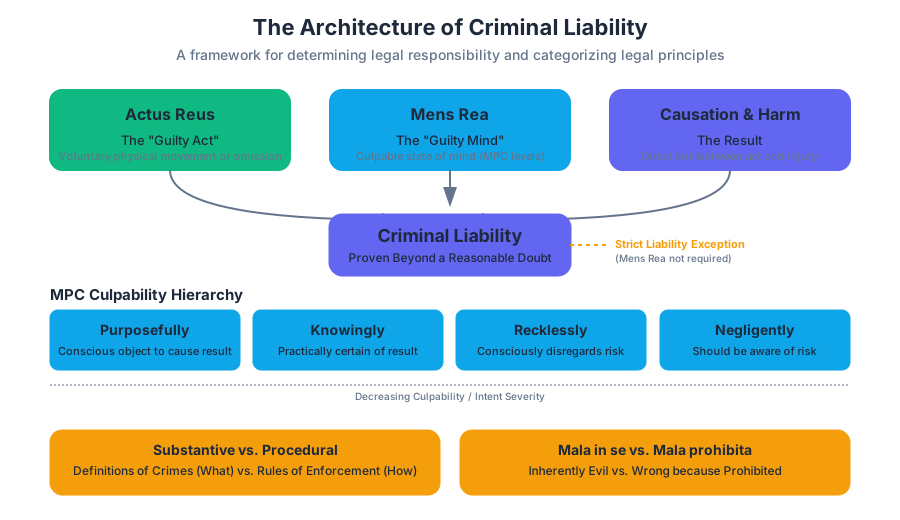
At the core of the American legal system is the requirement that a crime consists of specific, provable elements. The state bears the burden of proving these elements "beyond a reasonable doubt" to overcome the presumption of innocence.
Actus Reus: The Physical Component
Actus Reus (the "guilty act") refers to the physical act or unlawful omission that comprises the physical elements of a crime. It must be a voluntary movement.
Definition: Actus Reus A voluntary physical act, or a failure to act when a legal duty exists (omission), that causes a specific harm prohibited by law.
Mens Rea: The Mental Component
Mens Rea (the "guilty mind") refers to the state of mind of the defendant at the time the crime was committed. Modern American law, following the Model Penal Code (MPC), categorizes mental states into four distinct levels of culpability.
| Culpability Level | Definition | Example Scenario |
|---|---|---|
| Purposefully | The actor has the conscious object to engage in conduct or cause a specific result. | Shooting someone with the specific intent to kill them. |
| Knowingly | The actor is practically certain that their conduct will cause a specific result. | Bombing a building to claim insurance, knowing people are inside. |
| Recklessly | The actor consciously disregards a substantial and unjustifiable risk. | Drag racing on a crowded city street. |
| Negligently | The actor should be aware of a substantial and unjustifiable risk. | Leaving a loaded firearm on a coffee table with toddlers present. |
Strict Liability: The Exception
In certain cases, the law dispenses with the requirement of Mens Rea. These are known as Strict Liability crimes. Examples include traffic violations and statutory rape, where the state only needs to prove the Actus Reus occurred, regardless of the defendant's intent or knowledge.
The Architecture of Law: Classifications and Sources
The legal landscape is divided into two primary domains: Substantive Law, which defines the "what" (crimes and punishments), and Procedural Law, which defines the "how" (the rules the government must follow to enforce substantive law).
Stare Decisis and the Common Law
The American legal system is rooted in the English Common Law tradition, governed by the principle of Stare Decisis ("to stand by things decided"). This principle ensures that judicial decisions are consistent and predictable by requiring lower courts to follow the precedents set by higher courts.
Mala in se vs. Mala prohibita
Societies distinguish between acts that are inherently wrong and acts that are wrong because the legislature says so.
- Mala in se: Acts that are "evil in themselves." These are universally recognized as immoral and harmful, such as murder, rape, and robbery.
- Mala prohibita: Acts that are "wrong because they are prohibited." These are often regulatory or victimless crimes that vary by jurisdiction, such as gambling, public intoxication, or drug possession.
| Feature | Substantive Law | Procedural Law |
|---|---|---|
| Focus | Definitions of crimes and defenses. | Rights of the accused and state obligations. |
| Source | Statutes, Penal Codes. | Bill of Rights, Court Rules, Case Law. |
| Goal | To specify what conduct is prohibited. | To ensure fairness and prevent government overreach. |
| Example | The definition of First Degree Murder. | The requirement for a Miranda warning. |
Measuring Crime: The "Dark Figure" and Data Systems
To create effective policy, the state must measure crime. However, official statistics often fail to capture the true volume of criminal activity.
The Dark Figure of Crime
The Dark Figure of Crime represents the gap between the actual amount of crime committed and the amount reported to and recorded by the police. This gap exists due to victim fear, lack of trust in police, or the "victimless" nature of certain crimes.
Major Reporting Systems
- Uniform Crime Reports (UCR): Managed by the FBI, this system collects data from local law enforcement. It historically used the "Hierarchy Rule," only recording the most serious crime in a single incident.
- National Incident-Based Reporting System (NIBRS): A more granular successor to the UCR that records every offense within an incident, providing richer context (e.g., relationship between victim and offender).
- National Crime Victimization Survey (NCVS): A self-report survey that asks citizens about their experiences as victims, bypassing police reports to uncover the "Dark Figure."
\text{Dark Figure} = \text{Total Actual Crimes} - \text{Crimes Recorded in UCR/NIBRS}
The Crime Funnel
The Crime Funnel is a conceptual model illustrating how the number of cases decreases as they move through the justice system. For every 1,000 crimes committed, only a fraction result in arrest, and an even smaller fraction result in incarceration.
Sociological Perspectives: Consensus vs. Conflict
How does a behavior become a "crime"? Criminologists offer two primary competing views:
- Consensus View: This perspective assumes that the majority of citizens share similar values and agree on what behaviors should be criminalized. Law is seen as a tool to protect the common good.
- Conflict View: This perspective argues that law is a tool used by those in power (the "ruling class") to control the marginalized. Crises and crimes are defined in ways that protect the interests of the wealthy while criminalizing the survival behaviors of the poor.
The Dynamics of Criminal Justice Policy
Policy is the operational layer of the justice system. It is often reactive, driven by public sentiment or high-profile events.
Moral Panics and Folk Devils
A Moral Panic is a widespread, disproportionate fear that a particular group or behavior threatens the well-being of society. Sociologist Stanley Cohen identified the role of Folk Devils—individuals or groups (e.g., "super-predators," "hackers," "drug dealers") who are scapegoated by the media and politicians.
The Moral Panic Lifecycle:
- An event occurs.
- Media simplifies and exaggerates the threat.
- "Folk Devils" are identified.
- Public anxiety rises.
- Politicians pass "tough on crime" legislation (often with unintended consequences).
Evidence-Based Practices (EBP)
In contrast to reactive policy, Evidence-Based Practices rely on empirical research and rigorous evaluation to determine "what works." EBP seeks to move away from "gut-feeling" legislation toward interventions that reduce recidivism and maximize cost-benefit ratios.
Criminological Theory: Why Do People Commit Crime?
Policy is ultimately built on theories of human behavior. If we believe people are rational, we use deterrence; if we believe they are products of their environment, we use social reform.
Rational Choice and Deterrence
Rooted in the Social Contract, this theory posits that humans are hedonistic and rational. To prevent crime, the punishment must outweigh the gain.
- Specific Deterrence: Aimed at the individual offender.
- General Deterrence: Aimed at the public to set an example.
Social Disorganization and Strain Theory
- Social Disorganization: Crime is a product of broken social institutions (schools, families) in specific geographic areas.
- Strain Theory: Crime occurs when there is a gap between societal goals (e.g., the American Dream) and the legitimate means to achieve them.
The Wedding Cake Model
The Wedding Cake Model explains how the system handles cases differently based on their "celebrity" or seriousness:
- Layer 1: Celebrated Cases: High-media attention, full jury trials (e.g., O.J. Simpson).
- Layer 2: Serious Felonies: Violent crimes by experienced offenders.
- Layer 3: Lesser Felonies: First-time offenders or less violent acts, often plea-bargained.
- Layer 4: Misdemeanors: The "assembly line" of the system (public intoxication, shoplifting).
Common Pitfalls in Law and Policy
- Conflating Deviance and Crime: Not all deviant behavior (violating social norms) is criminal, and not all criminal behavior is viewed as deviant by all subcultures.
- The "CSI Effect": Jurors often have unrealistic expectations of forensic evidence due to media portrayals, leading to wrongful acquittals or convictions.
- Ignoring Police Discretion: While laws are written in black and white, their enforcement is highly discretionary. A "meat-eater" (corrupt officer) and a "grass-eater" (passive officer) apply the law differently.
- Correlation vs. Causation in Policy: Just because crime dropped after a "Three Strikes" law was passed doesn't mean the law caused the drop; economic shifts or demographic changes may be the actual drivers.
Source Materials
Study Criminology and Criminal Justice on Lykke
This course page is free to open: signed out, you can read its first two sections, and signing in, on any plan, opens the rest. The free Lykke Chrome extension syncs your own Canvas courses, so ChatGPT, Claude and Muse can answer from your classes and deadlines. It only reads Canvas.
Add the free extensionSign in to open every sectionAll sections of Criminology and Criminal Justice · Browse more course pages