From the free course Criminology and Criminal Justice on Lykke
Community Corrections and Reentry
Key concepts: Probation · Parole · Intermediate Sanctions · Diversion · Restorative Justice
Alternatives to incarceration, including probation, parole, and restorative justice programs.
Community Corrections and Reentry
Community corrections represents the most significant component of the American criminal justice system by volume, encompassing all non-incarcerative sanctions and supervision strategies. While the "Mass Incarceration" era often dominates public discourse, the reality of the system is one of Mass Supervision. At any given time, the number of individuals under community-based supervision—primarily probation and parole—dramatically outpaces the population held in jails and prisons.
This domain operates at the intersection of public safety, rehabilitative science, and fiscal pragmatism. It seeks to solve the "Incarceration Paradox": while prison removes a threat from the community, it often degrades the individual's social capital, making them more likely to offend upon release. Community corrections attempts to maintain or rebuild those social ties while managing risk through surveillance and intervention.
The Mechanics of Supervision: Probation and Parole
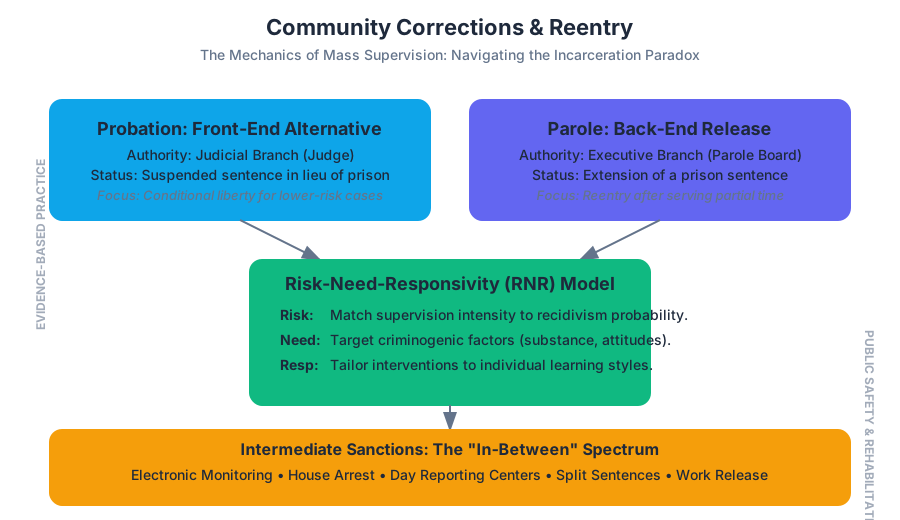
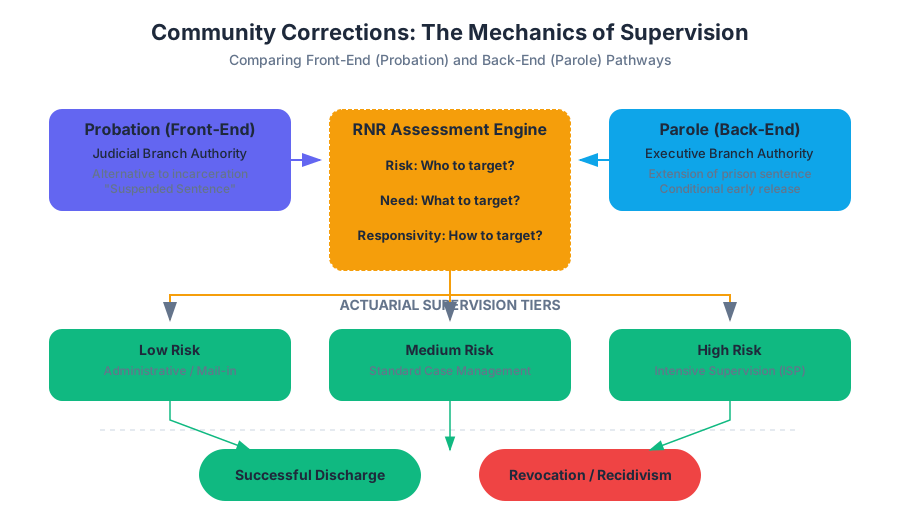
Though often used interchangeably in lay conversation, Probation and Parole are distinct legal mechanisms with different origins, jurisdictional oversight, and placement within the "Crime Funnel."
Probation: The Front-End Alternative
Probation is a court-ordered sanction that allows a person to remain in the community under the supervision of a probation officer, typically in lieu of a prison or jail sentence. It is a "suspended sentence," meaning the threat of incarceration remains a latent motivator for compliance.
Definition: Probation A judicial requirement that a defendant fulfill certain conditions of behavior in exchange for remaining in the community, rather than being incarcerated. It is governed by the principle of conditional liberty.
Parole: The Back-End Release
Parole is the conditional release of an inmate from a correctional institution after they have served a portion of their sentence. Unlike probation, which is a judicial function, parole is an administrative function of the executive branch (specifically, a Parole Board or Department of Corrections).
| Feature | Probation | Parole |
|---|---|---|
| Timing | Sentenced at the "front end" (pre-prison) | Granted at the "back end" (post-prison) |
| Authority | Judicial Branch (Judge) | Executive Branch (Parole Board) |
| Legal Status | Alternative to incarceration | Extension of a prison sentence |
| Population | Generally lower-risk or first-time offenders | Individuals who have served time for more serious crimes |
| Revocation Consequence | Imposition of the original suspended sentence | Return to prison to serve the remainder of the term |
Risk Assessment and Actuarial Supervision
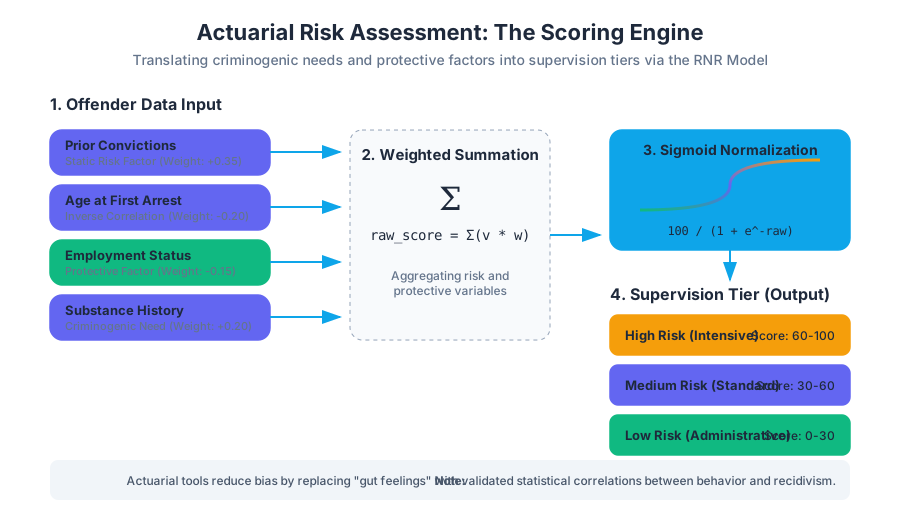
Modern community corrections has moved away from "gut-feeling" supervision toward Evidence-Based Practices (EBP). Central to this is the use of actuarial risk assessment tools, such as the COMPAS (Correctional Offender Management Profiling for Alternative Sanctions) or the LSI-R (Level of Service Inventory-Revised). These tools calculate the probability of Recidivism—the tendency of a convicted criminal to re-offend.
The Risk-Need-Responsivity (RNR) Model
The RNR model is the "gold standard" for effective community supervision:
- Risk Principle: Match the level of service to the offender's risk to re-offend (high-risk individuals need more intensive supervision).
- Need Principle: Target Criminogenic Needs—factors directly linked to criminal behavior (e.g., anti-social personality, substance abuse, pro-criminal attitudes).
- Responsivity Principle: Tailor the intervention to the individual's learning style, motivation, and abilities.
Intermediate Sanctions: The "In-Between"
Intermediate sanctions are a spectrum of punishments that are more restrictive than traditional probation but less severe than total incarceration. They are designed to provide "proportionality" in sentencing and to reduce the "Net Widening" effect—where new programs intended to divert people from prison actually end up capturing lower-level offenders who would have previously received simple probation.
Common Intermediate Sanctions
- Intensive Supervision Probation (ISP): Probation with frequent check-ins, unannounced home visits, and strict curfews.
- Electronic Monitoring (EM): The use of GPS or Radio Frequency (RF) technology to track an individual's location.
- Day Reporting Centers (DRC): Non-residential hubs where offenders must report daily for drug testing, counseling, and job training.
- House Arrest (Home Confinement): Restricting an individual to their residence except for pre-approved activities (work, medical, religious).
- Split Sentences/Shock Probation: A short period of incarceration followed by a term of probation, intended to "shock" the offender into compliance.
| Sanction Type | Primary Goal | Cost (Per Day) | Tech Dependency |
|---|---|---|---|
| Traditional Probation | Rehabilitation | $3 - $5 | Low |
| Electronic Monitoring | Surveillance | $10 - $25 | High (GPS/Cellular) |
| Day Reporting Center | Treatment/Skills | $40 - $80 | Medium |
| Residential Reentry | Reintegration | $70 - $100 | Medium |
| Prison | Incapacitation | $100 - $150+ | N/A |
Diversion and Specialty Courts
Diversion programs seek to move individuals out of the formal criminal justice process before a conviction is even recorded. This is often achieved through Specialty Courts (or Problem-Solving Courts).
Drug Courts and Mental Health Courts
These courts operate on a non-adversarial model. Instead of a prosecutor and defense attorney fighting over guilt, the "court team" (including a judge, social workers, and treatment providers) works to address the underlying cause of the criminal behavior. If the participant successfully completes the program, the charges are often dismissed.
The Logic of Diversion
The following logic represents the decision-making pipeline for a pre-trial diversion program.
PROCEDURE EvaluateDiversionEligibility(Offender, CurrentCharge):
    IF CurrentCharge.IsViolent() OR CurrentCharge.IsSexOffense():
        RETURN "Ineligible: Statutory Exclusion"

    IF Offender.PriorFelonies > 1:
        RETURN "Ineligible: Criminal History Threshold"

    NeedsProfile = AssessCriminogenicNeeds(Offender)

    IF NeedsProfile.PrimaryIssue == "SubstanceAbuse":
        ASSIGN TO "Drug Court Pipeline"
        SET Conditions = [RandomScreening, GroupTherapy, BiWeeklyHearing]
    ELSE IF NeedsProfile.PrimaryIssue == "MentalHealth":
        ASSIGN TO "Mental Health Court Pipeline"
        SET Conditions = [MedicationCompliance, CaseManagement]
    ELSE:
        RETURN "Ineligible: No Applicable Treatment Track"

    RETURN "Eligible: Diversion Offered"
END PROCEDURE
Restorative Justice: A Paradigm Shift
While traditional community corrections focus on the offender and the state, Restorative Justice (RJ) focuses on the Victim, the Community, and the Offender. It views crime not just as a violation of the law, but as a violation of people and relationships.
Core Components of RJ
- Encounter: Creating opportunities for victims, offenders, and community members to meet and discuss the crime and its aftermath.
- Amends: Expecting offenders to take steps to repair the harm they have caused (restitution, community service).
- Reintegration: Seeking to restore victims and offenders to whole, contributing members of society.
- Inclusion: Providing opportunities for all parties with a stake in a specific crime to participate in its resolution.
| Perspective | Retributive Justice | Restorative Justice |
|---|---|---|
| Question | What laws were broken? | Who was harmed? |
| Focus | Offender's guilt and punishment | Victim's needs and offender's responsibility |
| Method | Adversarial process | Collaborative dialogue |
| Outcome | Pain/Deprivation (Incarceration) | Healing/Repair (Restitution/Mediation) |
Reentry: The Transition from Cell to Community
Reentry is the process of leaving prison and returning to society. It is not a single event but a complex transition fraught with Collateral Consequences—legal and social restrictions that persist long after a sentence is served.
Challenges to Successful Reentry
- Employment Barriers: Many states allow employers to deny jobs based on criminal records; professional licenses (barbering, nursing, etc.) are often revoked.
- Housing Instability: Public housing authorities often exclude those with drug convictions or violent histories.
- The "Digital Divide": Long-term inmates may return to a world where basic tasks (applying for jobs, banking) require technological literacy they do not possess.
- Social Capital Erosion: Prison often severs ties with family and prosocial friends, leaving the individual dependent on "anti-social" networks.
Common Pitfalls and Controversies
- Technical Violations: A significant portion of prison admissions are not for new crimes, but for Technical Violations of supervision (e.g., missing a meeting, failing a drug test, or failing to pay fees). Critics argue this creates a "revolving door" that penalizes poverty rather than criminality.
- Net Widening: As mentioned, the availability of intermediate sanctions can lead judges to impose more restrictive conditions on people who would have otherwise been low-risk, increasing their chance of failing due to a technicality.
- Algorithmic Bias: Risk assessment tools have been criticized for potentially baking in racial and socioeconomic biases, as factors like "employment history" or "neighborhood crime rate" correlate with race in the United States.
- Privatization: Many community corrections functions (drug testing, electronic monitoring, even probation supervision) are outsourced to private companies that charge the offenders "user fees." This can lead to a "debtor's prison" scenario.
Conclusion
Community corrections and reentry represent the "living" part of the criminal justice system. While the walls of a prison provide a clear, if expensive, boundary for social control, the community-based approach requires a delicate balance of surveillance and support. The success of these programs is measured not just by the absence of new crimes (recidivism), but by the successful reintegration of individuals into the social and economic fabric of their communities.
Source Materials
Study Criminology and Criminal Justice on Lykke
This course page is free to open: signed out, you can read its first two sections, and signing in, on any plan, opens the rest. The free Lykke Chrome extension syncs your own Canvas courses, so ChatGPT, Claude and Muse can answer from your classes and deadlines. It only reads Canvas.
Add the free extensionSign in to open every sectionAll sections of Criminology and Criminal Justice · Browse more course pages