From the free course Computing on Lykke
Scope and Unit Testing
Key concepts: Local scope · Global scope · Unit testing
Understanding variable visibility and ensuring individual parts of a program work correctly.
Scope and Unit Testing
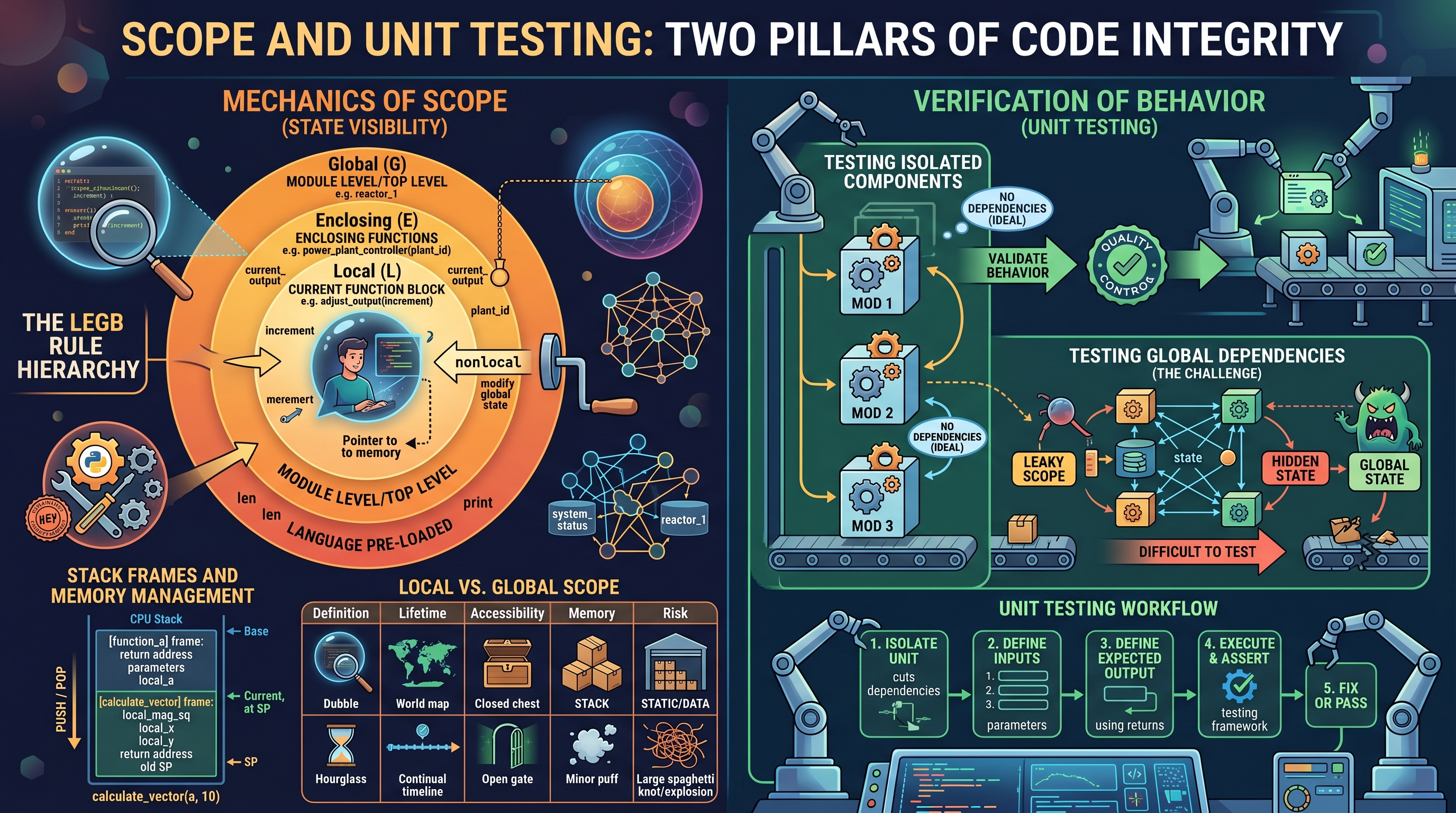
In the architecture of modern software, two pillars support the structural integrity of a codebase: the management of state (Scope) and the verification of behavior (Unit Testing). While they may appear as disparate topics—one dealing with the internal visibility of variables and the other with external validation—they are deeply intertwined. A program with poorly defined scope is inherently difficult to test, and a program that is difficult to test often suffers from "leaky" scope and global state dependencies.
This article explores the mechanics of variable lifetimes, the hierarchy of lexical environments, and the rigorous methodologies used to ensure that individual components of a system function with mathematical certainty.
The Mechanics of Scope
Scope is the region of a program where a defined identifier (such as a variable or function name) is valid and accessible. From a compiler's perspective, scope defines the "lexical environment"—a mapping of names to values that changes as the program's execution pointer moves through different blocks of code.
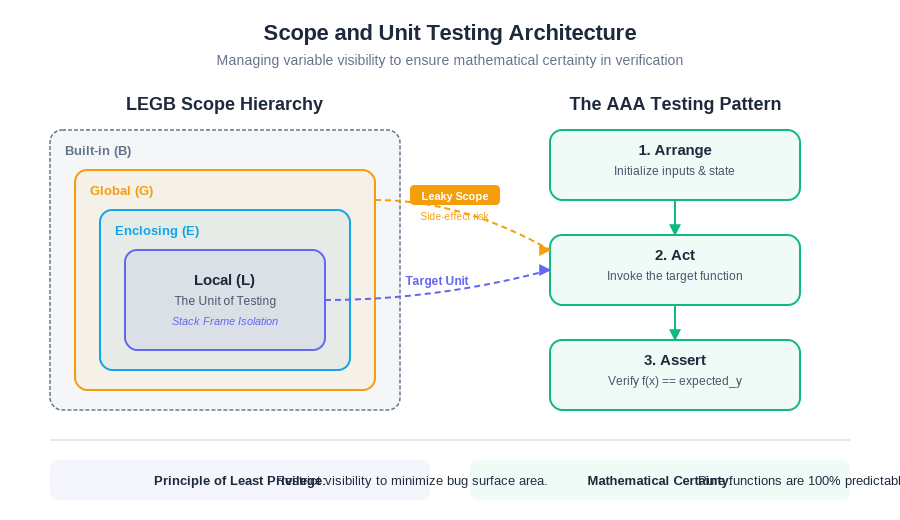
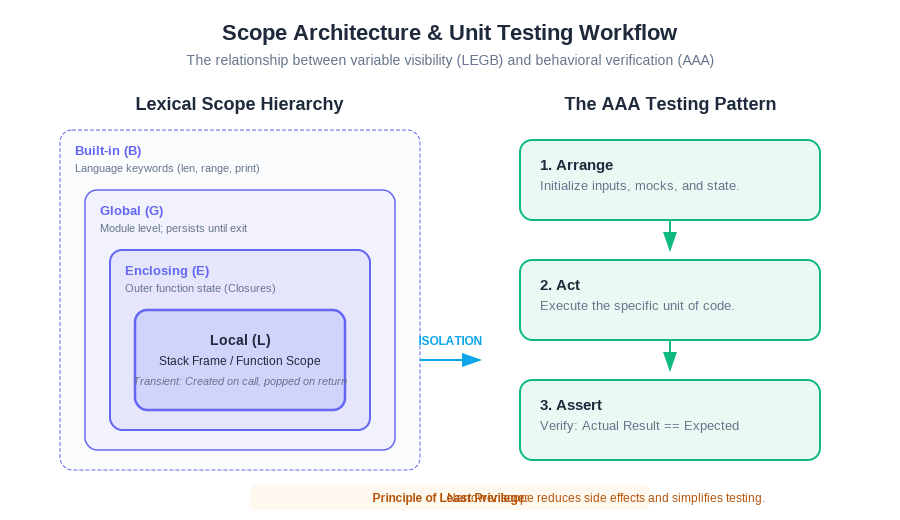
The LEGB Rule
In languages like Python, scope resolution follows the LEGB hierarchy. When a program encounters a variable name, it searches for that name in a specific order:
- Local (L): Defined inside the current function or class method.
- Enclosing (E): Defined in the local scope of any enclosing functions (relevant in nested functions or closures).
- Global (G): Defined at the top level of the script or module.
- Built-in (B): Reserved names pre-loaded by the language (e.g.,
len,range,print).
The Principle of Least Privilege: A variable should only be visible to the components that absolutely require it. Restricting scope minimizes the "surface area" for bugs and prevents accidental state mutation.
Local vs. Global Scope
The distinction between local and global scope is primarily a matter of lifetime and visibility.
| Feature | Local Scope | Global Scope |
|---|---|---|
| Definition Location | Inside a function or block. | Outside all functions/classes. |
| Lifetime | Created on function call; destroyed on return. | Created at program start; persists until exit. |
| Accessibility | Only within the specific function. | Accessible from any function in the module. |
| Memory Management | Typically stored on the Stack. | Typically stored in Static/Data segment. |
| Risk Factor | Low; changes are isolated. | High; can lead to "spaghetti code" and side effects. |
Implementation: Scope and Closures in Python
The following implementation demonstrates the interaction between local, enclosing, and global scopes, including the use of the nonlocal and global keywords to bridge these boundaries.
# Global Scope variable
system_status = "IDLE"

def power_plant_controller(plant_id):
    """
    Demonstrates Enclosing and Local scope.
    'plant_id' is in the Local scope of power_plant_controller,
    but in the Enclosing scope of the inner 'adjust_output' function.
    """
    current_output = 0  # Local to power_plant_controller

    def adjust_output(increment):
        # Accessing Enclosing scope
        nonlocal current_output

        # Accessing Global scope
        global system_status

        if increment > 100:
            system_status = "WARNING: HIGH LOAD"

        current_output += increment
        print(f"[Plant {plant_id}] Output adjusted to {current_output}MW. Status: {system_status}")
        return current_output

    return adjust_output

# Usage
reactor_1 = power_plant_controller("RX-99")
reactor_1(50)   # Output: [Plant RX-99] Output adjusted to 50MW. Status: IDLE
reactor_1(150)  # Output: [Plant RX-99] Output adjusted to 200MW. Status: WARNING: HIGH LOAD
The Low-Level Reality: Stack Frames and Memory
To truly understand scope, one must look at how the CPU handles function calls. When a function is invoked, the system allocates a Stack Frame (or Activation Record). This frame contains the function's local variables, parameters, and the return address.
The Stack Mechanism
- Push: When
function_a()callsfunction_b(), a new frame forbis pushed onto the stack. - Isolation:
function_bcannot see the variables infunction_a's frame (unless passed as pointers/references). - Pop: When
function_bfinishes, its frame is "popped" off the stack, and its local variables are deallocated.
The following C snippet illustrates how local scope is tied to the stack pointer ($SP$).
#include <stdio.h>

void calculate_vector(int x, int y) {
    // These variables exist only while this frame is on the stack
    int magnitude_sq = (x * x) + (y * y);
    printf("Local Magnitude Squared: %d\n", magnitude_sq);
}

int main() {
    int a = 5; // Main's stack frame
    calculate_vector(a, 10);

    // magnitude_sq is unreachable here; the memory has been reclaimed.
    // printf("%d", magnitude_sq); // COMPILER ERROR: Use of undeclared identifier
    return 0;
}
Unit Testing: The Science of Verification
Unit Testing is the practice of isolating the smallest functional parts of an application (units) and verifying their correctness independently of the rest of the system. In procedural programming, a "unit" is typically a single function; in object-oriented programming, it is often a class method.
The AAA Pattern
A professional unit test follows the AAA structure to ensure clarity and repeatability:
- Arrange: Set up the necessary preconditions and inputs (e.g., initialize objects, define input variables).
- Act: Invoke the function or method being tested.
- Assert: Compare the actual result against the expected outcome.
Mathematical Definition of a Test
A unit test can be viewed as an assertion of a mapping: $$f(x) = y$$ Where $f$ is the unit under test, $x$ is the input vector, and $y$ is the expected output. A test fails if the actual output $y' \neq y$.
Designing Testable Code
The difficulty of testing is directly proportional to the complexity of a function's scope. Pure Functions—functions that depend only on their input parameters and produce no side effects—are the gold standard for testability.
Determinism and Side Effects
A function is deterministic if it always produces the same output for the same input. Functions that rely on global variables are often non-deterministic because their output can change based on the state of the global variable, which may be modified by other parts of the program.
| Function Type | Scope Dependency | Testability | Side Effects |
|---|---|---|---|
| Pure Function | Local only. | Extremely High. | None. |
| Impure Function | Local + Global. | Low (Requires setup). | Modifies external state. |
| Method (OOP) | Local + Instance (self). |
Medium (Requires object init). | Modifies object state. |
Comprehensive Testing Example: The pytest Framework
In professional Python development, pytest is the industry standard. It allows for "parameterized" testing, where a single test logic can be run against multiple sets of data.
import pytest

# The Unit Under Test
def calculate_tax(income, tax_rate):
    if income < 0:
        raise ValueError("Income cannot be negative")
    if not (0 <= tax_rate <= 1):
        raise ValueError("Tax rate must be between 0 and 1")
    return round(income * tax_rate, 2)

# The Test Suite
class TestTaxCalculations:

    def test_standard_calculation(self):
        # Arrange
        salary = 50000
        rate = 0.2
        expected = 10000.0

        # Act
        result = calculate_tax(salary, rate)

        # Assert
        assert result == expected

    @pytest.mark.parametrize("income, rate, expected", [
        (1000, 0.1, 100.0),
        (0, 0.5, 0.0),
        (100.55, 0.1, 10.06), # Testing rounding
    ])
    def test_various_inputs(self, income, rate, expected):
        assert calculate_tax(income, rate) == expected

    def test_negative_income_error(self):
        with pytest.raises(ValueError, match="Income cannot be negative"):
            calculate_tax(-100, 0.2)
Common Pitfalls in Scope and Testing
1. The "Global" Trap
Beginners often use global variables to pass information between functions. This creates a "hidden dependency." If Function A and Function B both modify Global X, testing Function A in isolation becomes impossible because its behavior depends on whether Function B ran first.
2. Shadowing
Shadowing occurs when a variable in a local scope has the same name as a variable in an outer scope. This can lead to logic errors where the programmer intends to update a global value but instead creates a new local variable.
count = 0

def increment():
    count = count + 1 # UnboundLocalError: local variable 'count' referenced before assignment
    # In Python, assigning to a variable inside a function makes it local by default.
3. Fragile Tests
A test is "fragile" if it breaks due to changes in implementation details rather than changes in behavior. Effective unit tests should treat the unit as a Black Box—focusing on inputs and outputs rather than how the calculation is performed internally.
4. High Cyclomatic Complexity
Cyclomatic Complexity measures the number of linearly independent paths through a program's source code. A function with many nested if statements and loops has high complexity and requires more unit tests to achieve full Code Coverage.
| Complexity Score | Risk | Testability |
|---|---|---|
| 1-10 | Simple, low risk. | Easy to test. |
| 11-20 | Moderate risk. | Requires significant testing. |
| 21-50 | High risk. | Difficult to test; refactor recommended. |
| >50 | Untestable. | High probability of latent bugs. |
Advanced Concept: Mocking and Dependency Injection
When a unit depends on an external system (like a database or an API), unit testing becomes difficult because the test would require that external system to be active. To solve this, engineers use Mocking.
A Mock is a simulated object that mimics the behavior of a real component in controlled ways. This ensures that the unit test is only testing the logic of the function itself, not the reliability of the internet or the database server.
# Example of running tests with coverage reporting in a real-world CI/CD pipeline
pip install pytest pytest-cov

# Run tests and generate a report showing which lines of code were NOT executed
pytest --cov=my_application --cov-report=term-missing
Summary of Best Practices
- Minimize Global State: Pass variables as arguments and return values.
- Use Descriptive Naming: Avoid name collisions to prevent accidental shadowing.
- Test Early, Test Often: Follow the "Red-Green-Refactor" cycle (Write a failing test, make it pass, then clean up the code).
- Aim for High Coverage: Ensure that your tests exercise both the "Happy Path" (valid inputs) and "Edge Cases" (invalid or extreme inputs).
Study Computing on Lykke
This course page is free to open: signed out, you can read its first two sections, and signing in, on any plan, opens the rest. The free Lykke Chrome extension syncs your own Canvas courses, so ChatGPT, Claude and Muse can answer from your classes and deadlines. It only reads Canvas.
Add the free extensionSign in to open every section