From the free course Computer Applications and Information Technology on Lykke
IT Governance, Policy, Ethics, and Law
Key concepts: IT Governance · Information Policy · Ethics in IT · IT Law · Social Implications of IT
An examination of the ethical, legal, and social implications of information technology, focusing on governance and best practices.
IT Governance, Policy, Ethics, and Law
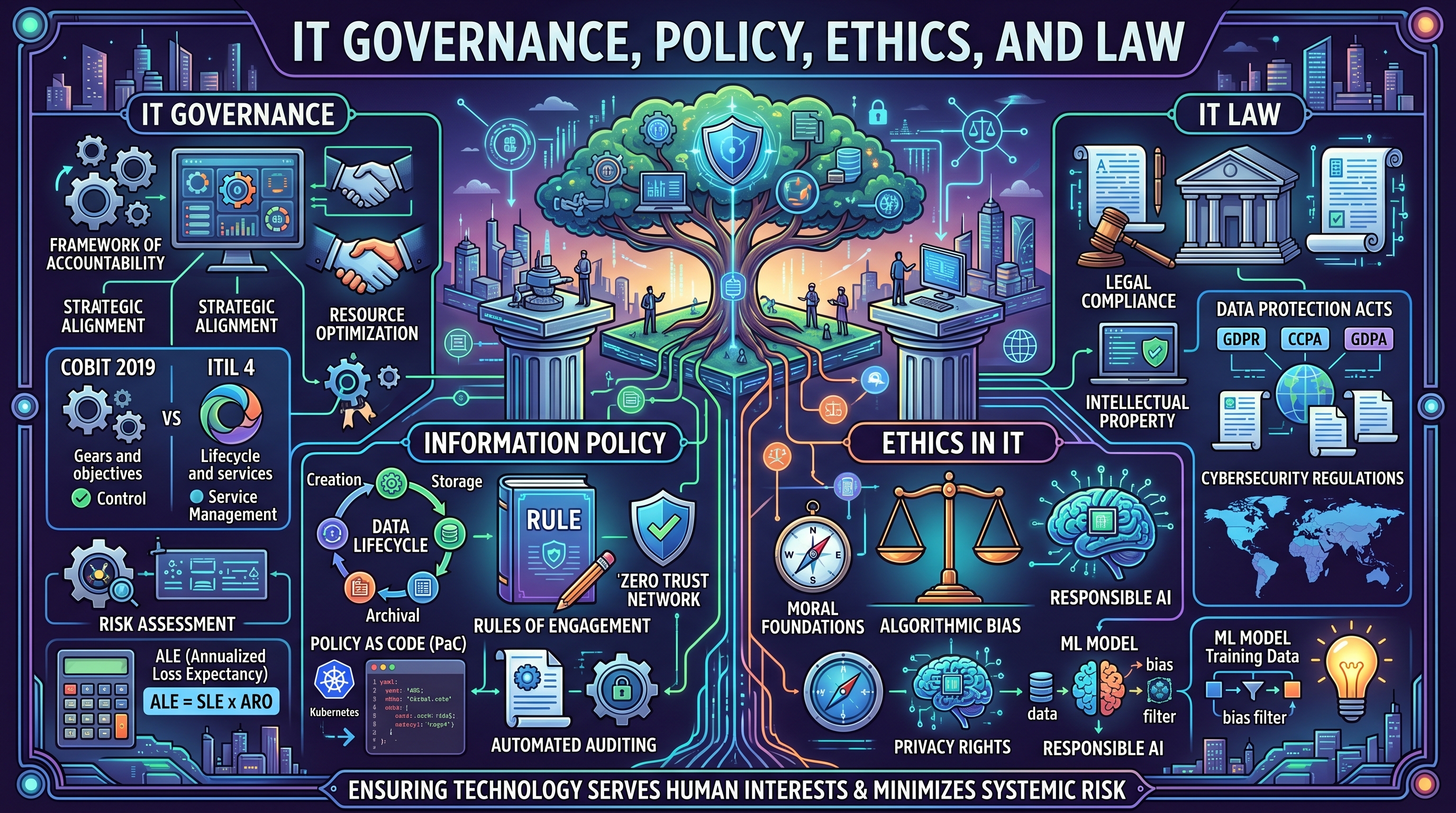
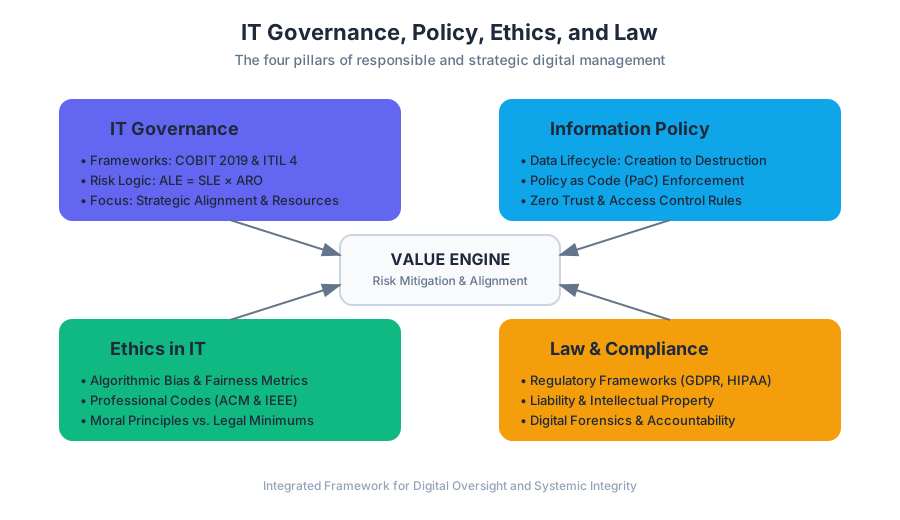
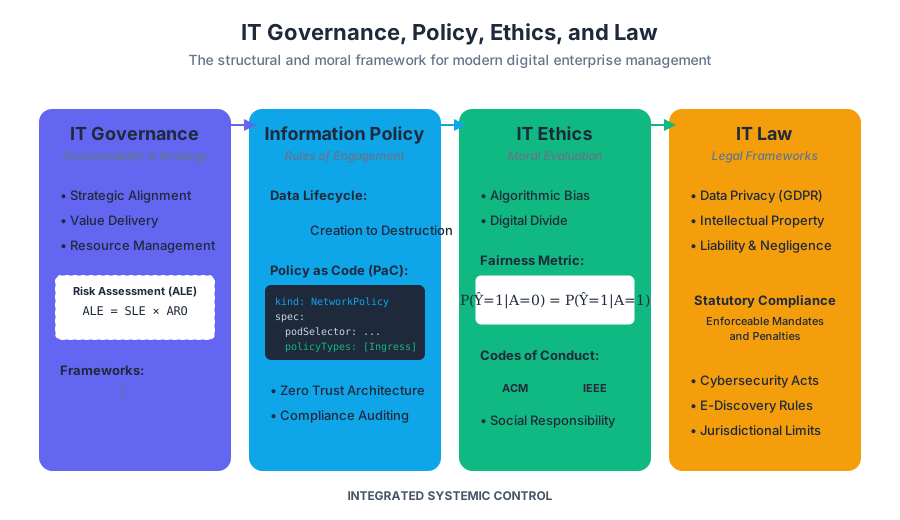
The rapid evolution of Information Technology (IT) has outpaced the development of traditional social and legal frameworks. In the modern enterprise, IT is no longer a support function but the primary engine of value creation. This shift necessitates a robust structure of IT Governance, Information Policy, Ethics, and Law to ensure that technology serves human interests while minimizing systemic risk. This article explores the intersection of these four pillars, providing a technical and philosophical deep-dive into how digital systems are controlled, regulated, and ethically evaluated.
IT Governance: The Framework of Accountability
IT Governance is the formal framework that provides a structure for organizations to ensure that IT investments support business objectives. It is a subset of corporate governance, focused specifically on the performance and risk management of IT systems.
Why It Matters
Without formal governance, organizations suffer from "Shadow IT," misaligned priorities, and catastrophic security failures. Governance ensures Strategic Alignment, Value Delivery, Resource Management, and Risk Mitigation.
Core Frameworks: COBIT vs. ITIL
Two primary frameworks dominate the landscape: COBIT (Control Objectives for Information and Related Technologies) and ITIL (Information Technology Infrastructure Library).
| Feature | COBIT 2019 | ITIL 4 |
|---|---|---|
| Primary Focus | Governance and Management Objectives | Service Management and Lifecycle |
| Orientation | Top-down, business-centric | Bottom-up, process-centric |
| Key Metric | Compliance and Risk Control | Service Value System (SVS) |
| Scope | Enterprise-wide IT control | IT Service delivery and support |
| Audience | Board of Directors, Auditors | IT Managers, Service Desk |
Implementing Governance: Risk Assessment Logic
A core component of governance is the quantitative assessment of risk. This involves calculating the Annualized Loss Expectancy (ALE) to justify security spending.
# Low-level implementation of a Quantitative Risk Assessment Engine
# This script calculates the financial impact of potential IT threats.

class RiskAssessment:
    def __init__(self, asset_value, exposure_factor, annualized_rate_of_occurrence):
        self.av = asset_value  # Total value of the IT asset
        self.ef = exposure_factor  # Percentage of loss if threat occurs (0.0 to 1.0)
        self.aro = annualized_rate_of_occurrence  # How many times per year

    def calculate_sle(self):
        """Single Loss Expectancy (SLE) = AV * EF"""
        return self.av * self.ef

    def calculate_ale(self):
        """Annualized Loss Expectancy (ALE) = SLE * ARO"""
        return self.calculate_sle() * self.aro

# Example: A database server worth $500,000.
# A data breach (EF=0.20) happens once every 2 years (ARO=0.5).
db_risk = RiskAssessment(asset_value=500000, exposure_factor=0.20, annualized_rate_of_occurrence=0.5)

print(f"Single Loss Expectancy: ${db_risk.calculate_sle():,.2f}")
print(f"Annualized Loss Expectancy: ${db_risk.calculate_ale():,.2f}")
# If the cost of a firewall is < $50,000/year, it is a sound governance investment.
Information Policy: The Rules of Engagement
Information Policy consists of the formal set of rules governing the lifecycle of information—from creation and storage to dissemination and destruction. It translates high-level governance goals into actionable requirements.
The Data Lifecycle and Policy Mapping
Policies must address every stage of the data lifecycle to ensure integrity and availability.
- Creation/Capture: Who is authorized to generate data?
- Storage: What encryption standards (e.g., AES-256) are required?
- Usage: Can data be used for secondary purposes (e.g., training ML models)?
- Archival: How long must data be kept for legal compliance?
- Destruction: How is data cryptographically erased?
Policy as Code (PaC)
In modern DevOps environments, policies are no longer just PDFs; they are enforced via configuration files.
# Example: Kubernetes Network Policy (Policy as Code)
# This enforces a "Zero Trust" architecture by denying all ingress
# except from specific authorized microservices.

apiVersion: networking.k8s.io/v1
kind: NetworkPolicy
metadata:
  name: restrict-database-access
  namespace: production
spec:
  podSelector:
    matchLabels:
      app: postgres-db
  policyTypes:
  - Ingress
  ingress:
  - from:
    - podSelector:
        matchLabels:
          role: api-backend
    ports:
    - protocol: TCP
      port: 5432
Key Insight: A policy is only as effective as its enforcement mechanism. Without automated auditing, policies suffer from "compliance drift."
Ethics in IT: Navigating Moral Complexity
Ethics in IT involves the application of moral principles to the design and use of technology. Unlike law, which defines what is legal, ethics defines what is right.
The Digital Divide and Algorithmic Bias
Two major ethical concerns in the 21st century are the Digital Divide (inequity in access to technology) and Algorithmic Bias (systemic unfairness in automated decision-making).
Mathematical Formalization of Fairness
In Machine Learning, ethics can be quantified through metrics like Demographic Parity or Equalized Odds.
$$ P(\hat{Y}=1 | A=0) = P(\hat{Y}=1 | A=1) $$
Where:
- $\hat{Y}=1$ is the positive outcome (e.g., getting a loan).
- $A$ is a protected attribute (e.g., race or gender).
- The equation represents the goal where the probability of a positive outcome is equal across different groups.
Professional Codes of Conduct
Organizations like the ACM (Association for Computing Machinery) and IEEE provide ethical guidelines for engineers. These codes emphasize:
- Public Interest: The well-being of the public is the primary consideration.
- Integrity: Avoiding conflicts of interest and being honest about system limitations.
- Privacy: Respecting the autonomy of individuals regarding their data.
IT Law: The Legal Landscape
IT Law (or Cyberlaw) is the collection of statutes and precedents that govern digital activities. It is inherently complex because the internet is borderless, while laws are jurisdictional.
Major Regulatory Frameworks
The legal burden on IT departments has increased significantly with the rise of data protection acts.
| Regulation | Jurisdiction | Focus | Key Requirement |
|---|---|---|---|
| GDPR | European Union | Data Privacy | "Right to be Forgotten," Consent, Data Portability |
| HIPAA | United States | Healthcare | Protection of PHI (Protected Health Information) |
| CCPA | California, USA | Consumer Privacy | Opt-out of data sales, transparency |
| DMCA | United States | Intellectual Property | Takedown notices for copyrighted content |
| PCI-DSS | Global (Industry) | Credit Cards | Security standards for payment processing |
Implementing Compliance: The "Right to be Forgotten"
Under GDPR Article 17, users have the right to request the erasure of their personal data. Implementing this requires precise database operations to ensure data is removed from all relational tables and backups.
-- Real-world example: GDPR Data Deletion Procedure
-- This script ensures a user's PII is removed while maintaining
-- referential integrity for non-identifiable transaction records.

BEGIN;

-- 1. Identify the user
SET @target_user_id = 98765;

-- 2. Anonymize transaction history (keep for financial auditing)
UPDATE transactions
SET user_email = 'ANONYMIZED',
    billing_address = NULL
WHERE user_id = @target_user_id;

-- 3. Delete sensitive profile data
DELETE FROM user_profiles WHERE user_id = @target_user_id;

-- 4. Remove from marketing lists
DELETE FROM newsletter_subs WHERE email = (SELECT email FROM users WHERE id = @target_user_id);

-- 5. Finally, remove the core user record
DELETE FROM users WHERE id = @target_user_id;

COMMIT;
Social Implications of IT
The deployment of IT systems has profound effects on the structure of society.
1. Automation and the Future of Work
As AI and robotics advance, the "Social Implications" include the displacement of routine labor. However, history suggests technology creates new categories of work (e.g., Prompt Engineers, Data Labelers).
2. Surveillance Capitalism
The business model of "free" services in exchange for behavioral data has created a society of constant surveillance. This raises questions about Informed Consent—do users truly understand the value of the data they are trading?
3. Globalization and Regulatory Arbitrage
Companies often move data or operations to "data havens"—countries with weak privacy or labor laws. This creates a "race to the bottom" that IT Governance must address through ethical sourcing and vendor management.
Common Pitfalls in IT Governance and Ethics
- The "Check-Box" Compliance Trap: Thinking that being legal means being ethical. An action can be 100% compliant with the law but still cause significant social harm.
- Technological Determinism: The belief that technology's path is inevitable. Governance exists precisely to steer technology toward desired social outcomes.
- Ignoring Technical Debt: Poor governance often leads to "quick fixes" that accumulate technical debt, eventually leading to system failure or security breaches.
- Vague Policies: Policies that use non-specific language (e.g., "users should be careful") are unenforceable. Policies must be specific, measurable, and achievable.
Source Materials
- InfoTech Governance, Policy, Ethics and Law (Tuffley)
- Information Systems
- Computer Applications and Information Technology
- Introduction to Computer Applications and Concepts (Lumen)
- 12: Ethics, Sustainability, and Social Issues in Information Systems
- Workplace Software and Skills (OpenStax)
- 2: Data Management and Information Systems Business Strategies
- 10: Emerging Technologies and Frontiers of Information Systems
Study Computer Applications and Information Technology on Lykke
This course page is free to open: signed out, you can read its first two sections, and signing in, on any plan, opens the rest. The free Lykke Chrome extension syncs your own Canvas courses, so ChatGPT, Claude and Muse can answer from your classes and deadlines. It only reads Canvas.
Add the free extensionSign in to open every sectionAll sections of Computer Applications and Information Technology · Browse more course pages