From the free course Computer Applications and Information Technology on Lykke
Foundations of Information Technology and Systems
Key concepts: Information Technology · Information Systems · Data Manipulation · Digital Literacy · Business Operations
An introduction to the core definitions of IT and Information Systems, exploring how hardware, software, and data integrate to support business operations.
Foundations of Information Technology and Systems
Information Technology (IT) and Information Systems (IS) are the twin engines of the modern global economy. While often used interchangeably in casual conversation, they represent distinct layers of the socio-technical stack. IT refers to the physical and logical tools—the "bricks and mortar" of the digital world—while IS encompasses the broader integration of those tools with people, processes, and data to achieve organizational objectives. Understanding these foundations is not merely an academic exercise; it is a prerequisite for navigating the complexities of digital transformation, cybersecurity, and strategic business management.
The IT vs. IS Dichotomy: Tools vs. Context
To understand the foundations, one must first deconstruct the relationship between Information Technology and Information Systems.
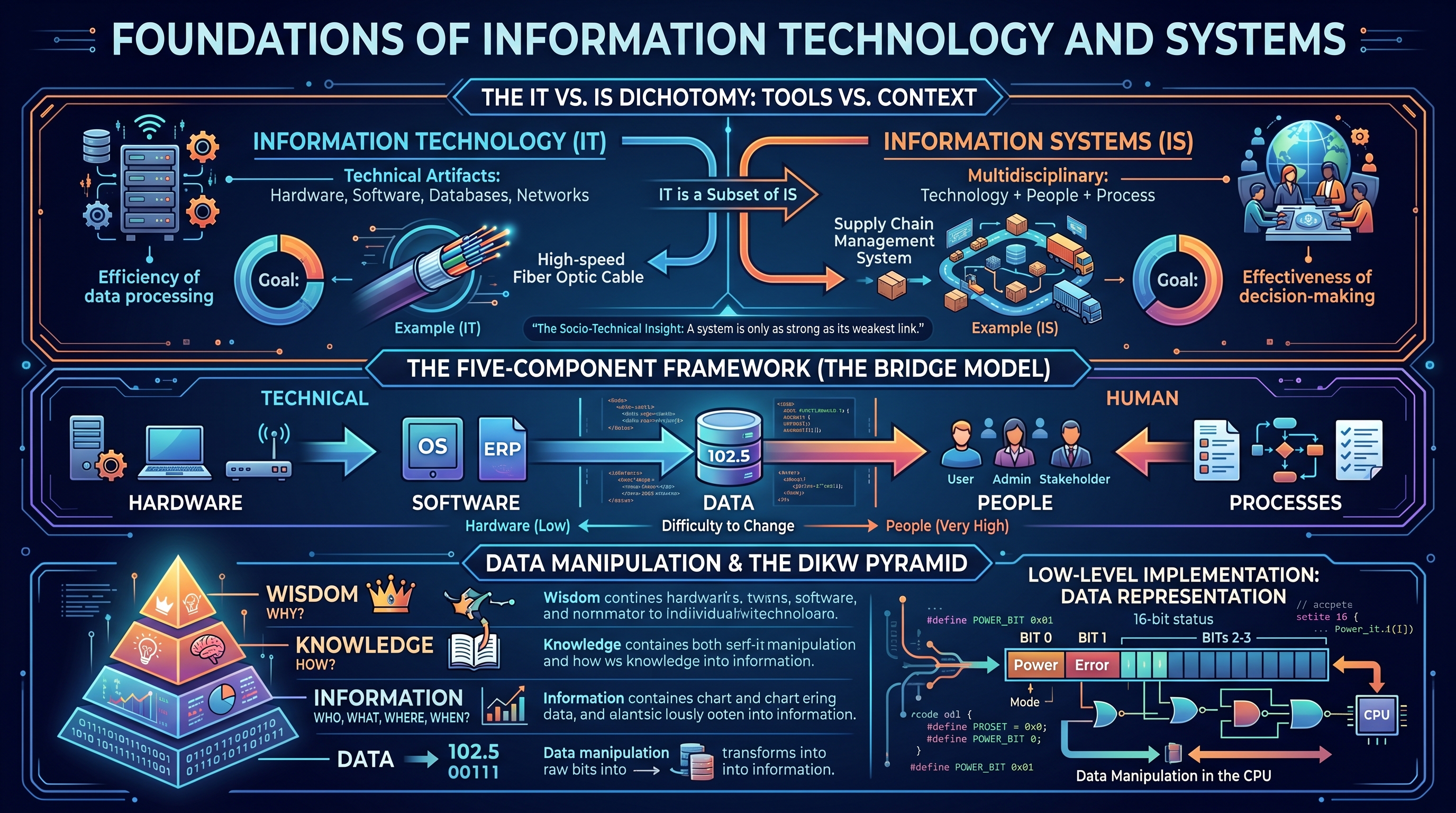
Information Technology (IT) is a subset of Information Systems. it focuses on the technical artifacts: the hardware, software, databases, and networking components that facilitate the storage, retrieval, transmission, and manipulation of data.
Information Systems (IS), conversely, is a multidisciplinary field. It views technology as one component of a larger system that includes human actors and organizational workflows. An information system exists to solve a problem or realize an opportunity within a specific context.
| Feature | Information Technology (IT) | Information Systems (IS) |
|---|---|---|
| Primary Focus | Hardware, software, and networking. | Integration of technology, people, and process. |
| Goal | Efficiency of data processing and transmission. | Effectiveness of organizational decision-making. |
| Components | CPU, RAM, OS, SQL, TCP/IP. | Hardware, Software, Data, People, Processes. |
| Perspective | Technical and engineering-centric. | Strategic and managerial-centric. |
| Example | A high-speed fiber optic cable. | A supply chain management system using that cable. |
The Socio-Technical Insight: An information system is only as strong as its weakest link. A multi-million dollar software suite (IT) will fail to deliver value if the organizational processes are broken or if the people using it lack the necessary digital literacy.
The Five-Component Framework of Information Systems
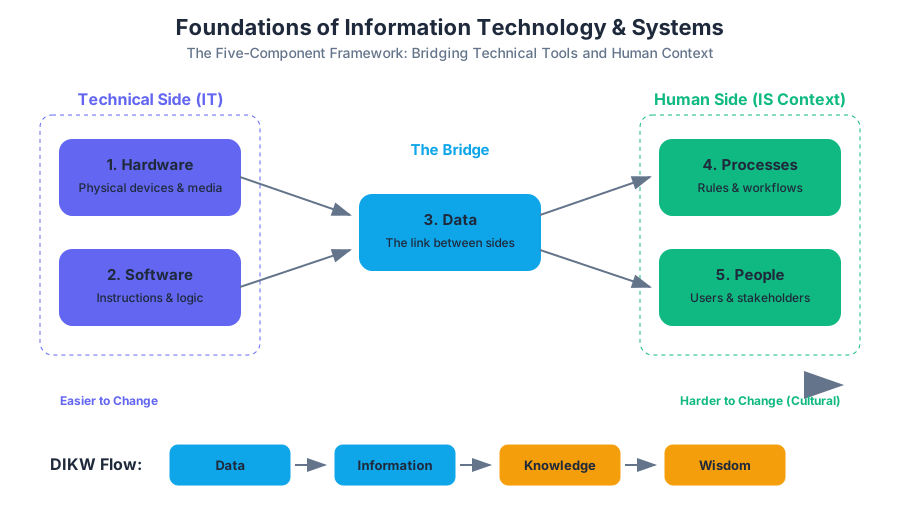
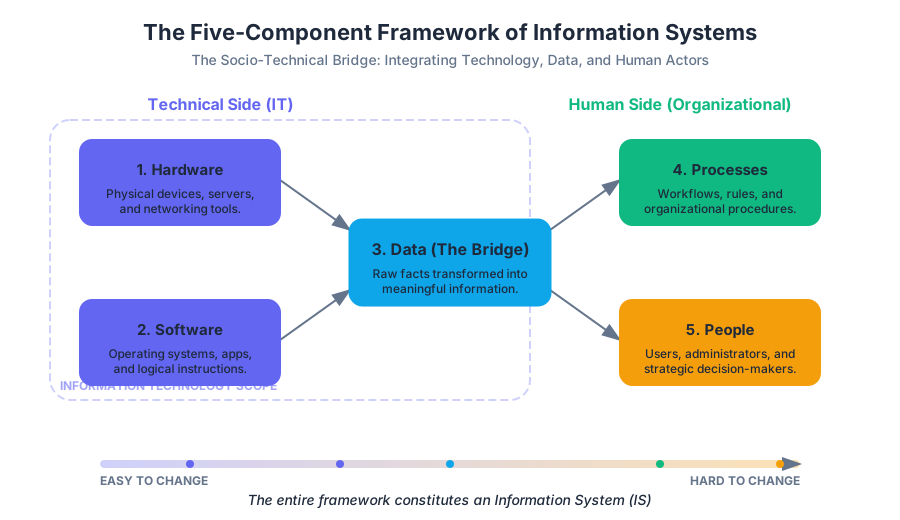
A robust Information System is composed of five interacting components. These components are often categorized into the "Bridge" model, where data serves as the link between the technical side (Hardware/Software) and the human side (People/Processes).
- Hardware: The physical devices (e.g., servers, workstations, mobile devices, routers).
- Software: The instructions that tell the hardware what to do (e.g., Operating Systems, Enterprise Resource Planning (ERP) suites).
- Data: The raw facts and figures that are processed into information.
- People: The most critical component, including users, administrators, and stakeholders.
- Processes: The steps or rules followed to achieve a specific task or outcome.
The Hierarchy of Complexity in IS Components
| Component | Difficulty to Change | Role in the System |
|---|---|---|
| Hardware | Low | Provides the physical substrate for computation. |
| Software | Medium | Defines the logic and capabilities of the system. |
| Data | Medium-High | The "fuel" that provides value and context. |
| Processes | High | The "how" of the organization; requires cultural shifts. |
| People | Very High | The "who"; requires training, buy-in, and literacy. |
Data Manipulation and the DIKW Pyramid
At the heart of IT is Data Manipulation: the process of transforming raw inputs into meaningful outputs. This is best understood through the DIKW Pyramid (Data, Information, Knowledge, Wisdom).
- Data: Discrete, objective facts (e.g., "102.5").
- Information: Data that has been processed to be useful; it answers "who, what, where, when" (e.g., "The patient's temperature is 102.5°F").
- Knowledge: The application of data and information to answer "how" (e.g., "A temperature of 102.5°F indicates a high fever").
- Wisdom: The evaluated understanding of knowledge to answer "why" (e.g., "We should administer antipyretics and monitor for infection").
Low-Level Implementation: Data Representation
At the lowest level, data manipulation occurs in the CPU through bitwise operations. The following C code demonstrates a low-level manipulation of a 16-bit status register, a common task in system-level IT.
#include <stdio.h>
#include <stdint.h>

/**
 * Low-level bit manipulation of a System Status Register.
 * BIT 0: Power (1 = On, 0 = Off)
 * BIT 1: Error (1 = Error present, 0 = OK)
 * BIT 2-3: Mode (00 = Standby, 01 = Active, 10 = Maintenance)
 */

#define POWER_BIT 0x01
#define ERROR_BIT 0x02
#define MODE_MASK 0x0C

void analyze_system_state(uint8_t register_val) {
    // Check Power Status
    if (register_val & POWER_BIT) {
        printf("System Power: ON\n");
    } else {
        printf("System Power: OFF\n");
    }

    // Check Error Flag
    if (register_val & ERROR_BIT) {
        printf("Alert: System Error Detected!\n");
    }

    // Extract Mode using Bit Shifting
    uint8_t mode = (register_val & MODE_MASK) >> 2;
    switch(mode) {
        case 0: printf("Mode: Standby\n"); break;
        case 1: printf("Mode: Active\n"); break;
        case 2: printf("Mode: Maintenance\n"); break;
        default: printf("Mode: Unknown\n");
    }
}

int main() {
    uint8_t status_reg = 0x05; // Binary: 00000101 (Power ON, Mode Standby)
    analyze_system_state(status_reg);
    return 0;
}
Computer Hardware: Architecture vs. Organization
The study of hardware is divided into two distinct but related perspectives: Computer Architecture and Computer Organization.
- Computer Architecture refers to the attributes of a system as seen by the programmer. It includes the instruction set, the number of bits used to represent data types, and I/O mechanisms.
- Computer Organization refers to the operational units and their interconnections that realize the architectural specifications. This includes hardware details transparent to the programmer, such as control signals and memory technology.
Internal vs. External Components
Internal components (CPU, RAM, Motherboard) handle the core processing, while external components (peripherals) handle input, output, and long-term storage.
| Component | Type | Function | Key Metric |
|---|---|---|---|
| CPU | Internal | Executes instructions via the Fetch-Decode-Execute cycle. | Clock Speed (GHz), Cores |
| RAM | Internal | Volatile, high-speed temporary storage for active data. | Capacity (GB), Throughput |
| SSD/HDD | Internal/Ext | Non-volatile storage for persistent data. | IOPS, Read/Write Speed |
| GPU | Internal | Specialized processor for parallel tasks (graphics/ML). | CUDA Cores, VRAM |
| NIC | Internal | Network Interface Card for data transmission. | Bandwidth (Gbps) |
Software Ecosystems and System Logic
Software acts as the intermediary between the user and the hardware. It is generally categorized into System Software and Application Software.
- System Software: Includes the Operating System (OS) and utility programs. It manages hardware resources and provides a platform for application software.
- Application Software: Programs designed to perform specific tasks for users (e.g., Microsoft Excel for data analysis, Adobe Photoshop for image editing).
Database Management Systems (DBMS)
A critical subset of software in the IS world is the DBMS. It allows for the structured storage and manipulation of data, ensuring integrity and security.
The following SQL snippet represents a typical schema for an Information System managing employee records and their associated IT assets.
-- Schema for IT Asset Management System
CREATE TABLE Employees (
    EmployeeID INT PRIMARY KEY,
    FullName VARCHAR(100) NOT NULL,
    Department VARCHAR(50),
    AccessLevel INT DEFAULT 1
);

CREATE TABLE HardwareAssets (
    AssetID VARCHAR(20) PRIMARY KEY,
    AssetType ENUM('Laptop', 'Mobile', 'Server', 'Workstation'),
    PurchaseDate DATE,
    AssignedTo INT,
    FOREIGN KEY (AssignedTo) REFERENCES Employees(EmployeeID)
);

-- Query to find all Laptops assigned to the 'Engineering' department
SELECT e.FullName, h.AssetID, h.PurchaseDate
FROM Employees e
JOIN HardwareAssets h ON e.EmployeeID = h.AssignedTo
WHERE e.Department = 'Engineering' AND h.AssetType = 'Laptop';
Digital Literacy and Information Ethics
In the foundational layer of IS, Digital Literacy is the "soft" infrastructure. It is defined as the ability to find, evaluate, and communicate information through various digital platforms. However, modern digital literacy also encompasses Information Literacy—the ability to recognize when information is needed and have the ability to locate, evaluate, and use effectively the needed information.
The Ethical Dimensions of IT
As technology becomes more pervasive, ethical considerations become paramount. Organizations must navigate:
- Privacy: How data is collected and who has access to it.
- Accuracy: Ensuring data integrity and preventing misinformation.
- Property: Intellectual property rights in a digital-copy world.
- Accessibility: Ensuring systems are usable by people with disabilities (Web Accessibility).
The Governance Mandate: IT Governance is the formal framework that provides a structure for organizations to ensure that IT investments support business objectives. It involves the strategic alignment of IT with the business, risk management, and resource management.
Business Operations and Strategic Advantage
The ultimate goal of any Information System in a professional context is to provide a Strategic Advantage. Michael Porter’s Value Chain model illustrates how IS can be applied to primary and support activities to increase margin.
- Inbound Logistics: Using IS for real-time inventory tracking.
- Operations: Automating manufacturing processes via Computer-Integrated Manufacturing (CIM).
- Outbound Logistics: Optimizing delivery routes using GPS and GIS data.
- Marketing and Sales: Utilizing Customer Relationship Management (CRM) software to target specific demographics.
High-Level Data Analysis for Business
Modern business operations rely on Data Analytics to drive decision-making. The following Python example uses the pandas library to perform a typical data manipulation task: analyzing sales data to identify trends.
import pandas as pd

# Load raw sales data (Data component of IS)
data = {
    'Date': ['2023-01-01', '2023-01-01', '2023-01-02', '2023-01-02'],
    'Product': ['Laptop', 'Mouse', 'Laptop', 'Monitor'],
    'Units': [5, 20, 3, 10],
    'Price': [1200, 25, 1200, 300]
}

df = pd.DataFrame(data)

# Data Manipulation: Calculate Total Revenue per row
df['Revenue'] = df['Units'] * df['Price']

# Information Generation: Aggregate revenue by Product
product_performance = df.groupby('Product')['Revenue'].sum().sort_values(ascending=False)

print("Product Performance Report:")
print(product_performance)

# Strategic Insight (Knowledge):
# "Laptops generate 80% of revenue despite lower unit volume than peripherals."
Common Pitfalls in IT and IS Foundations
- The "Silver Bullet" Fallacy: Believing that buying the latest technology (IT) will automatically fix organizational problems (IS).
- Ignoring the Human Factor: Implementing systems without proper training or considering user experience (UX), leading to "shadow IT" where employees use unauthorized tools to get work done.
- Data Silos: Creating systems that don't communicate with each other, leading to inconsistent data and fragmented business operations.
- Underestimating Maintenance: Failing to account for the Total Cost of Ownership (TCO), which includes updates, security patches, and hardware depreciation.
Source Materials
- Computer Applications and Information Technology
- Information Systems
- 2: Data Management and Information Systems Business Strategies
- Workplace Software and Skills (OpenStax)
- Introduction to Computer Applications and Concepts (Lumen)
- Information Systems for Business and Beyond (Bourgeois) (2019 Edition)
- InfoTech Governance, Policy, Ethics and Law (Tuffley)
- Professional Web Accessibility Auditing Made Easy
Study Computer Applications and Information Technology on Lykke
This course page is free to open: signed out, you can read its first two sections, and signing in, on any plan, opens the rest. The free Lykke Chrome extension syncs your own Canvas courses, so ChatGPT, Claude and Muse can answer from your classes and deadlines. It only reads Canvas.
Add the free extensionSign in to open every sectionAll sections of Computer Applications and Information Technology · Browse more course pages