From the free course Business Law I Essentials on Lykke
Tort Law and Criminal Liability
Key concepts: Negligence · Intentional Torts · Strict Liability · White-Collar Crime
Exploration of civil wrongs (torts) and criminal acts that occur within a business context, focusing on liability and prevention.
Tort Law and Criminal Liability
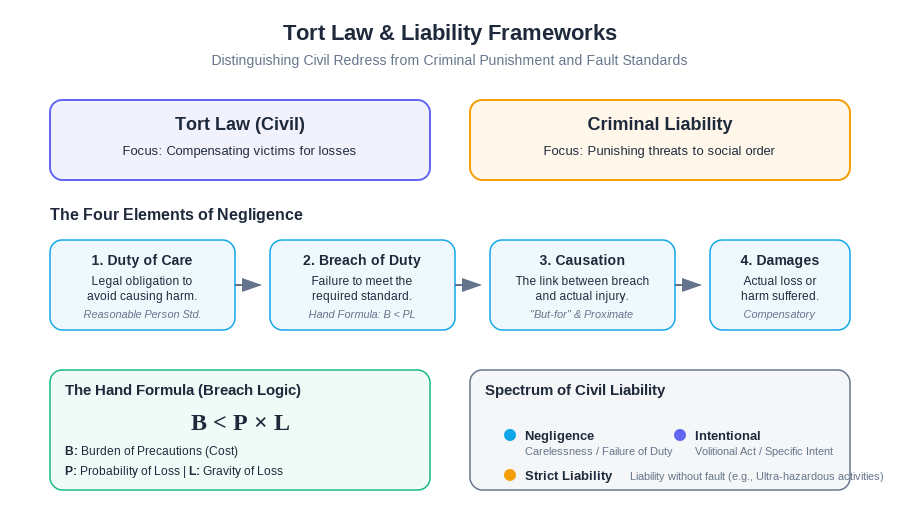
In the modern commercial landscape, the boundary between a "bad business decision" and a "legal violation" is defined by the frameworks of Tort Law and Criminal Liability. While both systems aim to regulate conduct and discourage harm, they operate on different planes of the legal system. Tort law is a civil mechanism designed to compensate victims for losses, shifting the cost of injuries from the "innocent" party to the "at-fault" party. Criminal liability, conversely, represents the state’s interest in punishing conduct that threatens the social order itself.
For business professionals, understanding these frameworks is not merely an academic exercise but a core component of risk management. A single product defect or a lapse in financial oversight can trigger a cascade of litigation, regulatory fines, and potential incarceration.
Negligence: The Standard of Care
Negligence is the most common basis for tort liability in the business world. It is defined not by the intent to do harm, but by the failure to exercise the degree of care that a "reasonably prudent person" would have exercised under similar circumstances.
Definition: Negligence A failure to behave with the level of care that someone of ordinary prudence would have exercised under the same circumstances. The behavior usually consists of actions, but can also consist of omissions when there is some duty to act.
The Four-Element Framework
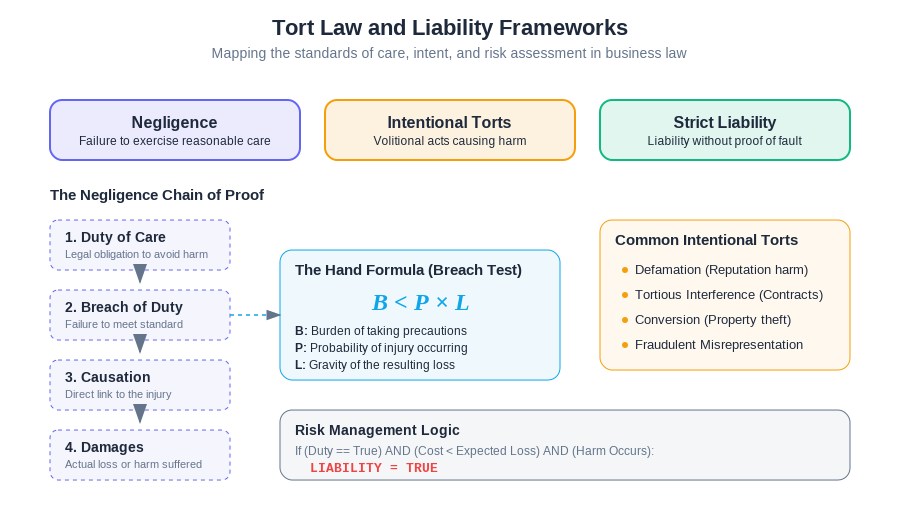
To prevail in a negligence claim, a plaintiff must prove four distinct elements by a preponderance of the evidence. If any single element is missing, the claim fails.
| Element | Description | Legal Test/Standard |
|---|---|---|
| Duty of Care | The legal obligation to avoid causing harm to others. | The "Reasonable Person" standard; Foreseeability. |
| Breach of Duty | The failure to meet the required standard of care. | The Hand Formula ($B < PL$); Industry standards. |
| Causation | The link between the breach and the actual injury. | "But-for" test (Actual) and "Proximate Cause" (Legal). |
| Damages | Actual loss or harm suffered by the plaintiff. | Compensatory, Punitive (rare), or Nominal damages. |
The Mechanics of Breach: The Hand Formula
In a technical sense, determining a breach of duty often involves an implicit or explicit cost-benefit analysis. Judge Learned Hand famously formulated this as a mathematical relationship:
B < PL
Where:
B= The Burden of taking precautions (cost of prevention).P= The Probability of loss/injury occurring.L= The gravity of the Loss (magnitude of the injury).
If the cost of prevention (B) is less than the expected loss (P * L), the failure to take that precaution constitutes a breach of duty.
Intentional Torts: Volitional Harm
Unlike negligence, Intentional Torts require a volitional act. The defendant must have intended the physical act that caused the harm, though they need not have intended the specific resulting injury. In a business context, intentional torts often involve interference with property, reputation, or contractual relationships.
Key Categories of Intentional Torts
- Defamation: A false statement of fact communicated to a third party that harms a person's or business's reputation.
- Tortious Interference: Intentionally inducing a party to breach a contract with a third party.
- Conversion: The civil equivalent of theft; exercising dominion over another's personal property without consent.
- Fraudulent Misrepresentation: A material misrepresentation made with the intent to deceive, which the victim reasonably relies upon to their detriment.
Comparison: Negligence vs. Intentional Torts
| Feature | Negligence | Intentional Tort |
|---|---|---|
| State of Mind | Carelessness / Inadvertence | Volitional Act / Specific Intent |
| Standard | Reasonable Person | Subjective Intent to Act |
| Punitive Damages | Rarely awarded | Frequently awarded to deter conduct |
| Insurance Coverage | Usually covered | Often excluded (Public Policy) |
Common Pitfall: The "Transferred Intent" Doctrine
A common misconception is that if you intend to hit Person A but accidentally hit Person B, you are only liable for negligence. Under the doctrine of Transferred Intent, the intent to commit a tort against one person is transferred to the actual victim.
Strict Liability: Liability Without Fault
In certain scenarios, the law abandons the requirement of "fault" (negligence or intent) altogether. Under Strict Liability, a defendant is held responsible for damages even if they took every possible precaution.
Applications in Business
Strict liability is typically reserved for three specific areas:
- Ultra-hazardous Activities: Activities that involve a high risk of serious harm that cannot be eliminated by reasonable care (e.g., blasting, keeping wild animals).
- Product Liability: Manufacturers and sellers are held liable if a product is sold in a "defective condition unreasonably dangerous" to the user.
- Vicarious Liability (Respondeat Superior): Employers are strictly liable for the torts committed by employees acting within the "scope of employment."
Product Liability Logic
For a product liability claim to succeed, the plaintiff must prove the product was defective in one of three ways:
- Manufacturing Defect: The unit that caused injury differs from the intended design.
- Design Defect: The entire product line is inherently dangerous, and a safer alternative design was feasible.
- Failure to Warn: Inadequate instructions or warnings regarding foreseeable risks.
\text{Strict Liability Condition: } \exists \text{ Product } P \in \text{ Market} \mid \text{Defect}(P) \land \text{ProximateCause}(P, \text{Injury}) \implies \text{Liability}
White-Collar Crime: The Criminal Dimension
While torts are disputes between private parties, White-Collar Crimes are offenses against the state. These are non-violent crimes committed by business professionals for financial gain.
The Anatomy of a Crime
Criminal liability requires the concurrence of two elements:
- Actus Reus: The "guilty act" (the physical commission of the crime).
- Mens Rea: The "guilty mind" (the mental state or intent).
Common White-Collar Offenses
- Embezzlement: The fraudulent conversion of property by someone to whom it was entrusted (e.g., an accountant siphoning funds).
- Money Laundering: Engaging in financial transactions to conceal the identity, source, or destination of illegally gained money.
- Insider Trading: Trading stock based on material, non-public information in breach of a fiduciary duty.
- RICO Violations: The Racketeer Influenced and Corrupt Organizations Act, used to prosecute ongoing criminal enterprises.
Corporate Criminal Liability
Under the doctrine of Corporate Personhood, a corporation can be criminally prosecuted. Since a corporation cannot be imprisoned, penalties usually involve massive fines, debarment from government contracts, or "corporate death" (dissolution).
| Crime Type | Primary Actor | Typical Mens Rea | Key Statute/Rule |
|---|---|---|---|
| Fraud | Individual/Org | Intent to Deceive | 18 U.S.C. § 1341 (Mail/Wire) |
| Embezzlement | Fiduciary | Intent to Deprive | State Penal Codes |
| Bribery | Public/Private Official | Corrupt Intent | FCPA (Foreign Corrupt Practices) |
| Tax Evasion | Taxpayer | Willfulness | 26 U.S.C. § 7201 |
Comparative Analysis: Civil vs. Criminal Liability
A single act can trigger both civil and criminal proceedings. For example, a CFO who steals company funds can be sued by the company for the tort of conversion (Civil) and prosecuted by the District Attorney for embezzlement (Criminal).
| Feature | Civil (Tort) | Criminal |
|---|---|---|
| Parties | Plaintiff vs. Defendant | State/Government vs. Defendant |
| Burden of Proof | Preponderance of the Evidence (>50%) | Beyond a Reasonable Doubt (~99%) |
| Purpose | Compensation / Restitution | Punishment / Deterrence / Rehabilitation |
| Verdict | Liable / Not Liable | Guilty / Not Guilty |
| Remedy | Monetary Damages / Injunctions | Fines / Probation / Imprisonment |
The Burden of Proof Gap
The difference in the burden of proof is critical. This is why a defendant might be acquitted in a criminal trial (where the state failed to prove guilt "beyond a reasonable doubt") but found liable in a subsequent civil trial (where the plaintiff only had to show it was "more likely than not" that the defendant committed the act). The most famous historical example of this is the O.J. Simpson trials.
Common Pitfalls in Liability Management
- The "Independent Contractor" Fallacy: Many businesses believe they are immune from liability if they hire contractors. However, if the business retains "control" over the methods of work, or if the task is "inherently dangerous," the business remains liable under strict liability or agency principles.
- Assuming Compliance Equals Safety: Meeting federal safety regulations (like OSHA or FDA standards) is often considered the "floor," not the "ceiling." A company can be in full regulatory compliance and still be found negligent if a reasonable person would have taken additional precautions.
- Ignoring "Soft" Intent: In intentional torts, you don't have to hate the victim. If you play a "prank" on a coworker that involves unconsented touching (Battery), your "good intentions" are irrelevant to liability.
Source Materials
Study Business Law I Essentials on Lykke
This course page is free to open: signed out, you can read its first two sections, and signing in, on any plan, opens the rest. The free Lykke Chrome extension syncs your own Canvas courses, so ChatGPT, Claude and Muse can answer from your classes and deadlines. It only reads Canvas.
Add the free extensionSign in to open every sectionAll sections of Business Law I Essentials · Browse more course pages