From the free course Business Law I Essentials on Lykke
Foundations of the Legal Environment
Key concepts: Constitutional Law · Statutory Law · Judicial Review · Business Ethics
An introduction to the sources of law, the American court system, and the ethical frameworks that guide business decisions.
Foundations of the Legal Environment
The legal environment of business is not merely a collection of restrictive rules; it is the fundamental operating system upon which modern commerce is built. Just as a software application requires a stable kernel and well-defined APIs to function, a market economy requires a predictable legal framework to enforce contracts, protect property rights, and resolve disputes. This article explores the architectural layers of the U.S. legal system, from the "root" level of Constitutional Law to the "application" layer of Business Ethics.
Constitutional Law: The System Kernel
Constitutional Law is the supreme source of law in the United States. It functions as the foundational architecture that defines the scope of governmental power and the boundaries of individual and corporate liberty. In technical terms, the Constitution acts as the "Root Specification" for all other legal sub-systems.
Definition: Constitutional Law is the body of law derived from a formal written constitution, defining the powers of the executive, legislative, and judicial branches, and establishing the fundamental rights of citizens.
The Hierarchy of Authority
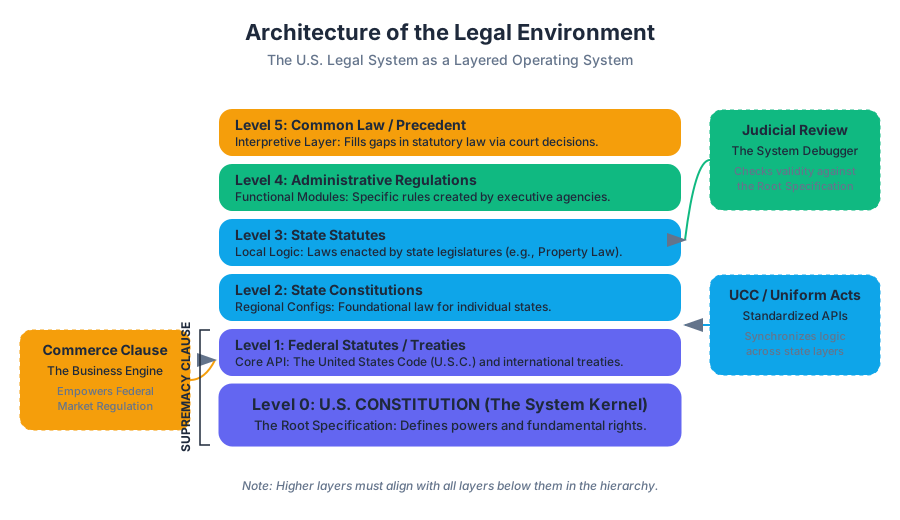
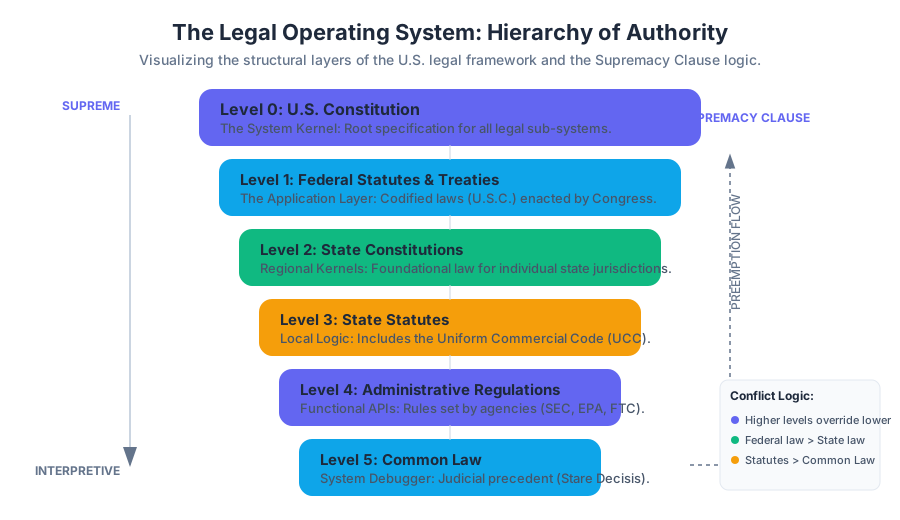
The Supremacy Clause (Article VI, Clause 2) establishes that the Constitution, federal laws made pursuant to it, and treaties made under its authority, constitute the "supreme Law of the Land." This creates a strict hierarchy where any state or local law in conflict with federal law is preempted.
| Layer | Source | Authority Level | Conflict Resolution |
|---|---|---|---|
| Level 0 | U.S. Constitution | Supreme | Overrides all other laws |
| Level 1 | Federal Statutes / Treaties | High | Overrides State Constitutions/Laws |
| Level 2 | State Constitutions | Medium-High | Overrides State Statutes |
| Level 3 | State Statutes | Medium | Overrides Local Ordinances |
| Level 4 | Administrative Regulations | Functional | Must align with enabling statutes |
| Level 5 | Common Law / Precedent | Interpretive | Fills gaps in statutory law |
The Commerce Clause: The Business Engine
For business entities, the most critical constitutional provision is the Commerce Clause (Article I, Section 8, Clause 3). It grants Congress the power "to regulate Commerce with foreign Nations, and among the several States." This has been interpreted broadly to allow federal regulation of any activity that has a "substantial economic effect" on interstate commerce.
Common Pitfalls: The State Action Doctrine
A frequent misconception is that the Bill of Rights applies to private corporations. In reality, the State Action Doctrine dictates that constitutional protections (like Free Speech or Due Process) generally protect individuals from government interference, not from private entities. A private employer can restrict speech in the workplace in ways the government cannot.
Statutory Law: The Application Layer
While the Constitution provides the framework, Statutory Law provides the specific rules of the road. These are laws enacted by legislative bodies (Congress or state legislatures).
The Lifecycle of a Statute
Statutes begin as bills. Once passed and signed into law, they are codified. At the federal level, they are organized into the United States Code (U.S.C.). For example, intellectual property laws are found in Title 17 (Copyrights) and Title 35 (Patents).
Uniform Acts and the UCC
Because the U.S. operates under a system of Federalism, each state has the power to create its own business laws. To prevent a "fragmentation" of the market, the Uniform Commercial Code (UCC) was developed. The UCC is a standardized set of laws governing commercial transactions (sales, leases, negotiable instruments) that has been adopted in some form by all 50 states.
Implementation Logic
In legal engineering, we can think of a statute as a conditional logic gate. If a set of facts matches the statutory criteria, a specific legal consequence follows.
Judicial Review: The System Debugger
Judicial Review is the power of the judiciary to examine the actions of the legislative and executive branches and determine their constitutionality. This power was famously established in the landmark case Marbury v. Madison (1803).
The Mechanics of Precedent (Stare Decisis)
The U.S. legal system relies on Common Law, where court decisions create binding precedents for future cases. This principle is known as Stare Decisis ("to stand by things decided").
- Vertical Stare Decisis: Lower courts must follow the decisions of higher courts within the same jurisdiction.
- Horizontal Stare Decisis: A court will generally follow its own previous decisions to ensure stability.
Standards of Review
When a court reviews a law, it doesn't use the same "magnification" for every case. It applies different levels of scrutiny based on the rights involved:
| Standard | Application | Requirement |
|---|---|---|
| Rational Basis | Economic regulations, age, wealth | Law must be "rationally related" to a "legitimate" government interest. (Easy to pass) |
| Intermediate Scrutiny | Gender, legitimacy | Law must be "substantially related" to an "important" government interest. |
| Strict Scrutiny | Fundamental rights (speech, religion) or suspect classifications (race) | Law must be "narrowly tailored" to achieve a "compelling" government interest. (Hard to pass) |
Formal Logic of Judicial Review
We can express the process of Judicial Review as a formal logical derivation. If a statute $S$ conflicts with a Constitutional provision $C$, and the Constitution is the supreme law ($C > S$), then $S$ must be declared null ($S \rightarrow \emptyset$).
\begin{aligned}
& \text{Let } \mathcal{C} \text{ be the set of Constitutional requirements.} \\
& \text{Let } f(x) \text{ be a legislative act (Statute).} \\
& \text{Judicial Review } \mathcal{J} \text{ is a function such that:} \\
& \mathcal{J}(f(x)) =
\begin{cases}
\text{Valid} & \text{if } f(x) \subseteq \mathcal{C} \\
\text{Void (Unconstitutional)} & \text{if } f(x) \cap \mathcal{C}^c \neq \emptyset
\end{cases} \\
& \text{where } \mathcal{C}^c \text{ represents the set of prohibited government actions.}
\end{aligned}
Business Ethics: The Governance Layer
While law defines what is required, Business Ethics defines what is right. Ethics often serves as a "leading indicator" for future laws; practices that are considered unethical today often become illegal tomorrow (e.g., environmental dumping, insider trading).
Competing Ethical Frameworks
Business leaders must navigate different philosophical approaches to decision-making.
| Framework | Core Principle | Business Application |
|---|---|---|
| Utilitarianism | Greatest good for the greatest number. | Cost-Benefit Analysis; prioritizing majority stakeholder interests. |
| Deontology (Kant) | Duty-based; follow universal rules regardless of outcome. | Strict adherence to codes of conduct and "Categorical Imperatives." |
| Virtue Ethics | Focus on the character of the decision-maker. | Developing corporate culture and leadership integrity. |
| Social Contract | Business exists by permission of society. | Corporate Social Responsibility (CSR) and "License to Operate." |
The Stakeholder vs. Shareholder Debate
A central tension in business ethics is the conflict between Shareholder Primacy (the duty to maximize profits for owners) and Stakeholder Theory (the duty to consider employees, customers, the environment, and the community).
Corporate Social Responsibility (CSR) Pipeline
Modern firms integrate ethics into their operations through a CSR pipeline, ensuring that values are not just "marketing" but are hard-coded into the supply chain.
Connecting the Dots: The Legal-Ethical Matrix
The relationship between law and ethics can be visualized as a four-quadrant matrix. The goal of a sustainable business is to operate primarily in the "Legal and Ethical" quadrant.
- Legal and Ethical: Paying a living wage, producing safe products.
- Legal but Unethical: Tax avoidance through aggressive (but legal) loopholes, "planned obsolescence."
- Illegal but Ethical: Civil disobedience, whistleblowing in some jurisdictions where protections are weak.
- Illegal and Unethical: Fraud, embezzlement, human rights violations in the supply chain.
Case Study: Data Privacy
Consider the evolution of data privacy. Historically, collecting and selling user data was largely unregulated (Legal but Unethical in the eyes of many). Public outcry led to ethical shifts, which eventually codified into Statutory Law like the GDPR in Europe and the CCPA in California. This demonstrates the "Legal Environment" as a dynamic system that responds to ethical pressures.
Summary of Foundational Concepts
The foundations of the legal environment provide the stability necessary for complex economic interactions. Constitutional law sets the boundaries, statutory law provides the rules, judicial review ensures system integrity, and business ethics provides the normative guidance that keeps the system aligned with societal values.
Source Materials
Study Business Law I Essentials on Lykke
This course page is free to open: signed out, you can read its first two sections, and signing in, on any plan, opens the rest. The free Lykke Chrome extension syncs your own Canvas courses, so ChatGPT, Claude and Muse can answer from your classes and deadlines. It only reads Canvas.
Add the free extensionSign in to open every sectionAll sections of Business Law I Essentials · Browse more course pages