From the free course Business Law I Essentials on Lykke
Contract Law Fundamentals
Key concepts: Offer and Acceptance · Consideration · Contractual Capacity · Statute of Frauds · Remedies
A deep dive into the formation, performance, and breach of contracts, which serve as the backbone of all commercial transactions.
Contract Law Fundamentals
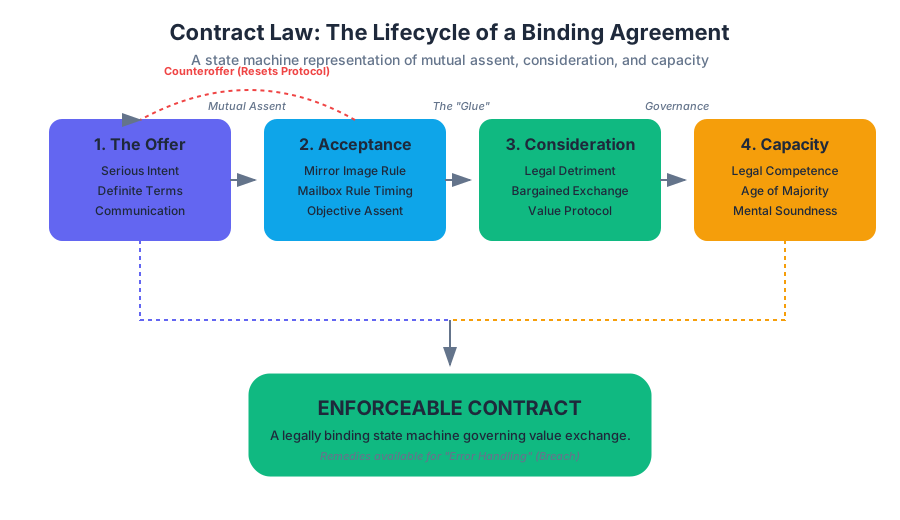
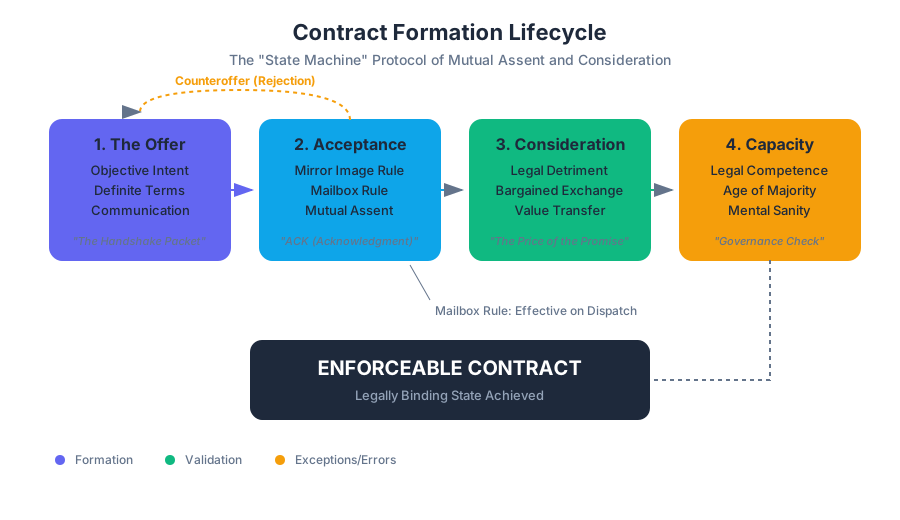
In the architecture of modern commerce, a contract is more than a mere agreement; it is a legally binding state machine that governs the exchange of value. At its core, contract law provides the "protocol" for private ordering, allowing individuals and entities to create their own enforceable rules. This section explores the lifecycle of a contract, from the initial "handshake" protocol of offer and acceptance to the "error handling" mechanisms of legal remedies.
1. Offer and Acceptance: The Mutual Assent Protocol
The formation of a contract begins with Mutual Assent, often described as a "meeting of the minds." However, modern jurisprudence relies on the Objective Theory of Contracts. This theory dictates that a party’s intent is determined by outward, objective facts—what they said, how they acted, and the circumstances—rather than their subjective, secret intentions.
1.1 The Offer
An Offer is a manifestation of willingness to enter into a bargain, made in a way that justifies another person in understanding that their assent to that bargain is invited and will conclude it.
| Element | Requirement | Description |
|---|---|---|
| Intent | Serious & Objective | Must not be made in jest, anger, or undue excitement (e.g., Lucy v. Zehmer). |
| Definiteness | Essential Terms | Must include parties, subject matter, price, and time of performance. |
| Communication | Direct or Indirect | The offeree must actually know the offer exists to accept it. |
1.2 The Acceptance
Acceptance is the offeree's expression of assent to the terms of the offer. Under the common law Mirror Image Rule, the acceptance must exactly match the offer. Any deviation or additional term converts the "acceptance" into a Counteroffer, which effectively terminates the original offer.
"The Mirror Image Rule ensures that the 'protocol' of the contract is identical on both sides. If Node A sends a packet with Parameter X, Node B must acknowledge Parameter X exactly; acknowledging Parameter X+1 is a protocol mismatch."
1.3 The Mailbox Rule
A critical timing mechanism in contract law is the Mailbox Rule. It states that an acceptance is generally effective upon dispatch (when it is placed in the control of the postal service), whereas revocations and rejections are only effective upon receipt.
2. Consideration: The Price of the Promise
Consideration is the "glue" that makes a promise legally enforceable. It distinguishes a contract from a gift. It requires a Bargained-for Exchange of something of Legal Value.
2.1 Elements of Consideration
- Legal Sufficiency: The promisee must either incur a legal detriment (doing something they aren't obligated to do) or the promisor must receive a legal benefit.
- Bargained-for Exchange: The item of value must be given by the promisor in exchange for the promisee's promise, performance, or promise of performance.
2.2 Common Pitfalls in Consideration
- Past Consideration: An act done before the contract is made is not consideration. You cannot "pay" for a new promise with an old deed.
- Pre-existing Duty: A promise to do what one already has a legal duty to do does not constitute legally sufficient consideration.
- Illusory Promises: If the terms of the contract express such uncertainty of performance that the promisor has not actually promised to do anything, the promise is illusory (e.g., "I will buy all the grain I want from you").
| Concept | Status | Reason |
|---|---|---|
| Gift | Unenforceable | No bargained-for exchange; no detriment to the donor. |
| Promissory Estoppel | Enforceable (Exception) | Reliance on a promise leads to injustice; used when consideration is missing. |
| Adequacy of Consideration | Generally Irrelevant | Courts don't care if you made a "bad deal," only that a deal was made. |
3. Contractual Capacity: The Governance of Competence
Not every entity has the legal power to bind themselves to a contract. Capacity refers to the legal qualification of a person to enter into a binding agreement.
3.1 Minors
Contracts entered into by minors (typically under 18) are Voidable at the option of the minor. This is known as the power of Disaffirmance. However, if a minor contracts for "necessaries" (food, shelter, medical care), they may be held liable for the reasonable value of the goods under a theory of quasi-contract.
3.2 Mental Incompetence and Intoxication
- Void: If a person has been adjudged mentally incompetent by a court, any contract they sign is void ab initio (from the beginning).
- Voidable: If the person lacked the mental capacity to understand the nature and consequences of the transaction at the time of signing, the contract is voidable.
- Intoxication: This is a high bar. A contract is voidable only if the person was so intoxicated that they lacked the ability to comprehend the legal consequences of their actions, and the other party had reason to know of the intoxication.
4. Statute of Frauds: The Requirement of Writing
The Statute of Frauds is a legal doctrine that requires certain types of contracts to be in writing and signed by the party against whom enforcement is sought. The purpose is to prevent fraud and perjury in the testimony of oral contracts.
4.1 The "MYLEGS" Acronym
The types of contracts typically falling under the Statute of Frauds can be remembered by the acronym MYLEGS:
- Marriage: Contracts made in consideration of marriage (e.g., prenuptial agreements).
- Year: Contracts that cannot be performed within one year from the day after the date of formation.
- Land: Contracts for the sale of an interest in land (including leases and mortgages).
- Executor: Promises by an executor to pay estate debts out of their own pocket.
- Goods: Sale of goods priced at $500 or more (under the UCC).
- Suretyship: Promises to pay the debt of another person.
4.2 Sufficiency of the Writing
The "writing" does not need to be a formal contract. It can be a memo, an invoice, or even a series of emails, provided it contains:
- The essential terms (parties, subject matter, consideration).
- The signature of the party to be charged (the defendant).
5. Remedies: Error Handling in Contract Law
When a party fails to perform their duties under a contract, a Breach occurs. The law provides Remedies to compensate the non-breaching party. The goal of contract remedies is generally Compensatory, not punitive—to put the non-breaching party in the position they would have been in had the contract been performed.
5.1 Legal Remedies (Damages)
Legal remedies consist of monetary awards.
| Type of Damage | Purpose | Calculation |
|---|---|---|
| Compensatory | Cover direct losses. | (Contract Price) - (Market Price) or (Cost of Substitute). |
| Consequential | Cover indirect, foreseeable losses. | Lost profits resulting from the breach (must be foreseeable). |
| Liquidated | Pre-determined amount. | Fixed in the contract itself if actual damages are hard to estimate. |
| Nominal | Recognize a technical breach. | Usually $1; awarded when no actual financial loss occurred. |
5.2 Equitable Remedies
When money is an inadequate remedy, courts may grant equitable relief.
- Specific Performance: A court order requiring the breaching party to perform their contractual duty. This is common in real estate transactions (because land is unique) but rare in personal service contracts (to avoid "involuntary servitude").
- Rescission: The contract is canceled, and the parties are returned to their pre-contractual positions.
- Reformation: The court rewrites the contract to reflect the parties' true intentions (often used in cases of mutual mistake).
5.3 Mitigation of Damages
The non-breaching party has a legal duty to Mitigate their damages. They must take reasonable steps to minimize the loss resulting from the breach. For example, if a tenant breaks a lease, the landlord must make reasonable efforts to find a new tenant rather than simply suing for the remaining months of rent without acting.
6. Summary of Contractual Lifecycle
The lifecycle of a contract can be viewed as a pipeline:
- Formation: Offer, Acceptance, and Consideration create the binding obligation.
- Validation: Capacity and the Statute of Frauds act as filters to ensure the obligation is enforceable.
- Performance: The parties fulfill their promises, terminating the contract naturally.
- Breach/Remedy: If performance fails, the "exception handling" of remedies triggers to restore balance.
Understanding these fundamentals allows business professionals to mitigate risk and ensure that their strategic agreements have the full force of the law behind them.
Source Materials
Study Business Law I Essentials on Lykke
This course page is free to open: signed out, you can read its first two sections, and signing in, on any plan, opens the rest. The free Lykke Chrome extension syncs your own Canvas courses, so ChatGPT, Claude and Muse can answer from your classes and deadlines. It only reads Canvas.
Add the free extensionSign in to open every sectionAll sections of Business Law I Essentials · Browse more course pages