From the free course Business Law I Essentials on Lykke
Agency and Business Organizations
Key concepts: Principal-Agent Relationship · Fiduciary Duty · Sole Proprietorship · Corporations · LLCs
An examination of how businesses are structured and the legal relationships between employers, employees, and third parties.
Agency and Business Organizations
In the modern economic landscape, the "firm" is rarely a single individual acting in isolation. Instead, businesses operate through a complex web of delegated authority and structured legal entities.
At its core, agency law governs the relationship where one person (the agent) acts on behalf of another (the principal). Business organization law then applies these principles to specific structures—ranging from the informal Sole Proprietorship to the highly regulated Corporation—to define liability, taxation, and governance.
The Principal-Agent Relationship
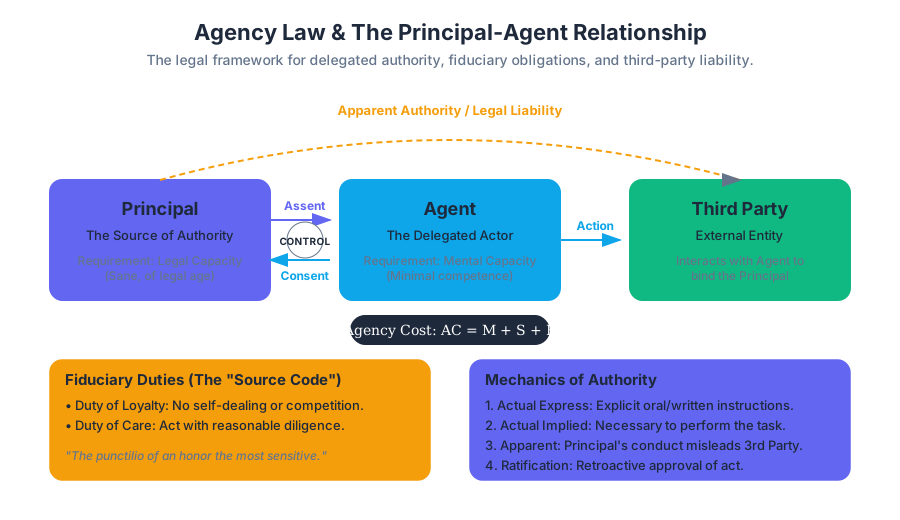
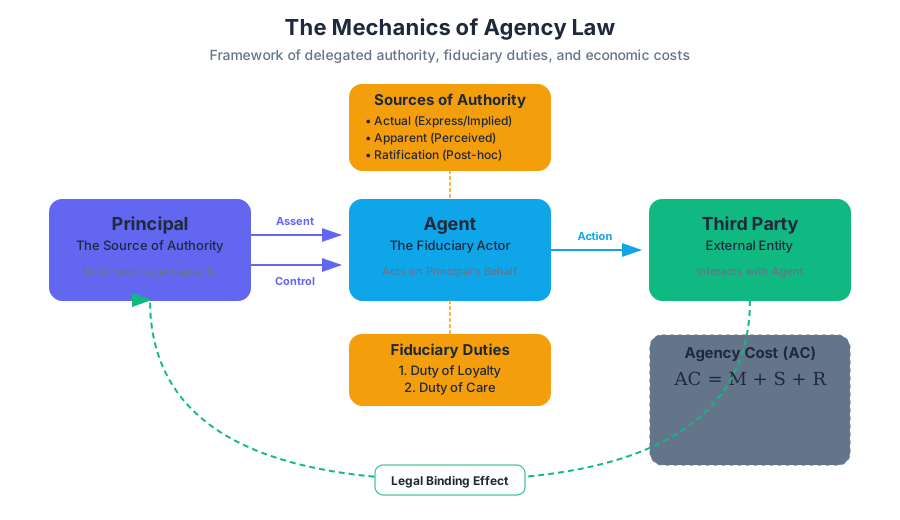
The Principal-Agent Relationship is a fiduciary relationship that arises when one person (the principal) manifests assent to another person (the agent) that the agent shall act on the principal's behalf and subject to the principal's control, and the agent consents so to act.
Mechanics of Agency
Agency is not defined by a contract alone; it is defined by the conduct of the parties. Even if a contract explicitly states "no agency relationship exists," a court may find one if the functional elements of consent and control are present.
| Component | Description | Legal Requirement |
|---|---|---|
| Principal | The entity with the original authority. | Must have legal capacity (sane, of age). |
| Agent | The entity acting on behalf of the principal. | Must have minimal mental capacity. |
| Consent | Both parties must agree to the relationship. | Can be express (written/oral) or implied. |
| Control | The principal has the right to control the agent's objectives. | The "right to control" is the hallmark of agency. |
Types of Authority
An agent's power to bind a principal to a third party depends on the type of Authority granted:
- Actual Express Authority: Explicit instructions given via written or oral communication (e.g., "I authorize you to sign this lease").
- Actual Implied Authority: Authority to do what is reasonably necessary to carry out the express mandate (e.g., authority to manage a store implies authority to hire staff).
- Apparent Authority: Created when a principal’s conduct leads a third party to reasonably believe the agent has authority, even if they do not.
- Ratification: Occurs when a principal accepts the benefits of an unauthorized act after the fact, thereby retroactively creating authority.
Fiduciary Duty: The "Source Code" of Trust
The most critical aspect of the agency relationship is the Fiduciary Duty. This is a high standard of care and loyalty that prevents the agent from exploiting the principal's trust for personal gain.
"A fiduciary is held to something stricter than the morals of the market place. Not honesty alone, but the punctilio of an honor the most sensitive, is then the standard of behavior." — Justice Benjamin Cardozo, Meinhard v. Salmon
The Two Pillars of Fiduciary Duty
- Duty of Loyalty: The agent must act solely for the benefit of the principal. This includes:
- No self-dealing (buying from or selling to oneself).
- No usurping business opportunities that belong to the principal.
- No competing with the principal while the relationship exists.
- Maintaining confidentiality.
- Duty of Care: The agent must act with the same care, competence, and diligence as a normally prudent person in similar circumstances.
Formalizing Fiduciary Obligations
We can represent the "Agency Cost" ($AC$)—the loss incurred by the principal due to the divergence of interests—mathematically:
AC = M + S + R
Where:
- $M$ = Monitoring Costs: Expenses paid by the principal to limit the agent's aberrant activities (e.g., audits).
- $S$ = Bonding Costs: Expenses paid by the agent to guarantee they will not take certain actions (e.g., contractual penalties).
- $R$ = Residual Loss: The remaining reduction in the principal's welfare despite monitoring and bonding.
Business Organizations: The Spectrum of Structure
When individuals decide to conduct business, they must choose a legal "container." This choice determines the Liability (who pays if things go wrong), Taxation (how the government takes its cut), and Governance (who makes the decisions).
1. Sole Proprietorship
The simplest and most common form of business. There is no legal distinction between the owner and the business.
- Formation: No formal filing required (except local DBAs or licenses).
- Liability: Unlimited Personal Liability. If the business is sued or goes bankrupt, the owner's personal assets (house, car, savings) are at risk.
- Taxation: Pass-through; income is reported on the owner's personal tax return.
2. Partnerships
A partnership is an association of two or more persons to carry on as co-owners of a business for profit.
| Feature | General Partnership (GP) | Limited Partnership (LP) |
|---|---|---|
| Liability | All partners have unlimited personal liability. | General partners have unlimited liability; Limited partners have limited liability. |
| Management | All partners share equal management rights. | Limited partners usually cannot participate in management. |
| Taxation | Pass-through. | Pass-through. |
| Creation | Can be created by conduct (informal). | Requires formal filing with the state. |
3. Corporations (C-Corps and S-Corps)
A corporation is a legal entity that is separate and distinct from its owners. It is a "legal person" that can enter contracts, sue, and be sued.
- Limited Liability: Shareholders are generally not personally liable for the corporation's debts. Their risk is limited to the amount of their investment.
- Double Taxation: C-Corps are taxed at the entity level on profits, and shareholders are taxed again on dividends.
- Governance Hierarchy: Shareholders elect Directors, who appoint Officers (CEO, CFO) to manage daily operations.
4. Limited Liability Company (LLC)
The LLC is a hybrid structure designed to provide the limited liability of a corporation with the tax flexibility of a partnership.
- Members: Owners are called "members" (not shareholders).
- Operating Agreement: The "source code" of the LLC, defining how it is run.
- Taxation: Default is pass-through, but can elect to be taxed as a corporation.
Comparative Decision Matrix
Choosing a structure involves balancing competing priorities. The following table provides a technical comparison for founders.
| Metric | Sole Prop | Partnership | LLC | C-Corp |
|---|---|---|---|---|
| Entity Status | None | Separate (mostly) | Separate | Separate |
| Liability | Unlimited | Unlimited (General) | Limited | Limited |
| Taxation | Single (Personal) | Single (Pass-through) | Single (Default) | Double |
| Capital Raising | Difficult | Moderate | Moderate | High (VC/IPO) |
| Continuity | Ends with owner | Ends with partner | Perpetual | Perpetual |
| Complexity | Low | Low to Moderate | Moderate | High |
Common Pitfalls and Edge Cases
1. Piercing the Corporate Veil
The "Corporate Veil" is the legal shield protecting owners from personal liability. However, courts may "pierce" this veil if:
- The business is the Alter Ego of the owner (mixing personal and business funds).
- The corporation was Under-capitalized at formation to defraud creditors.
- The owner failed to follow Corporate Formalities (e.g., not holding annual meetings or keeping minutes).
2. Apparent Authority in the Digital Age
In modern systems, apparent authority often arises through automated systems. If a company provides an employee with an @company.com email and a "VP" signature, and that employee signs a contract they weren't authorized to sign, the company may still be bound under the doctrine of apparent authority.
3. The "Self-Dealing" Trap
A director of a corporation finds a piece of real estate perfect for the company's expansion. Instead of telling the board, they buy it personally and lease it back to the company. This is a classic breach of the Duty of Loyalty (Usurpation of Corporate Opportunity).
Example: Setting up a Tech Startup
To illustrate the lifecycle, consider a founder, "Devin," launching a SaaS product.
- Phase 1 (Sole Prop): Devin writes code in his garage. He is a sole proprietor. If his code accidentally deletes a client's database, the client can sue Devin and take his house.
- Phase 2 (LLC): Devin brings on a co-founder. They file an LLC. They now have limited liability. If the same error occurs, only the LLC's assets are at risk.
- Phase 3 (C-Corp): They want to raise Venture Capital. VCs require a Delaware C-Corp for its predictable legal environment and ease of issuing stock options. They "convert" the LLC to a C-Corp.
Summary of Key Terms
- Principal: The party who authorizes another to act on their behalf.
- Agent: The party authorized to act for the principal.
- Fiduciary: A person in a position of trust who owes duties of loyalty and care.
- Limited Liability: A legal protection where owners are not personally responsible for business debts.
- Pass-through Taxation: A system where business income is only taxed once at the individual level.
- Articles of Incorporation: The formal document filed with the state to create a corporation.
Study Guide: Agency and Business Organizations
I. Agency Law Fundamentals
- Definition: A consensual relationship where an Agent acts for a Principal.
- Creation: Requires Manifestation of Consent and Control.
- Authority Types:
- Actual: Principal tells Agent what to do.
- Apparent: Principal makes Third Party think Agent has authority.
- Ratification: Principal says "I'll allow it" after the fact.
- Fiduciary Duties: Duty of Loyalty (no self-dealing) and Duty of Care (prudence).
II. Business Entities Comparison
- Sole Proprietorship: 1 owner, unlimited liability, easy to start.
- Partnership: 2+ owners, unlimited liability (usually), pass-through tax.
- Corporation: Separate legal person, limited liability, double taxation, formal governance.
- LLC: Hybrid, limited liability, flexible taxation, "Members" instead of "Shareholders."
III. Key Legal Risks
- Vicarious Liability (Respondeat Superior): Principals are liable for torts committed by agents within the scope of employment.
- Piercing the Veil: Losing limited liability by failing to keep the business separate from personal affairs.
- Agency Costs: The inherent conflict of interest between owners and managers.
IV. Practical Application
- When to choose an LLC: For small to medium businesses wanting protection without the complexity of a corporation.
- When to choose a C-Corp: When planning to go public or raise significant Venture Capital.
- When to stay a Sole Prop: Almost never, once the business has any significant revenue or risk.
Source Materials
Study Business Law I Essentials on Lykke
This course page is free to open: signed out, you can read its first two sections, and signing in, on any plan, opens the rest. The free Lykke Chrome extension syncs your own Canvas courses, so ChatGPT, Claude and Muse can answer from your classes and deadlines. It only reads Canvas.
Add the free extensionSign in to open every sectionAll sections of Business Law I Essentials · Browse more course pages