From the free course Art on Lykke
The Structure of Art: Elements and Principles
Key concepts: Elements of Art · Principles of Design · Dimensionality · Composition · Visual Vocabulary
A deep dive into the specialized vocabulary of art, focusing on the formal elements and design principles that govern visual composition.
The Structure of Art: Elements and Principles
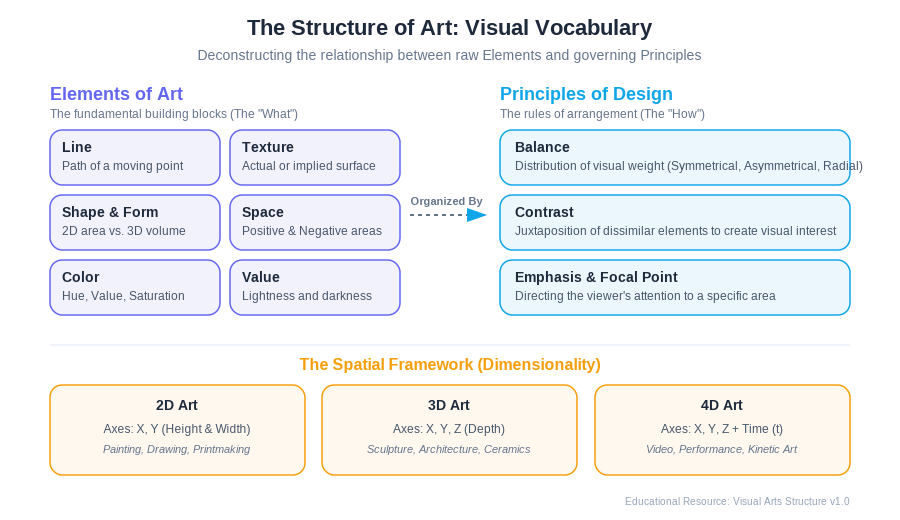
To analyze art effectively, one must understand its Visual Vocabulary—the formal "grammar" that governs how visual information is encoded, transmitted, and perceived. Just as a linguist breaks down a sentence into phonemes, morphemes, and syntax, an art historian or practitioner deconstructs a work into its Elements of Art (the raw components) and Principles of Design (the rules governing their arrangement). This structural framework allows us to move beyond subjective "liking" toward a technical understanding of how a composition functions.
Dimensionality: The Spatial Framework
Before examining individual elements, we must define the spatial context in which they exist. Dimensionality dictates the constraints and possibilities of the artistic medium.
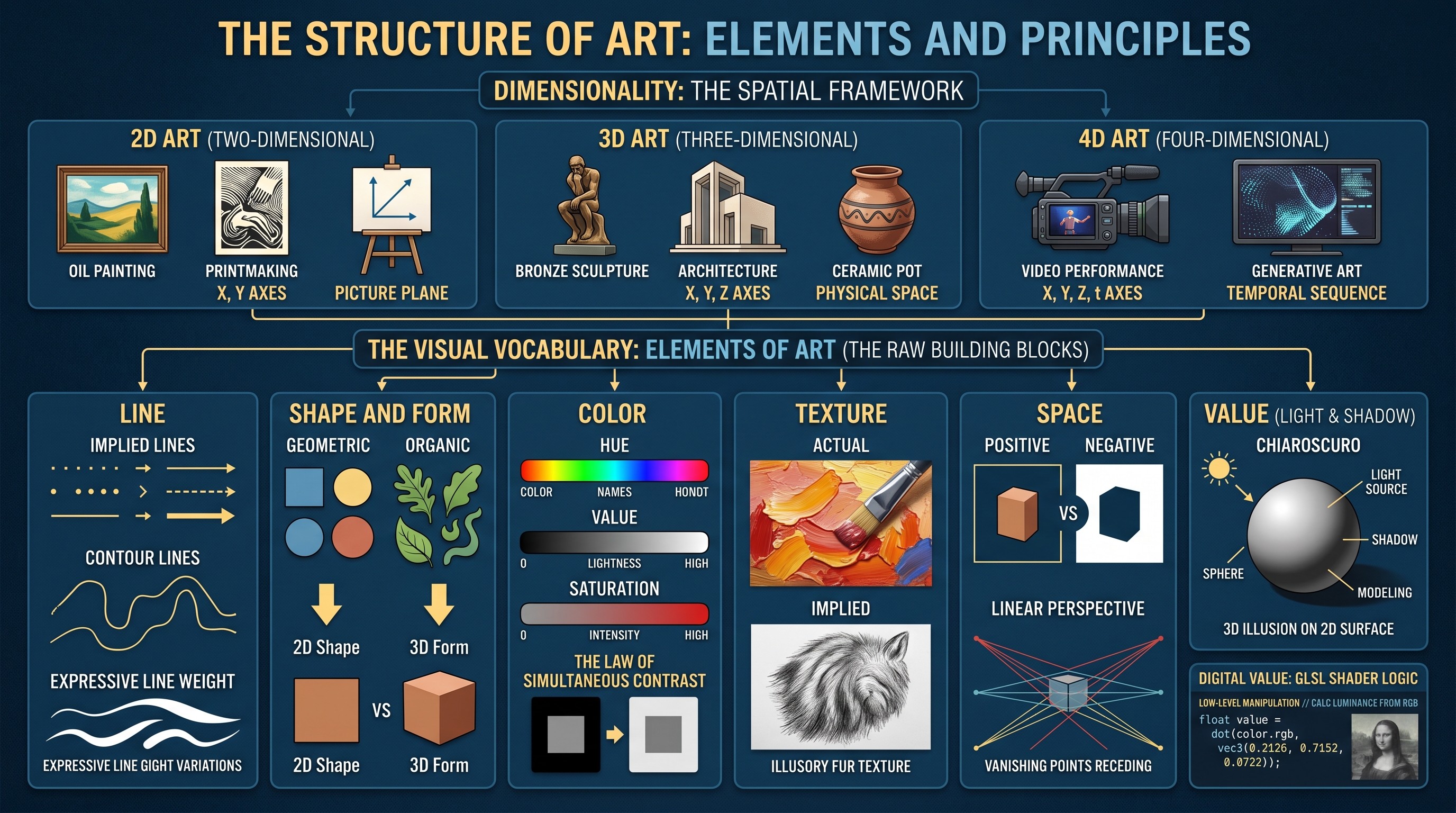
- 2D Art (Two-Dimensional): Defined by height and width. The primary challenge is the "illusion of depth" on a flat plane (the picture plane). Examples include drawing, painting, and printmaking.
- 3D Art (Three-Dimensional): Defined by height, width, and depth. These works occupy physical space and are subject to the laws of gravity and lighting. Examples include sculpture, architecture, and ceramics.
- 4D Art (Four-Dimensional): Includes the element of Time. This encompasses video art, performance art, and kinetic sculpture where the work changes state or position over a duration.
| Dimension | Primary Axis | Key Constraint | Typical Media |
|---|---|---|---|
| 2D | X, Y | Surface Flatness | Oil on Canvas, Lithography, Digital Illustration |
| 3D | X, Y, Z | Structural Integrity | Bronze Casting, Architecture, Installation |
| 4D | X, Y, Z, $t$ | Temporal Sequence | Video, Performance, Generative Code Art |
The Elements of Art: The Visual Building Blocks
The elements are the fundamental components used by artists to create imagery. They are the "atoms" of the visual world.
Line
A Line is technically the path of a point moving through space. In geometry, a line has length but no width; in art, the "weight" (thickness) of a line is a critical expressive tool.
- Implied Lines: Lines that are not physically drawn but suggested by the alignment of shapes or the "eyeline" of a subject.
- Contour Lines: Lines that define the outer edges of a form and its internal surface variations.
Shape and Form
Shape refers to a two-dimensional area defined by an enclosed line or a change in color/value. Form refers to three-dimensional volume (or the illusion of it).
- Geometric: Precise and regular (circles, squares, triangles). Often associated with man-made structures.
- Organic: Irregular and asymmetrical. Often associated with nature and living organisms.
Color (Hue, Value, Saturation)
Color is the most complex element, rooted in the physics of light. It is defined by three dimensions:
- Hue: The name of the color (Red, Blue, Green).
- Value: The lightness or darkness of a color.
- Saturation (Chroma): The intensity or purity of the color.
The Law of Simultaneous Contrast: Proposed by Michel Eugène Chevreul, this theorem states that the perception of a color is significantly altered by the colors surrounding it. A grey square will appear lighter against a black background than against a white one.
Texture
Texture refers to the surface quality of a work. It can be Actual (tactile, as in a thick impasto painting) or Visual/Implied (the illusion of texture, as in a hyper-realistic drawing of fur).
Space
Space involves the area around and within objects.
- Positive Space: The area occupied by the primary subjects.
- Negative Space: The "empty" area around the subjects.
- Linear Perspective: A mathematical system for representing 3D space on a 2D surface using vanishing points and horizon lines.
Value (Light and Shadow)
Value is the relative lightness or darkness of a surface. In 2D art, the manipulation of value is known as Chiaroscuro, used to create the illusion of three-dimensional volume through "modeling."
The Principles of Design: The Grammar of Composition
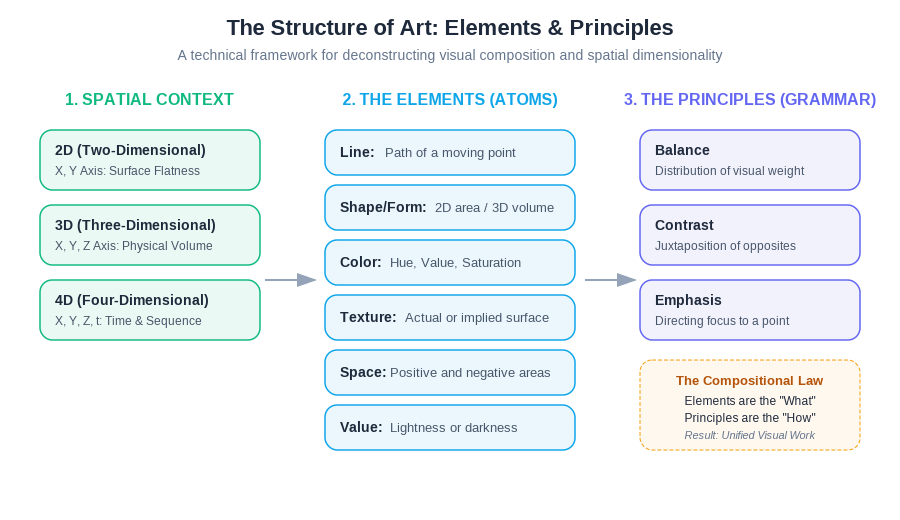
If the elements are the "what," the principles are the "how." They describe how the elements are organized to create a successful Composition.
Balance
Balance is the distribution of visual weight. A composition feels "balanced" when the visual forces are in equilibrium.
- Symmetrical Balance: Mirror-image or near-mirror-image arrangement. Conveys stability and formality.
- Asymmetrical Balance: Different elements on either side that still achieve equilibrium through visual weight (e.g., one large dark shape balanced by several small light shapes).
- Radial Balance: Elements radiate from a central point.
Contrast
Contrast is the juxtaposition of strongly dissimilar elements (light vs. dark, rough vs. smooth, large vs. small). It is the primary tool for creating Emphasis and visual interest.
Emphasis and Focal Point
Emphasis is the strategy of drawing the viewer's attention to a specific area, known as the Focal Point. This is often achieved through high contrast, isolation, or "leading lines."
Rhythm and Movement
Movement is the path the viewer's eye takes through the work. Rhythm is the repetition of elements to create a sense of organized movement, much like a beat in music.
Unity and Variety
Unity is the sense of "oneness" or wholeness in a work—the feeling that all parts belong together. Variety provides the necessary diversity to keep the viewer engaged. A successful work balances both; too much unity is boring (monotony), while too much variety is chaotic.
Proportion and Scale
Scale refers to the size of an object in relation to a standard (usually the human body). Proportion refers to the size relationship between parts of a whole.
The Golden Ratio ($\phi$): A mathematical proportion ($\approx 1.618$) found in nature and used in art to create aesthetically pleasing compositions. It is defined by the relationship: $$\frac{a+b}{a} = \frac{a}{b} = \phi$$
Mathematical Derivation of the Golden Spiral
The Golden Ratio is often implemented in generative art using the Fibonacci sequence, which approximates $\phi$ as the sequence progresses.
% Mathematical representation of the Golden Ratio growth
F_n = F_{n-1} + F_{n-2}
\lim_{n \to \infty} \frac{F_n}{F_{n-1}} \approx 1.618033...

% To generate a Golden Spiral in polar coordinates:
r = a e^{b \theta}
where:
b = \frac{\ln(\phi)}{\pi/2} \approx 0.30635
Synthesis: The Grammar in Action
The mastery of art lies not in the isolated use of these elements, but in their Synthesis. A "Composition" is the final arrangement where elements and principles work in concert to communicate a message or evoke an emotion.
Visual Weight Factors
Visual weight is the perceived "heaviness" of an object in a composition. Understanding this is crucial for achieving balance.
| Factor | High Visual Weight | Low Visual Weight |
|---|---|---|
| Size | Large | Small |
| Color | Warm (Red/Orange) | Cool (Blue/Green) |
| Value | Dark | Light |
| Texture | Complex/Rough | Smooth/Simple |
| Position | Near the edges/top | Near the center/bottom |
Common Pitfalls in Composition
- The Dead Center: Placing the focal point exactly in the center of the frame often creates a static, uninteresting composition. Using the Rule of Thirds (placing elements at the intersections of a $3 \times 3$ grid) usually creates more dynamic tension.
- Edge Kissing: Allowing an object to just barely touch the edge of the frame (a "tangent"). This creates visual tension that distracts from the focal point.
- Value Flattening: Failing to use a full range of values (from pure black to pure white). This results in a "muddy" or flat image that lacks depth.
- Lack of Hierarchy: When every element has the same visual weight, the viewer's eye has no place to start, leading to visual fatigue.
Conclusion: The Language of the Eye
Understanding the structure of art transforms the viewer from a passive consumer into an active decoder. By identifying the lines that lead our eyes, the colors that set the mood, and the balance that provides stability, we gain insight into the artist's intent and the cultural context of the work. Whether analyzing a Renaissance fresco or a modern user interface, the elements and principles of design remain the universal constants of visual communication.
Source Materials
Study Art on Lykke
This course page is free to open: signed out, you can read its first two sections, and signing in, on any plan, opens the rest. The free Lykke Chrome extension syncs your own Canvas courses, so ChatGPT, Claude and Muse can answer from your classes and deadlines. It only reads Canvas.
Add the free extensionSign in to open every section