From the free course Art on Lykke
Museums, Collections, and Cultural Heritage
Key concepts: Museum Curation · Material Culture · Cultural Heritage · Object-Based Research · Community Identity
A study of how art and objects are collected, curated, and used to document community identity and material history.
Museums, Collections, and Cultural Heritage
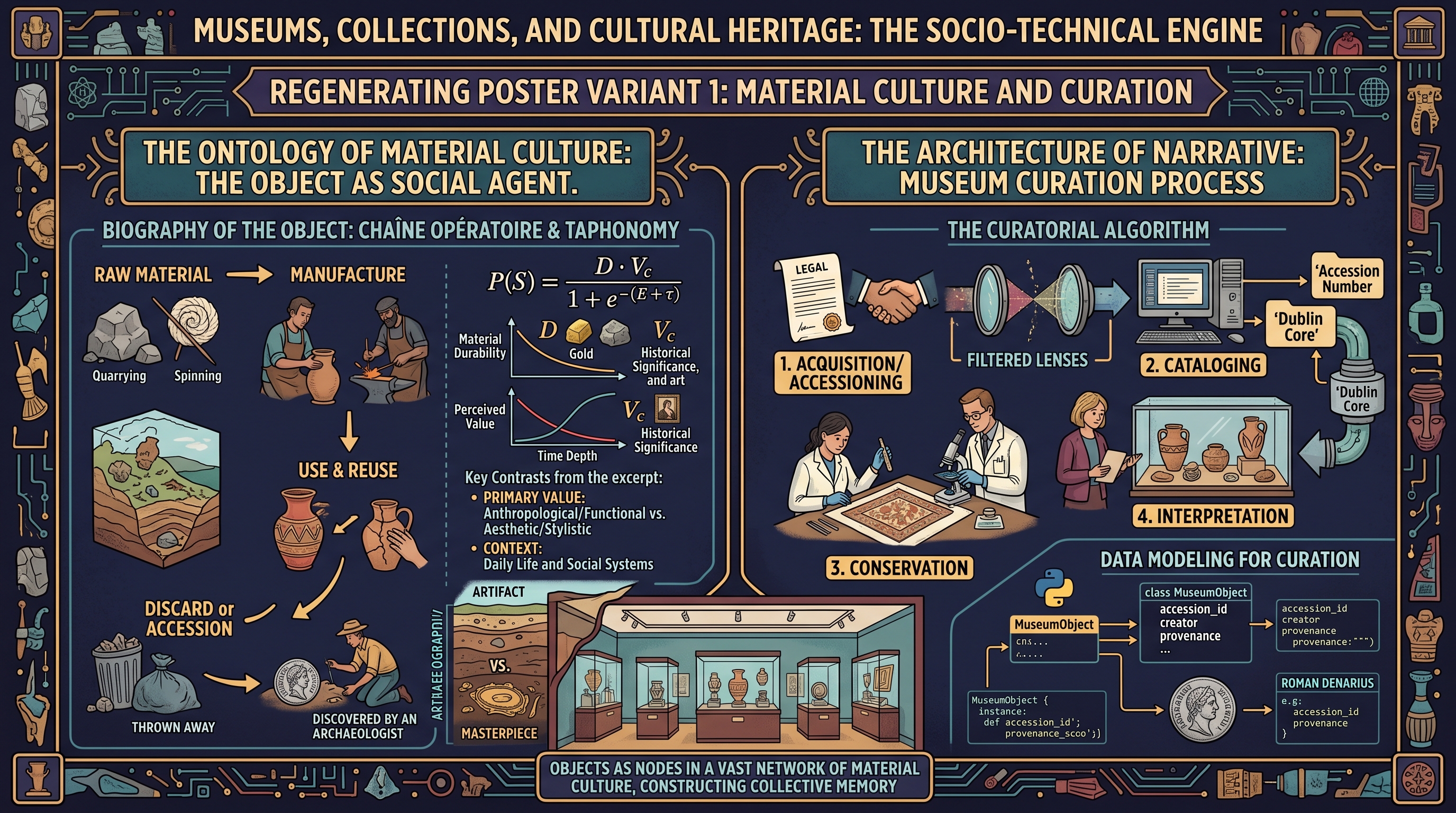
Museums are not merely passive repositories for "old things"; they are active, socio-technical engines that construct history, validate identity, and negotiate the meaning of human existence. In the professional study of art and history, we transition from seeing an object as a solitary aesthetic item to seeing it as a node in a vast network of Material Culture. This section explores the mechanics of how objects are selected, researched, and deployed to create collective memory.
Material Culture: The Ontology of the Object
At the heart of museum studies lies Material Culture—the interdisciplinary study of all physical objects created by humans. Unlike traditional art history, which may focus primarily on the "masterpiece," material culture analysis treats every object—from a Ming Dynasty vase to a mass-produced plastic spoon—as a carrier of cultural DNA.
Definition: Material Culture The physical evidence of a culture in the objects and architecture they make or have made. It is the study of the relationship between artifacts and social relations, predicated on the idea that objects are not just "tools" but are "social agents" that shape human behavior.
The Biography of the Object
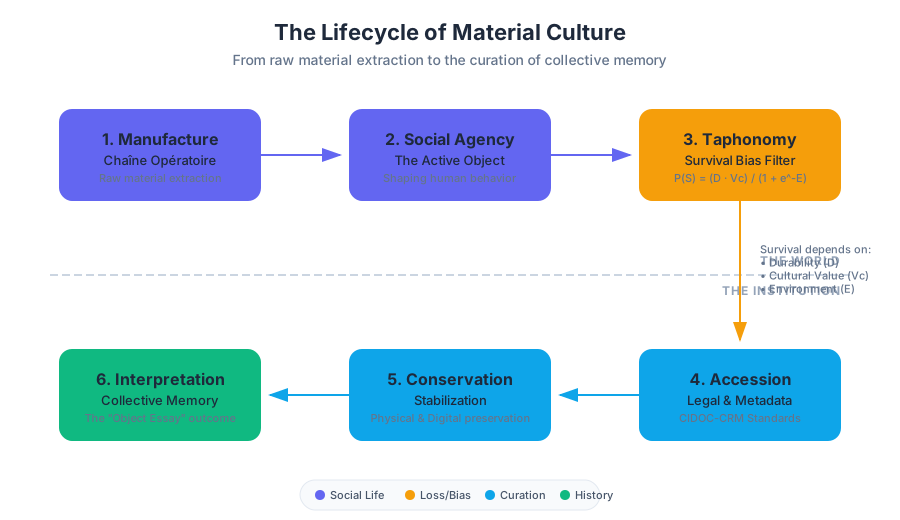
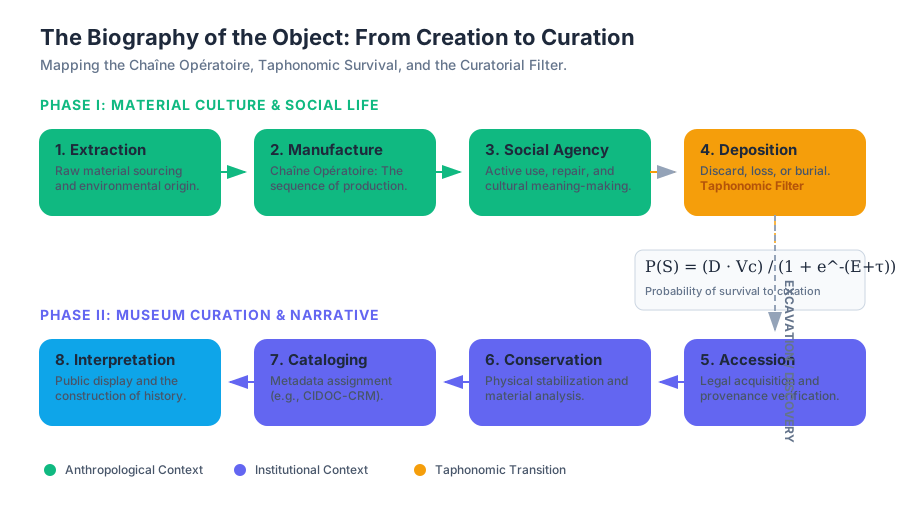
To understand an object, we must trace its "life history." This involves examining its Chaîne Opératoire (operational chain)—the sequence of steps from raw material extraction to manufacture, use, reuse, and eventual discard or museum accession.
| Attribute | Material Culture Focus | Traditional Art History Focus |
|---|---|---|
| Primary Value | Anthropological / Functional | Aesthetic / Stylistic |
| Object Status | Artifact / Tool | Masterpiece / Work of Art |
| Context | Daily life and social systems | The "Genius" of the individual artist |
| Analysis Method | Stratigraphy and Use-Wear | Formalism and Iconography |
Mathematical Modeling of Taphonomy
In archaeological and museum contexts, we often deal with the "survival bias" of material culture. The probability $P(S)$ of an object surviving to be curated is a function of its material durability $D$, its cultural value $V_c$, and the environmental conditions $E$.
P(S) = \frac{D \cdot V_c}{1 + e^{-(E + \tau)}}
Where:
- $D$ is the material's resistance to decay (e.g., gold vs. wood).
- $V_c$ is the perceived value over time (preventing it from being melted or thrown away).
- $\tau$ represents the "Time Depth" or age of the object.
Museum Curation: The Architecture of Narrative
Museum Curation is the intellectual and technical process of managing a collection and interpreting it for the public. A curator acts as a "translator" between the raw data of the object and the visitor's experience.
The Curatorial Algorithm
Curation is a filtering process. Out of millions of possible objects, only a fraction are "accessioned" (officially added to a collection), and an even smaller fraction are "exhibited."
- Acquisition/Accessioning: Legal transfer of ownership.
- Cataloging: Assigning unique identifiers (Accession Numbers) and metadata.
- Conservation: Physical stabilization of the object.
- Interpretation: Developing the narrative or "story" the object will tell.
Object-Based Research: The Methodology of the "Object Essay"
The Object Essay is a rigorous research format used by curators and historians to extract the maximum amount of information from a single item. It moves from the "What" (description) to the "So What?" (significance).
The Four-Fold Analysis Framework
- Physical Analysis: What is it made of? How was it made? (e.g., using X-ray fluorescence or microscopic analysis).
- Contextual Analysis: Where was it found? Who owned it? What was happening in the world when it was made?
- Comparative Analysis: How does it relate to similar objects? Is it a "standard" example or an "anomaly"?
- Interpretive Analysis: What does this object tell us about the values, fears, or aspirations of the people who used it?
Worked Example: The "Spolia" Analysis
Spolia refers to the repurposing of building stone or decorative sculpture for new monuments. It is a prime example of "Borrowed Glory."
| Layer of Analysis | Observation |
|---|---|
| Physical | A porphyry column in a Medieval church that doesn't match the surrounding limestone. |
| Contextual | The church was built in the 12th century; the column is 2nd-century Roman. |
| Comparative | Similar columns are found only in Imperial Roman palaces. |
| Interpretation | The Medieval builders used the column to "steal" the authority and prestige of the Roman Empire for the Church. |
Cultural Heritage and Community Identity
Cultural Heritage is the legacy of physical artifacts and intangible attributes of a group or society. It is the primary tool for Community Identity—the sense of belonging and shared history that defines a group.
Cultural Branding and "Place-Making"
Communities often use material culture to create a "brand" that attracts tourism and reinforces local pride. This is sometimes called "Heritage Engineering."
Example: "Trolltown, USA" In Mount Horeb, Wisconsin, the community adopted Norwegian folklore (trolls) as a central theme. By placing wooden troll carvings along the "Trollway" (the main street), they transformed a generic Midwestern town into a specific cultural destination. This is a deliberate use of Material Culture to drive Economic Identity.
Intangible vs. Tangible Heritage
The UNESCO definition of heritage has expanded to include the "intangible"—traditions, oral histories, and performing arts.
| Type | Examples | Preservation Method |
|---|---|---|
| Tangible | Buildings, Paintings, Manuscripts | Conservation, Climate Control |
| Intangible | Language, Music, Rituals, Craft Skills | Documentation, Apprenticeship |
Ethics, Provenance, and the Global Commons
The most contentious area of museum studies today is Provenance—the history of ownership of a work of art or antique.
The Provenance Principle A work of art is only as "clean" as its chain of ownership. If a gap exists (especially during periods of conflict, like WWII or colonial eras), the object’s legal and ethical status is called into question.
Common Pitfalls in Heritage Management
- Aesthetic Bias: Saving only "pretty" things while letting "ugly" but historically significant industrial sites decay.
- Colonial Narrative: Interpreting indigenous objects through a Western lens without consulting the source community.
- Digital Obsolescence: Creating "Digital Twins" of artifacts using file formats that will be unreadable in 20 years.
Source Materials
- Museums and Collections
- Art Introduction and Fundamentals
- Introduction to Art: Design, Context, and Meaning (Sachant et al.)
- 1: What is Art?
- 3: Significance of Materials Used in Art
- American Encounters: Art, History, and Cultural Identity (Miller, Berlo, Wolf, and Roberts)
- Art Appreciation
- Art History and Theory
Study Art on Lykke
This course page is free to open: signed out, you can read its first two sections, and signing in, on any plan, opens the rest. The free Lykke Chrome extension syncs your own Canvas courses, so ChatGPT, Claude and Muse can answer from your classes and deadlines. It only reads Canvas.
Add the free extensionSign in to open every section