From the free course Art on Lykke
Meaning in Art: Iconography and Context
Key concepts: Iconography · Symbolism · Contextual Analysis · Visual Literacy · Socio-Cultural Context
Investigating how art is understood through symbolism, historical context, and the identity of the creator.
Meaning in Art: Iconography and Context
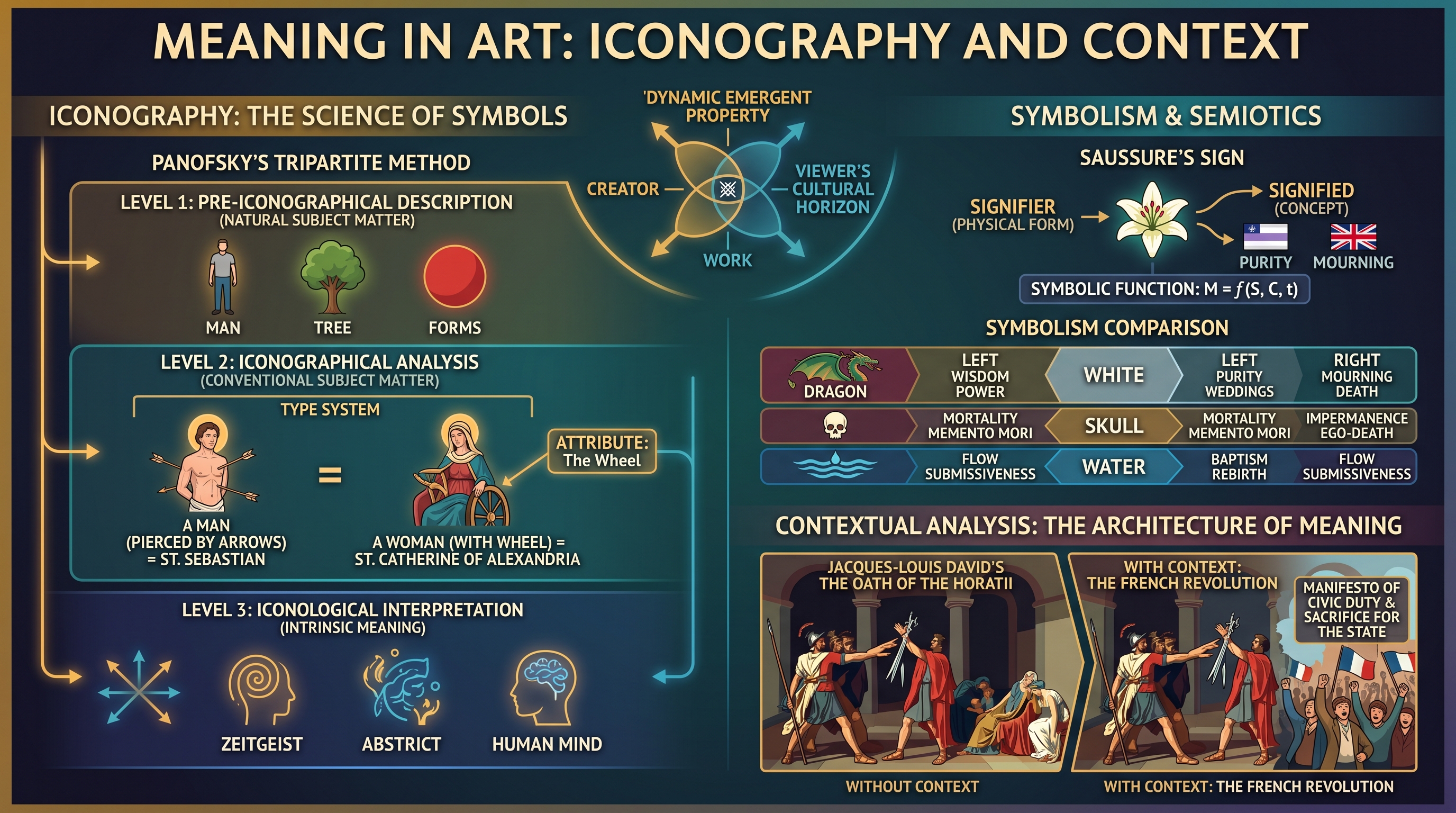
Meaning in art is not an intrinsic property of the object, like mass or volume; rather, it is a dynamic emergent property generated at the intersection of the work, its creator, and the viewer’s historical and cultural horizon. To "read" a work of art is to engage in a multi-layered decoding process that moves from the literal identification of forms to the deep analysis of socio-political undercurrents.
Iconography: The Science of Symbols
Iconography is the branch of art history which concerns itself with the subject matter or meaning of works of art, as opposed to their form. Derived from the Greek words eikon (image) and graphein (to write), it literally translates to "image writing." In a technical sense, iconography is the systematic study of the identification, description, and interpretation of the content of images.
Panofsky’s Tripartite Method
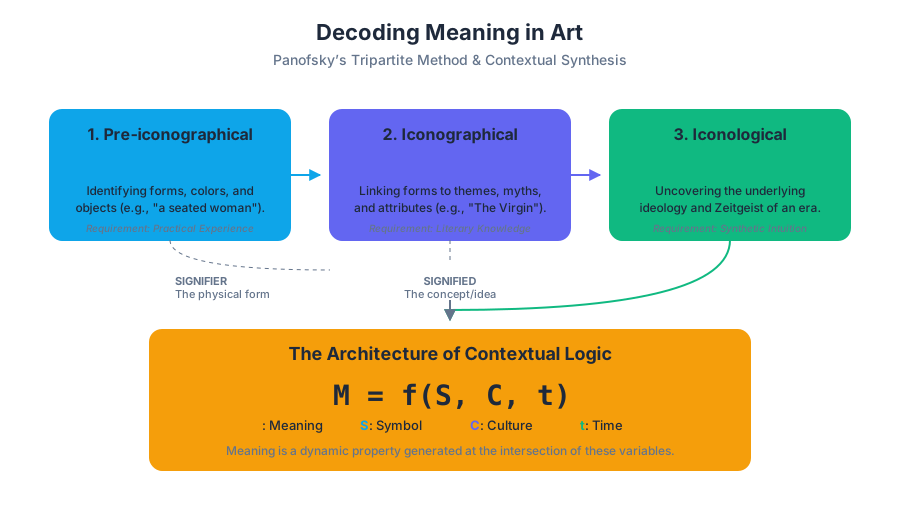
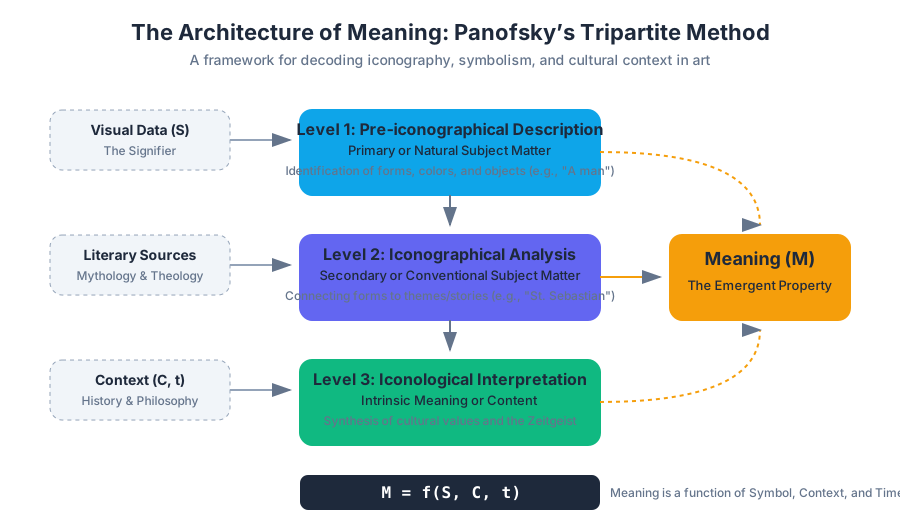
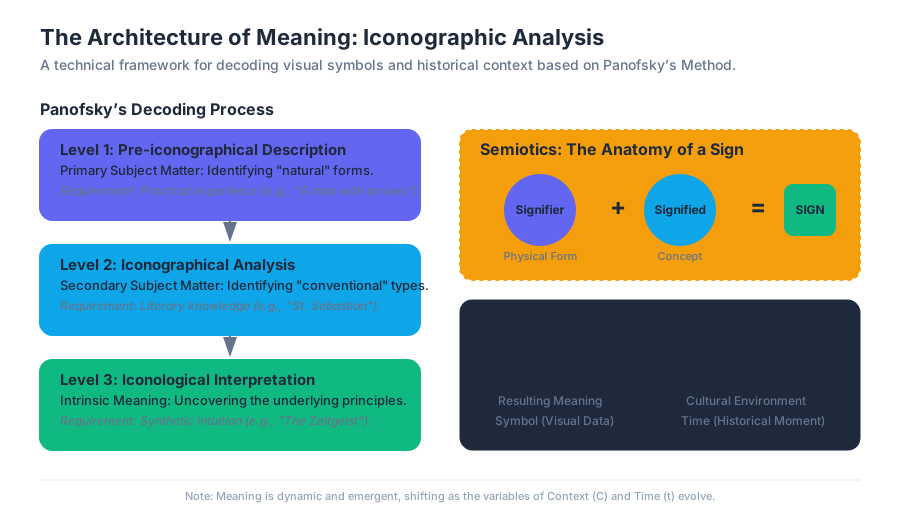
The most influential framework for iconographic analysis was developed by Erwin Panofsky. He proposed that meaning is layered, requiring different levels of "literacy" to uncover.
| Level | Name | Description | Requirement |
|---|---|---|---|
| Level 1 | Pre-iconographical Description | Identifying "natural" subject matter (e.g., a man, a tree, a red circle). | Practical experience (familiarity with objects and events). |
| Level 2 | Iconographical Analysis | Identifying "conventional" subject matter (e.g., the man is St. Sebastian because he is pierced by arrows). | Knowledge of literary sources (theology, mythology, history). |
| Level 3 | Iconological Interpretation | Uncovering the "intrinsic meaning" or content (the underlying principles of a nation, a period, a class, or a religious persuasion). | Synthetic intuition (understanding the human mind and zeitgeist). |
The Mechanics of Identification
To perform Level 2 analysis, an art historian must utilize a "type" system. For example, in Western Christian art, a woman holding a wheel is almost certainly St. Catherine of Alexandria. The wheel is her attribute. Without the attribute, she is merely a woman; with it, she becomes a specific narrative entity.
Definition: Attribute A physical object or conventional sign associated with a specific figure in art, used to identify them to the viewer (e.g., the keys of St. Peter, the owl of Athena).
Symbolism and Semiotics
While iconography deals with established "types," symbolism is the broader practice of using an image to represent an abstract idea, emotion, or state of being. Symbolism operates through semiotics—the study of signs and sign-processes.
The Signifier and the Signified
According to Ferdinand de Saussure, a sign consists of two parts:
- The Signifier: The physical form of the sign (the paint on the canvas, the shape of the marble).
- The Signified: The concept it represents.
In art, the relationship between the signifier and the signified is rarely 1:1. It is often mediated by culture. For instance, a "lily" (signifier) might signify "purity" (signified) in a 15th-century Flemish painting, but in a different context, it might signify "death" or "royalty."
Formalizing Symbolic Logic
We can represent the interpretation of a symbol as a function of its visual properties and its cultural environment.
M = f(S, C, t)
Where:
Mis the resulting Meaning.Sis the Symbol (the visual data).Cis the Cultural Context (the set of shared beliefs).tis the Time period (the historical moment).
If we change C or t, the meaning M changes even if the visual data S remains constant.
Symbolism Comparison Table
| Symbol | Common Western Meaning | Common Eastern Meaning | Abstract Concept |
|---|---|---|---|
| Dragon | Evil, chaos, greed | Wisdom, power, luck | Primordial Force |
| White | Purity, weddings | Mourning, death | Void/Beginning |
| Skull | Mortality (Memento Mori) | Impermanence, ego-death | Transience |
| Water | Baptism, rebirth | Flow, submissiveness | Transformation |
Contextual Analysis: The Architecture of Meaning
Contextual Analysis is the practice of examining the social, political, economic, and religious environment in which a work of art was produced. It posits that art is not created in a vacuum but is a "symptom" of its time.
The Socio-Cultural Lens
To understand a work like Jacques-Louis David’s The Oath of the Horatii, one must understand the impending French Revolution. Without that context, it is merely a painting of three men with swords. With it, it becomes a manifesto of civic duty and sacrifice for the state.
Material Significance: Monetary vs. Cultural Value
As noted in the source material, the materials themselves carry meaning.
- Intrinsic Value: The worth of the raw materials (e.g., gold, lapis lazuli).
- Monetary Value: The market price of the finished work.
- Cultural Value: The prestige or religious power the material commands.
The use of Spolia (repurposed building stone or decorative elements from ancient monuments) is a prime example of contextual meaning. When a medieval ruler used Roman columns in a new church, they weren't just recycling; they were "borrowing glory" from the Roman Empire to legitimize their own power.
Visual Literacy: Decoding the Image
Visual Literacy is the ability to interpret, negotiate, and make meaning from information presented in the form of an image. It is the "grammar" of art. Just as one must learn the rules of syntax to read a book, one must learn the rules of visual composition to read a painting.
The Elements of Visual Grammar
Visual literacy involves identifying how the Elements of Art (line, shape, color) are organized by the Principles of Design (balance, contrast, emphasis).
- Line: Can suggest stability (horizontal), growth (vertical), or chaos (diagonal).
- Color: Uses hue, value, and intensity to evoke emotional responses or symbolic associations.
- Space: The use of perspective to create the illusion of depth or to emphasize the flat surface of the canvas.
A Bayesian Approach to Interpretation
In a computational or cognitive model, visual literacy can be viewed as a Bayesian update process. The viewer starts with a "prior" (their existing knowledge) and updates it as they observe "evidence" (visual cues).
P(Meaning | VisualCues) = \frac{P(VisualCues | Meaning) \times P(Meaning)}{P(VisualCues)}
In this model:
- $P(Meaning)$ is the prior probability of a certain theme being present based on the era.
- $P(VisualCues | Meaning)$ is the likelihood that these specific colors/shapes would be used to represent that theme.
- $P(Meaning | VisualCues)$ is our final "reading" of the work.
Socio-Cultural Context and Power Dynamics
Art is frequently a tool of power, used to reinforce or challenge the status quo. The identity of the artist—their gender, race, and class—acts as a filter through which meaning is funneled.
Art and Identity
The "reading" of a work changes based on the identity of the creator. For example, a portrait of a woman painted by a man in the 18th century often emphasizes the "Male Gaze"—viewing the woman as an object of desire or a symbol of domesticity. Conversely, a self-portrait by a female artist of the same period might emphasize her professional agency and intellectual life.
Art and Power
Governments and religious institutions have historically been the primary patrons of art, using it for:
- Propaganda: Communicating specific political messages.
- Legitimation: Using "Borrowed Glory" (Spolia) or classical styles to link current rulers to historical greatness.
- Didacticism: Teaching religious or moral lessons to an illiterate population.
| Power Dynamic | Method | Example |
|---|---|---|
| Imperialism | Monumental architecture, triumphal arches | Arch of Constantine |
| Theocracy | Iconography of divine right, halos, scale | Byzantine Mosaics |
| Subversion | Satire, caricature, street art | Banksy, Hogarth |
| Capitalism | Branding, celebrity portraiture, luxury materials | Warhol, Jeff Koons |
Technical Example: Linked Open Data (LOD) in Art History
To map these complex relationships between power, identity, and art, researchers use Resource Description Framework (RDF). This allows for "triples" (Subject-Predicate-Object) that can link an artist to their patron and the political movement they supported.
Common Pitfalls in Analysis
- Anachronism: Applying modern values or symbols to historical works (e.g., assuming a "thumbs up" in a Roman painting means "good job").
- Over-interpretation: Seeing deep symbolic meaning in purely decorative or functional elements (sometimes a red vase is just a red vase).
- Ignoring the Medium: Forgetting that the physical properties of the material (the "Structure of Art") limit and shape the possible meanings.
- Monolithic Interpretation: Assuming a work has only one "correct" meaning, rather than acknowledging the role of the viewer in creating meaning.
Summary: The Synthesis of Meaning
Meaning in art is a multi-dimensional construct. It begins with the Visual Literacy to recognize forms, proceeds through the Iconography to identify specific subjects, and culminates in a Contextual Analysis that situates the work within the broader human experience. By understanding the interplay of materials, symbols, and power, we move from simply "looking" at art to truly "seeing" it.
- Iconography: The study of subject matter and symbols in art.
- Attribute: An object used to identify a specific figure (e.g., St. Peter's keys).
- Semiotics: The study of signs and symbols and their use or interpretation.
- Signifier: The physical form of a sign (the image itself).
- Signified: The concept or idea a sign represents.
- Contextual Analysis: Evaluating art based on its historical, social, and political surroundings.
- Spolia: Repurposed building materials used for their symbolic or monetary value.
- Visual Literacy: The ability to decode and interpret visual information.
- Mimesis: The representation or imitation of the real world in art.
- Male Gaze: The perspective of a visual work from the viewpoint of a heterosexual man, often objectifying women.
-
Which level of Panofsky's method involves identifying that a man with arrows is St. Sebastian?
- A) Pre-iconographical Description
- B) Iconographical Analysis (Correct)
- C) Iconological Interpretation
- D) Formal Analysis
-
In semiotics, what do we call the physical form of a symbol (e.g., the red paint on a canvas)?
- A) The Signified
- B) The Attribute
- C) The Signifier (Correct)
- D) The Icon
-
What is the term for reusing materials from ancient monuments to "borrow" their historical prestige?
- A) Mimesis
- B) Spolia (Correct)
- C) Provenance
- D) Chiaroscuro
-
True or False: Contextual analysis suggests that the meaning of a work of art is fixed and never changes over time.
- False. Meaning is dynamic and changes with the viewer's context.
-
Which factor is most likely to influence the "Iconological" level of a painting?
- A) The type of brush used
- B) The price of the pigment
- C) The prevailing religious and philosophical beliefs of the era (Correct)
- D) The physical dimensions of the canvas
Deep Dive: Meaning in Art
Core Objectives:
- Master the three levels of Panofsky’s iconographic method.
- Distinguish between the signifier and the signified in artistic semiotics.
- Apply contextual lenses (political, economic, social) to historical works.
- Understand the relationship between material choice and cultural value.
Key Figures to Research:
- Erwin Panofsky: Founder of modern iconographic study.
- Ferdinand de Saussure: Pioneer of semiotics.
- Jacques-Louis David: Key artist for studying political context and propaganda.
Practical Exercise: Select a contemporary advertisement. Perform a tripartite analysis:
- Pre-iconographic: What objects/people are literally there?
- Iconographic: What do these people/objects represent in our current culture (e.g., a suit representing "success")?
- Iconological: What does this ad say about our society's values regarding gender, wealth, or happiness?
Further Reading:
- Studies in Iconology by Erwin Panofsky.
- Ways of Seeing by John Berger.
- Introduction to Art: Design, Context, and Meaning (Sachant et al.).
Source Materials
Study Art on Lykke
This course page is free to open: signed out, you can read its first two sections, and signing in, on any plan, opens the rest. The free Lykke Chrome extension syncs your own Canvas courses, so ChatGPT, Claude and Muse can answer from your classes and deadlines. It only reads Canvas.
Add the free extensionSign in to open every section