From the free course Art on Lykke
Significance of Materials and Media
Key concepts: Intrinsic vs. Monetary Value · Spolia · Artistic Medium · Materiality · Technical Application
Exploration of how the choice of physical materials—from precious metals to digital media—influences the meaning and value of artwork.
Significance of Materials and Media
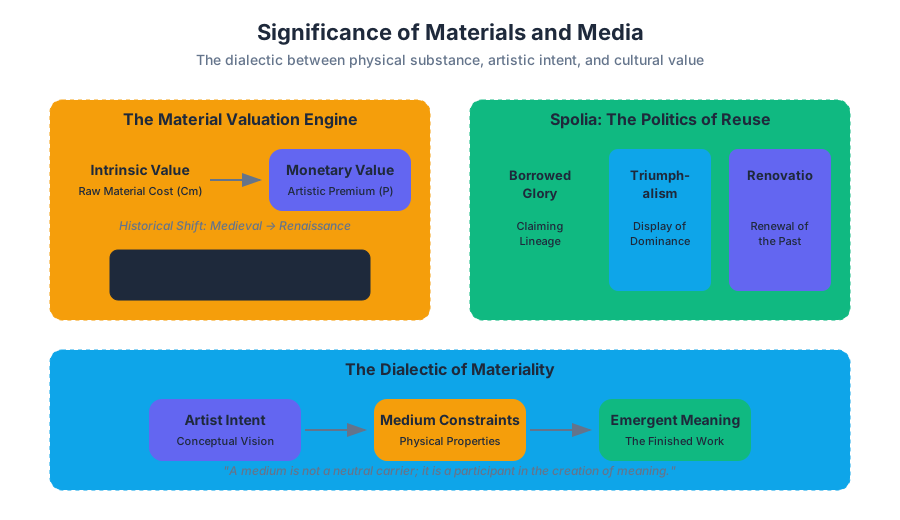
In the study of art history and visual culture, the "material turn" has refocused scholarly attention on the physical substances that constitute an object. A medium is not merely a neutral carrier for an image; it is a participant in the creation of meaning. To understand a work of art, one must analyze the dialectic between the artist's intent and the constraints, histories, and costs of the materials employed. This section explores the hierarchy of value, the politics of reuse, and the technical mechanics of various media.
Intrinsic vs. Monetary Value
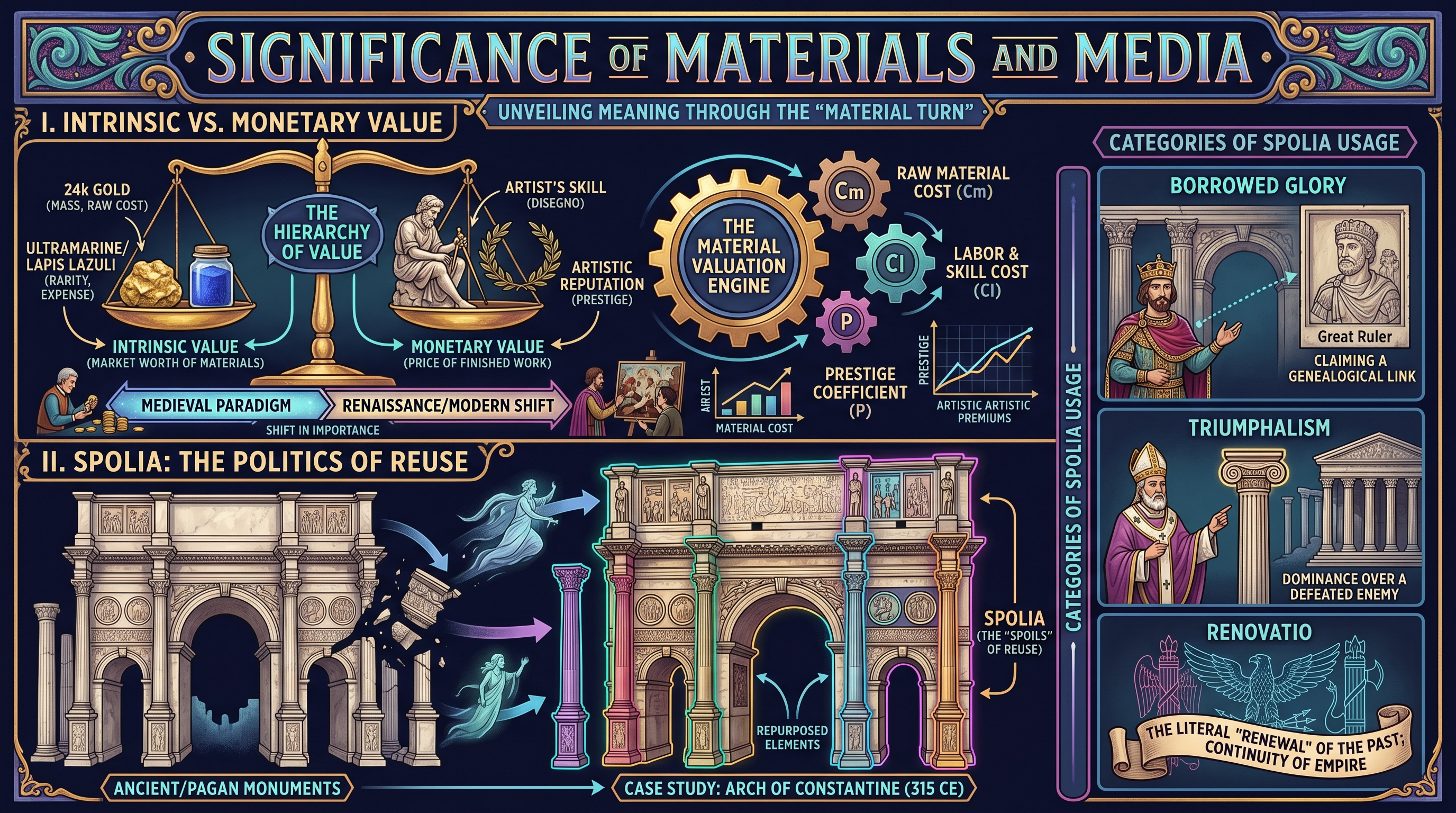
The valuation of an artwork is a complex function involving the raw cost of materials, the labor of the artist, and the cultural prestige of the finished object. Historically, these two forms of value—intrinsic and monetary—have fluctuated in their relative importance.
The Hierarchy of Value
Definition: Intrinsic Value refers to the market worth of the raw materials themselves (e.g., the weight of gold, the rarity of Lapis Lazuli), whereas Monetary Value (or Artistic Value) represents the price the finished work commands due to the artist's reputation, provenance, and aesthetic "genius."
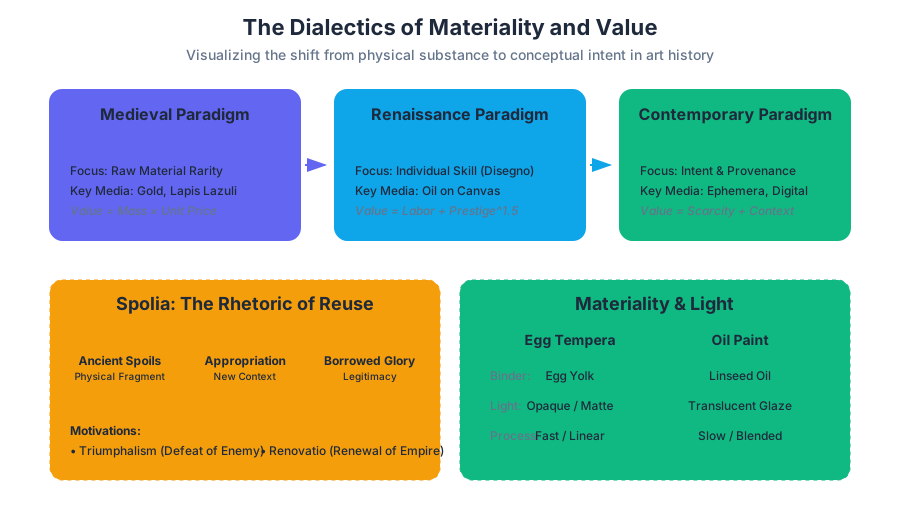
In the Medieval and early Renaissance periods, contracts often specified the exact quantity of gold leaf or ultramarine (ground Lapis Lazuli) to be used. The patron’s status was signaled by the intrinsic value of the materials. However, as the Renaissance progressed, writers like Leon Battista Alberti began to argue that the artist's skill (disegno) should be valued more highly than the "glitter of gold," marking a shift toward the modern conception of artistic value.
| Valuation Factor | Medieval Paradigm | Renaissance/Modern Paradigm | Contemporary Paradigm |
|---|---|---|---|
| Primary Driver | Material Rarity (Gold, Ivory) | Artist's Skill and Intellectual Labor | Conceptual Intent and Provenance |
| Role of Patron | Supplier of raw materials | Facilitator of creative vision | Investor or Institutional collector |
| Cost Basis | Weight-based (Mass $\times$ Unit Price) | Reputation-based (Market Demand) | Scarcity-based (Edition size, NFT) |
| Symbolism | Divine light, literal wealth | Humanist achievement | Critique of capital, social commentary |
The Material Valuation Engine
To understand the relationship between material cost and final valuation, we can model the "Value Multiplier" ($V_m$) of an artwork. In a system where the raw material cost is $C_m$ and the labor/skill cost is $C_l$, the total value $V_t$ is influenced by a prestige coefficient $P$.
Spolia: The Politics of Reuse
Spolia (from the Latin for "spoils") refers to the repurposing of architectural elements or decorative sculptures from older buildings for use in new ones. This is rarely a matter of mere convenience or resource scarcity; it is a profound rhetorical gesture.
Categories of Spolia Usage
- Borrowed Glory: A new ruler incorporates elements from the monuments of a "Great" predecessor to claim a genealogical or political link to their success.
- Triumphalism: The use of materials taken from a defeated enemy as a display of dominance (e.g., the use of columns from pagan temples in early Christian basilicas).
- Renovatio: The literal "renewal" of the past, where the physical continuity of the material suggests the continuity of the Empire or State.
Case Study: The Arch of Constantine (315 CE)
The Arch of Constantine is the most famous example of spolia. It incorporates reliefs from the eras of Trajan, Hadrian, and Marcus Aurelius. By placing his own image alongside these "Good Emperors," Constantine used the materiality of the past to legitimize his present rule.
| Spolia Element | Original Source | Intended Connotation |
|---|---|---|
| Dacian Prisoners | Trajanic Forum | Military conquest and expansion |
| Hunting Medallions | Hadrianic Monuments | Personal courage and piety |
| Battle Reliefs | Marcus Aurelius | Stoic leadership and civic duty |
| New Constantinian Frieze | Contemporary (4th Century) | The specific narrative of Constantine's victory |
Artistic Medium and Materiality
The Artistic Medium is the specific substance used by the artist. Materiality refers to the physical properties of that medium and how they dictate the viewer's experience and the artist's process.
The Physics of Light in Painting
The choice between Egg Tempera and Oil Paint is not just an aesthetic one; it is a chemical one. The refractive index of the binder determines how light interacts with the pigment particles.
The Kubelka-Munk Theory: This describes how light is scattered and absorbed within a layer of paint. The reflectance $R$ of a paint layer is a function of the absorption coefficient $K$ and the scattering coefficient $S$.
R = 1 + \frac{K}{S} - \sqrt{\left( \frac{K}{S} \right)^2 + 2\left( \frac{K}{S} \right)}
In Egg Tempera, the binder (egg yolk) dries quickly and has a low refractive index, leading to a matte, opaque surface where light scatters mostly at the surface. In Oil Painting, the linseed oil has a high refractive index and dries slowly, allowing light to penetrate multiple translucent layers (glazes) before reflecting back, creating a "deep" glow and realistic flesh tones.
Comparison of Traditional Media
| Medium | Binder | Support | Drying Mechanism | Visual Characteristic |
|---|---|---|---|---|
| Fresco | Lime Plaster (Wet) | Wall | Carbonatization | Matte, integrated with architecture |
| Encaustic | Beeswax | Wood Panel | Cooling (Phase change) | Waxy, textural, durable |
| Tempera | Egg Yolk | Poplar Panel | Evaporation | Linear, detailed, matte |
| Oil | Linseed/Walnut Oil | Canvas/Panel | Oxidation (Polymerization) | Luminous, blended, versatile |
Technical Application: The Pipeline of Creation
The "Technical Application" refers to the specific sequence of operations required to transform raw material into a finished form. This is often a multi-stage pipeline involving specialized tools and environments.
The Lost-Wax Casting Process (Cire Perdue)
For bronze sculpture, the technical application is a high-stakes engineering feat. If the gases are not vented correctly, the bronze will explode or develop "pitting."
- Core Creation: A clay core is built to reduce the weight of the final bronze.
- Wax Modeling: A layer of wax is applied over the core and sculpted into the final shape.
- Investment: The wax is covered in a heat-resistant material (like ceramic shell).
- Burn-out: The mold is heated; the wax melts and runs out, leaving a cavity.
- Pouring: Molten bronze (approx. 1200°C) is poured into the cavity.
- Chasing: Once cooled, the mold is broken, and the bronze is polished and "chased" to remove imperfections.
Modern Technical Application: Digital Materiality
In the 21st century, "material" has expanded to include bits and pixels. However, even digital art has a technical pipeline that mimics physical constraints, such as bit-depth and color space.
Material Connotations and Social Status
Materials carry "social lives." The use of a particular medium can immediately signal the class, religion, or geographic reach of the patron.
- Purple (Porphyry): A hard igneous rock found only in one remote Egyptian quarry. In the Roman Empire, its use was restricted to the Imperial family, making the material itself a symbol of the Emperor.
- Ivory: Derived from elephant tusks, its use in Northern Europe (where elephants do not exist) signaled the vast trade networks and wealth of the Carolingian and Ottonian courts.
- Steel and Glass: In the 19th and 20th centuries, these materials became the "medium" of the Industrial Revolution, signaling progress, transparency, and the triumph of engineering over traditional masonry.
Common Pitfalls in Material Analysis
- The "Progress" Fallacy: Assuming that newer materials (like oil paint) are "better" than older ones (like tempera). Each medium offers different affordances; tempera allows for a precision of line that oil cannot easily replicate.
- Ignoring the "Substrate": Focusing only on the paint and ignoring the support (canvas, wood, copper). The expansion and contraction of a wood panel in humidity can destroy an artwork, regardless of the quality of the paint.
- Over-emphasizing Rarity: Assuming a work is important only because it uses gold. Many of the most significant works in art history (e.g., Picasso’s Guernica) use humble materials (house paint on canvas) to achieve their impact.
Source Materials
Study Art on Lykke
This course page is free to open: signed out, you can read its first two sections, and signing in, on any plan, opens the rest. The free Lykke Chrome extension syncs your own Canvas courses, so ChatGPT, Claude and Muse can answer from your classes and deadlines. It only reads Canvas.
Add the free extensionSign in to open every section