From the free course Art on Lykke
Art History: 1776 to the Present
Key concepts: Modernism · Post-Modernism · Contemporary Art · Industrialization · 21st Century Art
The evolution of art from the birth of modern nations through the industrial revolution to contemporary global practices.
Art History: 1776 to the Present
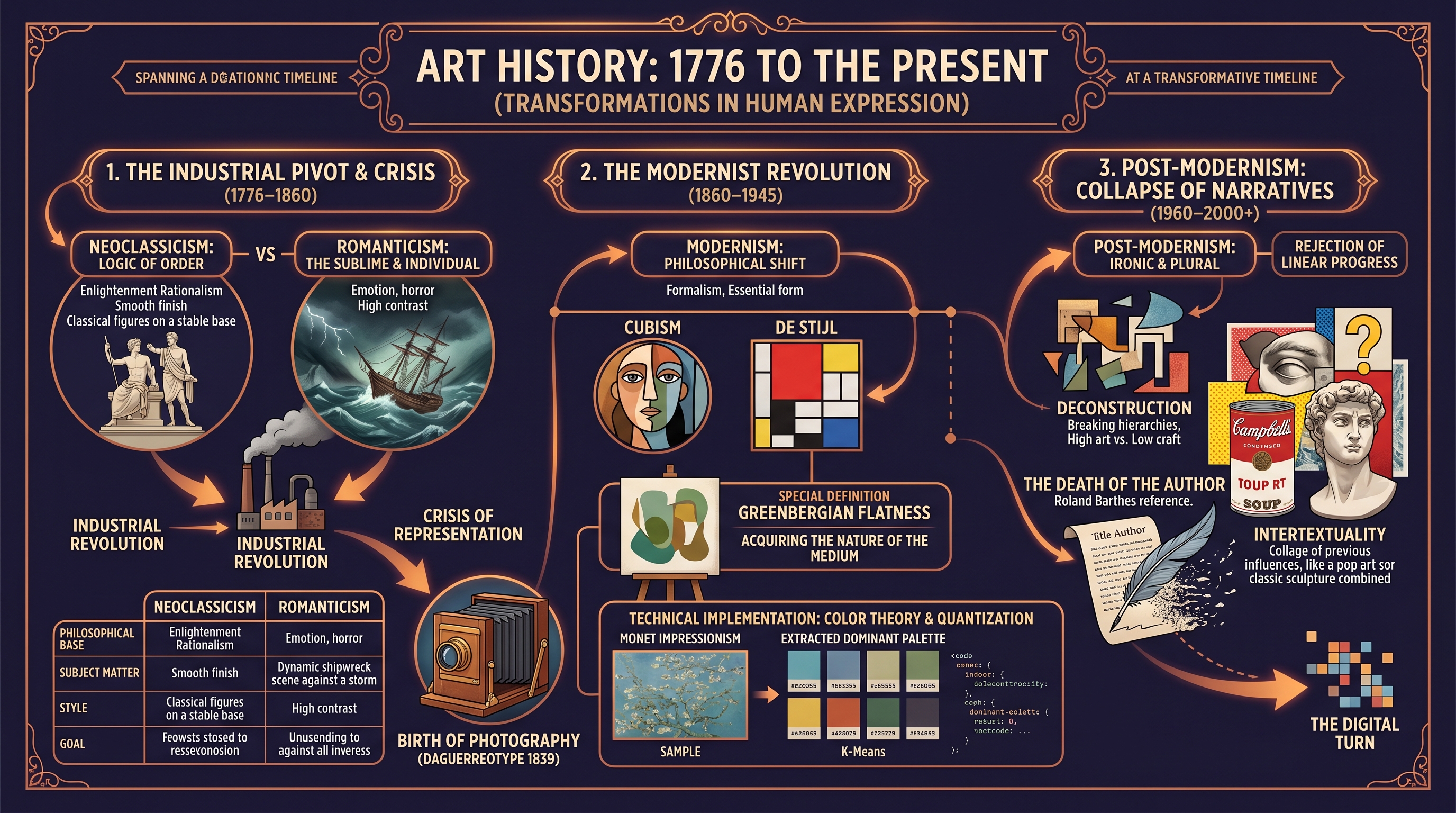
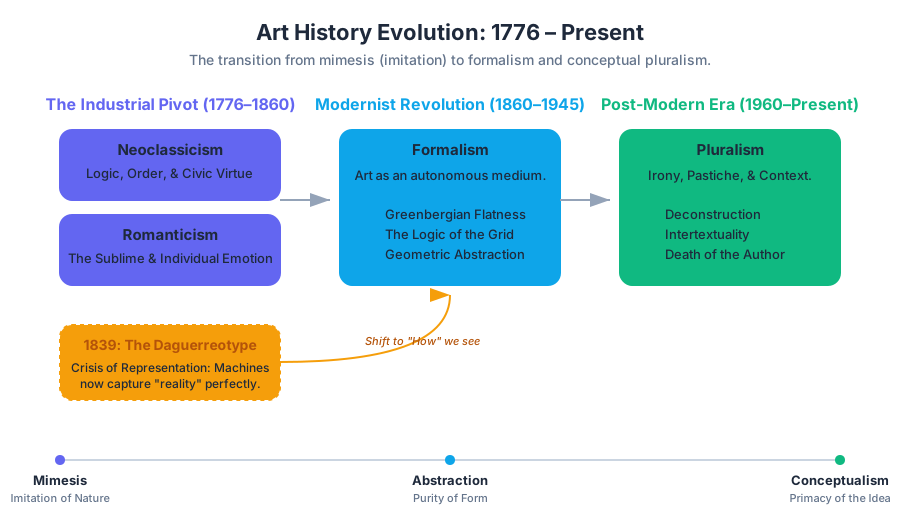
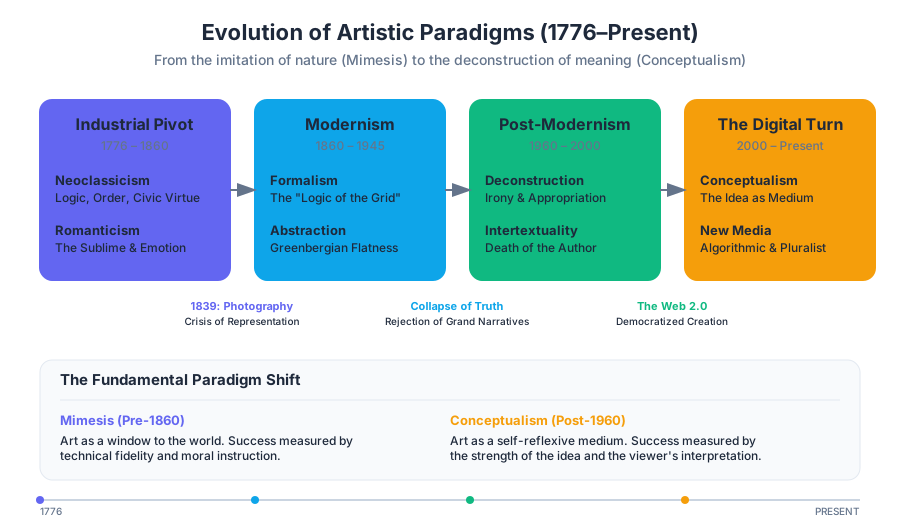
The period from 1776 to the present represents the most volatile and transformative era in the history of human expression. This epoch marks the transition from art as a tool of the state and church to art as an autonomous, self-reflexive, and often subversive medium. The trajectory is defined by the collapse of mimesis (the imitation of nature) and the rise of conceptualism, driven by the twin engines of the Industrial Revolution and the digital turn.
The Industrial Pivot and the Crisis of Representation (1776–1860)
The year 1776 serves as a symbolic boundary, coinciding with the American Revolution and the publication of Adam Smith’s The Wealth of Nations. In art, this period is defined by the tension between Neoclassicism—the visual language of the Enlightenment—and Romanticism—the reaction against industrial rationalization.
Neoclassicism: The Logic of Order
Neoclassicism sought to revive the "noble simplicity and quiet grandeur" of Greek and Roman antiquity. It was the "official" style of revolutions, used to instill civic virtue and rationalism.
Romanticism: The Sublime and the Individual
As factories began to mar the landscape, Romanticism emerged as a counter-movement. It prioritized the Sublime—an aesthetic quality of greatness, whether physical, moral, intellectual, or spiritual, that is beyond all possibility of calculation or imitation.
| Feature | Neoclassicism | Romanticism |
|---|---|---|
| Philosophical Base | Enlightenment Rationalism | Individualism & Emotion |
| Subject Matter | History, Mythology, Civic Duty | Nature, Horror, The Exotic |
| Visual Style | Linear, smooth finish, "invisible" brushwork | Painterly, expressive, high contrast |
| Goal | Moral instruction | Emotional transcendence |
The Impact of Industrialization
The invention of the Daguerreotype in 1839 (the birth of photography) created a fundamental "crisis of representation." If a machine could capture reality perfectly, what was the purpose of the painter? This question forced art to move away from what is seen toward how it is seen.
The Modernist Revolution (1860–1945)
Modernism is not just a style but a philosophical shift. It is characterized by Formalism—the idea that a work’s value is determined by its form (line, color, shape) rather than its narrative content.
The Logic of the Grid and Abstraction
Modernism sought to strip art down to its "essential" components. This culminated in movements like Cubism, which deconstructed objects into geometric primitives, and De Stijl, which reduced the visual world to the grid and primary colors.
Definition: The Greenbergian Flatness Art critic Clement Greenberg argued that the "unique and proper area of competence" of each art form coincided with all that was unique to the nature of its medium. For painting, this meant acknowledging the flatness of the canvas rather than trying to create the illusion of 3D space.
Color Theory and Quantization
The Modernists, particularly the Pointillists (Seurat), were early "engineers" of visual perception. They understood that the human eye performs spatial averaging. To represent this technically, we can look at how modern computer vision quantizes color spaces to mimic the "essential" palettes used by Modernist painters.
Post-Modernism: The Collapse of Grand Narratives (1960–2000)
If Modernism was a search for "Truth" and "Purity," Post-Modernism is a celebration of "Irony," "Pastiche," and "Pluralism." It rejects the idea that art progresses in a linear fashion toward a goal.
Key Concepts of Post-Modernism
- Deconstruction: Breaking down the hierarchies within a work (e.g., high art vs. low craft).
- Intertextuality: The realization that every "new" work is actually a collage of previous influences.
- The Death of the Author: Roland Barthes’ theory that the meaning of a work is determined by the viewer, not the creator.
Mathematical Derivation: The Compositional Shift
Modernist composition often relied on the Golden Ratio ($\phi$) to find a "universal" harmony. Post-modernism often intentionally breaks these ratios to create "glitch" aesthetics or "anti-form."
\text{Golden Ratio } \phi = \frac{1 + \sqrt{5}}{2} \approx 1.61803398875

\text{Modernist Composition Constraint:}
\text{Let } W \text{ be width and } H \text{ be height.}
\text{Optimal Focal Point } (x, y) = (\frac{W}{\phi}, \frac{H}{\phi})

\text{Post-Modernist Subversion (Randomized/Decentered):}
(x, y) = (\text{rand}(0, W), \text{rand}(0, H)) \text{ where } (x, y) \notin \text{Centroid Area}
Comparison of Paradigms
| Aspect | Modernism (1900-1960) | Post-Modernism (1960-2000) |
|---|---|---|
| Core Value | Authenticity & Originality | Irony & Appropriation |
| Structure | Hierarchy & Order | Rhizome & Chaos |
| Medium | Specificity (Painting is Painting) | Intermedia (Installation, Video) |
| Narrative | The "Grand Narrative" (Progress) | "Petit Récits" (Local stories) |
Contemporary Art and the 21st Century (2000–Present)
Contemporary art is defined by Globalization and Digitality. The "object" of art has largely been replaced by the "experience" or the "data."
Relational Aesthetics
Proposed by Nicolas Bourriaud, this theory suggests that art is a set of practices which take as their theoretical and practical point of departure the whole of human relations and their social context, rather than an independent and private space.
The Algorithmic Turn
In the 21st century, the artist often acts as a system designer rather than a manual laborer. Generative art, AI-driven installations, and Bio-art use living systems or code as their primary medium.
Common Pitfalls in Art History Analysis
- The "Teleological" Fallacy: Assuming that art is "improving" over time. Art doesn't get "better"; its goals simply change.
- Ignoring Materiality: Focusing only on the "image" while ignoring what it's made of. A digital NFT has a different ontology than an oil painting, even if they look identical on a screen.
- Over-Categorization: Movements like "Impressionism" or "Pop Art" were often labels applied by critics, not the artists themselves. Many artists worked across multiple styles simultaneously.
Summary of Media Evolution
| Era | Primary Media | Technical Constraint | Role of the Artist |
|---|---|---|---|
| 1776-1850 | Oil, Marble, Print | Manual Dexterity | Master Craftsman |
| 1850-1950 | Industrial Paints, Photography | Chemical Stability | Visionary / Formalist |
| 1960-2000 | Video, Plastic, Found Objects | Durability of Synthetics | Philosopher / Critic |
| 2000-Present | Code, Bio-matter, Pixels | Computation / Ethics | System Architect |
Source Materials
Study Art on Lykke
This course page is free to open: signed out, you can read its first two sections, and signing in, on any plan, opens the rest. The free Lykke Chrome extension syncs your own Canvas courses, so ChatGPT, Claude and Muse can answer from your classes and deadlines. It only reads Canvas.
Add the free extensionSign in to open every section