From the free course Art on Lykke
Art History: Ancient Times to the Late Colonial Era
Key concepts: Prehistoric Art · Global Inclusivity · Colonial Art · Cultural Exchange · Ancient Civilizations
A chronological survey of global art movements from prehistory through the 18th century, focusing on cultural encounters.
Art History: Ancient Times to the Late Colonial Era
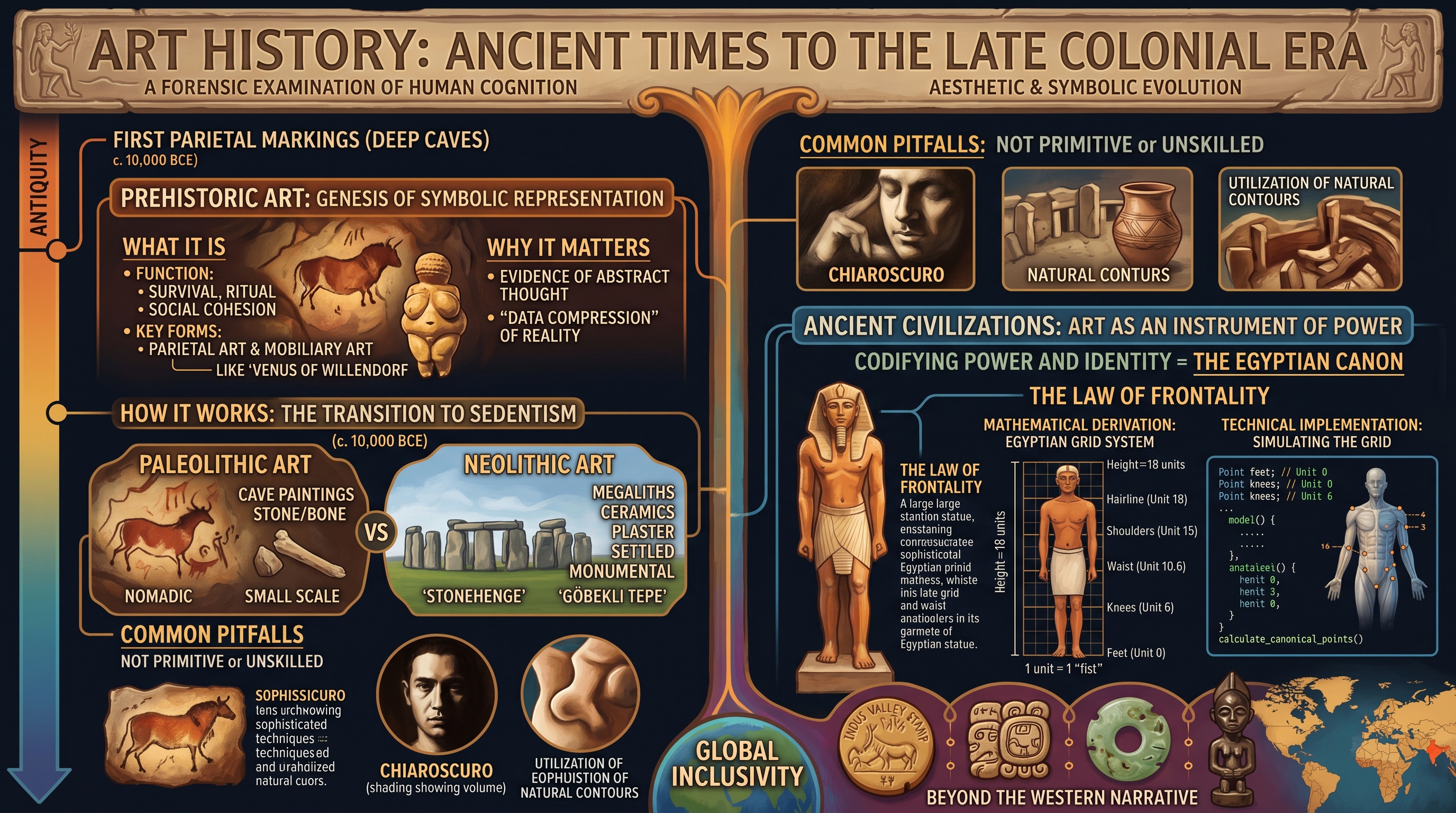
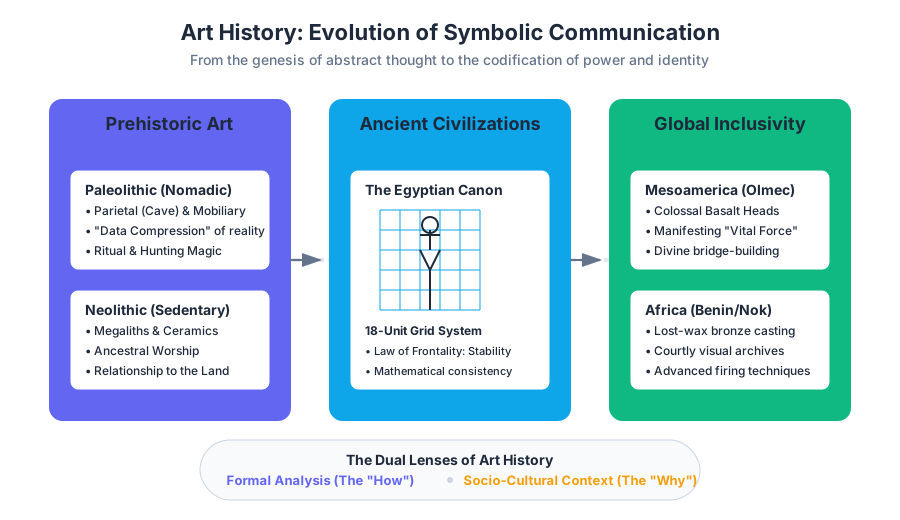
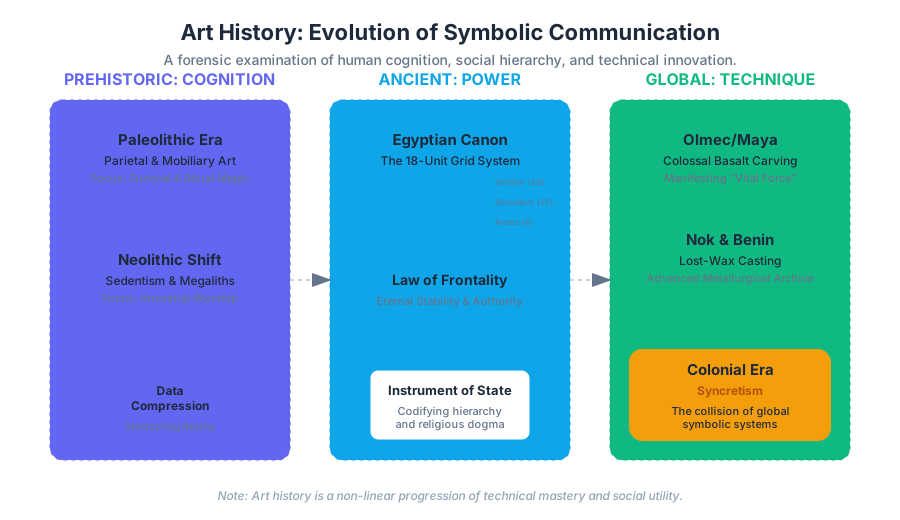
The study of art history from antiquity through the late colonial era is not merely a chronological survey of aesthetic preferences; it is a forensic examination of human cognition, social hierarchy, and the evolution of symbolic communication. This era encompasses the transition from the first parietal markings in deep caves to the complex, often violent, syncretism of the "New World." To understand this progression, one must analyze art through the dual lenses of formal analysis (the "how") and socio-cultural context (the "why").
Prehistoric Art: The Genesis of Symbolic Representation
Prehistoric Art refers to all artifacts produced by pre-literate cultures, traditionally divided into the Paleolithic (Old Stone Age), Mesolithic (Middle Stone Age), and Neolithic (New Stone Age) periods. This era marks the biological and cognitive "leap" where Homo sapiens began to use external media to represent internal concepts.
What it is
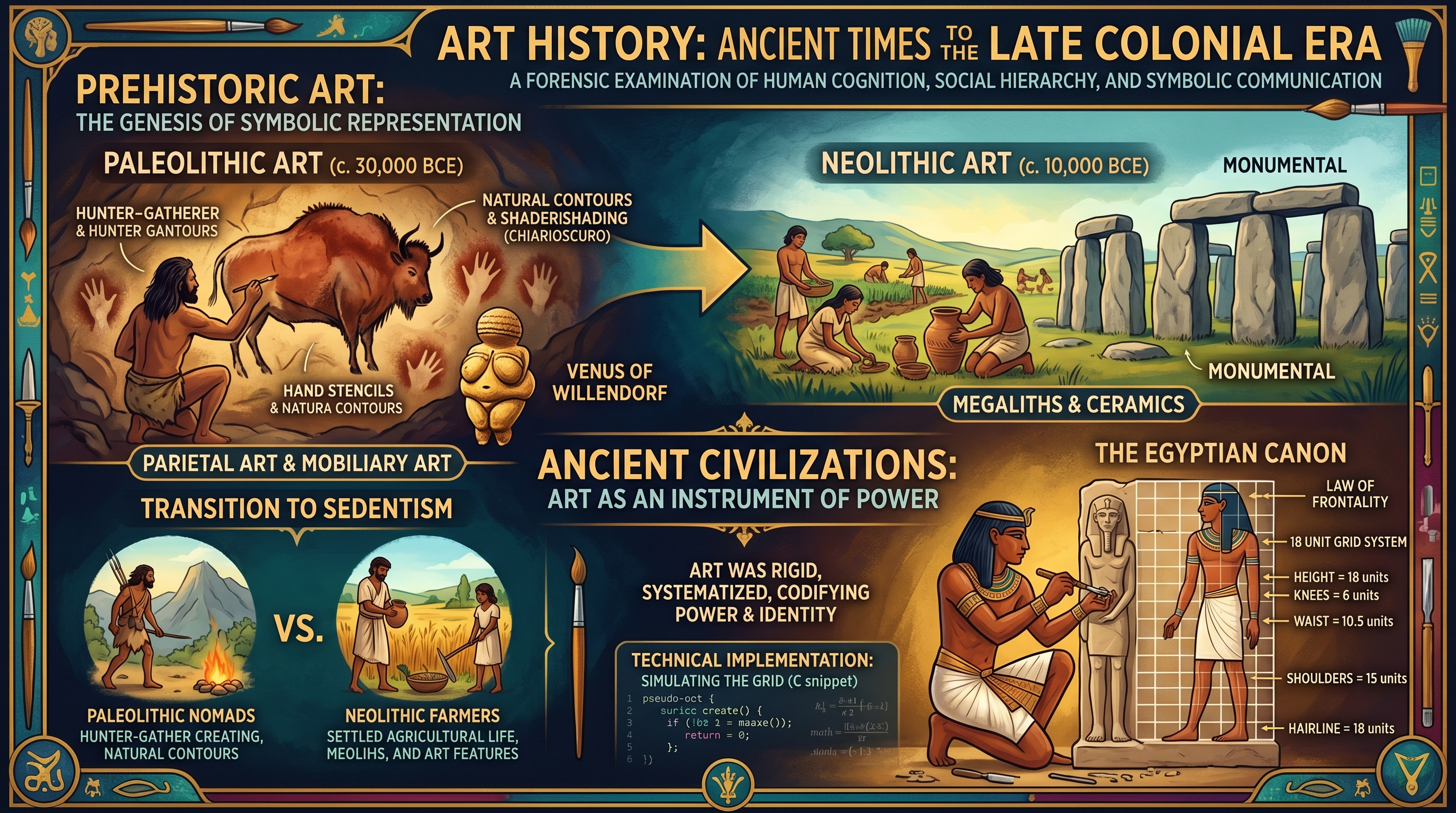
Art in this period was rarely "art for art's sake." It functioned as a tool for survival, ritual, and social cohesion. Key forms include parietal art (cave paintings) and mobiliary art (small, portable sculptures like the Venus of Willendorf).
Why it matters
It represents the first evidence of abstract thought. By creating a representation of a bison, the prehistoric artist was performing a "data compression" of reality—stripping away the noise of the physical world to capture the essence of the animal, likely for sympathetic magic or educational purposes.
How it works: The Transition to Sedentism
The shift from the Paleolithic to the Neolithic (c. 10,000 BCE) changed the "architecture" of art. As humans moved from nomadic hunter-gatherer lifestyles to settled agricultural communities, art became larger, more permanent, and more focused on the relationship between humans and the land.
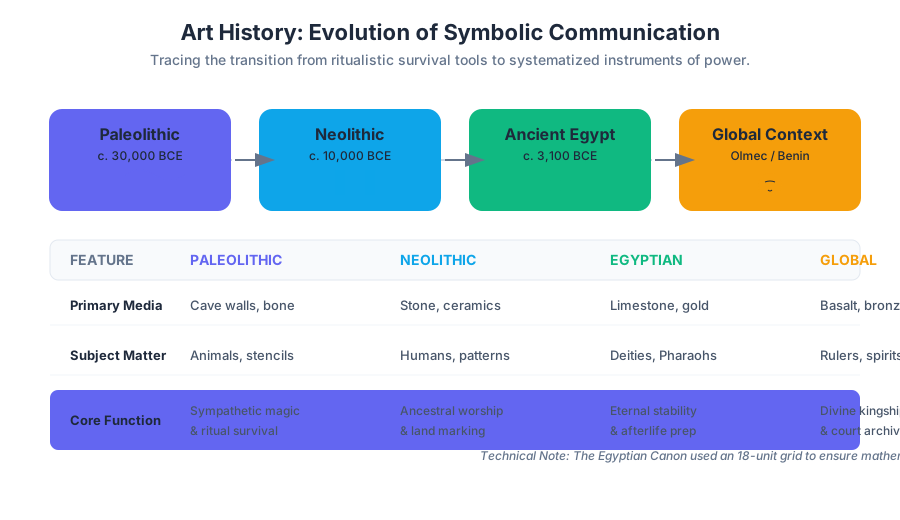
| Feature | Paleolithic Art | Neolithic Art |
|---|---|---|
| Primary Media | Cave walls, bone, ivory | Stone (Megaliths), ceramics, plaster |
| Subject Matter | Animals, hand stencils | Human figures, geometric patterns |
| Scale | Small/Portable or Deep Cave | Monumental (Stonehenge, Göbekli Tepe) |
| Function | Ritual/Hunting magic | Commemoration/Ancestral worship |
Common Pitfalls
A frequent mistake is viewing prehistoric artists as "primitive" or "unskilled." Technically, the use of chiaroscuro (shading to show volume) and the utilization of natural rock contours to suggest muscle mass in Altamira or Lascaux show a sophisticated understanding of three-dimensional form that would not be "rediscovered" in Western art until the Renaissance.
Ancient Civilizations: Art as an Instrument of Power
As civilizations emerged in the Fertile Crescent, the Nile Valley, and the Indus Valley, art became the primary medium for codifying power and identity. In these contexts, the artist was often an anonymous functionary working within a strict canon of proportions.
The Egyptian Canon
Ancient Egyptian art is perhaps the most rigid example of a "systematized" aesthetic. To ensure the efficacy of the Ka (soul) in the afterlife, the human body had to be represented with mathematical precision.
The Law of Frontality: In Egyptian statuary, figures are depicted looking straight ahead, with bodies oriented toward the viewer to project eternal stability and authority.
Mathematical Derivation: The Egyptian Grid System
Egyptian artists used a squared grid to maintain consistency across millennia. The standard unit was the "fist," and a standing figure was exactly 18 units high from the soles of the feet to the hairline.
\text{Height} = 18 \text{ units} \\
\text{Knees} = 6 \text{ units} \\
\text{Shoulders} = 15 \text{ units} \\
\text{Hairline} = 18 \text{ units}
Global Inclusivity: Beyond the Western Narrative
Traditional art history often suffers from "Eurocentrism," focusing on the Greco-Roman lineage while ignoring the sophisticated developments in the Americas, Africa, and Asia. A deep-dive requires examining these cultures on their own technical and philosophical terms.
Mesoamerican Monumentality
The Olmec and Maya civilizations utilized art to bridge the gap between the terrestrial and the divine. The Colossal Heads of the Olmec (c. 1200–400 BCE) are masterpieces of basalt carving, weighing up to 40 tons. These were not just portraits; they were physical manifestations of the ruler's "vital force."
Sub-Saharan African Sophistication
The Nok culture (Nigeria, c. 1000 BCE) produced complex terracotta sculptures that utilized advanced firing techniques to achieve structural integrity at large scales. Later, the Kingdom of Benin utilized the lost-wax casting (cire perdue) process to create bronze plaques that functioned as a visual archive of the royal court.
| Civilization | Key Innovation | Material Significance |
|---|---|---|
| Olmec | Colossal basalt carving | Volcanic stone = Earth power |
| Nok | Large-scale terracotta | Clay = Human origin/fertility |
| Benin | Lost-wax bronze casting | Brass/Bronze = Eternal kingship |
| Maya | Hieroglyphic stelae | Limestone = Historical record |
Common Pitfalls
Avoid the "Ethnographic Trap"—the tendency to view non-Western art as "timeless" or "tribal." These works were often highly specific to individual artists and political moments, just as a portrait of Louis XIV was specific to 17th-century France.
The Colonial Era: American Encounters and Syncretism
The "Colonial Era" (c. 1492–1820s) represents one of the most complex periods in art history. It is characterized by cultural exchange, but also by cultural erasure and the birth of new, hybrid visual languages.
Syncretism and Tequitqui
When Spanish friars arrived in Mexico, they employed Indigenous artists to decorate churches. The resulting style, often called Tequitqui, combined European Christian iconography with Indigenous carving techniques (flat surfaces, sharp edges, and floral motifs derived from pre-Columbian codices).
Material Significance: Spolia and Borrowed Glory
In the colonial context, materials often carried political weight. The use of spolia—repurposing stones from Indigenous temples to build Christian cathedrals—was a literal and symbolic act of dominance.
Spolia: The repurposing of building stone or decorative elements for new construction, typically as a sign of conquest or the continuity of power.
The Casta System: Art as Social Database
One of the most unique genres of the colonial era was Casta Painting. These were sets of 16 paintings that categorized the various racial combinations in the Spanish Americas (e.g., Español + Mora = Mulato). These functioned as a visual "API" for the colonial administration to maintain social hierarchy.
Data Representation of Casta Metadata
Technical Analysis: The Elements and Principles of Design
To analyze any work from this vast timeline, scholars use a standardized "toolkit" of terms. This is the Structure of Art.
Elements of Art (The Building Blocks)
- Line: The path of a point moving through space.
- Shape: A two-dimensional area defined by an edge.
- Form: A three-dimensional object or the illusion of one.
- Color: Produced when light, striking an object, is reflected back to the eye.
- Texture: The surface quality of an artwork.
Principles of Design (The Rules of Engagement)
These principles govern how the elements are arranged to create a specific effect.
- Balance: The distribution of visual weight (Symmetrical, Asymmetrical, Radial).
- Emphasis: The focal point that catches the viewer's attention.
- Unity: The sense of harmony between all parts of the work.
Worked Example: Analyzing the Parthenon Frieze
If we apply these principles to the Parthenon Frieze (Ancient Greece):
- Element (Line): The rhythmic repetition of vertical lines in the drapery creates a sense of movement.
- Principle (Balance): The frieze uses isocephaly (the heads of the figures are at the same level), creating a sense of democratic equality and visual stability.
The Role of the Viewer and Cultural Preservation
Art does not exist in a vacuum; it requires a viewer to complete the circuit of meaning. This is particularly true for colonial art, where the intended viewer (often a European monarch or a local convert) dictated the artistic choices.
Art vs. Craft
A recurring debate in this section of history is the distinction between "art" and "craft." In many ancient and colonial cultures, this distinction did not exist. A finely woven Inca tunic (T'oqapu) was not "craft"—it was a high-status political garment that conveyed the wearer's genealogy through geometric "code."
Ethics and Repatriation
Many of the works discussed—from the Benin Bronzes to the Parthenon Marbles—are currently the subject of intense ethical debate regarding repatriation. Because these items were often removed during colonial occupations, the question of "who owns history" remains a central tension in modern art history.
Repatriation: The process of returning an asset, an item of symbolic value, or a person—voluntarily or forcibly—to its owner or its place of origin or citizenship.
Conclusion: The Visual Record of Humanity
From the ochre-stained walls of prehistoric caves to the oil-on-canvas hierarchies of the Spanish Empire, art serves as our most durable record of human existence. It is a technology for memory, a weapon for power, and a bridge between disparate cultures. By mastering the formal elements and understanding the socio-political contexts of these eras, we gain the ability to "read" the past with the same precision we apply to modern data.
Source Materials
Study Art on Lykke
This course page is free to open: signed out, you can read its first two sections, and signing in, on any plan, opens the rest. The free Lykke Chrome extension syncs your own Canvas courses, so ChatGPT, Claude and Muse can answer from your classes and deadlines. It only reads Canvas.
Add the free extensionSign in to open every section