From the free course Art on Lykke
Describing Art: Formal Analysis
Key concepts: Formal Analysis · Naturalism · Abstraction · Non-objective Art · Artistic Style
Methods for systematic analysis and description of art, moving from objective observation to subjective evaluation.
Describing Art: Formal Analysis
Formal analysis is the foundational methodology of art history and visual culture studies. It is the systematic process of examining the visual elements of a work of art—its "form"—independent of its historical context or narrative content. If art is a language, formal analysis is the study of its grammar and syntax. By deconstructing a work into its constituent parts, we can understand how an artist communicates meaning through purely visual means.
This approach assumes that the meaning of a work is inextricably linked to its physical properties. A formal analysis does not begin with "What is this about?" but rather "What do I see, and how is it organized?" This rigorous observation allows the viewer to move beyond subjective "liking" toward an objective understanding of the work's internal logic.
The Formal Analysis Pipeline: The Four Pillars
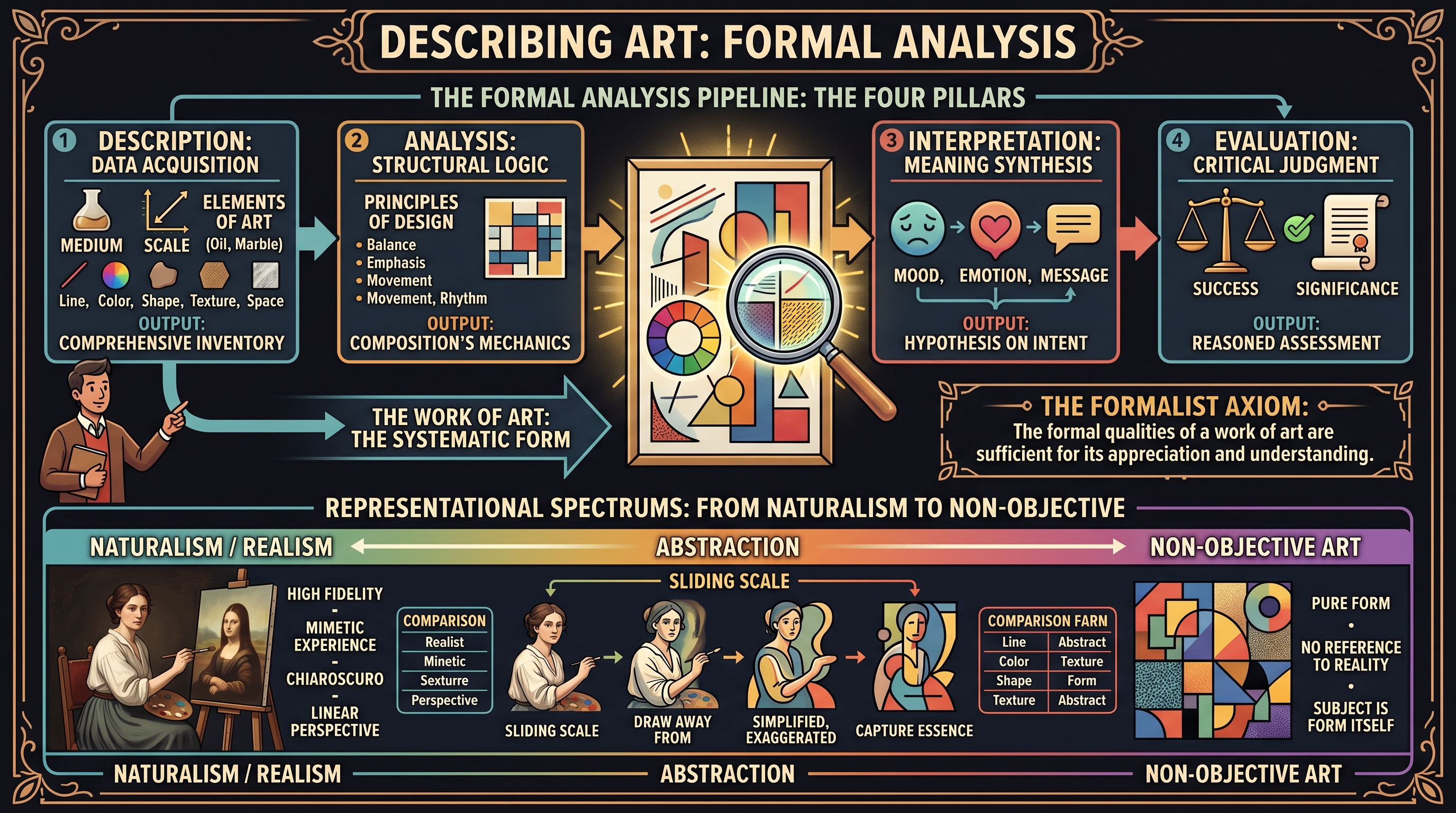
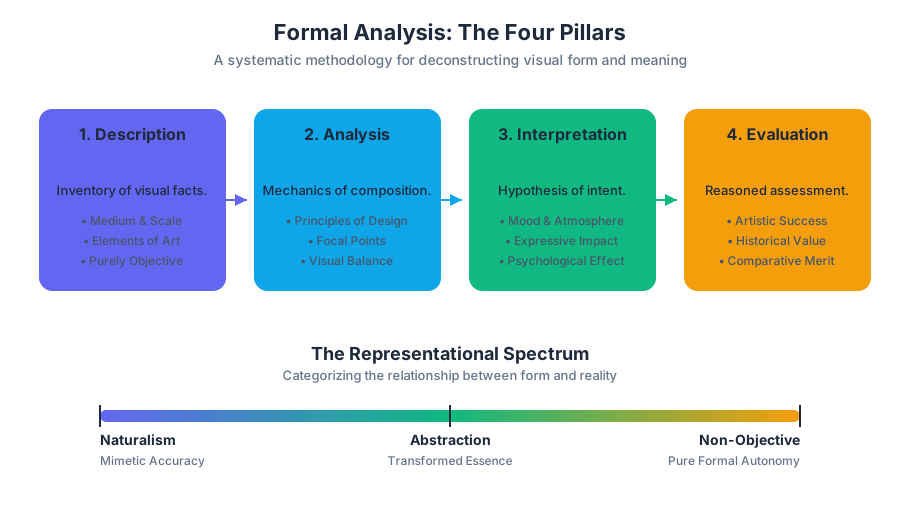
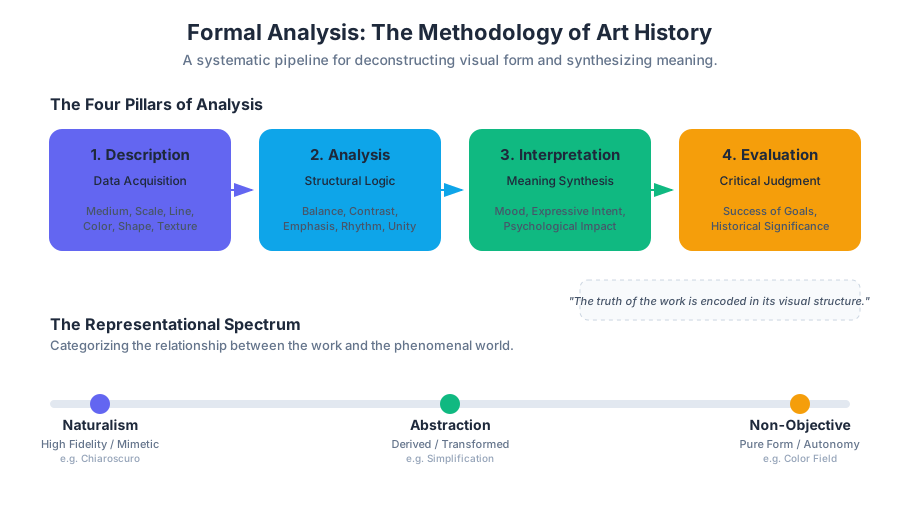
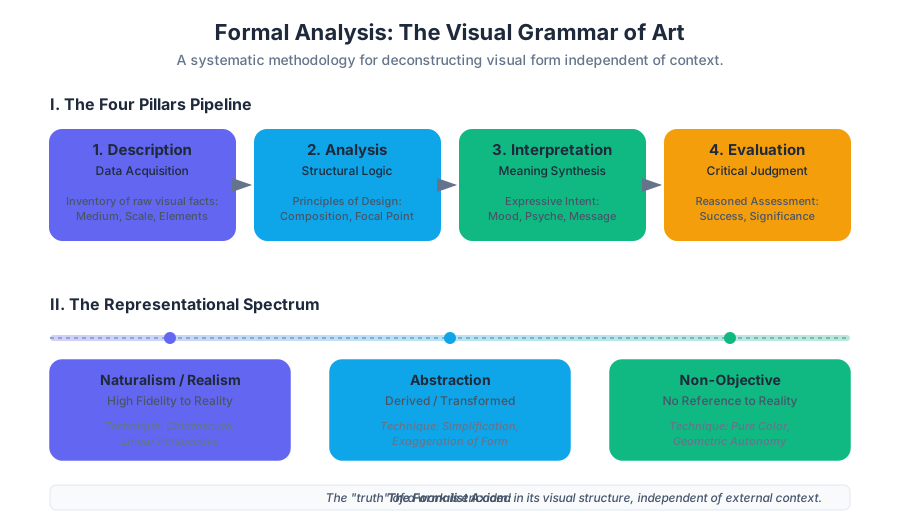
To perform a formal analysis, scholars utilize a four-step iterative process. This pipeline ensures that the final interpretation is grounded in observable data rather than mere intuition.
| Phase | Objective | Key Questions | Output |
|---|---|---|---|
| 1. Description | Data Acquisition | What colors, shapes, and textures are present? What is the medium? | A comprehensive inventory of visual facts. |
| 2. Analysis | Structural Logic | How are the elements related? Is there symmetry? Where is the focal point? | An understanding of the composition's mechanics. |
| 3. Interpretation | Meaning Synthesis | What mood or message do these formal choices convey? | A hypothesis regarding the work's expressive intent. |
| 4. Evaluation | Critical Judgment | How successful is the work in its goals? What is its historical significance? | A reasoned assessment of the work's value. |
1. Description: The Inventory of Form
The descriptive phase is purely objective. It avoids "why" and focuses on "what." In a technical sense, this is the extraction of raw features from the visual field. We identify the medium (oil on canvas, marble, digital render), the scale, and the Elements of Art (line, shape, color, texture, space).
2. Analysis: The Principles of Design
Analysis examines how the elements described in step one are organized. This involves the Principles of Design: balance, contrast, emphasis, movement, pattern, rhythm, and unity. For instance, an artist might use a complementary color scheme (element) to create high contrast (principle), which in turn creates a focal point (analysis).
3. Interpretation: From Form to Meaning
Interpretation bridges the gap between the physical object and the human experience. Here, we ask how the formal qualities influence the viewer's psyche. Does the use of jagged, vertical lines create a sense of anxiety? Does the atmospheric perspective suggest a yearning for the infinite?
4. Evaluation: The Conclusion
Evaluation is the final synthesis. It is not a matter of personal taste ("I like this"), but of professional judgment. Was the artist successful in using these formal tools to achieve a specific effect? How does this work compare to others in the same style or period?
The Formalist Axiom: The formal qualities of a work of art are sufficient for its appreciation and understanding. While context (history, biography) adds depth, the "truth" of the work is encoded in its visual structure.
Representational Spectrums: Naturalism to Non-Objective
One of the primary goals of formal analysis is to categorize where a work falls on the spectrum of representation. This spectrum measures the relationship between the artwork and the "real" world (the phenomenal world).
Naturalism and Realism
Naturalism refers to art that retains a high degree of physical accuracy. It mimics the optical experience of the world. Realism, while often used interchangeably, specifically refers to the depiction of subject matter in a straightforward, unidealized manner.
In a naturalistic work, the artist employs techniques like chiaroscuro (modeling with light and shadow) and linear perspective to create the illusion of three-dimensional space on a two-dimensional surface.
Abstraction: The Transformation of Form
Abstraction exists on a sliding scale. To "abstract" means to "draw away from." An abstract work takes a recognizable subject from reality and simplifies, distorts, or exaggerates it. The goal is often to capture an essence or an emotional state rather than a literal likeness.
Non-Objective Art: Pure Form
Non-objective art (or non-representational art) makes no reference to the physical world. It is "pure" formal analysis in practice. The subject of the work is the line, the color, and the shape itself. There is no "hidden" figure.
| Category | Relationship to Reality | Primary Focus | Example Technique |
|---|---|---|---|
| Naturalism | High Fidelity | Mimetic Accuracy | 3-Point Perspective |
| Abstraction | Derived/Transformed | Expressive Essence | Geometric Simplification |
| Non-Objective | No Reference | Formal Autonomy | Color Field Painting |
The Mathematics of Abstraction
Abstraction can be viewed as a mathematical transformation. If $R$ represents a perfectly realistic image in a high-dimensional space, an abstract work $A$ is the result of a function $f$ applied to $R$, where $f$ reduces dimensionality or introduces non-linear distortions.
A = f(R, \theta) + \epsilon
Where:
- $R$: The "Realist" input (the source object).
- $\theta$: The artist's stylistic parameters (e.g., degree of geometric simplification).
- $f$: The transformation function (e.g., projection onto a 2D plane with forced cubist perspectives).
- $\epsilon$: The "expressive noise" or individual touch that deviates from the source.
In Non-Objective art, $R$ is null. The function $f$ operates on an empty set or a set of pure mathematical primitives (points, lines, planes), making $A$ an autonomous system.
Artistic Style: The Visual Signature
Artistic Style is the constant form—and sometimes the constant elements, qualities, and expression—in the art of an individual or a group. It is the recognizable "hand" of the artist or the "spirit" of an era.
Types of Style
- Period Style: The characteristic visual language of a specific time (e.g., Italian Renaissance, Baroque).
- Regional Style: Variations based on geography (e.g., Dutch vs. Italian Baroque).
- Individual Style: The unique aesthetic choices of a single artist (e.g., Van Gogh’s impasto brushwork).
The Elements and Principles: A Technical Deep-Dive
To perform a formal analysis, one must master the vocabulary of the elements and principles. These are the "data types" and "operators" of the visual world.
The Elements (The Data)
- Line: A point in motion. Lines can be actual (drawn), implied (a series of dots), or psychic (the line of sight between two characters).
- Shape and Form: Shape is 2D (height/width); Form is 3D (height/width/depth). They can be geometric (mathematically regular) or organic (irregular, nature-based).
- Color: Defined by hue (the name), value (lightness/darkness), and intensity/saturation (purity).
- Texture: The surface quality. Actual texture can be felt; visual texture is an illusion.
- Space: The area around and within objects. Positive space is the object; negative space is the "empty" area.
The Principles (The Operators)
- Balance: The distribution of visual weight. Can be symmetrical, asymmetrical, or radial.
- Emphasis: The creation of a focal point through contrast or placement.
- Rhythm/Movement: The repetition of elements to guide the viewer's eye through the composition.
- Unity and Variety: The balance between elements that hold the work together (unity) and elements that provide interest (variety).
| Principle | Mechanism | Effect on Viewer |
|---|---|---|
| Symmetrical Balance | Mirroring across an axis | Stability, formality, divinity |
| Asymmetrical Balance | Balancing dissimilar weights | Dynamism, modernism, tension |
| Proportion | Size relationships of parts | Realism (if standard) or Heroism (if hierarchical) |
| Contrast | Juxtaposition of opposites | Clarity, drama, visual hierarchy |
Common Pitfalls in Formal Analysis
Even experienced critics can fall into traps when performing a formal analysis.
- The Intentional Fallacy: Assuming that the artist's stated intent is the only meaning. Formal analysis focuses on what is actually on the canvas, which may contradict what the artist said they were doing.
- Confusing Subject with Form: Describing a "sad man" is an interpretation of subject matter. Describing "downward sloping lines and desaturated blues" is formal analysis.
- Ignoring Scale: A formal analysis of a 2-inch miniature is vastly different from a 20-foot mural, even if the composition is identical. The physical relationship between the viewer's body and the work is a formal quality.
- Projecting Context: It is difficult to "unsee" history. However, a pure formal analysis must temporarily ignore that a cross represents Christianity and instead see it as two intersecting perpendicular lines.
Worked Example: Formal Analysis of a Landscape
Imagine a painting of a mountain range.
1. Description: The work is a 24x36 inch oil painting. It features a range of jagged blue peaks in the background, a green valley in the midground, and a dark, gnarled tree in the foreground. The colors are cool (blues, greens) with a single orange sun.
2. Analysis: The composition follows the Rule of Thirds. The tree in the foreground acts as a repoussoir element, pushing the mountains further back and creating spatial depth. There is a diagonal movement from the bottom left (tree) to the top right (sun). The contrast between the orange sun and the blue mountains creates a focal point.
3. Interpretation: The vast scale of the mountains compared to the small, twisted tree suggests the sublime power of nature over the individual. The cool color palette creates a sense of tranquility, while the orange sun provides a spark of hope or energy.
4. Evaluation: The artist successfully uses atmospheric perspective (making the mountains lighter and bluer) to create a convincing sense of vast space. The work is a strong example of Romantic landscape painting, effectively communicating the emotional weight of the natural world.
Summary of Methodology
Formal analysis is not a rigid cage, but a set of spectacles that allows us to see the "how" of art. By breaking down an image into its fundamental elements and principles, we can decode the visual rhetoric used by artists across centuries and cultures. Whether analyzing a Renaissance fresco or a modern user interface, the principles of formal analysis remain the most powerful tools for understanding the impact of the visual world.
Source Materials
Study Art on Lykke
This course page is free to open: signed out, you can read its first two sections, and signing in, on any plan, opens the rest. The free Lykke Chrome extension syncs your own Canvas courses, so ChatGPT, Claude and Muse can answer from your classes and deadlines. It only reads Canvas.
Add the free extensionSign in to open every section