From the free course Art on Lykke
Defining Art and Its Foundations
Key concepts: Mimesis · Art vs. Craft · Artistic Expression · Role of the Viewer · Visual Culture
An introduction to the evolving definitions of art, the distinction between artists and artisans, and the core motivations behind human creativity.
Defining Art and Its Foundations
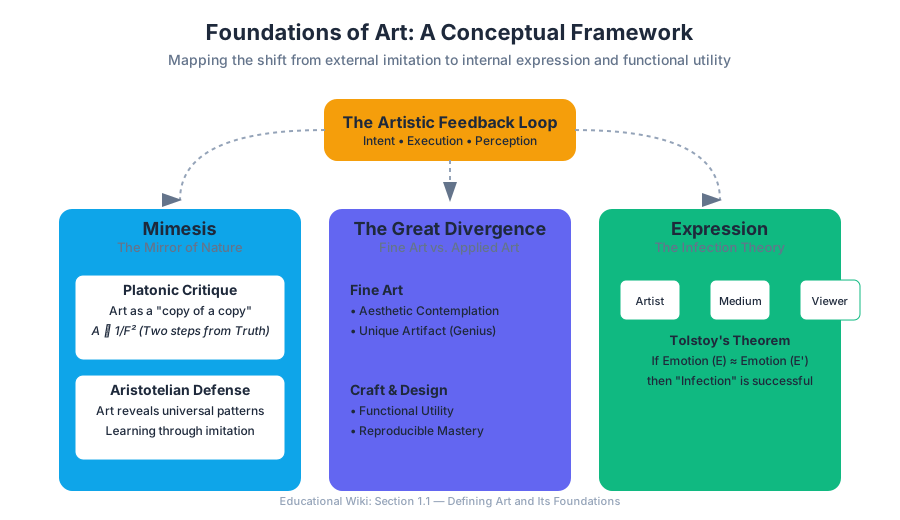
Art is not a static category of objects, but a dynamic, recursive feedback loop between human intent, technical execution, and sensory perception. At its most fundamental level, art is a communicative system that utilizes visual, auditory, or haptic signals to encode complex imaginative ideas or high-level technical skills. Historically, the definition of art has migrated from the rigid imitation of the physical world to a fluid exploration of conceptual and socio-cultural boundaries.
To understand the foundations of art, we must move beyond the "I know it when I see it" heuristic and engage with the formal structures, philosophical derivations, and historical shifts that have shaped the discipline.
Mimesis: The Mirror of Nature
The earliest formal theories of art are rooted in Mimesis, a Greek term meaning "imitation" or "representation." For centuries, the primary metric of artistic success was the degree to which a work could simulate the appearance of the natural world.
The Platonic Critique
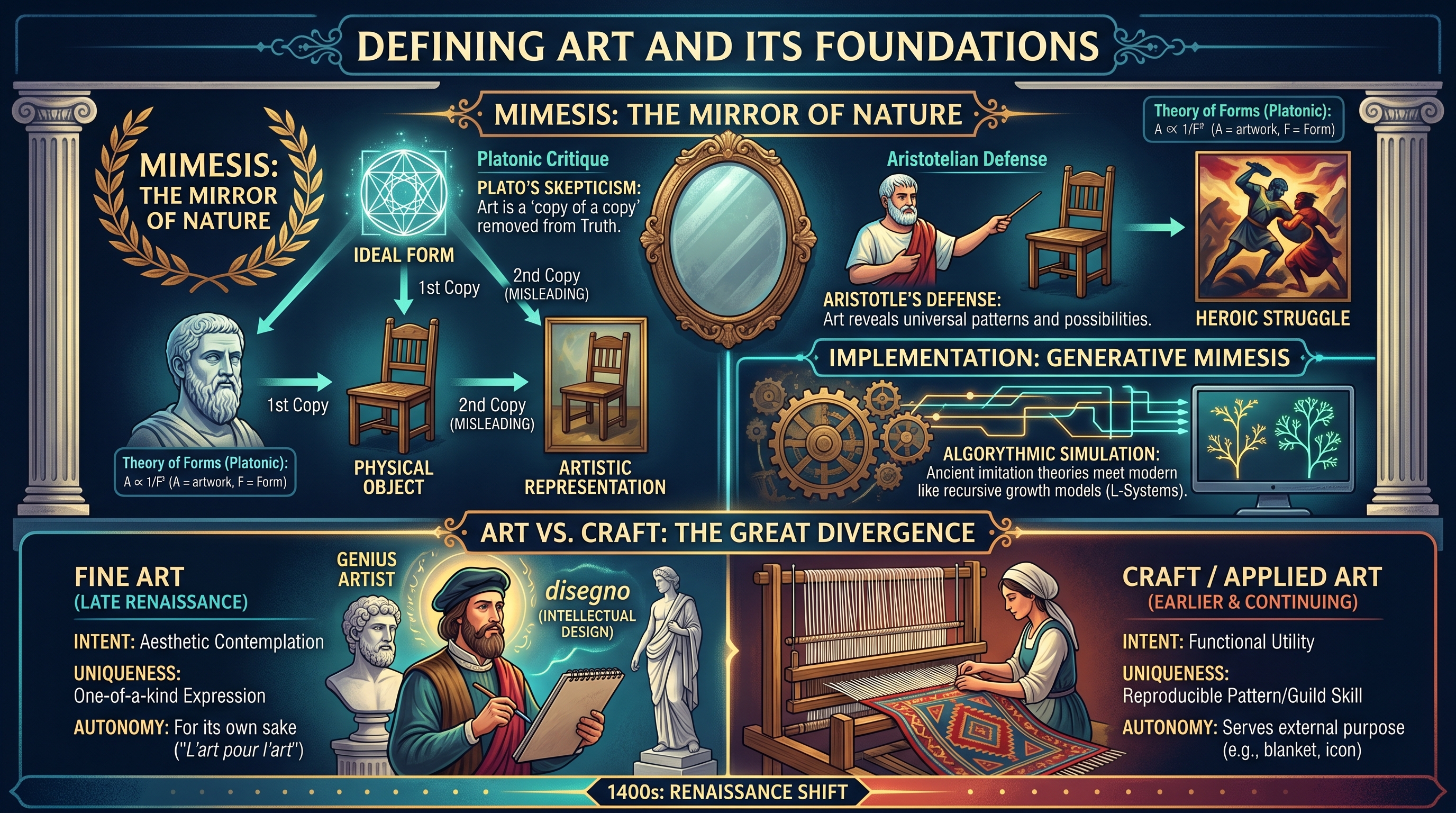
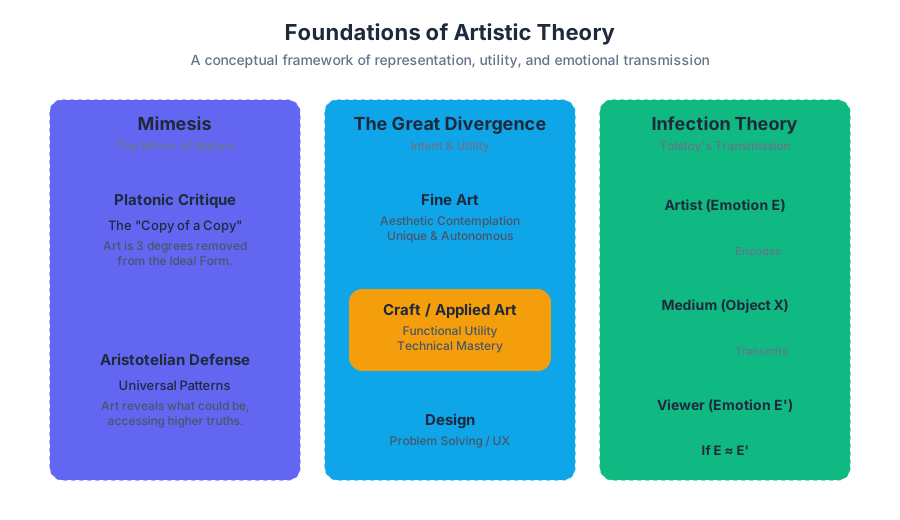
Plato, in The Republic (Book X), offered a skeptical view of mimesis. He proposed a tripartite hierarchy of reality, where the "Ideal Form" (the concept of a thing) is the highest truth, the "Physical Object" is a secondary imitation, and the "Artistic Representation" is a tertiary imitation—a "copy of a copy."
The Theory of Forms (Platonic Derivation): If $F$ is the Ideal Form, $O$ is the physical object, and $A$ is the artwork, then:
- $O \approx F$ (The carpenter imitates the Form of a bed)
- $A \approx O$ (The painter imitates the physical bed)
- Therefore, $A$ is at a remove of two degrees from the truth ($A \propto \frac{1}{F^2}$).
The Aristotelian Defense
Aristotle countered this by suggesting that mimesis is a natural human instinct and a primary tool for learning. In his Poetics, he argued that art does not just copy what exists, but represents what could exist, thereby accessing universal truths rather than mere specific instances.
| Perspective | Core Philosophy | Role of the Artist | Goal of Art |
|---|---|---|---|
| Platonic | Essentialism | Deceiver / Imitator | To mislead from the Truth |
| Aristotelian | Empiricism | Educator / Interpreter | To reveal universal patterns |
| Modernist | Subjectivism | Creator / Originator | To express internal states |
Art vs. Craft: The Great Divergence
The distinction between Art (Fine Art) and Craft (Applied Art) is a relatively modern construct, largely solidified during the Renaissance and the subsequent Industrial Revolution.
The Renaissance Shift
Before the 1400s, the term technē (Greek) or ars (Latin) referred to any skilled activity, from weaving to ship-building. The artist was an artisan, a member of a guild. The Renaissance introduced the concept of the "Genius," elevating the status of painters and sculptors above manual laborers because their work involved disegno (intellectual design) rather than just physical toil.
Criteria for Distinction
The modern distinction typically rests on three pillars:
- Intent: Is the object intended for aesthetic contemplation or functional utility?
- Uniqueness: Is the object a one-of-a-kind expression or a reproducible pattern?
- Autonomy: Does the work exist for its own sake (l'art pour l'art), or does it serve an external master (e.g., a teapot, a religious icon)?
| Category | Primary Driver | Output Type | Evaluation Metric |
|---|---|---|---|
| Fine Art | Concept / Expression | Unique Artifact | Aesthetic Impact / Meaning |
| Craft | Utility / Tradition | Functional Object | Technical Mastery / Durability |
| Design | Problem Solving | Mass-Produced | User Experience / Efficiency |
| Kitsch | Sentimentality | Commodity | Emotional Accessibility |
Artistic Expression and the "Infection Theory"
If mimesis is about looking outward, expression is about looking inward. Artistic Expression posits that art is the externalization of the artist's internal emotional state.
Tolstoy’s Infection Theory
Leo Tolstoy argued in What is Art? (1897) that art is a bridge between souls. He proposed that the artist "infects" the viewer with an emotion they have experienced.
The Expression Theorem: For an object $X$ to be art, the artist $A$ must:
- Experience an emotion $E$.
- Encode $E$ into a medium $M$.
- Ensure that the viewer $V$, upon perceiving $M$, experiences $E'$.
- If $E \approx E'$, the "infection" is successful and the work is art.
The Mechanics of Expressionism
Expressionism as a movement (e.g., Munch, Van Gogh) prioritized emotional intensity over mimetic accuracy. This involved the distortion of form and the use of non-naturalistic color to evoke specific psychological responses.
\text{Aesthetic Force} (F_a) = \frac{\text{Emotional Intensity} (I) \times \text{Technical Clarity} (C)}{\text{Noise/Distraction} (N)}
The Role of the Viewer: The Beholder's Share
A work of art is not a "closed" system. It requires an observer to complete the circuit of meaning. This concept, known as the Beholder's Share, suggests that the viewer's brain provides the missing information, cultural context, and emotional resonance.
Reception Theory
Reception theory asserts that a work's meaning is not fixed at the moment of creation but is negotiated every time it is viewed. This is influenced by the viewer's "Horizon of Expectations"—the sum of their cultural knowledge, personal history, and visual literacy.
Psychological Completion
The human visual system is hardwired to find patterns. In art, this manifests as:
- Gestalt Principles: The mind perceives the whole before the parts (e.g., seeing a face in a collection of brushstrokes).
- Top-Down Processing: Our expectations (e.g., "this is a landscape") dictate how we interpret ambiguous visual data.
Visual Culture: The Expanded Field
In the 21st century, the study of art has expanded into the broader field of Visual Culture. This discipline recognizes that we live in an image-saturated world where the line between "High Art" and "Low Culture" (advertising, memes, UI design) has blurred.
Semiotics in Visual Culture
To analyze visual culture, we use Semiotics—the study of signs and symbols. Every visual element is a "sign" consisting of two parts:
- Signifier: The physical form (the pixels, the ink, the light).
- Signified: The concept or meaning triggered by the signifier.
Digital Visual Culture and Metadata
In the digital age, art is often defined by its metadata and its position within a network. The "meaning" of a digital image is often inseparable from its provenance and its tags.
The Structure of Art: Elements and Principles
While the definition of art is philosophical, the structure of art is technical. Artists use a specific vocabulary to build visual experiences.
The Elements (The "Tools")
- Line: A point moving in space. Can be actual, implied, or psychic.
- Shape/Mass: 2D areas (shape) or 3D volumes (mass).
- Color: Defined by hue, value (lightness/darkness), and intensity (saturation).
- Texture: The surface quality, either tactile or visual.
- Space: The area around, between, or within components.
The Principles (The "Rules")
- Balance: The distribution of visual weight (symmetrical, asymmetrical, radial).
- Contrast: The juxtaposition of different elements to create interest.
- Emphasis: Drawing the viewer's attention to a focal point.
- Rhythm/Movement: The suggestion of motion through repetition.
| Element | Principle | Resulting Effect |
|---|---|---|
| Color | Contrast | High visual impact / Vibrancy |
| Line | Rhythm | Directional flow / Energy |
| Shape | Balance | Stability or Tension |
| Space | Emphasis | Isolation of the subject (Negative Space) |
Common Pitfalls in Defining Art
- The "Skill" Fallacy: Assuming that if something doesn't require obvious manual dexterity, it isn't art (e.g., Readymades or Conceptual Art). Art is often about the choice or the idea rather than the fabrication.
- The "Beauty" Trap: Confining art to the "beautiful." Much of the most significant art in history was designed to be provocative, ugly, or disturbing to spark social change.
- Ignoring Context: Attempting to judge a work without understanding its historical or cultural origin. A white square on a white canvas means something very different in 1918 (Malevich) than it does in 2024.
Source Materials
Study Art on Lykke
This course page is free to open: signed out, you can read its first two sections, and signing in, on any plan, opens the rest. The free Lykke Chrome extension syncs your own Canvas courses, so ChatGPT, Claude and Muse can answer from your classes and deadlines. It only reads Canvas.
Add the free extensionSign in to open every section