From the free course Art on Lykke
Connecting Art to Our Lives
Key concepts: Aesthetics · Political Protest · Commemoration · Unification · Public Art
Examining the multifaceted roles of art in society, from personal expression to political protest and religious worship.
Connecting Art to Our Lives
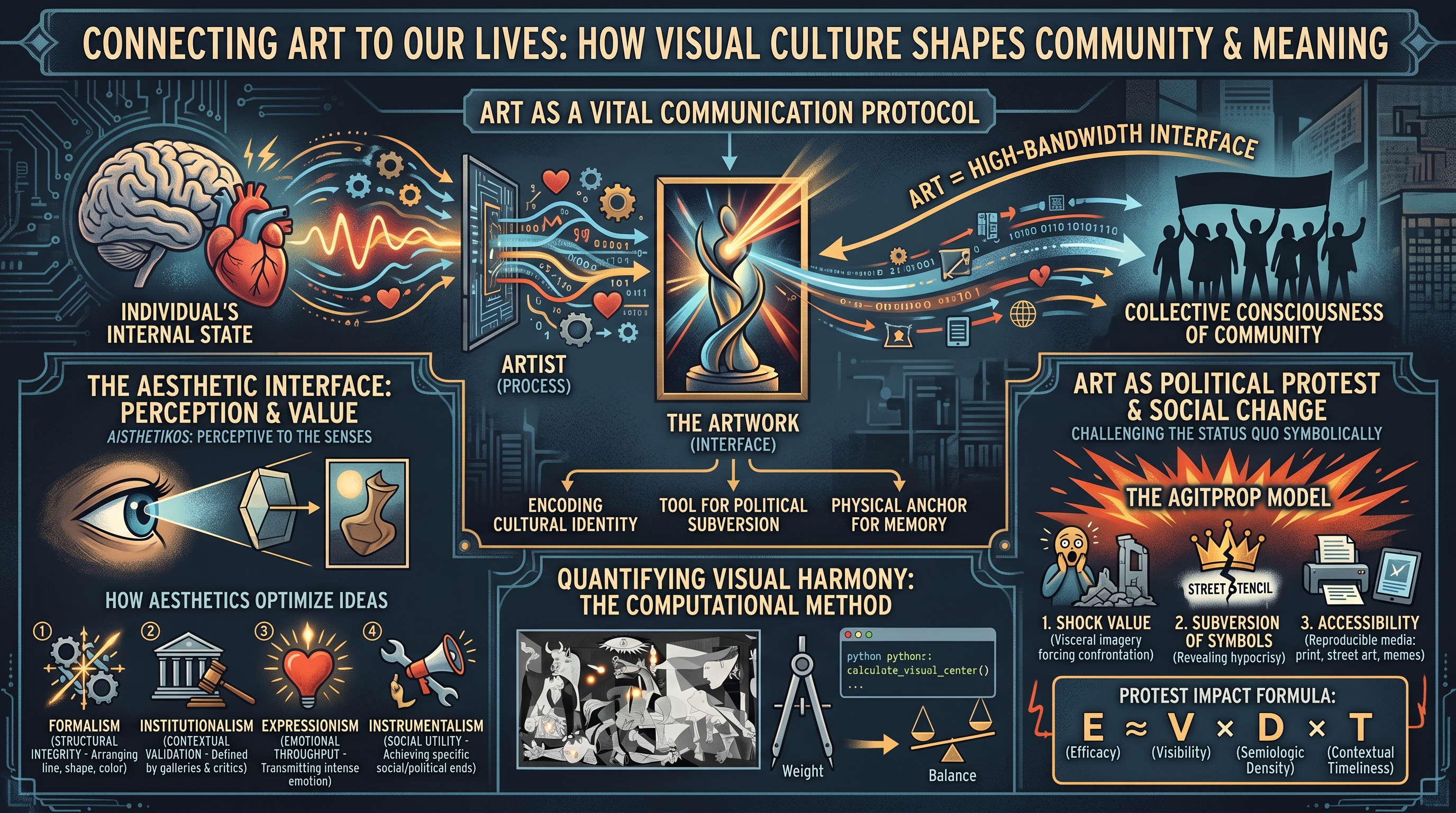
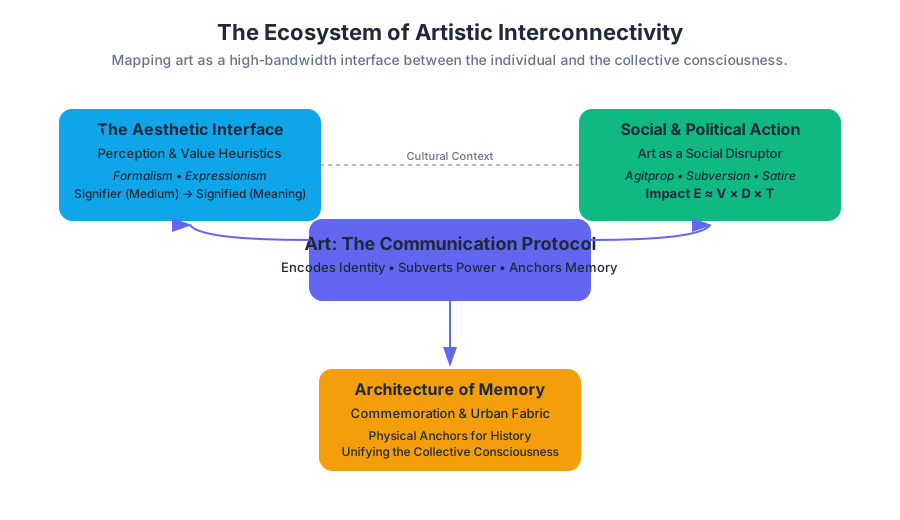
Art is rarely a solitary phenomenon. While the romanticized image of the "starving artist" suggests a vacuum of creation, the reality of art history and visual culture is one of profound interconnectedness. Art serves as a vital communication protocol—a high-bandwidth interface between the internal state of the individual and the collective consciousness of the community. It is a mechanism for encoding cultural identity, a tool for political subversion, and a physical anchor for memory.
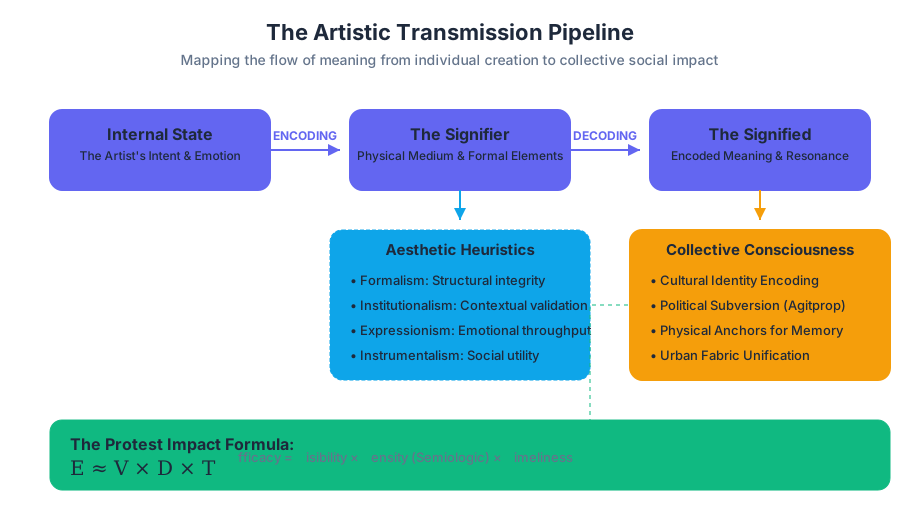
In this deep dive, we will analyze the structural and social frameworks that allow art to transcend its physical medium (the signifier) and become a carrier of profound human meaning (the signified). We will examine how aesthetics govern our perception, how protest art functions as a social disruptor, and how public art unifies or divides the urban fabric.
The Aesthetic Interface: Perception and Value
The term Aesthetics is derived from the Greek aisthetikos, meaning "perceptive to the senses." In a contemporary context, aesthetics is the branch of philosophy dealing with the nature of beauty, art, and taste, and with the creation and appreciation of beauty. However, for the "engineer" of art, aesthetics is more than just "looking good"; it is a set of heuristics used to optimize the transmission of an idea.
The Mechanics of Aesthetic Experience
An aesthetic experience occurs when a viewer engages with an object’s formal qualities—its Elements of Art (line, shape, color, texture) and Principles of Design (balance, unity, rhythm)—to reach a state of heightened awareness or emotional resonance. This is not a passive process; it is a computational one where the brain attempts to resolve the visual data against known patterns and cultural expectations.
| Theory of Aesthetics | Core Metric | Primary Focus |
|---|---|---|
| Formalism | Structural Integrity | The arrangement of elements (lines, colors, shapes) independent of social context. |
| Institutionalism | Contextual Validation | Art is defined by the "Art World" (galleries, critics, museums). |
| Expressionism | Emotional Throughput | The success of the work is measured by the intensity of the transmitted emotion. |
| Instrumentalism | Social Utility | Art is a tool to achieve a specific social or political end. |
Quantifying Visual Harmony
While beauty is subjective, we can model the "balance" of a composition using computational methods.
Art as Political Protest and Social Change
Art has historically been one of the most potent weapons for challenging the status quo. Because art operates in the realm of the symbolic, it can bypass the logical defenses of an audience, delivering a "shock to the system" that traditional rhetoric cannot.
The Agitprop Model
Agitprop (agitation-propaganda) is a strategy where art is intentionally designed to provoke a specific political response. This often involves the use of Satire, Subversion, and Iconoclasm.
- Shock Value: Using visceral imagery to force the viewer to confront an ignored reality (e.g., Goya’s The Disasters of War).
- Subversion of Symbols: Taking established icons of power and recontextualizing them to reveal hypocrisy (e.g., Banksy’s use of corporate logos).
- Accessibility: Protest art often utilizes reproducible media—printmaking, street art, or digital memes—to ensure maximum distribution.
The Protest Impact Formula: The efficacy of a protest work ($E$) can be modeled as a function of its Visibility ($V$), its Semiologic Density ($D$ - the layers of meaning), and its Contextual Timeliness ($T$). $$E \approx V \times D \times T$$
Case Studies in Political Art
The following table compares different approaches to art as a catalyst for change:
| Movement/Artist | Technique | Primary Objective | Result/Impact |
|---|---|---|---|
| Dadaism | Readymades / Nonsense | Challenge the logic of a world at war. | Birth of conceptual art; questioned "What is art?" |
| Guerrilla Girls | Data Visualization / Posters | Expose gender and racial bias in the art world. | Forced museums to audit their collection demographics. |
| Ai Weiwei | Large-scale Installation | Critique of government transparency and human rights. | Global awareness of Chinese political censorship. |
| Social Realism | Figurative Painting | Depict the hardships of the working class. | Influenced labor laws and public empathy during the Depression. |
Commemoration: The Architecture of Memory
Commemoration is the act of using art to ensure that a person, group, or event is not forgotten. This is where art meets history. Unlike a textbook, which records facts, a Monument or Memorial records feeling and reverence.
The Cenotaph and the Monolith
A Cenotaph is an "empty tomb"—a monument erected in honor of a person or group whose remains are elsewhere. These structures use Form and Space to create a vacuum that the viewer fills with their own grief or respect.
- Scale: Large-scale monuments (like the Pyramids or the Lincoln Memorial) use size to evoke the "Sublime"—a feeling of awe mixed with a sense of our own insignificance.
- Materiality: The choice of material is critical. Granite and bronze suggest permanence (Intrinsic Value), while ephemeral materials (like ice or light) suggest the fleeting nature of life.
Digital Commemoration and Metadata
In the modern era, commemoration has moved into the digital sphere. Archiving these "digital monuments" requires rigorous metadata standards to ensure the context is preserved along with the image.
Unification and Cultural Identity
Art acts as the "social glue" of a community. It defines the boundaries of an In-group by creating a shared visual language. This can be seen in religious iconography, nationalistic art, and even subcultural aesthetics (like punk or hip-hop).
The Role of Ritual
In many cultures, the distinction between "Art" and "Object" is non-existent. A mask used in a ritual is not a "sculpture" to be looked at; it is a functional tool for spiritual unification. When the community sees the mask, they are not seeing an artist's "expression"—they are seeing their own collective history and beliefs made manifest.
Spolia and Borrowed Glory
Spolia is the practice of repurposing stones or decorative elements from ancient monuments into new ones. This is a literal "Connecting of Art to Lives" across centuries. By incorporating the art of a conquered or admired predecessor, a new regime "borrows" the legitimacy and power of the past.
| Mechanism of Unification | Description | Example |
|---|---|---|
| Heraldry/Vexillology | Use of flags and coats of arms to denote lineage and loyalty. | National Flags, Family Crests. |
| Religious Iconography | Standardized depictions of deities to unify worshipers. | Byzantine Icons, Hindu Murti. |
| Public Murals | Large-scale works depicting local heroes or history. | Chicano Park Murals (San Diego). |
Public Art and the Urban Fabric
Public art is art that is "site-specific"—it is designed to exist in a particular location and to interact with the people who inhabit that space. It moves art out of the "white cube" of the gallery and into the "gray world" of the street.
The "Percent for Art" Program
Many cities have a "Percent for Art" ordinance, requiring that a small percentage (usually 0.5% to 2%) of the cost of any large municipal construction project be spent on public art. This treats art as a necessary piece of infrastructure, much like plumbing or electricity.
The Lifecycle of a Public Art Project
The creation of public art is a complex engineering and bureaucratic process.
- Commissioning: A call for proposals is issued.
- Site Analysis: The artist must consider wind loads, sun exposure, and pedestrian flow.
- Community Engagement: Public hearings to ensure the work reflects the community's values.
- Fabrication: Using industrial processes (welding, 3D printing, casting).
- Maintenance: Planning for graffiti removal and structural integrity over decades.
Common Pitfalls in Connecting Art to Life
- The "Parachute Art" Problem: When an artist places a work in a community without understanding its history or needs, leading to resentment (e.g., Richard Serra’s Tilted Arc).
- Aesthetic Anachronism: Judging the art of the past solely by modern aesthetic standards, ignoring its original functional or ritual context.
- Commodification of Protest: When protest art is co-opted by corporations for branding, it often loses its "Subversive" power and becomes mere decoration.
Conclusion: The Feedback Loop
Art is not a one-way transmission. It is a feedback loop. The artist takes from the culture, processes it through their personal identity and technical skill, and returns it to the culture as a new object. This object then changes the culture, which in turn influences the next generation of artists. By understanding the mechanics of aesthetics, the power of protest, and the weight of commemoration, we can better navigate the visual world we inhabit.
- Aesthetics: The branch of philosophy dealing with beauty and taste; the "UI/UX" of the art world.
- Cenotaph: A monument to someone whose body is buried elsewhere; a "placeholder" for memory.
- Agitprop: Art designed specifically for political agitation and propaganda.
- Spolia: Repurposed building materials or decorative elements used in new monuments to link them to the past.
- Formalism: An approach to art that focuses strictly on its visual elements rather than its social or historical context.
- Site-Specific: Art that is created to exist in a certain place; the location is integral to the meaning of the work.
- Visual Weight: The perceived "heaviness" of an element in a composition, determined by color, size, and texture.
-
Which aesthetic theory would prioritize the "Rule of Thirds" and color harmony over the political message of a painting?
- A) Instrumentalism
- B) Formalism
- C) Institutionalism
- D) Expressionism (Answer: B)
-
What is the primary function of a Cenotaph?
- A) To house the remains of a king.
- B) To serve as a functional bridge.
- C) To honor individuals whose remains are not present.
- D) To provide a space for digital art. (Answer: C)
-
In the context of Public Art, what does "Site-Specificity" imply?
- A) The art can be moved to any museum.
- B) The art's meaning is tied to its physical location.
- C) The art must be made of local stone.
- D) The art is only visible at night. (Answer: B)
-
Which concept describes the reuse of ancient architectural elements in new structures to claim historical authority?
- A) Mimesis
- B) Spolia
- C) Agitprop
- D) Readymade (Answer: B)
-
True or False: The "Percent for Art" program is a voluntary donation by artists to the city.
- (Answer: False. It is usually a mandatory ordinance for municipal construction projects.)
Key Themes to Remember:
- Art as Communication: Art is a "high-bandwidth" tool for sharing complex emotions and social critiques.
- The Power of Materials: The choice between gold, bronze, or recycled plastic carries intrinsic, monetary, and cultural value.
- Art and Power: Throughout history, those in power have used art (monuments, spolia) to legitimize their rule, while those outside power have used art (protest, street art) to challenge it.
- Structural Analysis: Use the "Elements of Art" (the building blocks) and "Principles of Design" (the rules) to deconstruct any visual work.
- The Viewer's Role: Art is incomplete without the viewer. The "Aesthetic Experience" is a collaboration between the creator's intent and the observer's perception.
Source Materials
Study Art on Lykke
This course page is free to open: signed out, you can read its first two sections, and signing in, on any plan, opens the rest. The free Lykke Chrome extension syncs your own Canvas courses, so ChatGPT, Claude and Muse can answer from your classes and deadlines. It only reads Canvas.
Add the free extensionSign in to open every section