From the free course Art on Lykke
Art, Identity, and Power
Key concepts: Art and Identity · Art and Power · Art and Ethics · Propaganda · Censorship
Analyzing how art is used to assert authority, represent social groups, and navigate the ethics of ownership and censorship.
Art, Identity, and Power
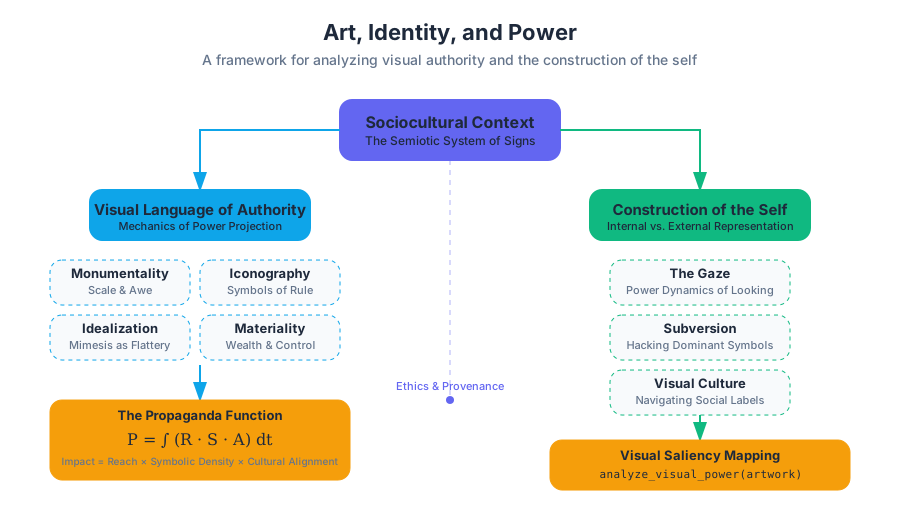
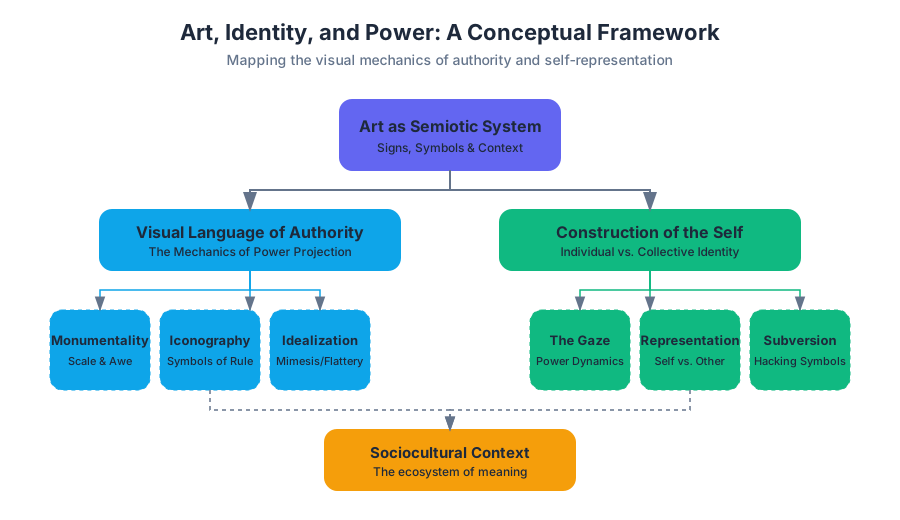
Art is rarely a neutral act of creation. It exists within a complex ecosystem of social hierarchies, political agendas, and individual self-actualization. To study art through the lens of Identity and Power is to move beyond formal analysis—the study of line, color, and composition—and into the realm of Sociocultural Context. In this framework, art functions as a semiotic system: a collection of signs and symbols that communicate who we are, who holds authority, and what values a society deems worth preserving or suppressing.
Art and Power: The Visual Language of Authority
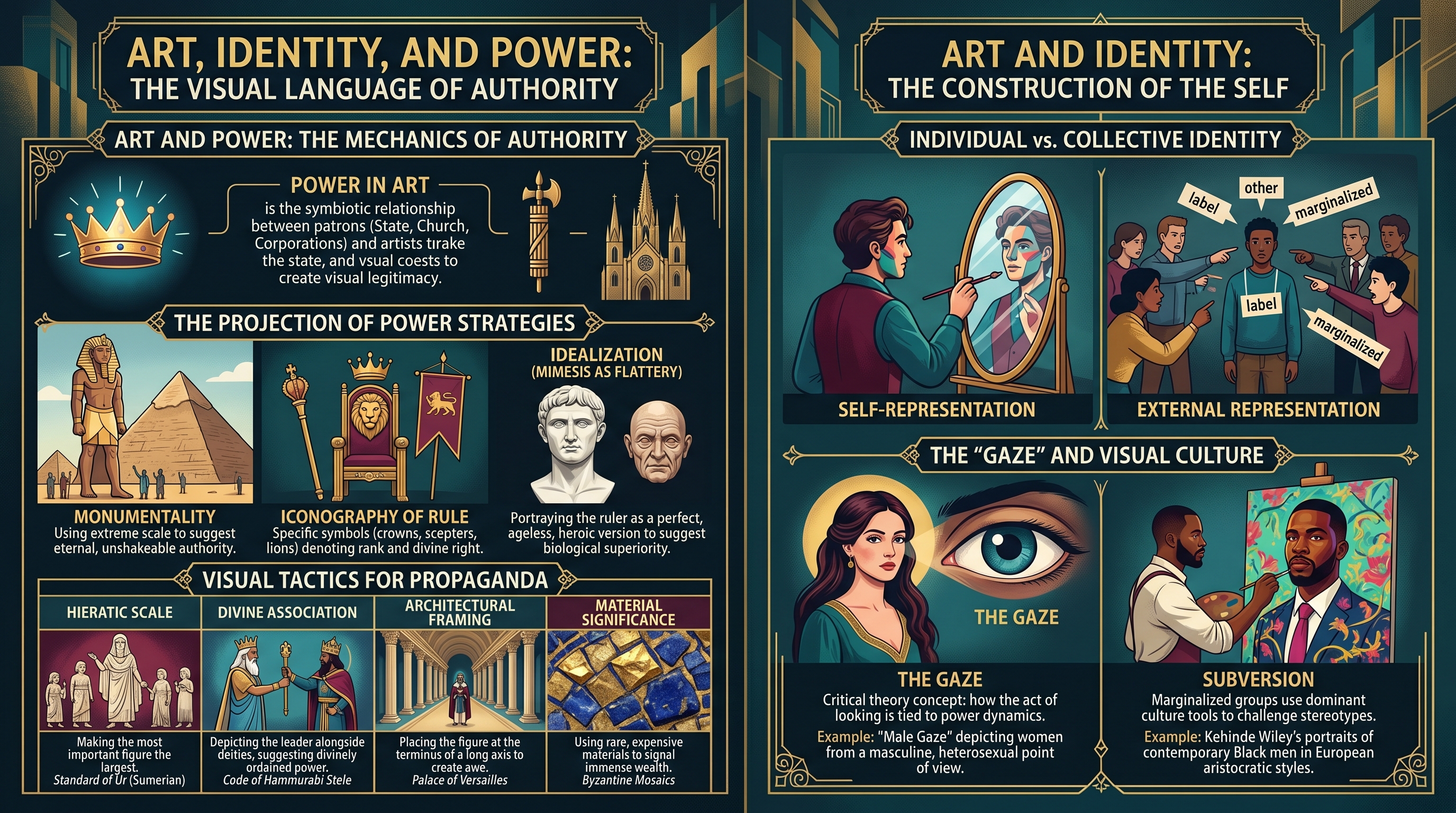
Power in art is often expressed through Propaganda, a term that, while modernly pejorative, historically refers to any systematic effort to propagate a set of beliefs or a specific image of a leader. The relationship between art and power is symbiotic: the patron (the State, the Church, or the Corporation) provides the resources, and the artist provides the visual legitimacy.
The Mechanics of Power Projection
The projection of power through art typically utilizes three primary strategies:
- Monumentality: Using scale to dwarf the viewer, suggesting an eternal and unshakeable authority (e.g., the Pyramids of Giza or the brutalist architecture of the Soviet era).
- Iconography of Rule: The use of specific symbols—crowns, scepters, or specific animals like lions—to denote rank and divine right.
- Idealization (Mimesis as Flattery): Portraying the ruler not as they are, but as a perfect, ageless, or heroic version of themselves to suggest biological or moral superiority.
| Strategy | Visual Tactic | Psychological Effect | Historical Example |
|---|---|---|---|
| Hieratic Scale | Making the most important figure the largest. | Establishes natural order and dominance. | Standard of Ur (Sumerian) |
| Divine Association | Depicting the leader alongside deities. | Suggests the ruler's power is divinely ordained. | Code of Hammurabi Stele |
| Architectural Framing | Placing the figure at the terminus of a long axis. | Focuses the viewer's attention and creates awe. | Palace of Versailles |
| Material Significance | Using rare materials (gold, lapis lazuli, purple dye). | Signals immense wealth and control over trade. | Byzantine Mosaics |
Propaganda and the State
Propaganda is the intentional manipulation of symbols to influence public opinion. In the 20th century, this became a highly technical field, blending art with mass-media psychology.
Definition: The Propaganda Function Let $P$ be the persuasive impact of a work of art. $P$ can be modeled as a function of its Reach ($R$), its Symbolic Density ($S$), and the Cultural Alignment ($A$) of the audience: $$P = \int (R \cdot S \cdot A) dt$$ Where $t$ represents the duration of exposure. High $P$ values indicate a successful shift in collective identity or political loyalty.
Art and Identity: The Construction of the Self
Identity in art is the exploration of the "Who am I?" and "Who are we?" questions. It is a dual process of Self-Representation (how we see ourselves) and External Representation (how others see us).
Individual vs. Collective Identity
Artists often use their work to navigate the tension between their personal experiences and the labels imposed upon them by society. This is particularly evident in the study of Visual Culture, where the "Gaze" plays a critical role.
- The Gaze: A term in critical theory describing how the act of looking is tied to power dynamics. The "Male Gaze," for instance, describes how visual arts have historically depicted the world and women from a masculine, heterosexual point of view.
- Subversion: When artists from marginalized groups use the tools of the dominant culture to challenge stereotypes. For example, Kehinde Wiley’s portraits use the conventions of European aristocratic portraiture to depict contemporary Black men, effectively "hacking" the visual language of power.
Analyzing Visual Attention
To understand how identity and power are communicated, researchers use saliency mapping to determine what parts of an image "grab" the viewer's attention.
Art and Ethics: Ownership, Repatriation, and Responsibility
The ethics of art involve the moral principles governing the creation, display, and ownership of artworks. As our global understanding of colonial history evolves, the ethics of Provenance (the history of ownership) have become a central conflict in the art world.
Repatriation and the "Spolia" of Empire
Repatriation is the return of art or cultural heritage to its country of origin. Many of the world's most famous museums (The British Museum, The Louvre) hold objects acquired during colonial expeditions, often under duress or through outright theft.
| Ethical Framework | Core Principle | Application to Art |
|---|---|---|
| Deontology | Duty-based ethics; some actions are inherently right or wrong. | Theft is wrong; therefore, the object must be returned regardless of the museum's ability to care for it. |
| Utilitarianism | The greatest good for the greatest number. | If more people can see the Parthenon Marbles in London than in Athens, they should stay in London. |
| Virtue Ethics | Focus on the character of the institution. | A museum should act with integrity and acknowledge the harm of colonial acquisition to maintain its moral authority. |
| Cultural Heritage Law | Legal frameworks (e.g., 1970 UNESCO Convention). | Objects exported illegally after a certain date must be returned. |
The Repatriation Logic
The decision-making process for repatriation can be modeled as a logical flow involving legal, ethical, and logistical variables.
FUNCTION Evaluate_Repatriation_Request(Artifact_A):
    IF Artifact_A.Provenance == "Illegal_Export" THEN
        RETURN "Mandatory_Return"

    IF Artifact_A.Cultural_Significance == "Sacred" AND Requesting_Party == "Origin_Culture" THEN
        IF Recipient_Facility.Is_Secure() THEN
            RETURN "Ethical_Return"
        ELSE
            RETURN "Collaborative_Custocdy_Agreement"

    IF Artifact_A.Acquisition_Context == "Colonial_War_Booty" THEN
        SET Negotiation_Status = "Active_Restitution"
        RETURN Negotiation_Status

    RETURN "Retain_and_Acknowledge_History"
Censorship: The Suppression of Art
Censorship is the suppression of speech, public communication, or other information. In art, censorship occurs when a work is deemed "dangerous" to the prevailing power structure or offensive to the collective identity of a dominant group.
Types of Censorship
- State Censorship: Direct government intervention (e.g., the Nazi "Degenerate Art" exhibition).
- Religious Censorship: Suppression based on blasphemy or violation of religious taboos (e.g., Aniconism in certain Islamic traditions).
- Market Censorship: When corporate interests or wealthy patrons refuse to fund or display work that threatens their brand or bottom line.
- Self-Censorship: When artists omit certain themes to avoid social ostracization or physical harm.
The "Streisand Effect" in Art
Censorship often backfires, a phenomenon known as the Streisand Effect. When a work is suppressed, the act of suppression itself draws more attention to the work than it would have received otherwise.
Theorem: The Inverse Visibility of Suppression Let $V$ be the visibility of a work and $C$ be the intensity of the censorship effort. $$V \propto \frac{1}{f(C)}$$ In a digitally connected society, as $C$ increases past a certain threshold, $V$ tends to increase exponentially rather than decrease, as the "forbidden" nature of the object increases its social currency.
Case Study: The Palace of Versailles as a System of Control
To understand the intersection of all these concepts, we can look at the Palace of Versailles under Louis XIV (the "Sun King").
- Power: The entire palace was a machine for the projection of absolute monarchy. The gardens were designed to show that the King could control nature itself (geometry over organic growth).
- Identity: Louis XIV constructed his identity as the "Sun King," the center of the universe. Every courtier’s identity was defined by their proximity to the King’s person.
- Ethics: The cost of Versailles was astronomical, built on the labor and taxes of a starving peasantry. The ethical "cost" of the art was the social instability that eventually led to the French Revolution.
- Censorship: The court had strict rules about what could be depicted. Any art that did not glorify the King was effectively banned from the royal sphere.
Technical Metadata for Cultural Heritage
To ensure that identity and history are preserved correctly, the CIDOC-CRM (Conceptual Reference Model) is used by museums globally to provide a formal ontology for cultural heritage information.
Common Pitfalls in Analyzing Art and Power
- Anachronism: Judging 16th-century power structures by 21st-century democratic standards. While critical analysis is necessary, understanding the original context is vital for historical accuracy.
- The "Great Man" Fallacy: Attributing the power of art solely to the artist or the ruler, while ignoring the thousands of laborers, craftspeople, and economic conditions that made the work possible.
- Binary Thinking: Viewing art as either propaganda or pure expression. Most art exists on a spectrum, containing elements of both.
Source Materials
Study Art on Lykke
This course page is free to open: signed out, you can read its first two sections, and signing in, on any plan, opens the rest. The free Lykke Chrome extension syncs your own Canvas courses, so ChatGPT, Claude and Muse can answer from your classes and deadlines. It only reads Canvas.
Add the free extensionSign in to open every section