Art
Institution: MIT
84 study materials · 11 sections
This course provides a comprehensive exploration of art as a diverse range of human activities involving the creation of visual, auditory, and performing artifacts. It covers the fundamental elements and principles of design, the historical evolution of art from ancient times to the contemporary era, and the technical applications of various media. Students will engage with critical theories, formal analysis, and the socio-political contexts that shape artistic expression, identity, and cultural heritage.
Course Sections
Defining Art and Its Foundations
Key concepts: Mimesis · Art vs. Craft · Artistic Expression · Role of the Viewer · Visual Culture
An introduction to the evolving definitions of art, the distinction between artists and artisans, and the core motivations behind human creativity.
Defining Art and Its Foundations
Art is not a static category of objects, but a dynamic, recursive feedback loop between human intent, technical execution, and sensory perception. At its most fundamental level, art is a communicative system that utilizes visual, auditory, or haptic signals to encode complex imaginative ideas or high-level technical skills. Historically, the definition of art has migrated from the rigid imitation of the physical world to a fluid exploration of conceptual and socio-cultural boundaries.
To understand the foundations of art, we must move beyond the "I know it when I see it" heuristic and engage with the formal structures, philosophical derivations, and historical shifts that have shaped the discipline.
Mimesis: The Mirror of Nature
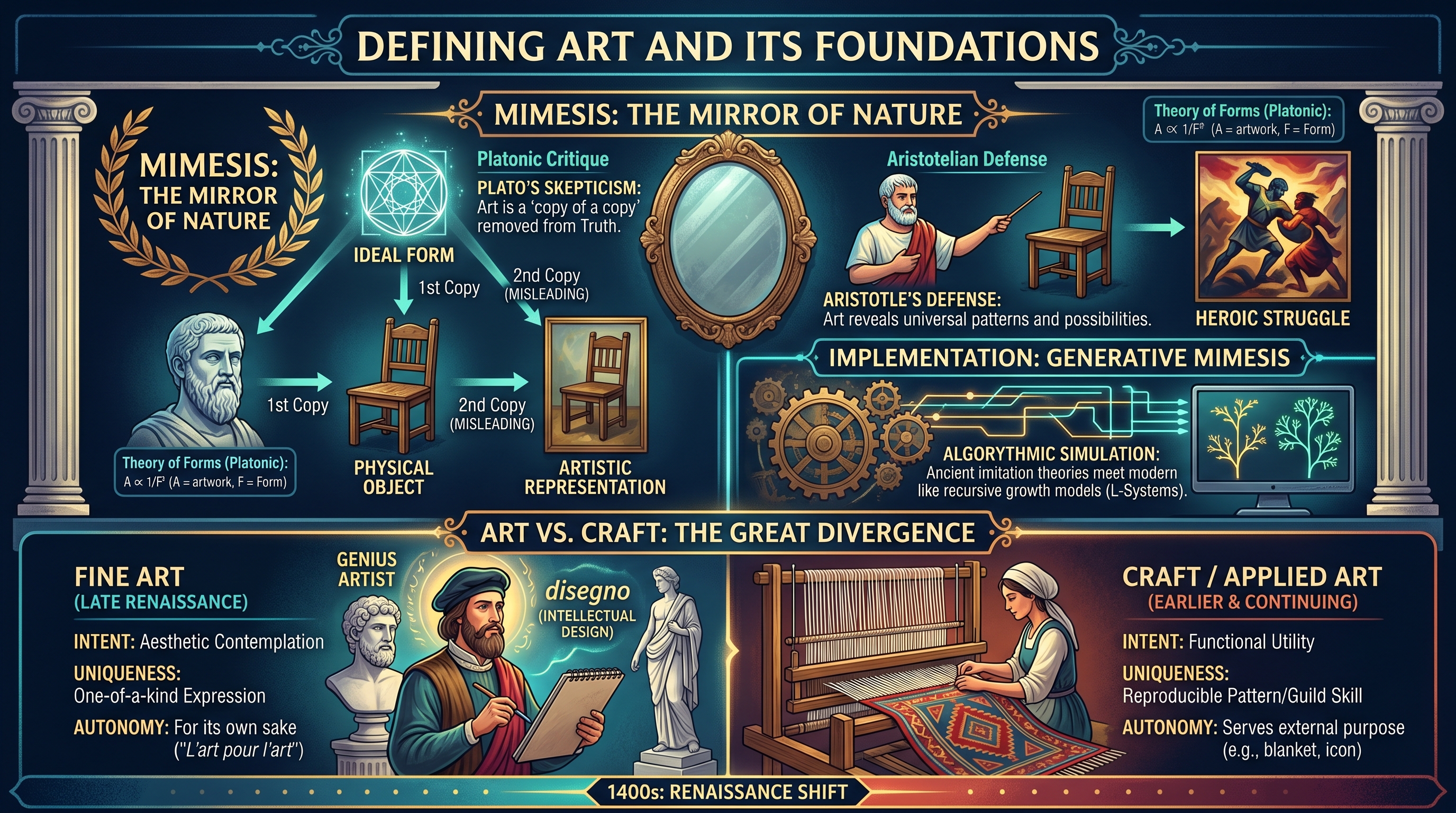
The earliest formal theories of art are rooted in Mimesis, a Greek term meaning "imitation" or "representation." For centuries, the primary metric of artistic success was the degree to which a work could simulate the appearance of the natural world.
The Platonic Critique
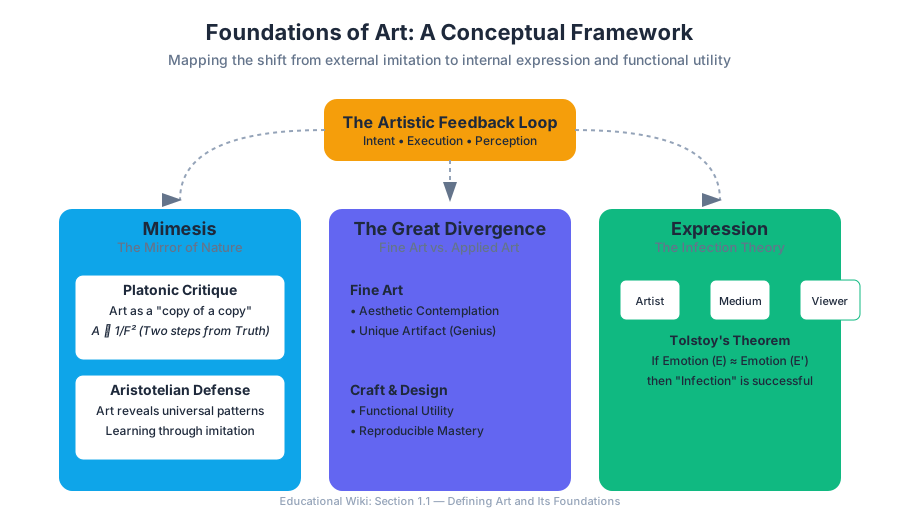
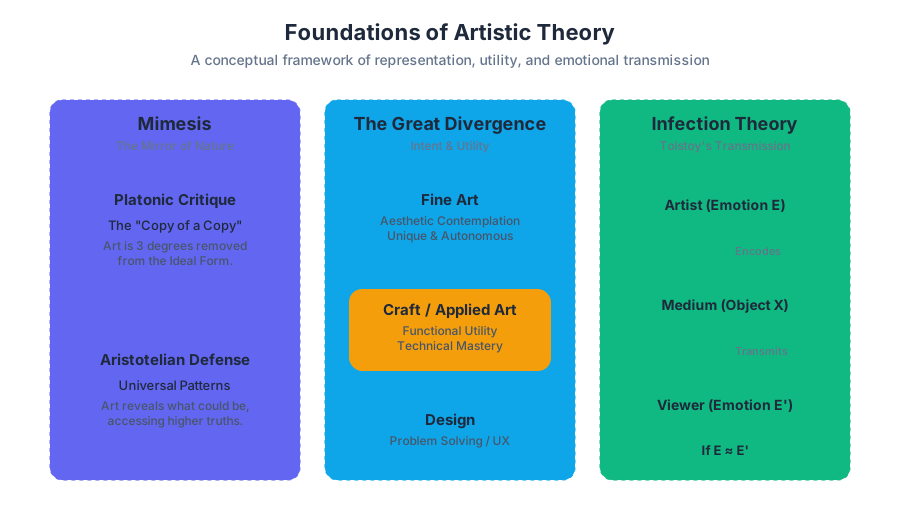
Plato, in The Republic (Book X), offered a skeptical view of mimesis. He proposed a tripartite hierarchy of reality, where the "Ideal Form" (the concept of a thing) is the highest truth, the "Physical Object" is a secondary imitation, and the "Artistic Representation" is a tertiary imitation—a "copy of a copy."
The Theory of Forms (Platonic Derivation): If $F$ is the Ideal Form, $O$ is the physical object, and $A$ is the artwork, then:
- $O \approx F$ (The carpenter imitates the Form of a bed)
- $A \approx O$ (The painter imitates the physical bed)
- Therefore, $A$ is at a remove of two degrees from the truth ($A \propto \frac{1}{F^2}$).
The Aristotelian Defense
Aristotle countered this by suggesting that mimesis is a natural human instinct and a primary tool for learning. In his Poetics, he argued that art does not just copy what exists, but represents what could exist, thereby accessing universal truths rather than mere specific instances.
| Perspective | Core Philosophy | Role of the Artist | Goal of Art |
|---|---|---|---|
| Platonic | Essentialism | Deceiver / Imitator | To mislead from the Truth |
| Aristotelian | Empiricism | Educator / Interpreter | To reveal universal patterns |
| Modernist | Subjectivism | Creator / Originator | To express internal states |
Implementation: Generative Mimesis
In contemporary technical terms, mimesis is often achieved through algorithmic simulation. Below is a low-level implementation of a simple recursive "L-System" in Python, used to mimic the growth patterns of plants—a digital form of mimesis.
import turtle

def create_l_system(iters, axiom, rules):
    """Generates a string representing a biological growth pattern."""
    start_str = axiom
    for _ in range(iters):
        end_str = "".join(rules.get(c, c) for c in start_str)
        start_str = end_str
    return start_str

def draw_l_system(t, instructions, angle, distance):
    """Translates the mimetic string into visual geometry."""
    stack = []
    for cmd in instructions:
        if cmd == 'F':
            t.forward(distance)
        elif cmd == '+':
            t.right(angle)
        elif cmd == '-':
            t.left(angle)
        elif cmd == '[':
            stack.append((t.position(), t.heading()))
        elif cmd == ']':
            pos, head = stack.pop()
            t.penup()
            t.setposition(pos)
            t.setheading(head)
            t.pendown()

# Rule for a fractal plant (Mimesis of nature)
rules = {"F": "FF-[-F+F+F]+[+F-F-F]"}
plant_string = create_l_system(4, "F", rules)
# Visualization logic follows...
Art vs. Craft: The Great Divergence
The distinction between Art (Fine Art) and Craft (Applied Art) is a relatively modern construct, largely solidified during the Renaissance and the subsequent Industrial Revolution.
The Renaissance Shift
Before the 1400s, the term technē (Greek) or ars (Latin) referred to any skilled activity, from weaving to ship-building. The artist was an artisan, a member of a guild. The Renaissance introduced the concept of the "Genius," elevating the status of painters and sculptors above manual laborers because their work involved disegno (intellectual design) rather than just physical toil.
Criteria for Distinction
The modern distinction typically rests on three pillars:
- Intent: Is the object intended for aesthetic contemplation or functional utility?
- Uniqueness: Is the object a one-of-a-kind expression or a reproducible pattern?
- Autonomy: Does the work exist for its own sake (l'art pour l'art), or does it serve an external master (e.g., a teapot, a religious icon)?
| Category | Primary Driver | Output Type | Evaluation Metric |
|---|---|---|---|
| Fine Art | Concept / Expression | Unique Artifact | Aesthetic Impact / Meaning |
| Craft | Utility / Tradition | Functional Object | Technical Mastery / Durability |
| Design | Problem Solving | Mass-Produced | User Experience / Efficiency |
| Kitsch | Sentimentality | Commodity | Emotional Accessibility |
Artistic Expression and the "Infection Theory"
If mimesis is about looking outward, expression is about looking inward. Artistic Expression posits that art is the externalization of the artist's internal emotional state.
Tolstoy’s Infection Theory
Leo Tolstoy argued in What is Art? (1897) that art is a bridge between souls. He proposed that the artist "infects" the viewer with an emotion they have experienced.
The Expression Theorem: For an object $X$ to be art, the artist $A$ must:
- Experience an emotion $E$.
- Encode $E$ into a medium $M$.
- Ensure that the viewer $V$, upon perceiving $M$, experiences $E'$.
- If $E \approx E'$, the "infection" is successful and the work is art.
The Mechanics of Expressionism
Expressionism as a movement (e.g., Munch, Van Gogh) prioritized emotional intensity over mimetic accuracy. This involved the distortion of form and the use of non-naturalistic color to evoke specific psychological responses.
\text{Aesthetic Force} (F_a) = \frac{\text{Emotional Intensity} (I) \times \text{Technical Clarity} (C)}{\text{Noise/Distraction} (N)}
The Role of the Viewer: The Beholder's Share
A work of art is not a "closed" system. It requires an observer to complete the circuit of meaning. This concept, known as the Beholder's Share, suggests that the viewer's brain provides the missing information, cultural context, and emotional resonance.
Reception Theory
Reception theory asserts that a work's meaning is not fixed at the moment of creation but is negotiated every time it is viewed. This is influenced by the viewer's "Horizon of Expectations"—the sum of their cultural knowledge, personal history, and visual literacy.
Psychological Completion
The human visual system is hardwired to find patterns. In art, this manifests as:
- Gestalt Principles: The mind perceives the whole before the parts (e.g., seeing a face in a collection of brushstrokes).
- Top-Down Processing: Our expectations (e.g., "this is a landscape") dictate how we interpret ambiguous visual data.
Visual Culture: The Expanded Field
In the 21st century, the study of art has expanded into the broader field of Visual Culture. This discipline recognizes that we live in an image-saturated world where the line between "High Art" and "Low Culture" (advertising, memes, UI design) has blurred.
Semiotics in Visual Culture
To analyze visual culture, we use Semiotics—the study of signs and symbols. Every visual element is a "sign" consisting of two parts:
- Signifier: The physical form (the pixels, the ink, the light).
- Signified: The concept or meaning triggered by the signifier.
Digital Visual Culture and Metadata
In the digital age, art is often defined by its metadata and its position within a network. The "meaning" of a digital image is often inseparable from its provenance and its tags.
{
  "@context": "http://schema.org",
  "@type": "VisualArtwork",
  "name": "The Persistence of Memory",
  "creator": {
    "@type": "Person",
    "name": "Salvador Dalí"
  },
  "artform": "Painting",
  "artMedium": "Oil on canvas",
  "description": "A surrealist masterpiece featuring melting clocks.",
  "visualAttributes": {
    "colorPalette": ["#8B4513", "#DAA520", "#4682B4"],
    "movement": "Surrealism",
    "symbolism": ["Time", "Decay", "Subconscious"]
  }
}
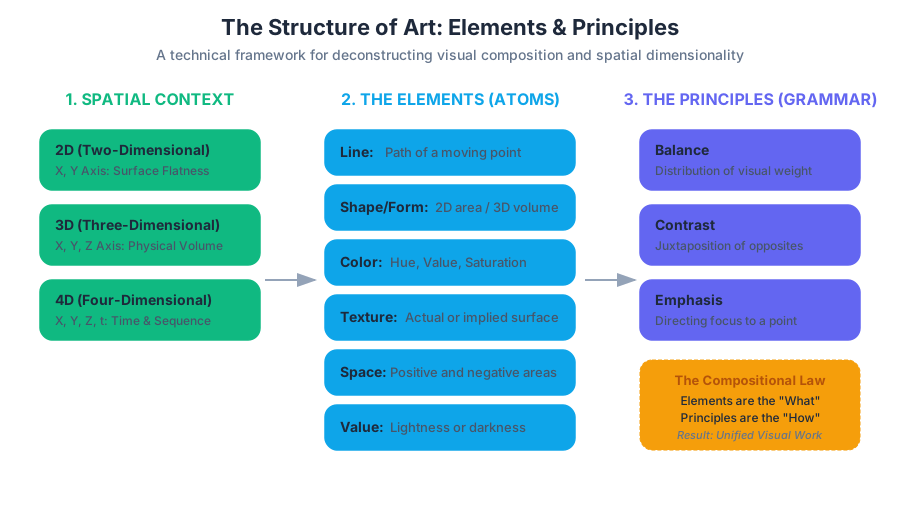
The Structure of Art: Elements and Principles
While the definition of art is philosophical, the structure of art is technical. Artists use a specific vocabulary to build visual experiences.
The Elements (The "Tools")
- Line: A point moving in space. Can be actual, implied, or psychic.
- Shape/Mass: 2D areas (shape) or 3D volumes (mass).
- Color: Defined by hue, value (lightness/darkness), and intensity (saturation).
- Texture: The surface quality, either tactile or visual.
- Space: The area around, between, or within components.
The Principles (The "Rules")
- Balance: The distribution of visual weight (symmetrical, asymmetrical, radial).
- Contrast: The juxtaposition of different elements to create interest.
- Emphasis: Drawing the viewer's attention to a focal point.
- Rhythm/Movement: The suggestion of motion through repetition.
| Element | Principle | Resulting Effect |
|---|---|---|
| Color | Contrast | High visual impact / Vibrancy |
| Line | Rhythm | Directional flow / Energy |
| Shape | Balance | Stability or Tension |
| Space | Emphasis | Isolation of the subject (Negative Space) |
Common Pitfalls in Defining Art
- The "Skill" Fallacy: Assuming that if something doesn't require obvious manual dexterity, it isn't art (e.g., Readymades or Conceptual Art). Art is often about the choice or the idea rather than the fabrication.
- The "Beauty" Trap: Confining art to the "beautiful." Much of the most significant art in history was designed to be provocative, ugly, or disturbing to spark social change.
- Ignoring Context: Attempting to judge a work without understanding its historical or cultural origin. A white square on a white canvas means something very different in 1918 (Malevich) than it does in 2024.
The Structure of Art: Elements and Principles
Key concepts: Elements of Art · Principles of Design · Dimensionality · Composition · Visual Vocabulary
A deep dive into the specialized vocabulary of art, focusing on the formal elements and design principles that govern visual composition.
The Structure of Art: Elements and Principles
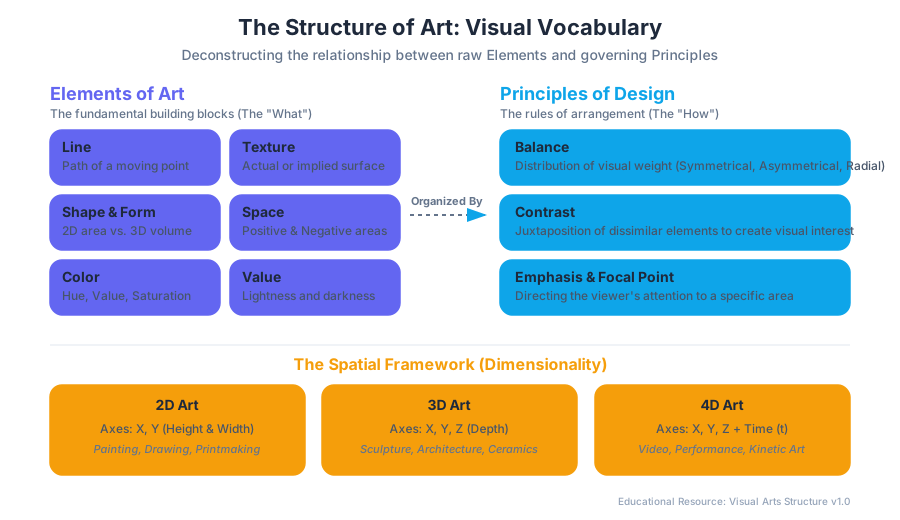
To analyze art effectively, one must understand its Visual Vocabulary—the formal "grammar" that governs how visual information is encoded, transmitted, and perceived. Just as a linguist breaks down a sentence into phonemes, morphemes, and syntax, an art historian or practitioner deconstructs a work into its Elements of Art (the raw components) and Principles of Design (the rules governing their arrangement). This structural framework allows us to move beyond subjective "liking" toward a technical understanding of how a composition functions.
Dimensionality: The Spatial Framework
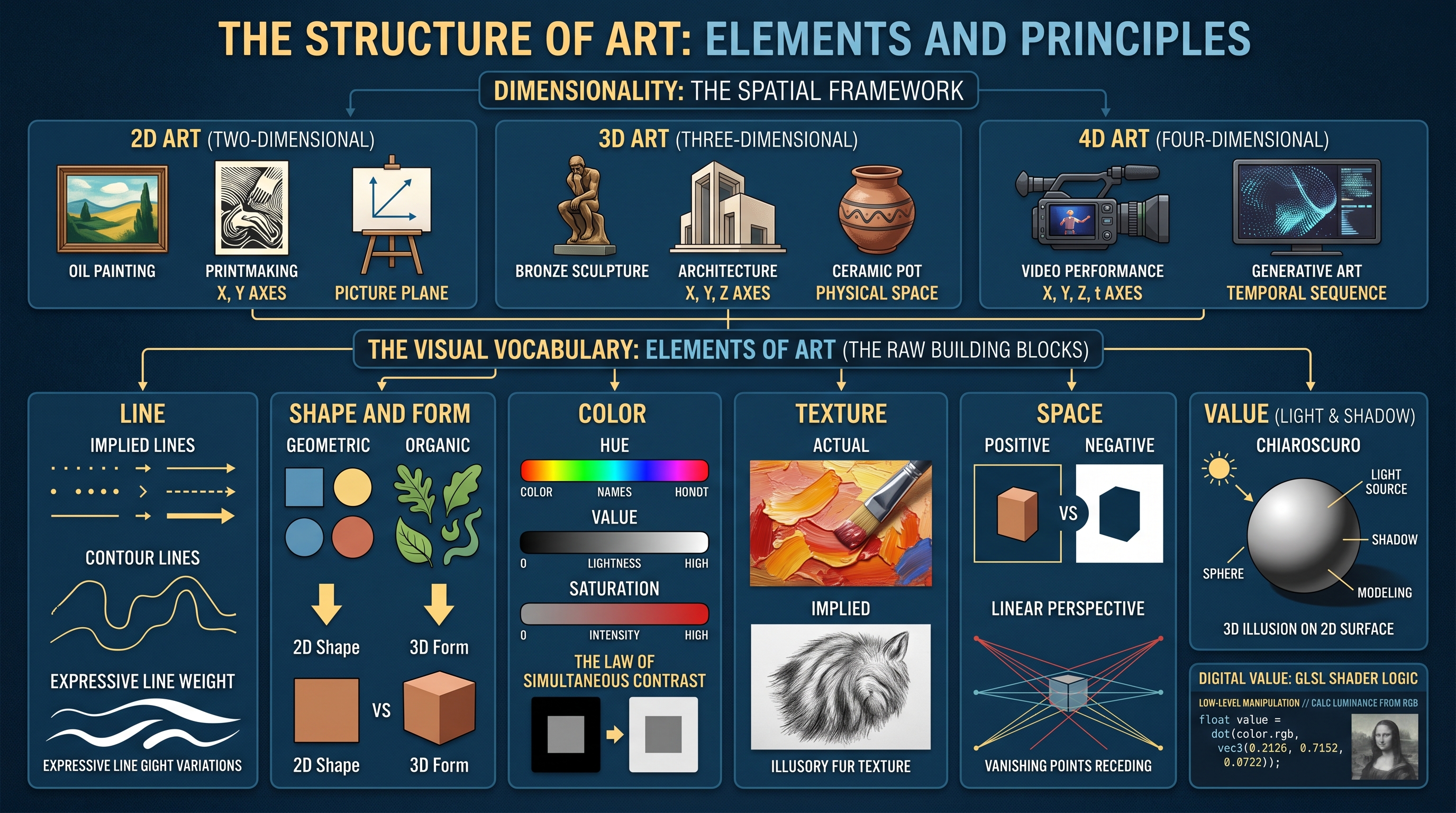
Before examining individual elements, we must define the spatial context in which they exist. Dimensionality dictates the constraints and possibilities of the artistic medium.
- 2D Art (Two-Dimensional): Defined by height and width. The primary challenge is the "illusion of depth" on a flat plane (the picture plane). Examples include drawing, painting, and printmaking.
- 3D Art (Three-Dimensional): Defined by height, width, and depth. These works occupy physical space and are subject to the laws of gravity and lighting. Examples include sculpture, architecture, and ceramics.
- 4D Art (Four-Dimensional): Includes the element of Time. This encompasses video art, performance art, and kinetic sculpture where the work changes state or position over a duration.
| Dimension | Primary Axis | Key Constraint | Typical Media |
|---|---|---|---|
| 2D | X, Y | Surface Flatness | Oil on Canvas, Lithography, Digital Illustration |
| 3D | X, Y, Z | Structural Integrity | Bronze Casting, Architecture, Installation |
| 4D | X, Y, Z, $t$ | Temporal Sequence | Video, Performance, Generative Code Art |
The Elements of Art: The Visual Building Blocks
The elements are the fundamental components used by artists to create imagery. They are the "atoms" of the visual world.
Line
A Line is technically the path of a point moving through space. In geometry, a line has length but no width; in art, the "weight" (thickness) of a line is a critical expressive tool.
- Implied Lines: Lines that are not physically drawn but suggested by the alignment of shapes or the "eyeline" of a subject.
- Contour Lines: Lines that define the outer edges of a form and its internal surface variations.
Shape and Form
Shape refers to a two-dimensional area defined by an enclosed line or a change in color/value. Form refers to three-dimensional volume (or the illusion of it).
- Geometric: Precise and regular (circles, squares, triangles). Often associated with man-made structures.
- Organic: Irregular and asymmetrical. Often associated with nature and living organisms.
Color (Hue, Value, Saturation)
Color is the most complex element, rooted in the physics of light. It is defined by three dimensions:
- Hue: The name of the color (Red, Blue, Green).
- Value: The lightness or darkness of a color.
- Saturation (Chroma): The intensity or purity of the color.
The Law of Simultaneous Contrast: Proposed by Michel Eugène Chevreul, this theorem states that the perception of a color is significantly altered by the colors surrounding it. A grey square will appear lighter against a black background than against a white one.
Texture
Texture refers to the surface quality of a work. It can be Actual (tactile, as in a thick impasto painting) or Visual/Implied (the illusion of texture, as in a hyper-realistic drawing of fur).
Space
Space involves the area around and within objects.
- Positive Space: The area occupied by the primary subjects.
- Negative Space: The "empty" area around the subjects.
- Linear Perspective: A mathematical system for representing 3D space on a 2D surface using vanishing points and horizon lines.
Value (Light and Shadow)
Value is the relative lightness or darkness of a surface. In 2D art, the manipulation of value is known as Chiaroscuro, used to create the illusion of three-dimensional volume through "modeling."
Code Example 1: Low-Level Value Manipulation (GLSL)
In digital art, "Value" is often calculated by converting RGB color data into a single luminance scalar. The following fragment shader demonstrates a standard weighted luminance algorithm.
// Fragment shader to calculate grayscale value (Luminance)
precision mediump float;
varying vec2 vTexCoord;
uniform sampler2D uTexture;

void main() {
    vec4 color = texture2D(uTexture, vTexCoord);

    // Standard ITU-R BT.709 weights for luma
    // Human eyes are most sensitive to green, then red, then blue.
    float value = dot(color.rgb, vec3(0.2126, 0.7152, 0.0722));

    gl_FragColor = vec4(vec3(value), color.a);
}
The Principles of Design: The Grammar of Composition
If the elements are the "what," the principles are the "how." They describe how the elements are organized to create a successful Composition.
Balance
Balance is the distribution of visual weight. A composition feels "balanced" when the visual forces are in equilibrium.
- Symmetrical Balance: Mirror-image or near-mirror-image arrangement. Conveys stability and formality.
- Asymmetrical Balance: Different elements on either side that still achieve equilibrium through visual weight (e.g., one large dark shape balanced by several small light shapes).
- Radial Balance: Elements radiate from a central point.
Contrast
Contrast is the juxtaposition of strongly dissimilar elements (light vs. dark, rough vs. smooth, large vs. small). It is the primary tool for creating Emphasis and visual interest.
Emphasis and Focal Point
Emphasis is the strategy of drawing the viewer's attention to a specific area, known as the Focal Point. This is often achieved through high contrast, isolation, or "leading lines."
Rhythm and Movement
Movement is the path the viewer's eye takes through the work. Rhythm is the repetition of elements to create a sense of organized movement, much like a beat in music.
Unity and Variety
Unity is the sense of "oneness" or wholeness in a work—the feeling that all parts belong together. Variety provides the necessary diversity to keep the viewer engaged. A successful work balances both; too much unity is boring (monotony), while too much variety is chaotic.
Proportion and Scale
Scale refers to the size of an object in relation to a standard (usually the human body). Proportion refers to the size relationship between parts of a whole.
The Golden Ratio ($\phi$): A mathematical proportion ($\approx 1.618$) found in nature and used in art to create aesthetically pleasing compositions. It is defined by the relationship: $$\frac{a+b}{a} = \frac{a}{b} = \phi$$
Code Example 2: Mathematical Derivation of the Golden Spiral
The Golden Ratio is often implemented in generative art using the Fibonacci sequence, which approximates $\phi$ as the sequence progresses.
% Mathematical representation of the Golden Ratio growth
F_n = F_{n-1} + F_{n-2}
\lim_{n \to \infty} \frac{F_n}{F_{n-1}} \approx 1.618033...

% To generate a Golden Spiral in polar coordinates:
r = a e^{b \theta}
where:
b = \frac{\ln(\phi)}{\pi/2} \approx 0.30635
Code Example 3: Procedural Composition Analysis (Python/OpenCV)
In modern technical art analysis, we can use Computer Vision to detect the "Rule of Thirds" or "Symmetry" within a composition.
import cv2
import numpy as np

def analyze_composition(image_path):
    img = cv2.imread(image_path)
    gray = cv2.cvtColor(img, cv2.COLOR_BGR2GRAY)

    # 1. Edge Detection (Analyzing Line and Shape)
    edges = cv2.Canny(gray, 100, 200)

    # 2. Calculate Visual Weight (Luminance Centroid)
    # Higher weight is given to darker/higher contrast areas
    moments = cv2.moments(edges)
    if moments["m00"] != 0:
        cX = int(moments["m10"] / moments["m00"])
        cY = int(moments["m01"] / moments["m00"])
    else:
        cX, cY = 0, 0

    # 3. Check for Symmetry (Horizontal Flip Comparison)
    h, w = gray.shape
    left_half = gray[:, :w//2]
    right_half = cv2.flip(gray[:, w//2:], 1)
    # Ensure dimensions match for comparison
    right_half = cv2.resize(right_half, (left_half.shape[1], left_half.shape[0]))

    diff = cv2.absdiff(left_half, right_half)
    symmetry_score = 1.0 - (np.sum(diff) / (h * (w//2) * 255))

    return {
        "visual_center": (cX, cY),
        "symmetry_score": symmetry_score,
        "edge_density": np.mean(edges) / 255
    }

# Usage
analysis = analyze_composition("masterpiece.jpg")
print(f"Symmetry Score: {analysis['symmetry_score']:.2f}")
Synthesis: The Grammar in Action
The mastery of art lies not in the isolated use of these elements, but in their Synthesis. A "Composition" is the final arrangement where elements and principles work in concert to communicate a message or evoke an emotion.
Visual Weight Factors
Visual weight is the perceived "heaviness" of an object in a composition. Understanding this is crucial for achieving balance.
| Factor | High Visual Weight | Low Visual Weight |
|---|---|---|
| Size | Large | Small |
| Color | Warm (Red/Orange) | Cool (Blue/Green) |
| Value | Dark | Light |
| Texture | Complex/Rough | Smooth/Simple |
| Position | Near the edges/top | Near the center/bottom |
Common Pitfalls in Composition
- The Dead Center: Placing the focal point exactly in the center of the frame often creates a static, uninteresting composition. Using the Rule of Thirds (placing elements at the intersections of a $3 \times 3$ grid) usually creates more dynamic tension.
- Edge Kissing: Allowing an object to just barely touch the edge of the frame (a "tangent"). This creates visual tension that distracts from the focal point.
- Value Flattening: Failing to use a full range of values (from pure black to pure white). This results in a "muddy" or flat image that lacks depth.
- Lack of Hierarchy: When every element has the same visual weight, the viewer's eye has no place to start, leading to visual fatigue.
Conclusion: The Language of the Eye
Understanding the structure of art transforms the viewer from a passive consumer into an active decoder. By identifying the lines that lead our eyes, the colors that set the mood, and the balance that provides stability, we gain insight into the artist's intent and the cultural context of the work. Whether analyzing a Renaissance fresco or a modern user interface, the elements and principles of design remain the universal constants of visual communication.
Significance of Materials and Media
Key concepts: Intrinsic vs. Monetary Value · Spolia · Artistic Medium · Materiality · Technical Application
Exploration of how the choice of physical materials—from precious metals to digital media—influences the meaning and value of artwork.
Significance of Materials and Media
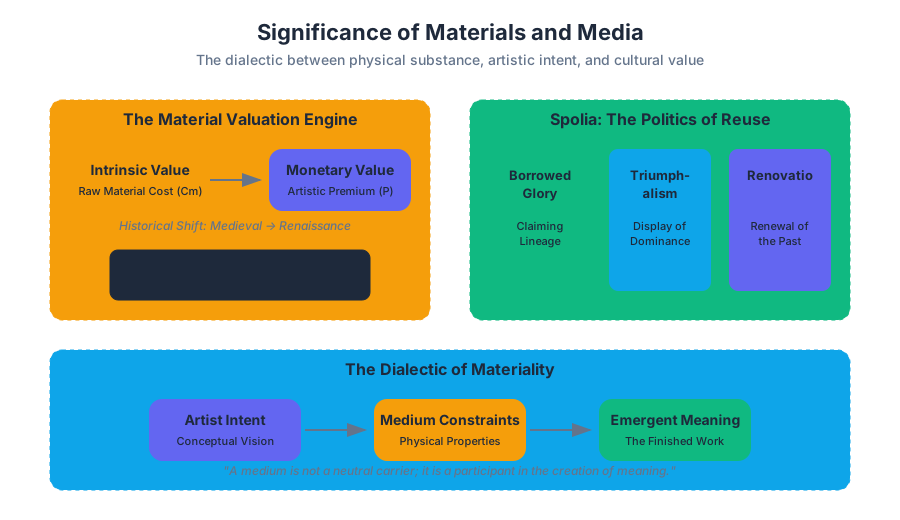
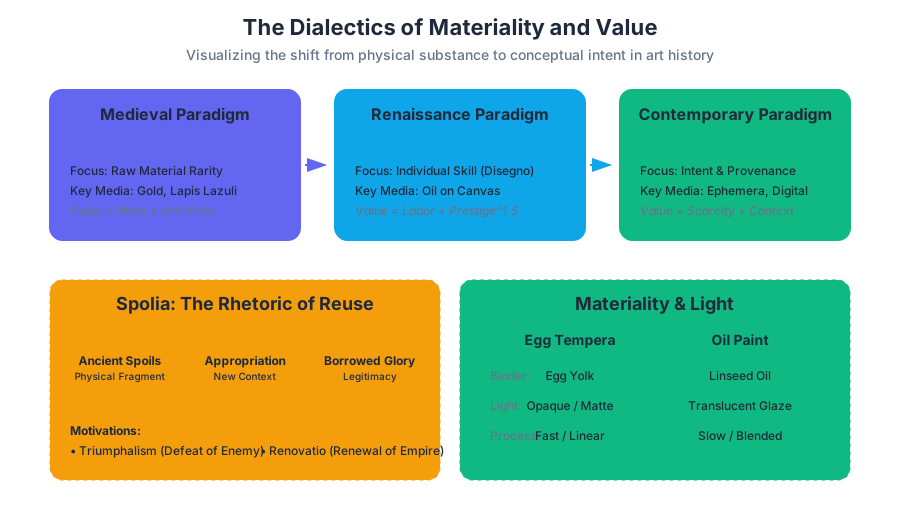
In the study of art history and visual culture, the "material turn" has refocused scholarly attention on the physical substances that constitute an object. A medium is not merely a neutral carrier for an image; it is a participant in the creation of meaning. To understand a work of art, one must analyze the dialectic between the artist's intent and the constraints, histories, and costs of the materials employed. This section explores the hierarchy of value, the politics of reuse, and the technical mechanics of various media.
Intrinsic vs. Monetary Value
The valuation of an artwork is a complex function involving the raw cost of materials, the labor of the artist, and the cultural prestige of the finished object. Historically, these two forms of value—intrinsic and monetary—have fluctuated in their relative importance.
The Hierarchy of Value
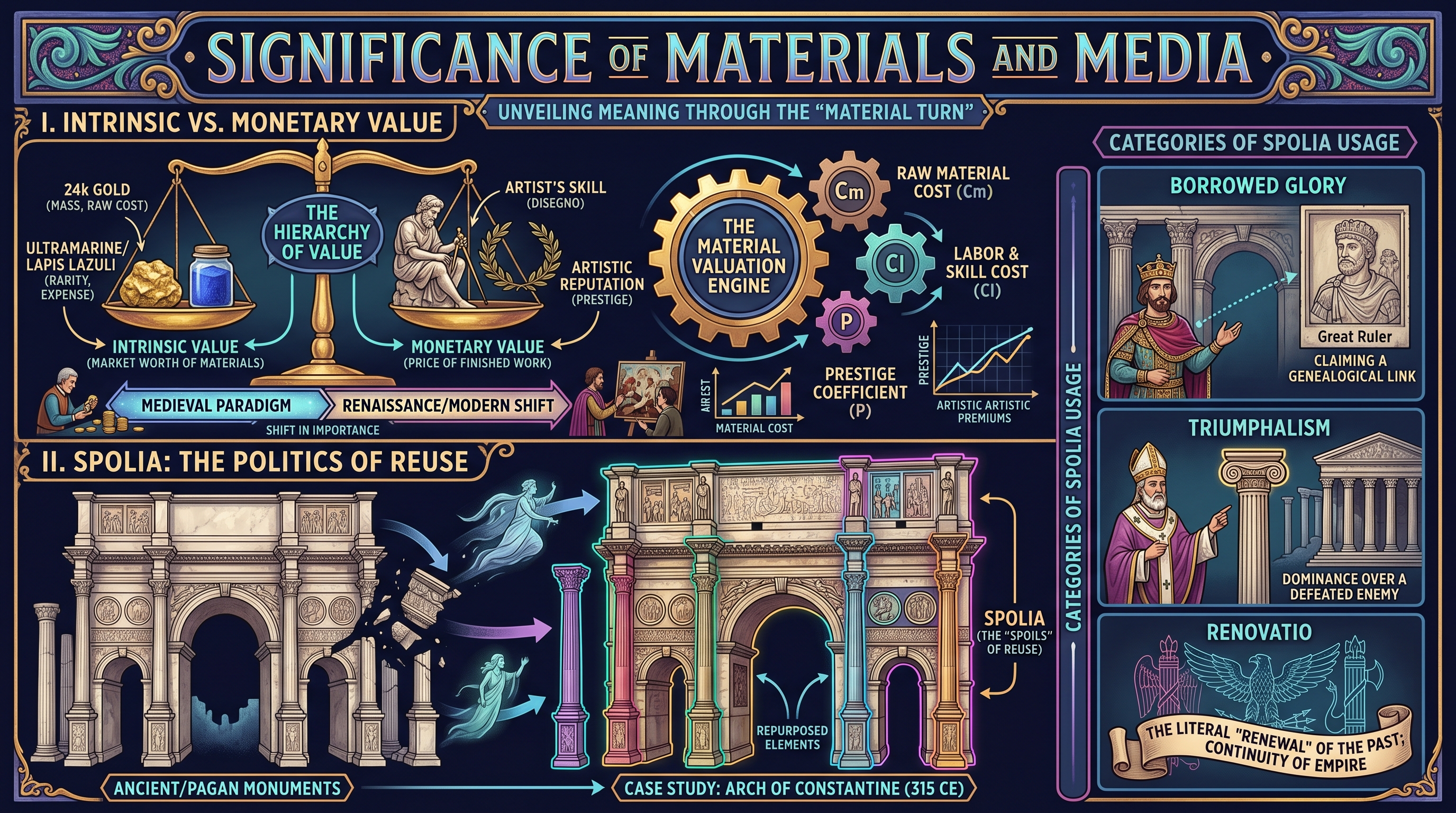
Definition: Intrinsic Value refers to the market worth of the raw materials themselves (e.g., the weight of gold, the rarity of Lapis Lazuli), whereas Monetary Value (or Artistic Value) represents the price the finished work commands due to the artist's reputation, provenance, and aesthetic "genius."
In the Medieval and early Renaissance periods, contracts often specified the exact quantity of gold leaf or ultramarine (ground Lapis Lazuli) to be used. The patron’s status was signaled by the intrinsic value of the materials. However, as the Renaissance progressed, writers like Leon Battista Alberti began to argue that the artist's skill (disegno) should be valued more highly than the "glitter of gold," marking a shift toward the modern conception of artistic value.
| Valuation Factor | Medieval Paradigm | Renaissance/Modern Paradigm | Contemporary Paradigm |
|---|---|---|---|
| Primary Driver | Material Rarity (Gold, Ivory) | Artist's Skill and Intellectual Labor | Conceptual Intent and Provenance |
| Role of Patron | Supplier of raw materials | Facilitator of creative vision | Investor or Institutional collector |
| Cost Basis | Weight-based (Mass $\times$ Unit Price) | Reputation-based (Market Demand) | Scarcity-based (Edition size, NFT) |
| Symbolism | Divine light, literal wealth | Humanist achievement | Critique of capital, social commentary |
The Material Valuation Engine
To understand the relationship between material cost and final valuation, we can model the "Value Multiplier" ($V_m$) of an artwork. In a system where the raw material cost is $C_m$ and the labor/skill cost is $C_l$, the total value $V_t$ is influenced by a prestige coefficient $P$.
// Low-level implementation of a Material Valuation Model
// Calculates the 'Artistic Premium' over raw material costs

struct ArtMaterial {
    name: String,
    cost_per_gram: f64,
    density_g_cm3: f64,
}

struct Artwork {
    material: ArtMaterial,
    volume_cm3: f64,
    artist_prestige_score: f64, // Scale of 1.0 to 100.0
    labor_hours: f64,
}

impl Artwork {
    fn calculate_intrinsic_value(&self) -> f64 {
        let mass = self.volume_cm3 * self.material.density_g_cm3;
        mass * self.material.cost_per_gram
    }

    fn calculate_market_value(&self, hourly_rate: f64) -> f64 {
        let intrinsic = self.calculate_intrinsic_value();
        let labor_cost = self.labor_hours * hourly_rate;

        // The 'Artistic Premium' scales exponentially with prestige
        let premium = (self.artist_prestige_score.powf(1.5)) * 100.0;

        intrinsic + labor_cost + premium
    }
}

fn main() {
    let gold = ArtMaterial {
        name: String::from("24k Gold"),
        cost_per_gram: 65.50,
        density_g_cm3: 19.3,
    };

    let sculpture = Artwork {
        material: gold,
        volume_cm3: 10.0, // Small figurine
        artist_prestige_score: 85.0,
        labor_hours: 200.0,
    };

    println!("Intrinsic Value: ${:.2}", sculpture.calculate_intrinsic_value());
    println!("Total Market Value: ${:.2}", sculpture.calculate_market_value(50.0));
}
Spolia: The Politics of Reuse
Spolia (from the Latin for "spoils") refers to the repurposing of architectural elements or decorative sculptures from older buildings for use in new ones. This is rarely a matter of mere convenience or resource scarcity; it is a profound rhetorical gesture.
Categories of Spolia Usage
- Borrowed Glory: A new ruler incorporates elements from the monuments of a "Great" predecessor to claim a genealogical or political link to their success.
- Triumphalism: The use of materials taken from a defeated enemy as a display of dominance (e.g., the use of columns from pagan temples in early Christian basilicas).
- Renovatio: The literal "renewal" of the past, where the physical continuity of the material suggests the continuity of the Empire or State.
Case Study: The Arch of Constantine (315 CE)
The Arch of Constantine is the most famous example of spolia. It incorporates reliefs from the eras of Trajan, Hadrian, and Marcus Aurelius. By placing his own image alongside these "Good Emperors," Constantine used the materiality of the past to legitimize his present rule.
| Spolia Element | Original Source | Intended Connotation |
|---|---|---|
| Dacian Prisoners | Trajanic Forum | Military conquest and expansion |
| Hunting Medallions | Hadrianic Monuments | Personal courage and piety |
| Battle Reliefs | Marcus Aurelius | Stoic leadership and civic duty |
| New Constantinian Frieze | Contemporary (4th Century) | The specific narrative of Constantine's victory |
Artistic Medium and Materiality
The Artistic Medium is the specific substance used by the artist. Materiality refers to the physical properties of that medium and how they dictate the viewer's experience and the artist's process.
The Physics of Light in Painting
The choice between Egg Tempera and Oil Paint is not just an aesthetic one; it is a chemical one. The refractive index of the binder determines how light interacts with the pigment particles.
The Kubelka-Munk Theory: This describes how light is scattered and absorbed within a layer of paint. The reflectance $R$ of a paint layer is a function of the absorption coefficient $K$ and the scattering coefficient $S$.
R = 1 + \frac{K}{S} - \sqrt{\left( \frac{K}{S} \right)^2 + 2\left( \frac{K}{S} \right)}
In Egg Tempera, the binder (egg yolk) dries quickly and has a low refractive index, leading to a matte, opaque surface where light scatters mostly at the surface. In Oil Painting, the linseed oil has a high refractive index and dries slowly, allowing light to penetrate multiple translucent layers (glazes) before reflecting back, creating a "deep" glow and realistic flesh tones.
Comparison of Traditional Media
| Medium | Binder | Support | Drying Mechanism | Visual Characteristic |
|---|---|---|---|---|
| Fresco | Lime Plaster (Wet) | Wall | Carbonatization | Matte, integrated with architecture |
| Encaustic | Beeswax | Wood Panel | Cooling (Phase change) | Waxy, textural, durable |
| Tempera | Egg Yolk | Poplar Panel | Evaporation | Linear, detailed, matte |
| Oil | Linseed/Walnut Oil | Canvas/Panel | Oxidation (Polymerization) | Luminous, blended, versatile |
Technical Application: The Pipeline of Creation
The "Technical Application" refers to the specific sequence of operations required to transform raw material into a finished form. This is often a multi-stage pipeline involving specialized tools and environments.
The Lost-Wax Casting Process (Cire Perdue)
For bronze sculpture, the technical application is a high-stakes engineering feat. If the gases are not vented correctly, the bronze will explode or develop "pitting."
- Core Creation: A clay core is built to reduce the weight of the final bronze.
- Wax Modeling: A layer of wax is applied over the core and sculpted into the final shape.
- Investment: The wax is covered in a heat-resistant material (like ceramic shell).
- Burn-out: The mold is heated; the wax melts and runs out, leaving a cavity.
- Pouring: Molten bronze (approx. 1200°C) is poured into the cavity.
- Chasing: Once cooled, the mold is broken, and the bronze is polished and "chased" to remove imperfections.
Modern Technical Application: Digital Materiality
In the 21st century, "material" has expanded to include bits and pixels. However, even digital art has a technical pipeline that mimics physical constraints, such as bit-depth and color space.
# Example: Digital Asset Preservation Metadata (METS/PREMIS style)
# Defining the 'Materiality' of a Digital Object

asset_id: "sculpture_3d_scan_001"
material_properties:
  physical_equivalent: "Carrara Marble"
  geometry:
    format: "OBJ"
    polygon_count: 4500000
    topology: "Non-manifold"
  texture_maps:
    diffuse: "marble_diff_8k.tif"
    normal: "marble_norm_8k.tif"
    specular: "marble_spec_8k.tif"
  color_space:
    profile: "ACEScg"
    bit_depth: 32
    gamma: 1.0
preservation_status:
  checksum: "sha256:e3b0c44298fc1c149afbf4c8996fb92427ae41e4649b934ca495991b7852b855"
  storage_medium: "LTO-8 Tape"
Material Connotations and Social Status
Materials carry "social lives." The use of a particular medium can immediately signal the class, religion, or geographic reach of the patron.
- Purple (Porphyry): A hard igneous rock found only in one remote Egyptian quarry. In the Roman Empire, its use was restricted to the Imperial family, making the material itself a symbol of the Emperor.
- Ivory: Derived from elephant tusks, its use in Northern Europe (where elephants do not exist) signaled the vast trade networks and wealth of the Carolingian and Ottonian courts.
- Steel and Glass: In the 19th and 20th centuries, these materials became the "medium" of the Industrial Revolution, signaling progress, transparency, and the triumph of engineering over traditional masonry.
Common Pitfalls in Material Analysis
- The "Progress" Fallacy: Assuming that newer materials (like oil paint) are "better" than older ones (like tempera). Each medium offers different affordances; tempera allows for a precision of line that oil cannot easily replicate.
- Ignoring the "Substrate": Focusing only on the paint and ignoring the support (canvas, wood, copper). The expansion and contraction of a wood panel in humidity can destroy an artwork, regardless of the quality of the paint.
- Over-emphasizing Rarity: Assuming a work is important only because it uses gold. Many of the most significant works in art history (e.g., Picasso’s Guernica) use humble materials (house paint on canvas) to achieve their impact.
Describing Art: Formal Analysis
Key concepts: Formal Analysis · Naturalism · Abstraction · Non-objective Art · Artistic Style
Methods for systematic analysis and description of art, moving from objective observation to subjective evaluation.
Describing Art: Formal Analysis
Formal analysis is the foundational methodology of art history and visual culture studies. It is the systematic process of examining the visual elements of a work of art—its "form"—independent of its historical context or narrative content. If art is a language, formal analysis is the study of its grammar and syntax. By deconstructing a work into its constituent parts, we can understand how an artist communicates meaning through purely visual means.
This approach assumes that the meaning of a work is inextricably linked to its physical properties. A formal analysis does not begin with "What is this about?" but rather "What do I see, and how is it organized?" This rigorous observation allows the viewer to move beyond subjective "liking" toward an objective understanding of the work's internal logic.
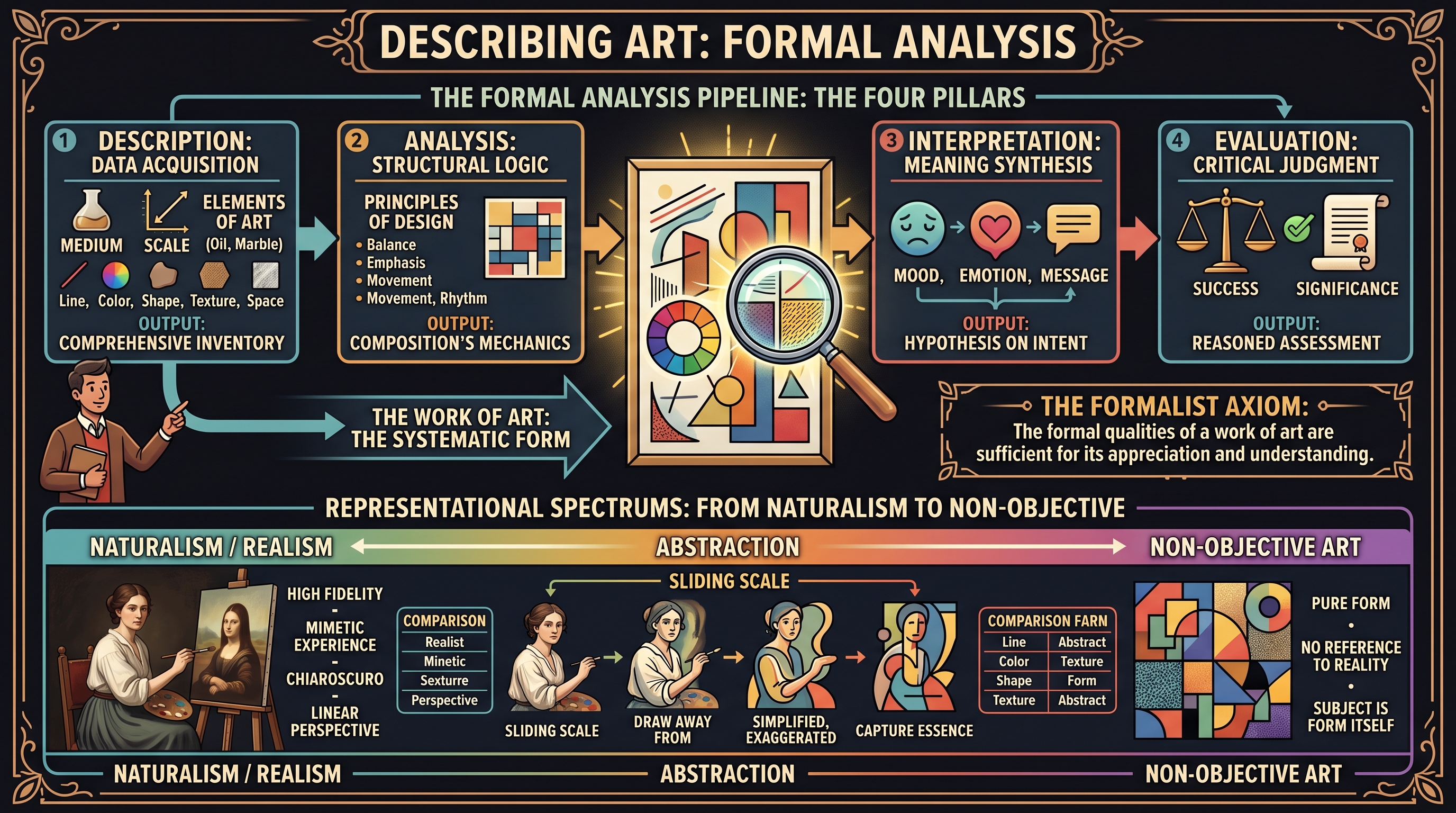
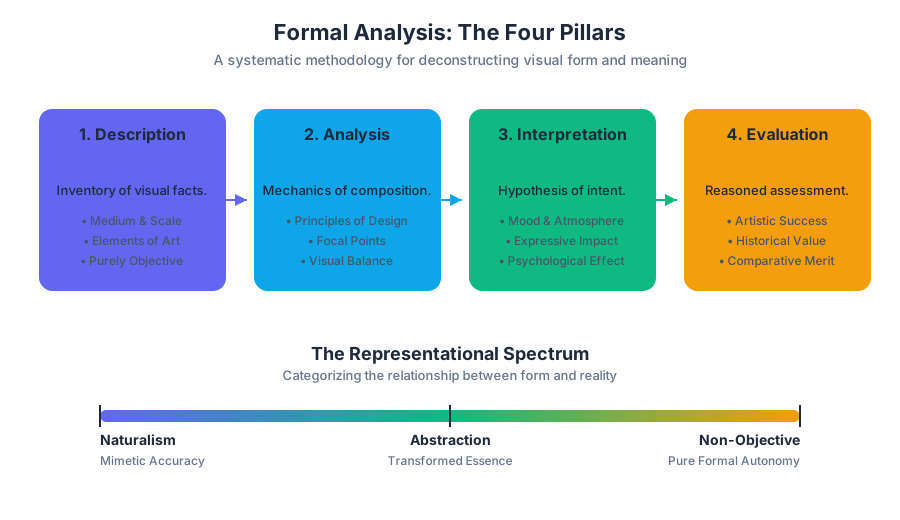
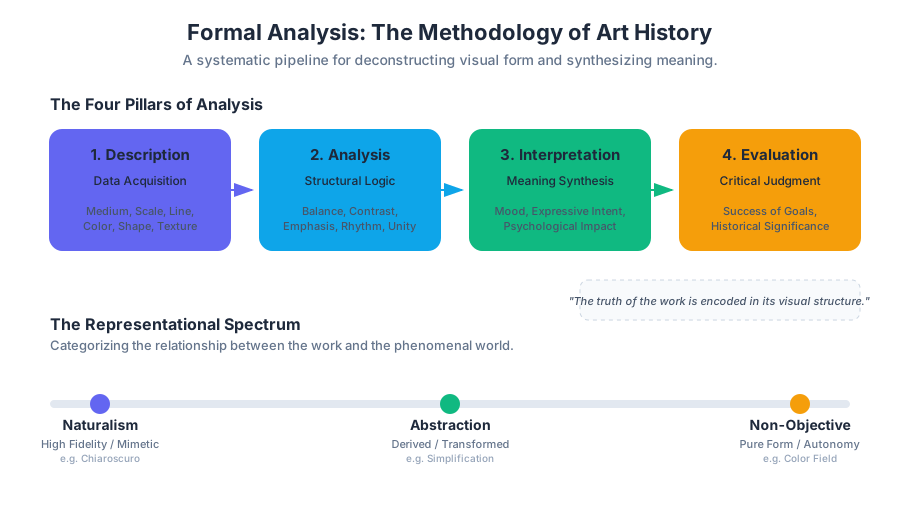
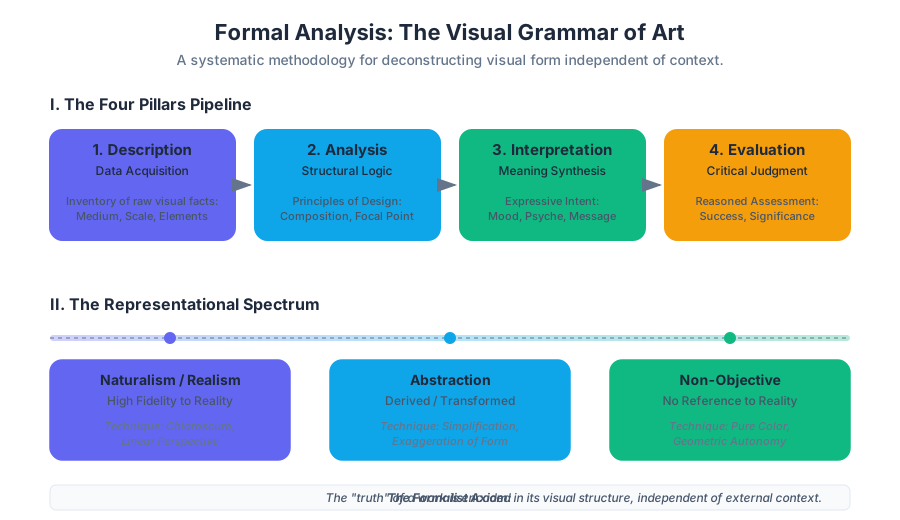
The Formal Analysis Pipeline: The Four Pillars
To perform a formal analysis, scholars utilize a four-step iterative process. This pipeline ensures that the final interpretation is grounded in observable data rather than mere intuition.
| Phase | Objective | Key Questions | Output |
|---|---|---|---|
| 1. Description | Data Acquisition | What colors, shapes, and textures are present? What is the medium? | A comprehensive inventory of visual facts. |
| 2. Analysis | Structural Logic | How are the elements related? Is there symmetry? Where is the focal point? | An understanding of the composition's mechanics. |
| 3. Interpretation | Meaning Synthesis | What mood or message do these formal choices convey? | A hypothesis regarding the work's expressive intent. |
| 4. Evaluation | Critical Judgment | How successful is the work in its goals? What is its historical significance? | A reasoned assessment of the work's value. |
1. Description: The Inventory of Form
The descriptive phase is purely objective. It avoids "why" and focuses on "what." In a technical sense, this is the extraction of raw features from the visual field. We identify the medium (oil on canvas, marble, digital render), the scale, and the Elements of Art (line, shape, color, texture, space).
2. Analysis: The Principles of Design
Analysis examines how the elements described in step one are organized. This involves the Principles of Design: balance, contrast, emphasis, movement, pattern, rhythm, and unity. For instance, an artist might use a complementary color scheme (element) to create high contrast (principle), which in turn creates a focal point (analysis).
3. Interpretation: From Form to Meaning
Interpretation bridges the gap between the physical object and the human experience. Here, we ask how the formal qualities influence the viewer's psyche. Does the use of jagged, vertical lines create a sense of anxiety? Does the atmospheric perspective suggest a yearning for the infinite?
4. Evaluation: The Conclusion
Evaluation is the final synthesis. It is not a matter of personal taste ("I like this"), but of professional judgment. Was the artist successful in using these formal tools to achieve a specific effect? How does this work compare to others in the same style or period?
The Formalist Axiom: The formal qualities of a work of art are sufficient for its appreciation and understanding. While context (history, biography) adds depth, the "truth" of the work is encoded in its visual structure.
Representational Spectrums: Naturalism to Non-Objective
One of the primary goals of formal analysis is to categorize where a work falls on the spectrum of representation. This spectrum measures the relationship between the artwork and the "real" world (the phenomenal world).
Naturalism and Realism
Naturalism refers to art that retains a high degree of physical accuracy. It mimics the optical experience of the world. Realism, while often used interchangeably, specifically refers to the depiction of subject matter in a straightforward, unidealized manner.
In a naturalistic work, the artist employs techniques like chiaroscuro (modeling with light and shadow) and linear perspective to create the illusion of three-dimensional space on a two-dimensional surface.
Abstraction: The Transformation of Form
Abstraction exists on a sliding scale. To "abstract" means to "draw away from." An abstract work takes a recognizable subject from reality and simplifies, distorts, or exaggerates it. The goal is often to capture an essence or an emotional state rather than a literal likeness.
Non-Objective Art: Pure Form
Non-objective art (or non-representational art) makes no reference to the physical world. It is "pure" formal analysis in practice. The subject of the work is the line, the color, and the shape itself. There is no "hidden" figure.
| Category | Relationship to Reality | Primary Focus | Example Technique |
|---|---|---|---|
| Naturalism | High Fidelity | Mimetic Accuracy | 3-Point Perspective |
| Abstraction | Derived/Transformed | Expressive Essence | Geometric Simplification |
| Non-Objective | No Reference | Formal Autonomy | Color Field Painting |
Technical Implementation: Feature Extraction
In modern computational art history, the "Description" phase of formal analysis can be modeled using computer vision. The following Python snippet demonstrates how we might programmatically "describe" the color distribution and edge density of a work, providing a quantitative basis for analysis.
import cv2
import numpy as np
from matplotlib import pyplot as plt

def analyze_formal_elements(image_path):
    # Load the artwork
    img = cv2.imread(image_path)
    img_rgb = cv2.cvtColor(img, cv2.COLOR_BGR2RGB)

    # 1. Color Description: Calculate Histogram
    # This represents the 'Palette' element
    colors = ('r', 'g', 'b')
    color_stats = {}
    for i, col in enumerate(colors):
        hist = cv2.calcHist([img], [i], None, [256], [0, 256])
        color_stats[col] = np.mean(hist)

    # 2. Line Description: Canny Edge Detection
    # This represents the 'Line' and 'Texture' elements
    gray = cv2.cvtColor(img, cv2.COLOR_BGR2GRAY)
    edges = cv2.Canny(gray, 100, 200)
    edge_density = np.sum(edges > 0) / (gray.shape[0] * gray.shape[1])

    # 3. Compositional Analysis: Centroid of Saliency
    # Finding the 'Focal Point'
    saliency = cv2.saliency.StaticSaliencySpectralResidual_create()
    (success, saliency_map) = saliency.computeSaliency(gray)
    M = cv2.moments((saliency_map * 255).astype("uint8"))
    cX = int(M["m10"] / M["m00"])
    cY = int(M["m01"] / M["m00"])

    return {
        "avg_color_intensity": color_stats,
        "edge_density": edge_density,
        "focal_point_coords": (cX, cY)
    }

# Example usage:
# results = analyze_formal_elements('starry_night.jpg')
# print(f"Visual Complexity (Edge Density): {results['edge_density']:.4f}")
The Mathematics of Abstraction
Abstraction can be viewed as a mathematical transformation. If $R$ represents a perfectly realistic image in a high-dimensional space, an abstract work $A$ is the result of a function $f$ applied to $R$, where $f$ reduces dimensionality or introduces non-linear distortions.
A = f(R, \theta) + \epsilon
Where:
- $R$: The "Realist" input (the source object).
- $\theta$: The artist's stylistic parameters (e.g., degree of geometric simplification).
- $f$: The transformation function (e.g., projection onto a 2D plane with forced cubist perspectives).
- $\epsilon$: The "expressive noise" or individual touch that deviates from the source.
In Non-Objective art, $R$ is null. The function $f$ operates on an empty set or a set of pure mathematical primitives (points, lines, planes), making $A$ an autonomous system.
Artistic Style: The Visual Signature
Artistic Style is the constant form—and sometimes the constant elements, qualities, and expression—in the art of an individual or a group. It is the recognizable "hand" of the artist or the "spirit" of an era.
Types of Style
- Period Style: The characteristic visual language of a specific time (e.g., Italian Renaissance, Baroque).
- Regional Style: Variations based on geography (e.g., Dutch vs. Italian Baroque).
- Individual Style: The unique aesthetic choices of a single artist (e.g., Van Gogh’s impasto brushwork).
Style as a Data Schema
We can define "Style" as a configuration of parameters applied to the formal elements. In a digital archiving context, style might be represented as a metadata schema.
artwork_metadata:
  id: "VG-1889-SN"
  artist: "Vincent van Gogh"
  title: "The Starry Night"
  style_classification:
    period: "Post-Impressionism"
    movement: "Expressionism"
  formal_parameters:
    brushwork:
      type: "impasto"
      directionality: "swirling/dynamic"
      thickness_mm: 3.5
    color_palette:
      primary: ["#1C39BB", "#27348B"] # Deep Blues
      secondary: ["#FDB813", "#FFD700"] # Yellow/Gold
      contrast_ratio: "high"
    spatial_depth: "shallow"
    line_usage: "contour-heavy"
The Elements and Principles: A Technical Deep-Dive
To perform a formal analysis, one must master the vocabulary of the elements and principles. These are the "data types" and "operators" of the visual world.
The Elements (The Data)
- Line: A point in motion. Lines can be actual (drawn), implied (a series of dots), or psychic (the line of sight between two characters).
- Shape and Form: Shape is 2D (height/width); Form is 3D (height/width/depth). They can be geometric (mathematically regular) or organic (irregular, nature-based).
- Color: Defined by hue (the name), value (lightness/darkness), and intensity/saturation (purity).
- Texture: The surface quality. Actual texture can be felt; visual texture is an illusion.
- Space: The area around and within objects. Positive space is the object; negative space is the "empty" area.
The Principles (The Operators)
- Balance: The distribution of visual weight. Can be symmetrical, asymmetrical, or radial.
- Emphasis: The creation of a focal point through contrast or placement.
- Rhythm/Movement: The repetition of elements to guide the viewer's eye through the composition.
- Unity and Variety: The balance between elements that hold the work together (unity) and elements that provide interest (variety).
| Principle | Mechanism | Effect on Viewer |
|---|---|---|
| Symmetrical Balance | Mirroring across an axis | Stability, formality, divinity |
| Asymmetrical Balance | Balancing dissimilar weights | Dynamism, modernism, tension |
| Proportion | Size relationships of parts | Realism (if standard) or Heroism (if hierarchical) |
| Contrast | Juxtaposition of opposites | Clarity, drama, visual hierarchy |
Common Pitfalls in Formal Analysis
Even experienced critics can fall into traps when performing a formal analysis.
- The Intentional Fallacy: Assuming that the artist's stated intent is the only meaning. Formal analysis focuses on what is actually on the canvas, which may contradict what the artist said they were doing.
- Confusing Subject with Form: Describing a "sad man" is an interpretation of subject matter. Describing "downward sloping lines and desaturated blues" is formal analysis.
- Ignoring Scale: A formal analysis of a 2-inch miniature is vastly different from a 20-foot mural, even if the composition is identical. The physical relationship between the viewer's body and the work is a formal quality.
- Projecting Context: It is difficult to "unsee" history. However, a pure formal analysis must temporarily ignore that a cross represents Christianity and instead see it as two intersecting perpendicular lines.
Worked Example: Formal Analysis of a Landscape
Imagine a painting of a mountain range.
1. Description: The work is a 24x36 inch oil painting. It features a range of jagged blue peaks in the background, a green valley in the midground, and a dark, gnarled tree in the foreground. The colors are cool (blues, greens) with a single orange sun.
2. Analysis: The composition follows the Rule of Thirds. The tree in the foreground acts as a repoussoir element, pushing the mountains further back and creating spatial depth. There is a diagonal movement from the bottom left (tree) to the top right (sun). The contrast between the orange sun and the blue mountains creates a focal point.
3. Interpretation: The vast scale of the mountains compared to the small, twisted tree suggests the sublime power of nature over the individual. The cool color palette creates a sense of tranquility, while the orange sun provides a spark of hope or energy.
4. Evaluation: The artist successfully uses atmospheric perspective (making the mountains lighter and bluer) to create a convincing sense of vast space. The work is a strong example of Romantic landscape painting, effectively communicating the emotional weight of the natural world.
Summary of Methodology
Formal analysis is not a rigid cage, but a set of spectacles that allows us to see the "how" of art. By breaking down an image into its fundamental elements and principles, we can decode the visual rhetoric used by artists across centuries and cultures. Whether analyzing a Renaissance fresco or a modern user interface, the principles of formal analysis remain the most powerful tools for understanding the impact of the visual world.
Meaning in Art: Iconography and Context
Key concepts: Iconography · Symbolism · Contextual Analysis · Visual Literacy · Socio-Cultural Context
Investigating how art is understood through symbolism, historical context, and the identity of the creator.
Meaning in Art: Iconography and Context
Meaning in art is not an intrinsic property of the object, like mass or volume; rather, it is a dynamic emergent property generated at the intersection of the work, its creator, and the viewer’s historical and cultural horizon. To "read" a work of art is to engage in a multi-layered decoding process that moves from the literal identification of forms to the deep analysis of socio-political undercurrents.
Iconography: The Science of Symbols
Iconography is the branch of art history which concerns itself with the subject matter or meaning of works of art, as opposed to their form. Derived from the Greek words eikon (image) and graphein (to write), it literally translates to "image writing." In a technical sense, iconography is the systematic study of the identification, description, and interpretation of the content of images.
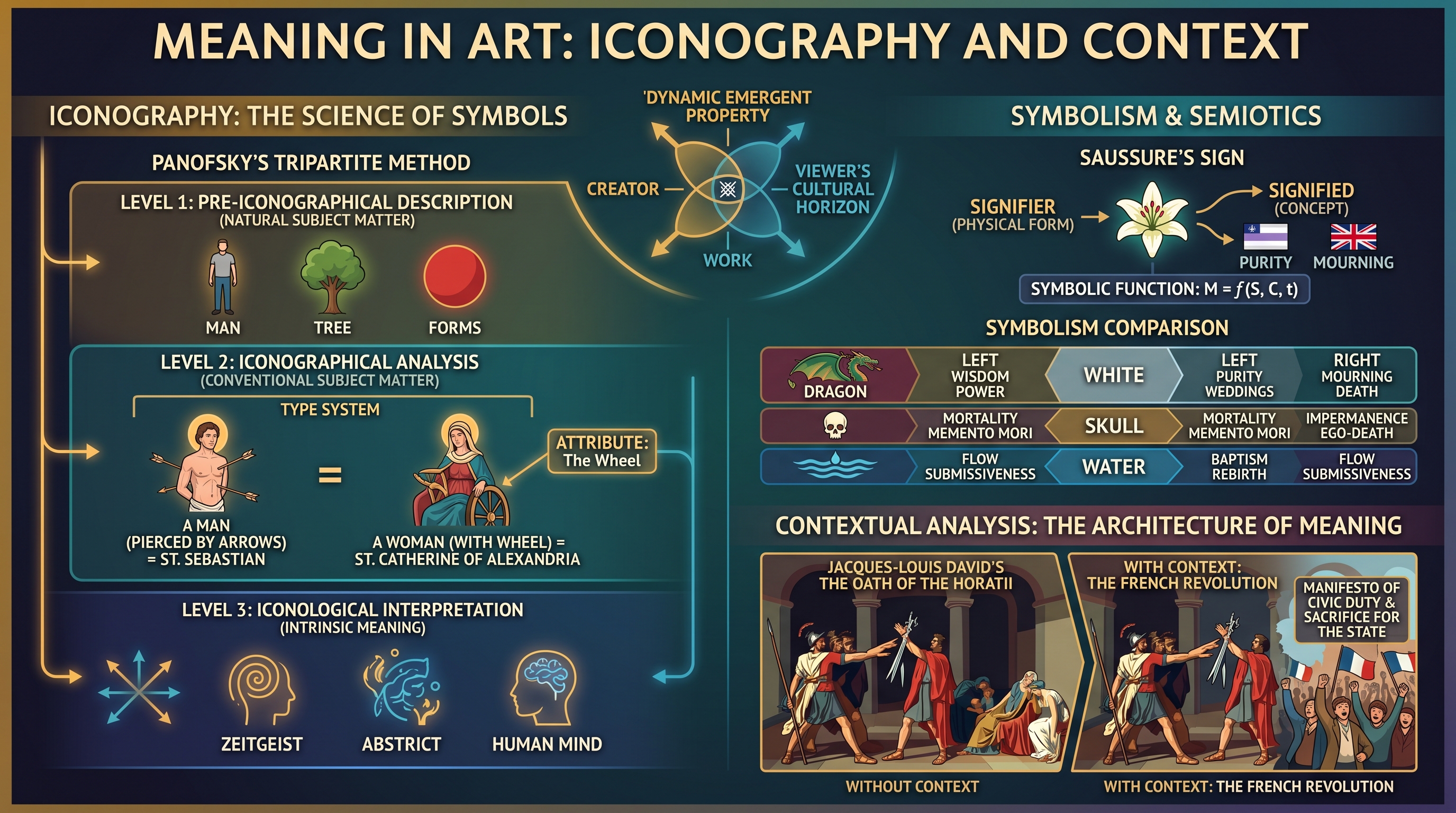
Panofsky’s Tripartite Method
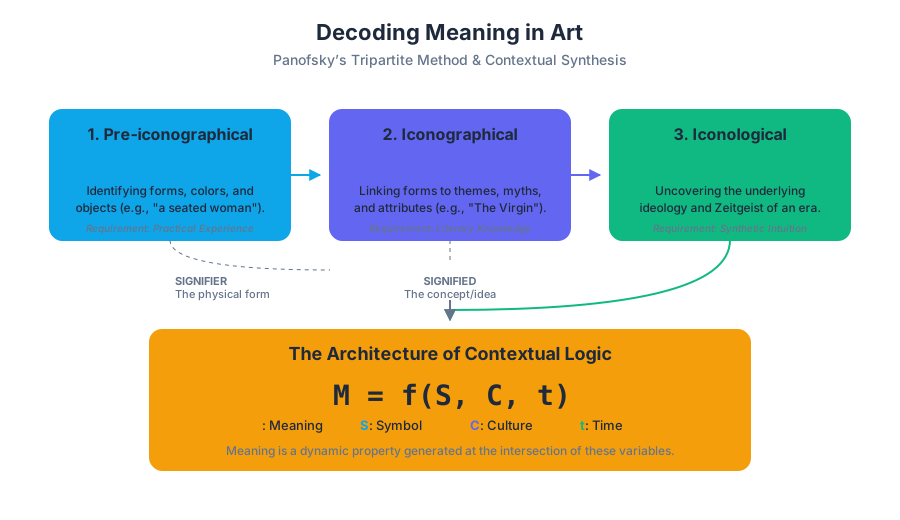
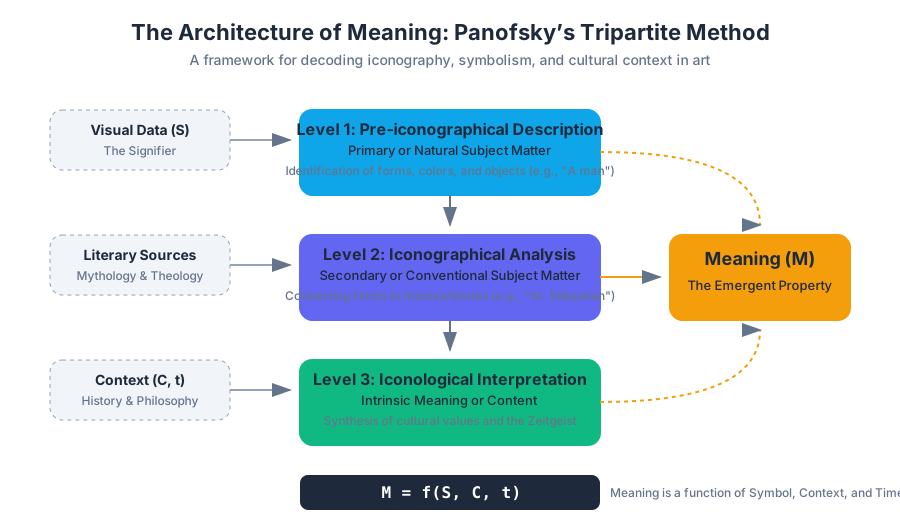
The most influential framework for iconographic analysis was developed by Erwin Panofsky. He proposed that meaning is layered, requiring different levels of "literacy" to uncover.
| Level | Name | Description | Requirement |
|---|---|---|---|
| Level 1 | Pre-iconographical Description | Identifying "natural" subject matter (e.g., a man, a tree, a red circle). | Practical experience (familiarity with objects and events). |
| Level 2 | Iconographical Analysis | Identifying "conventional" subject matter (e.g., the man is St. Sebastian because he is pierced by arrows). | Knowledge of literary sources (theology, mythology, history). |
| Level 3 | Iconological Interpretation | Uncovering the "intrinsic meaning" or content (the underlying principles of a nation, a period, a class, or a religious persuasion). | Synthetic intuition (understanding the human mind and zeitgeist). |
The Mechanics of Identification
To perform Level 2 analysis, an art historian must utilize a "type" system. For example, in Western Christian art, a woman holding a wheel is almost certainly St. Catherine of Alexandria. The wheel is her attribute. Without the attribute, she is merely a woman; with it, she becomes a specific narrative entity.
Definition: Attribute A physical object or conventional sign associated with a specific figure in art, used to identify them to the viewer (e.g., the keys of St. Peter, the owl of Athena).
Symbolism and Semiotics
While iconography deals with established "types," symbolism is the broader practice of using an image to represent an abstract idea, emotion, or state of being. Symbolism operates through semiotics—the study of signs and sign-processes.
The Signifier and the Signified
According to Ferdinand de Saussure, a sign consists of two parts:
- The Signifier: The physical form of the sign (the paint on the canvas, the shape of the marble).
- The Signified: The concept it represents.
In art, the relationship between the signifier and the signified is rarely 1:1. It is often mediated by culture. For instance, a "lily" (signifier) might signify "purity" (signified) in a 15th-century Flemish painting, but in a different context, it might signify "death" or "royalty."
Formalizing Symbolic Logic
We can represent the interpretation of a symbol as a function of its visual properties and its cultural environment.
M = f(S, C, t)
Where:
Mis the resulting Meaning.Sis the Symbol (the visual data).Cis the Cultural Context (the set of shared beliefs).tis the Time period (the historical moment).
If we change C or t, the meaning M changes even if the visual data S remains constant.
Symbolism Comparison Table
| Symbol | Common Western Meaning | Common Eastern Meaning | Abstract Concept |
|---|---|---|---|
| Dragon | Evil, chaos, greed | Wisdom, power, luck | Primordial Force |
| White | Purity, weddings | Mourning, death | Void/Beginning |
| Skull | Mortality (Memento Mori) | Impermanence, ego-death | Transience |
| Water | Baptism, rebirth | Flow, submissiveness | Transformation |
Contextual Analysis: The Architecture of Meaning
Contextual Analysis is the practice of examining the social, political, economic, and religious environment in which a work of art was produced. It posits that art is not created in a vacuum but is a "symptom" of its time.
The Socio-Cultural Lens
To understand a work like Jacques-Louis David’s The Oath of the Horatii, one must understand the impending French Revolution. Without that context, it is merely a painting of three men with swords. With it, it becomes a manifesto of civic duty and sacrifice for the state.
Technical Implementation: Metadata and Provenance
In modern archival science, we use structured data to capture the context of an artwork. Below is a SQL schema designed to track the "Contextual Entities" related to a specific piece of art, allowing for complex queries regarding patronage and historical events.
-- Schema for Art Contextual Mapping
CREATE TABLE Artworks (
    artwork_id INT PRIMARY KEY,
    title VARCHAR(255),
    creation_year INT,
    medium_id INT,
    artist_id INT
);

CREATE TABLE Contextual_Events (
    event_id INT PRIMARY KEY,
    event_name VARCHAR(255),
    start_year INT,
    end_year INT,
    description TEXT
);

CREATE TABLE Artwork_Context_Link (
    artwork_id INT,
    event_id INT,
    relevance_score FLOAT, -- 0.0 to 1.0
    FOREIGN KEY (artwork_id) REFERENCES Artworks(artwork_id),
    FOREIGN KEY (event_id) REFERENCES Contextual_Events(event_id)
);

-- Query to find artworks created during the Black Death (1347-1351)
SELECT a.title, a.creation_year
FROM Artworks a
JOIN Artwork_Context_Link acl ON a.artwork_id = acl.artwork_id
JOIN Contextual_Events ce ON acl.event_id = ce.event_id
WHERE ce.event_name = 'The Black Death'
AND a.creation_year BETWEEN ce.start_year AND ce.end_year;
Material Significance: Monetary vs. Cultural Value
As noted in the source material, the materials themselves carry meaning.
- Intrinsic Value: The worth of the raw materials (e.g., gold, lapis lazuli).
- Monetary Value: The market price of the finished work.
- Cultural Value: The prestige or religious power the material commands.
The use of Spolia (repurposed building stone or decorative elements from ancient monuments) is a prime example of contextual meaning. When a medieval ruler used Roman columns in a new church, they weren't just recycling; they were "borrowing glory" from the Roman Empire to legitimize their own power.
Visual Literacy: Decoding the Image
Visual Literacy is the ability to interpret, negotiate, and make meaning from information presented in the form of an image. It is the "grammar" of art. Just as one must learn the rules of syntax to read a book, one must learn the rules of visual composition to read a painting.
The Elements of Visual Grammar
Visual literacy involves identifying how the Elements of Art (line, shape, color) are organized by the Principles of Design (balance, contrast, emphasis).
- Line: Can suggest stability (horizontal), growth (vertical), or chaos (diagonal).
- Color: Uses hue, value, and intensity to evoke emotional responses or symbolic associations.
- Space: The use of perspective to create the illusion of depth or to emphasize the flat surface of the canvas.
A Bayesian Approach to Interpretation
In a computational or cognitive model, visual literacy can be viewed as a Bayesian update process. The viewer starts with a "prior" (their existing knowledge) and updates it as they observe "evidence" (visual cues).
P(Meaning | VisualCues) = \frac{P(VisualCues | Meaning) \times P(Meaning)}{P(VisualCues)}
In this model:
- $P(Meaning)$ is the prior probability of a certain theme being present based on the era.
- $P(VisualCues | Meaning)$ is the likelihood that these specific colors/shapes would be used to represent that theme.
- $P(Meaning | VisualCues)$ is our final "reading" of the work.
Socio-Cultural Context and Power Dynamics
Art is frequently a tool of power, used to reinforce or challenge the status quo. The identity of the artist—their gender, race, and class—acts as a filter through which meaning is funneled.
Art and Identity
The "reading" of a work changes based on the identity of the creator. For example, a portrait of a woman painted by a man in the 18th century often emphasizes the "Male Gaze"—viewing the woman as an object of desire or a symbol of domesticity. Conversely, a self-portrait by a female artist of the same period might emphasize her professional agency and intellectual life.
Art and Power
Governments and religious institutions have historically been the primary patrons of art, using it for:
- Propaganda: Communicating specific political messages.
- Legitimation: Using "Borrowed Glory" (Spolia) or classical styles to link current rulers to historical greatness.
- Didacticism: Teaching religious or moral lessons to an illiterate population.
| Power Dynamic | Method | Example |
|---|---|---|
| Imperialism | Monumental architecture, triumphal arches | Arch of Constantine |
| Theocracy | Iconography of divine right, halos, scale | Byzantine Mosaics |
| Subversion | Satire, caricature, street art | Banksy, Hogarth |
| Capitalism | Branding, celebrity portraiture, luxury materials | Warhol, Jeff Koons |
Technical Example: Linked Open Data (LOD) in Art History
To map these complex relationships between power, identity, and art, researchers use Resource Description Framework (RDF). This allows for "triples" (Subject-Predicate-Object) that can link an artist to their patron and the political movement they supported.
from rdflib import Graph, URIRef, Literal, Namespace

# Define Namespaces
ART = Namespace("http://schema.org/ArtWork/")
FOAF = Namespace("http://xmlns.com/foaf/0.1/")
HIST = Namespace("http://history.org/ontology/")

g = Graph()

# Define the relationship: Jacques-Louis David painted 'The Oath of the Horatii'
# which was influenced by the 'French Revolution'
david = URIRef("http://example.org/artist/JacquesLouisDavid")
oath = URIRef("http://example.org/artwork/OathOfTheHoratii")
revolution = URIRef("http://example.org/event/FrenchRevolution")

g.add((david, FOAF.made, oath))
g.add((oath, HIST.influencedBy, revolution))
g.add((oath, ART.material, Literal("Oil on Canvas")))

# Serialize to Turtle format for human reading
print(g.serialize(format="turtle"))
Common Pitfalls in Analysis
- Anachronism: Applying modern values or symbols to historical works (e.g., assuming a "thumbs up" in a Roman painting means "good job").
- Over-interpretation: Seeing deep symbolic meaning in purely decorative or functional elements (sometimes a red vase is just a red vase).
- Ignoring the Medium: Forgetting that the physical properties of the material (the "Structure of Art") limit and shape the possible meanings.
- Monolithic Interpretation: Assuming a work has only one "correct" meaning, rather than acknowledging the role of the viewer in creating meaning.
Summary: The Synthesis of Meaning
Meaning in art is a multi-dimensional construct. It begins with the Visual Literacy to recognize forms, proceeds through the Iconography to identify specific subjects, and culminates in a Contextual Analysis that situates the work within the broader human experience. By understanding the interplay of materials, symbols, and power, we move from simply "looking" at art to truly "seeing" it.
- Iconography: The study of subject matter and symbols in art.
- Attribute: An object used to identify a specific figure (e.g., St. Peter's keys).
- Semiotics: The study of signs and symbols and their use or interpretation.
- Signifier: The physical form of a sign (the image itself).
- Signified: The concept or idea a sign represents.
- Contextual Analysis: Evaluating art based on its historical, social, and political surroundings.
- Spolia: Repurposed building materials used for their symbolic or monetary value.
- Visual Literacy: The ability to decode and interpret visual information.
- Mimesis: The representation or imitation of the real world in art.
- Male Gaze: The perspective of a visual work from the viewpoint of a heterosexual man, often objectifying women.
-
Which level of Panofsky's method involves identifying that a man with arrows is St. Sebastian?
- A) Pre-iconographical Description
- B) Iconographical Analysis (Correct)
- C) Iconological Interpretation
- D) Formal Analysis
-
In semiotics, what do we call the physical form of a symbol (e.g., the red paint on a canvas)?
- A) The Signified
- B) The Attribute
- C) The Signifier (Correct)
- D) The Icon
-
What is the term for reusing materials from ancient monuments to "borrow" their historical prestige?
- A) Mimesis
- B) Spolia (Correct)
- C) Provenance
- D) Chiaroscuro
-
True or False: Contextual analysis suggests that the meaning of a work of art is fixed and never changes over time.
- False. Meaning is dynamic and changes with the viewer's context.
-
Which factor is most likely to influence the "Iconological" level of a painting?
- A) The type of brush used
- B) The price of the pigment
- C) The prevailing religious and philosophical beliefs of the era (Correct)
- D) The physical dimensions of the canvas
Deep Dive: Meaning in Art
Core Objectives:
- Master the three levels of Panofsky’s iconographic method.
- Distinguish between the signifier and the signified in artistic semiotics.
- Apply contextual lenses (political, economic, social) to historical works.
- Understand the relationship between material choice and cultural value.
Key Figures to Research:
- Erwin Panofsky: Founder of modern iconographic study.
- Ferdinand de Saussure: Pioneer of semiotics.
- Jacques-Louis David: Key artist for studying political context and propaganda.
Practical Exercise: Select a contemporary advertisement. Perform a tripartite analysis:
- Pre-iconographic: What objects/people are literally there?
- Iconographic: What do these people/objects represent in our current culture (e.g., a suit representing "success")?
- Iconological: What does this ad say about our society's values regarding gender, wealth, or happiness?
Further Reading:
- Studies in Iconology by Erwin Panofsky.
- Ways of Seeing by John Berger.
- Introduction to Art: Design, Context, and Meaning (Sachant et al.).
Connecting Art to Our Lives
Key concepts: Aesthetics · Political Protest · Commemoration · Unification · Public Art
Examining the multifaceted roles of art in society, from personal expression to political protest and religious worship.
Connecting Art to Our Lives
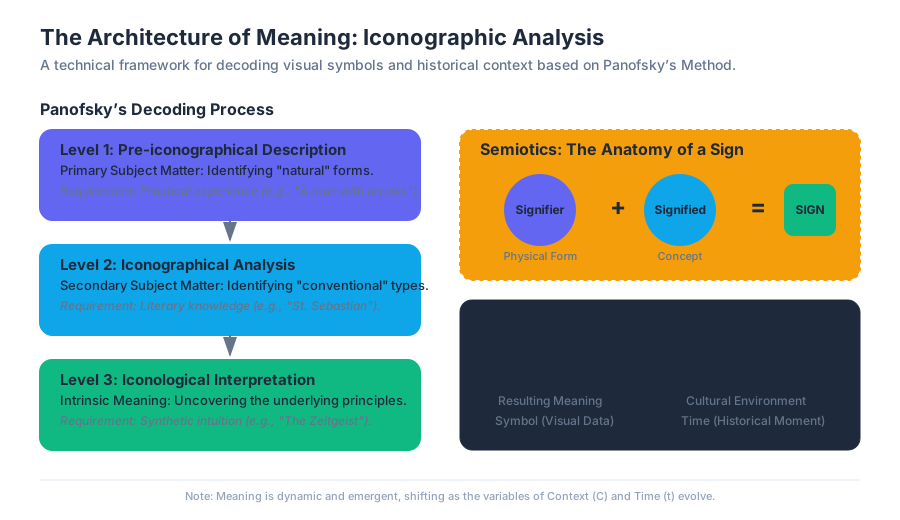
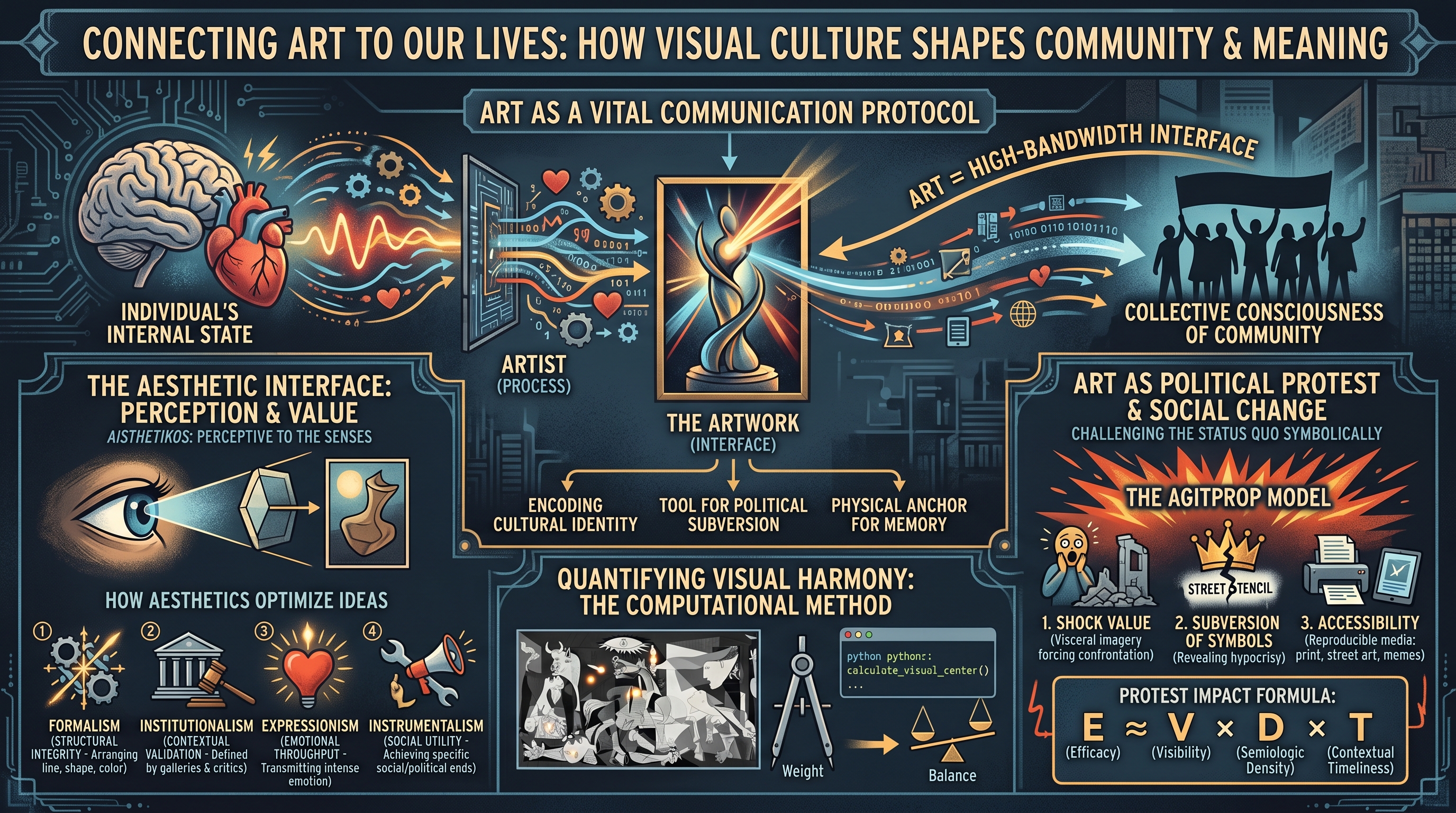
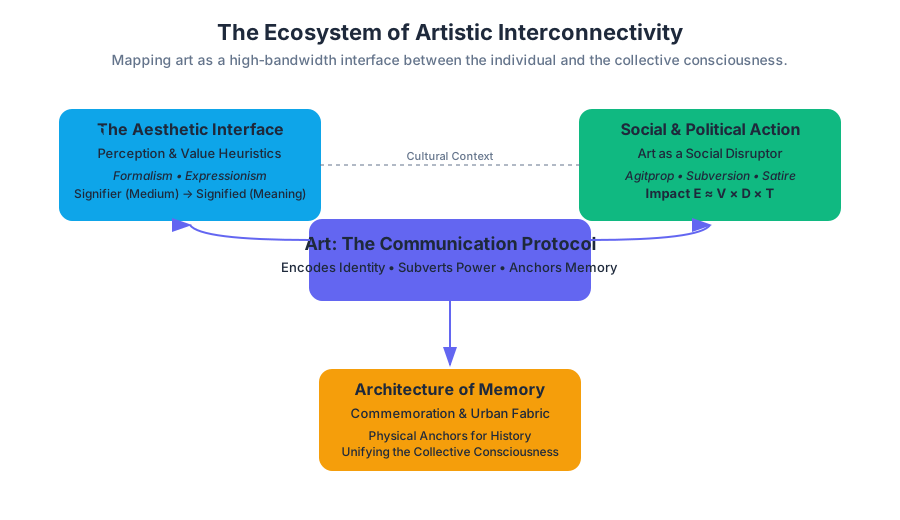
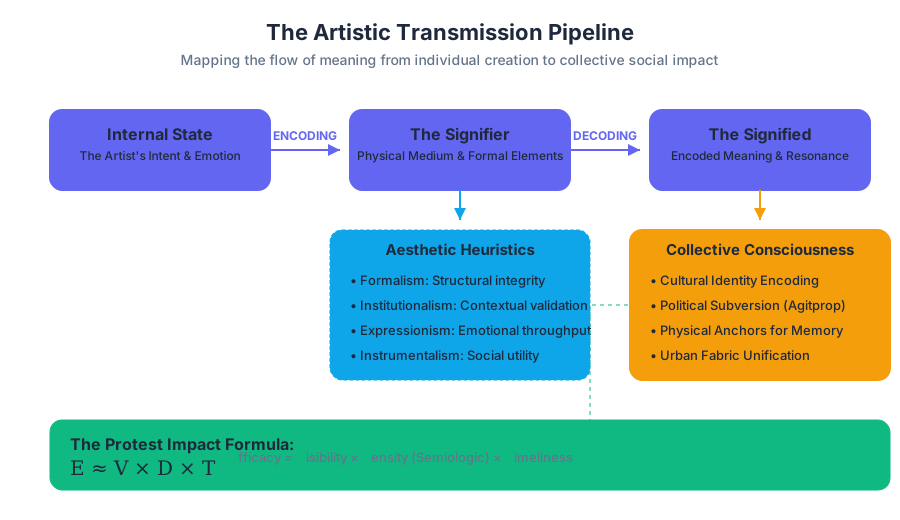
Art is rarely a solitary phenomenon. While the romanticized image of the "starving artist" suggests a vacuum of creation, the reality of art history and visual culture is one of profound interconnectedness. Art serves as a vital communication protocol—a high-bandwidth interface between the internal state of the individual and the collective consciousness of the community. It is a mechanism for encoding cultural identity, a tool for political subversion, and a physical anchor for memory.
In this deep dive, we will analyze the structural and social frameworks that allow art to transcend its physical medium (the signifier) and become a carrier of profound human meaning (the signified). We will examine how aesthetics govern our perception, how protest art functions as a social disruptor, and how public art unifies or divides the urban fabric.
The Aesthetic Interface: Perception and Value
The term Aesthetics is derived from the Greek aisthetikos, meaning "perceptive to the senses." In a contemporary context, aesthetics is the branch of philosophy dealing with the nature of beauty, art, and taste, and with the creation and appreciation of beauty. However, for the "engineer" of art, aesthetics is more than just "looking good"; it is a set of heuristics used to optimize the transmission of an idea.
The Mechanics of Aesthetic Experience
An aesthetic experience occurs when a viewer engages with an object’s formal qualities—its Elements of Art (line, shape, color, texture) and Principles of Design (balance, unity, rhythm)—to reach a state of heightened awareness or emotional resonance. This is not a passive process; it is a computational one where the brain attempts to resolve the visual data against known patterns and cultural expectations.
| Theory of Aesthetics | Core Metric | Primary Focus |
|---|---|---|
| Formalism | Structural Integrity | The arrangement of elements (lines, colors, shapes) independent of social context. |
| Institutionalism | Contextual Validation | Art is defined by the "Art World" (galleries, critics, museums). |
| Expressionism | Emotional Throughput | The success of the work is measured by the intensity of the transmitted emotion. |
| Instrumentalism | Social Utility | Art is a tool to achieve a specific social or political end. |
Quantifying Visual Harmony
While beauty is subjective, we can model the "balance" of a composition using computational methods. In the following Python example, we demonstrate a low-level approach to calculating the Weighted Visual Center of an image, which helps determine if a work achieves "Balance"—a key principle of design.
import numpy as np
from PIL import Image

def calculate_visual_center(image_path):
    """
    Calculates the 'Visual Center' of an artwork by analyzing pixel intensity.
    Heuristic: Darker or more saturated areas carry more 'visual weight'.
    """
    img = Image.open(image_path).convert('L')  # Convert to grayscale
    data = np.array(img)

    # Invert so that 'heavy' (dark) areas have higher values
    weight_map = 255 - data

    total_weight = np.sum(weight_map)
    if total_weight == 0:
        return (0.5, 0.5) # Default to geometric center

    # Calculate weighted coordinates
    h, w = weight_map.shape
    y_indices, x_indices = np.indices((h, w))

    center_y = np.sum(y_indices * weight_map) / total_weight
    center_x = np.sum(x_indices * weight_map) / total_weight

    # Normalize to 0.0 - 1.0 range
    return (center_x / w, center_y / h)

# Example usage:
# center = calculate_visual_center("guernica_picasso.jpg")
# print(f"Visual Center: {center}")
Art as Political Protest and Social Change
Art has historically been one of the most potent weapons for challenging the status quo. Because art operates in the realm of the symbolic, it can bypass the logical defenses of an audience, delivering a "shock to the system" that traditional rhetoric cannot.
The Agitprop Model
Agitprop (agitation-propaganda) is a strategy where art is intentionally designed to provoke a specific political response. This often involves the use of Satire, Subversion, and Iconoclasm.
- Shock Value: Using visceral imagery to force the viewer to confront an ignored reality (e.g., Goya’s The Disasters of War).
- Subversion of Symbols: Taking established icons of power and recontextualizing them to reveal hypocrisy (e.g., Banksy’s use of corporate logos).
- Accessibility: Protest art often utilizes reproducible media—printmaking, street art, or digital memes—to ensure maximum distribution.
The Protest Impact Formula: The efficacy of a protest work ($E$) can be modeled as a function of its Visibility ($V$), its Semiologic Density ($D$ - the layers of meaning), and its Contextual Timeliness ($T$). $$E \approx V \times D \times T$$
Case Studies in Political Art
The following table compares different approaches to art as a catalyst for change:
| Movement/Artist | Technique | Primary Objective | Result/Impact |
|---|---|---|---|
| Dadaism | Readymades / Nonsense | Challenge the logic of a world at war. | Birth of conceptual art; questioned "What is art?" |
| Guerrilla Girls | Data Visualization / Posters | Expose gender and racial bias in the art world. | Forced museums to audit their collection demographics. |
| Ai Weiwei | Large-scale Installation | Critique of government transparency and human rights. | Global awareness of Chinese political censorship. |
| Social Realism | Figurative Painting | Depict the hardships of the working class. | Influenced labor laws and public empathy during the Depression. |
Commemoration: The Architecture of Memory
Commemoration is the act of using art to ensure that a person, group, or event is not forgotten. This is where art meets history. Unlike a textbook, which records facts, a Monument or Memorial records feeling and reverence.
The Cenotaph and the Monolith
A Cenotaph is an "empty tomb"—a monument erected in honor of a person or group whose remains are elsewhere. These structures use Form and Space to create a vacuum that the viewer fills with their own grief or respect.
- Scale: Large-scale monuments (like the Pyramids or the Lincoln Memorial) use size to evoke the "Sublime"—a feeling of awe mixed with a sense of our own insignificance.
- Materiality: The choice of material is critical. Granite and bronze suggest permanence (Intrinsic Value), while ephemeral materials (like ice or light) suggest the fleeting nature of life.
Digital Commemoration and Metadata
In the modern era, commemoration has moved into the digital sphere. Archiving these "digital monuments" requires rigorous metadata standards to ensure the context is preserved along with the image.
# Example: Using ExifTool to embed historical context into a digital
# archive of a public monument to ensure 'Cultural Preservation'.

exiftool -Artist="Maya Lin" \
         -Title="Vietnam Veterans Memorial" \
         -Description="A V-shaped black granite wall inscribed with names." \
         -Location="Washington D.C." \
         -Subject="Commemoration, War, Minimalist" \
         -Copyright="Public Domain" \
         monument_archive_001.jpg
Unification and Cultural Identity
Art acts as the "social glue" of a community. It defines the boundaries of an In-group by creating a shared visual language. This can be seen in religious iconography, nationalistic art, and even subcultural aesthetics (like punk or hip-hop).
The Role of Ritual
In many cultures, the distinction between "Art" and "Object" is non-existent. A mask used in a ritual is not a "sculpture" to be looked at; it is a functional tool for spiritual unification. When the community sees the mask, they are not seeing an artist's "expression"—they are seeing their own collective history and beliefs made manifest.
Spolia and Borrowed Glory
Spolia is the practice of repurposing stones or decorative elements from ancient monuments into new ones. This is a literal "Connecting of Art to Lives" across centuries. By incorporating the art of a conquered or admired predecessor, a new regime "borrows" the legitimacy and power of the past.
| Mechanism of Unification | Description | Example |
|---|---|---|
| Heraldry/Vexillology | Use of flags and coats of arms to denote lineage and loyalty. | National Flags, Family Crests. |
| Religious Iconography | Standardized depictions of deities to unify worshipers. | Byzantine Icons, Hindu Murti. |
| Public Murals | Large-scale works depicting local heroes or history. | Chicano Park Murals (San Diego). |
Public Art and the Urban Fabric
Public art is art that is "site-specific"—it is designed to exist in a particular location and to interact with the people who inhabit that space. It moves art out of the "white cube" of the gallery and into the "gray world" of the street.
The "Percent for Art" Program
Many cities have a "Percent for Art" ordinance, requiring that a small percentage (usually 0.5% to 2%) of the cost of any large municipal construction project be spent on public art. This treats art as a necessary piece of infrastructure, much like plumbing or electricity.
The Lifecycle of a Public Art Project
The creation of public art is a complex engineering and bureaucratic process.
- Commissioning: A call for proposals is issued.
- Site Analysis: The artist must consider wind loads, sun exposure, and pedestrian flow.
- Community Engagement: Public hearings to ensure the work reflects the community's values.
- Fabrication: Using industrial processes (welding, 3D printing, casting).
- Maintenance: Planning for graffiti removal and structural integrity over decades.
-- Schema for a Public Art Management System (PAMS)
-- Tracks the 'Health' and 'Social Impact' of urban installations.

CREATE TABLE PublicArtInstallations (
    id INT PRIMARY KEY,
    title VARCHAR(255),
    artist_id INT,
    installation_date DATE,
    material_composition TEXT,
    gps_latitude DECIMAL(9,6),
    gps_longitude DECIMAL(9,6),
    maintenance_interval_days INT,
    last_inspected_date DATE,
    community_sentiment_score FLOAT -- Scale 1-10 based on surveys
);

INSERT INTO PublicArtInstallations
VALUES (101, 'Cloud Gate', 502, '2004-05-20', 'Stainless Steel', 41.8827, -87.6233, 180, '2023-10-12', 9.8);
Common Pitfalls in Connecting Art to Life
- The "Parachute Art" Problem: When an artist places a work in a community without understanding its history or needs, leading to resentment (e.g., Richard Serra’s Tilted Arc).
- Aesthetic Anachronism: Judging the art of the past solely by modern aesthetic standards, ignoring its original functional or ritual context.
- Commodification of Protest: When protest art is co-opted by corporations for branding, it often loses its "Subversive" power and becomes mere decoration.
Conclusion: The Feedback Loop
Art is not a one-way transmission. It is a feedback loop. The artist takes from the culture, processes it through their personal identity and technical skill, and returns it to the culture as a new object. This object then changes the culture, which in turn influences the next generation of artists. By understanding the mechanics of aesthetics, the power of protest, and the weight of commemoration, we can better navigate the visual world we inhabit.
- Aesthetics: The branch of philosophy dealing with beauty and taste; the "UI/UX" of the art world.
- Cenotaph: A monument to someone whose body is buried elsewhere; a "placeholder" for memory.
- Agitprop: Art designed specifically for political agitation and propaganda.
- Spolia: Repurposed building materials or decorative elements used in new monuments to link them to the past.
- Formalism: An approach to art that focuses strictly on its visual elements rather than its social or historical context.
- Site-Specific: Art that is created to exist in a certain place; the location is integral to the meaning of the work.
- Visual Weight: The perceived "heaviness" of an element in a composition, determined by color, size, and texture.
-
Which aesthetic theory would prioritize the "Rule of Thirds" and color harmony over the political message of a painting?
- A) Instrumentalism
- B) Formalism
- C) Institutionalism
- D) Expressionism (Answer: B)
-
What is the primary function of a Cenotaph?
- A) To house the remains of a king.
- B) To serve as a functional bridge.
- C) To honor individuals whose remains are not present.
- D) To provide a space for digital art. (Answer: C)
-
In the context of Public Art, what does "Site-Specificity" imply?
- A) The art can be moved to any museum.
- B) The art's meaning is tied to its physical location.
- C) The art must be made of local stone.
- D) The art is only visible at night. (Answer: B)
-
Which concept describes the reuse of ancient architectural elements in new structures to claim historical authority?
- A) Mimesis
- B) Spolia
- C) Agitprop
- D) Readymade (Answer: B)
-
True or False: The "Percent for Art" program is a voluntary donation by artists to the city.
- (Answer: False. It is usually a mandatory ordinance for municipal construction projects.)
Key Themes to Remember:
- Art as Communication: Art is a "high-bandwidth" tool for sharing complex emotions and social critiques.
- The Power of Materials: The choice between gold, bronze, or recycled plastic carries intrinsic, monetary, and cultural value.
- Art and Power: Throughout history, those in power have used art (monuments, spolia) to legitimize their rule, while those outside power have used art (protest, street art) to challenge it.
- Structural Analysis: Use the "Elements of Art" (the building blocks) and "Principles of Design" (the rules) to deconstruct any visual work.
- The Viewer's Role: Art is incomplete without the viewer. The "Aesthetic Experience" is a collaboration between the creator's intent and the observer's perception.
Studio Arts and Applied Design
Key concepts: 2D Design · Linear Perspective · Professional Illustration · User-Centered Innovation · Graphic Narrative
An overview of professional art fields, including 2D design, drawing techniques, and the integration of creativity with utility in design.
Studio Arts and Applied Design
Studio Arts and Applied Design represent the dual pillars of visual production: the former focused on the exploration of form, expression, and the "fine art" tradition, and the latter on the functional application of aesthetic principles to solve human-centric problems. This section explores the transition from the theoretical "Elements and Principles of Design" to the rigorous technical implementations found in linear perspective, professional illustration, and user-centered innovation.
In the contemporary landscape, the boundary between the "artist" and the "designer" is increasingly fluid. However, the distinction remains in the teleology of the work—the purpose for which it is created. While studio art may prioritize the artist's internal vision or socio-political critique, applied design is governed by the "brief," the user, and the constraints of the medium.
2D Design: The Grammar of Sight
2D Design is the study of organizing visual elements on a flat plane (the "picture plane") to communicate specific ideas or evoke particular emotional responses. It is often described as the "grammar" of visual language. Just as a sentence requires syntax to be intelligible, a visual composition requires the strategic arrangement of elements according to established principles.
The Elements vs. The Principles
To understand 2D design, one must distinguish between the Elements of Art (the raw data) and the Principles of Design (the algorithms used to process that data).
| Category | Component | Definition | Technical Function |
|---|---|---|---|
| Element | Line | A point in motion or the edge of a shape. | Directs the viewer's eye; creates "pathways." |
| Element | Value | The relative lightness or darkness of a surface. | Establishes volume, depth, and "chiaroscuro." |
| Element | Texture | The surface quality (tactile or implied). | Adds sensory richness and "noise" to a surface. |
| Principle | Balance | The distribution of visual weight (Symmetrical/Asymmetrical). | Establishes stability or tension within the frame. |
| Principle | Emphasis | The creation of a focal point. | Manages the hierarchy of information. |
| Principle | Economy | The removal of non-essential elements. | Maximizes the "signal-to-noise" ratio in communication. |
Color Theory and Subtractive Synthesis
In 2D design, color is not merely aesthetic but functional. Professional design typically utilizes the CMYK (Subtractive) model for physical media and RGB (Additive) for digital.
The Weber-Fechner Law in Design: The perceived change in a visual stimulus (like the brightness of a color or the weight of a line) is proportional to the initial intensity of the stimulus. In practice, this means that to make a "dark" area look significantly darker, the artist must decrease the value exponentially, not linearly.
Linear Perspective: The Geometry of Illusion
Linear Perspective is a mathematical system for representing three-dimensional objects and spatial relationships on a two-dimensional surface. It relies on the optical illusion that parallel lines appear to converge as they recede into the distance.
The Mathematical Foundation
The core of linear perspective is the Central Projection. If we treat the eye as a single point (the "station point"), every point in 3D space ($P$) is projected onto a 2D plane ($I$) along a ray passing through the station point.
The fundamental variables are:
- Horizon Line: The viewer's eye level.
- Vanishing Point (VP): The point on the horizon where parallel lines appear to meet.
- Orthogonals: The lines drawn from the edges of objects to the vanishing point.
The Perspective Projection Matrix
In computer graphics and advanced technical illustration, we use a 4x4 matrix to transform 3D coordinates into 2D screen space. This simulates the way the human eye perceives depth.
import numpy as np

def get_perspective_matrix(fovy, aspect, near, far):
    """
    Computes a standard OpenGL-style perspective projection matrix.
    fovy: Field of view in the y-direction (radians)
    aspect: Aspect ratio (width/height)
    near: Distance to the near clipping plane
    far: Distance to the far clipping plane
    """
    f = 1.0 / np.tan(fovy / 2.0)
    matrix = np.zeros((4, 4))

    matrix[0, 0] = f / aspect
    matrix[1, 1] = f
    matrix[2, 2] = (far + near) / (near - far)
    matrix[2, 3] = (2 * far * near) / (near - far)
    matrix[3, 2] = -1.0

    return matrix

# Example: 60-degree FOV, 16:9 aspect ratio
view_matrix = get_perspective_matrix(np.radians(60), 16/9, 0.1, 1000.0)
print("Perspective Projection Matrix:\n", view_matrix)
Variations of Perspective
- One-Point: Used when the front plane of an object is parallel to the picture plane.
- Two-Point: Used when the object is viewed at an angle; two vanishing points sit on the horizon.
- Three-Point (Bird's/Worm's Eye): Adds a third vanishing point above or below the horizon to simulate extreme height or depth.
- Atmospheric Perspective: A non-linear method where depth is signaled by decreasing contrast and shifting colors toward the blue end of the spectrum (due to Rayleigh scattering in the atmosphere).
Professional Illustration and Graphic Narrative
Professional Illustration differs from fine art primarily in its Intent and Context. While a painting in a gallery exists for its own sake, an illustration is commissioned to clarify, decorate, or interpret a text or concept.
The Illustration Pipeline
A senior illustrator follows a rigorous "Double Diamond" or iterative workflow:
- Thumbnailing: Rapid, low-fidelity sketches to explore composition and "readability."
- Value Comp: Establishing the light and dark structure before color is applied.
- Final Render: The application of texture, color, and "finish."
Graphic Narrative and Sequential Art
The Graphic Narrative (comics, storyboards, instructional manuals) introduces the element of Time. In sequential art, the "unit of meaning" is not the single image, but the transition between images.
Closure: The phenomenon of observing the parts but perceiving the whole. In a graphic narrative, the reader performs "closure" in the gutter (the space between panels), mentally connecting two static images into a continuous action.
| Transition Type | Description | Cognitive Load |
|---|---|---|
| Moment-to-Moment | Requires very little closure (e.g., a blinking eye). | Low |
| Action-to-Action | Shows a single subject progressing through a motion. | Medium |
| Aspect-to-Aspect | Bypasses time to set a mood or place (shifting focus across a scene). | High |
| Non-Sequitur | No logical relationship between panels. | Infinite (Surrealism) |
User-Centered Innovation (UCI)
User-Centered Innovation is the application of design principles to the creation of products, systems, and interfaces that prioritize the end-user's needs, limitations, and behaviors. It is the "Applied Design" of the modern era, spanning Industrial Design (ID) and User Experience (UX).
The Mechanics of UCI
UCI is governed by Heuristics—rules of thumb that ensure a design is functional and accessible.
- Affordance: A property of an object that suggests how it should be used (e.g., a handle "affords" pulling).
- Signifiers: Visual cues that point to affordances (e.g., the word "PULL" on the handle).
- Mapping: The relationship between controls and their effects (e.g., the layout of stove knobs matching the layout of burners).
Derivation of the "Golden Ratio" in Layout
In applied design, the Golden Ratio ($\phi \approx 1.618$) is often used to create "natural" feeling layouts. It is derived from the limit of the ratio of consecutive Fibonacci numbers.
$$ \phi = \frac{1 + \sqrt{5}}{2} $$
In a layout, if the total width is $W$, the primary content area $w_1$ and the sidebar $w_2$ should satisfy: $$ \frac{W}{w_1} = \frac{w_1}{w_2} = \phi $$
Implementation: A Design System Configuration
Modern applied design uses "Design Systems" to maintain consistency across complex products. This is often represented as a set of "Design Tokens."
{
  "design_tokens": {
    "spacing": {
      "scale": "geometric",
      "base": 4,
      "values": { "sm": 8, "md": 16, "lg": 32, "xl": 64 }
    },
    "typography": {
      "hierarchy": {
        "h1": { "size": "3.5rem", "weight": 700, "line_height": 1.2 },
        "body": { "size": "1rem", "weight": 400, "line_height": 1.5 }
      }
    },
    "accessibility": {
      "min_contrast_ratio": 4.5,
      "focus_indicator": "2px solid #005fcc"
    }
  }
}
Material Significance and Ethics
In both Studio Arts and Applied Design, the choice of material is never neutral. As noted in the Introduction to Art: Design, Context, and Meaning, materials carry Intrinsic, Monetary, and Cultural value.
The Value Triad
- Intrinsic Value: The physical properties of the material (e.g., the durability of granite vs. the fragility of glass).
- Monetary Value: The market cost of the raw material (e.g., Gold leaf vs. Yellow ochre).
- Cultural Value: The symbolic meaning assigned by society (e.g., the use of "Spolia"—repurposed stone from ancient monuments—to signal power and continuity).
Ethical Considerations in Applied Design
Designers today must navigate the Ecological Impact of their material choices. The "Cradle-to-Cradle" philosophy suggests that every material used in a design should either be a "biological nutrient" (biodegradable) or a "technical nutrient" (infinitely recyclable).
The Ethics of the Interface: In digital design, "Dark Patterns" are user interfaces designed to trick users into doing things they didn't intend to do (e.g., hidden costs in a checkout flow). User-Centered Innovation rejects these patterns in favor of transparency and user agency.
Common Pitfalls in Studio and Applied Arts
- The "Uncanny Valley" in Perspective: Over-reliance on strict mathematical perspective can sometimes make a drawing feel "dead" or distorted at the edges. Professional illustrators often "cheat" perspective to match human peripheral vision.
- Form Following Fashion, Not Function: In applied design, prioritizing aesthetic trends over usability leads to "over-designed" products that fail the end-user.
- Ignoring the Gutter: In graphic narratives, failing to provide enough information for the reader to perform "closure" results in a disjointed and confusing story.
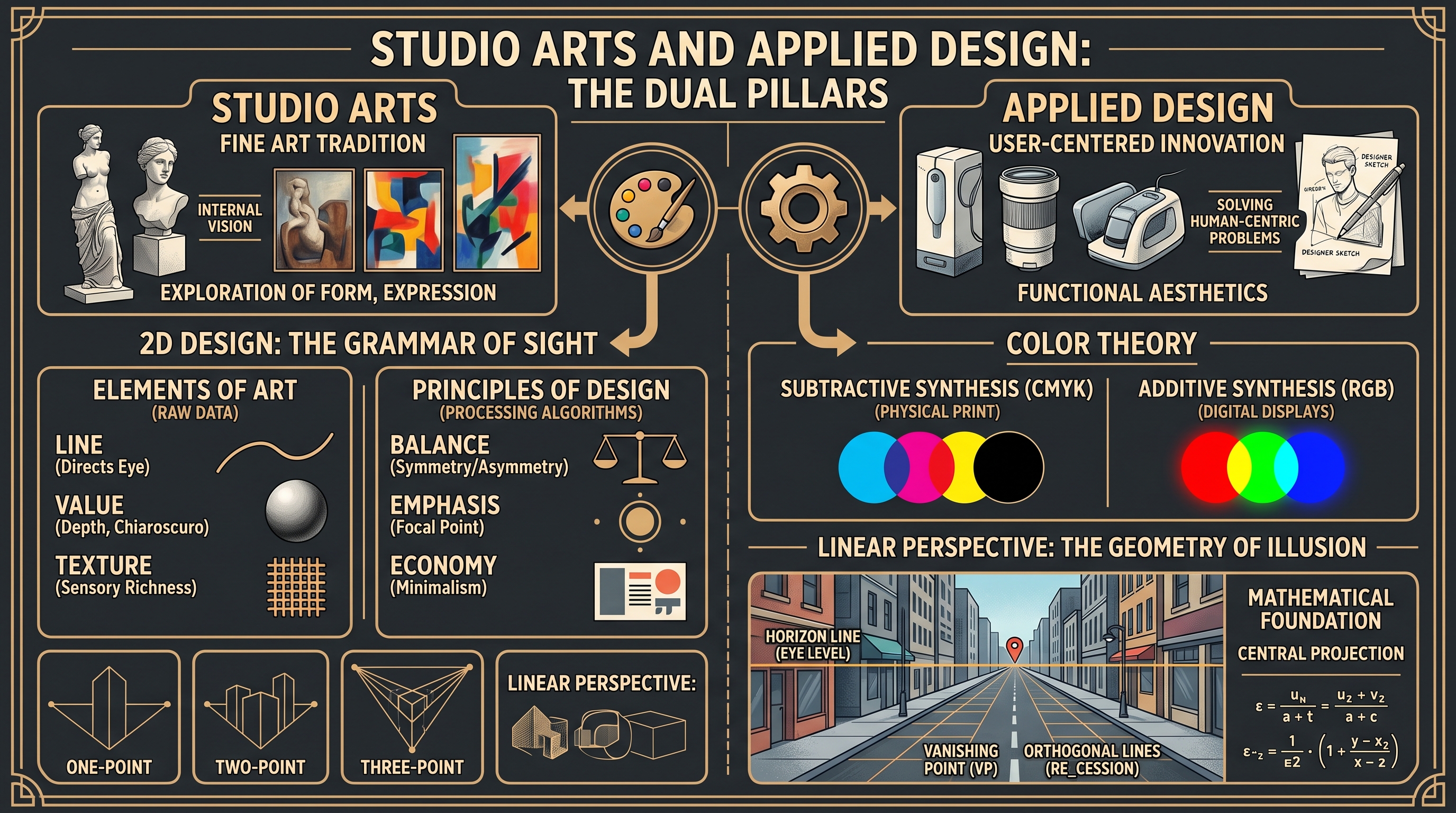
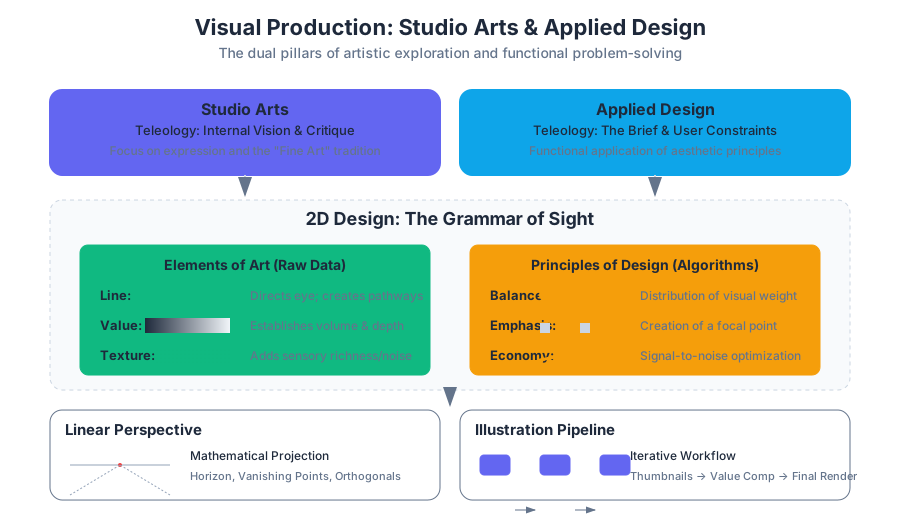
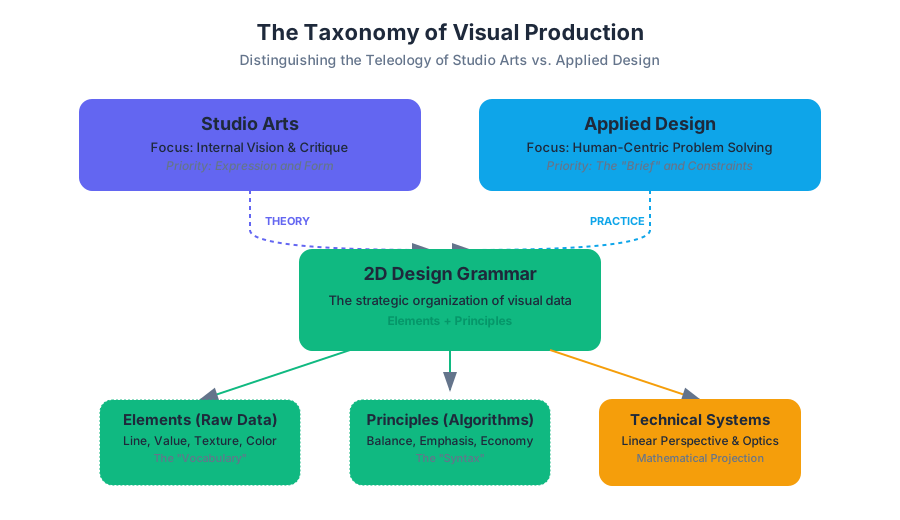
Museums, Collections, and Cultural Heritage
Key concepts: Museum Curation · Material Culture · Cultural Heritage · Object-Based Research · Community Identity
A study of how art and objects are collected, curated, and used to document community identity and material history.
Museums, Collections, and Cultural Heritage
Museums are not merely passive repositories for "old things"; they are active, socio-technical engines that construct history, validate identity, and negotiate the meaning of human existence. In the professional study of art and history, we transition from seeing an object as a solitary aesthetic item to seeing it as a node in a vast network of Material Culture. This section explores the mechanics of how objects are selected, researched, and deployed to create collective memory.
Material Culture: The Ontology of the Object
At the heart of museum studies lies Material Culture—the interdisciplinary study of all physical objects created by humans. Unlike traditional art history, which may focus primarily on the "masterpiece," material culture analysis treats every object—from a Ming Dynasty vase to a mass-produced plastic spoon—as a carrier of cultural DNA.
Definition: Material Culture The physical evidence of a culture in the objects and architecture they make or have made. It is the study of the relationship between artifacts and social relations, predicated on the idea that objects are not just "tools" but are "social agents" that shape human behavior.
The Biography of the Object
To understand an object, we must trace its "life history." This involves examining its Chaîne Opératoire (operational chain)—the sequence of steps from raw material extraction to manufacture, use, reuse, and eventual discard or museum accession.
| Attribute | Material Culture Focus | Traditional Art History Focus |
|---|---|---|
| Primary Value | Anthropological / Functional | Aesthetic / Stylistic |
| Object Status | Artifact / Tool | Masterpiece / Work of Art |
| Context | Daily life and social systems | The "Genius" of the individual artist |
| Analysis Method | Stratigraphy and Use-Wear | Formalism and Iconography |
Mathematical Modeling of Taphonomy
In archaeological and museum contexts, we often deal with the "survival bias" of material culture. The probability $P(S)$ of an object surviving to be curated is a function of its material durability $D$, its cultural value $V_c$, and the environmental conditions $E$.
P(S) = \frac{D \cdot V_c}{1 + e^{-(E + \tau)}}
Where:
- $D$ is the material's resistance to decay (e.g., gold vs. wood).
- $V_c$ is the perceived value over time (preventing it from being melted or thrown away).
- $\tau$ represents the "Time Depth" or age of the object.
Museum Curation: The Architecture of Narrative
Museum Curation is the intellectual and technical process of managing a collection and interpreting it for the public. A curator acts as a "translator" between the raw data of the object and the visitor's experience.
The Curatorial Algorithm
Curation is a filtering process. Out of millions of possible objects, only a fraction are "accessioned" (officially added to a collection), and an even smaller fraction are "exhibited."
- Acquisition/Accessioning: Legal transfer of ownership.
- Cataloging: Assigning unique identifiers (Accession Numbers) and metadata.
- Conservation: Physical stabilization of the object.
- Interpretation: Developing the narrative or "story" the object will tell.
Data Modeling for Curation
Modern curation relies on standardized metadata schemas like CIDOC-CRM or Dublin Core. Below is a Python-based representation of how a museum might programmatically model an object's relationship to its creator and its physical location.
class MuseumObject:
    def __init__(self, accession_id, title, creator, material, date):
        self.accession_id = accession_id
        self.title = title
        self.creator = creator
        self.material = material
        self.date = date
        self.provenance = []
        self.is_on_display = False

    def add_provenance_record(self, owner, date_acquired, method):
        """Tracks the chain of custody (Provenance)."""
        record = {
            "owner": owner,
            "date": date_acquired,
            "method": method # e.g., 'Purchase', 'Gift', 'Excavation'
        }
        self.provenance.append(record)

    def set_display_status(self, status: bool):
        self.is_on_display = status

# Example usage: Accessioning a Roman Denarius
coin = MuseumObject(
    accession_id="2023.04.12",
    title="Denarius of Hadrian",
    creator="Roman Imperial Mint",
    material="Silver",
    date="117-138 CE"
)

coin.add_provenance_record("Private Collection, London", "1950", "Purchase")
coin.add_provenance_record("Metropolitan Museum", "2023", "Donation")

print(f"Object: {coin.title} | Current Status: {'Exhibited' if coin.is_on_display else 'In Storage'}")
Object-Based Research: The Methodology of the "Object Essay"
The Object Essay is a rigorous research format used by curators and historians to extract the maximum amount of information from a single item. It moves from the "What" (description) to the "So What?" (significance).
The Four-Fold Analysis Framework
- Physical Analysis: What is it made of? How was it made? (e.g., using X-ray fluorescence or microscopic analysis).
- Contextual Analysis: Where was it found? Who owned it? What was happening in the world when it was made?
- Comparative Analysis: How does it relate to similar objects? Is it a "standard" example or an "anomaly"?
- Interpretive Analysis: What does this object tell us about the values, fears, or aspirations of the people who used it?
Worked Example: The "Spolia" Analysis
Spolia refers to the repurposing of building stone or decorative sculpture for new monuments. It is a prime example of "Borrowed Glory."
| Layer of Analysis | Observation |
|---|---|
| Physical | A porphyry column in a Medieval church that doesn't match the surrounding limestone. |
| Contextual | The church was built in the 12th century; the column is 2nd-century Roman. |
| Comparative | Similar columns are found only in Imperial Roman palaces. |
| Interpretation | The Medieval builders used the column to "steal" the authority and prestige of the Roman Empire for the Church. |
Cultural Heritage and Community Identity
Cultural Heritage is the legacy of physical artifacts and intangible attributes of a group or society. It is the primary tool for Community Identity—the sense of belonging and shared history that defines a group.
Cultural Branding and "Place-Making"
Communities often use material culture to create a "brand" that attracts tourism and reinforces local pride. This is sometimes called "Heritage Engineering."
Example: "Trolltown, USA" In Mount Horeb, Wisconsin, the community adopted Norwegian folklore (trolls) as a central theme. By placing wooden troll carvings along the "Trollway" (the main street), they transformed a generic Midwestern town into a specific cultural destination. This is a deliberate use of Material Culture to drive Economic Identity.
Intangible vs. Tangible Heritage
The UNESCO definition of heritage has expanded to include the "intangible"—traditions, oral histories, and performing arts.
| Type | Examples | Preservation Method |
|---|---|---|
| Tangible | Buildings, Paintings, Manuscripts | Conservation, Climate Control |
| Intangible | Language, Music, Rituals, Craft Skills | Documentation, Apprenticeship |
Ethics, Provenance, and the Global Commons
The most contentious area of museum studies today is Provenance—the history of ownership of a work of art or antique.
The Provenance Principle A work of art is only as "clean" as its chain of ownership. If a gap exists (especially during periods of conflict, like WWII or colonial eras), the object’s legal and ethical status is called into question.
The Repatriation Database
Museums now use complex databases to track claims of "looted" art. Below is a conceptual SQL schema for managing repatriation claims.
-- Schema for tracking Cultural Heritage Repatriation Claims
CREATE TABLE RepatriationClaims (
    claim_id INT PRIMARY KEY,
    object_id VARCHAR(50) NOT NULL,
    claiming_entity VARCHAR(100), -- e.g., 'Government of Greece'
    claim_date DATE,
    legal_basis TEXT, -- e.g., '1970 UNESCO Convention'
    status VARCHAR(20) CHECK (status IN ('Pending', 'Approved', 'Denied', 'In Negotiation'))
);

-- Query to find all pending claims for objects acquired before 1970
SELECT object_id, claiming_entity, claim_date
FROM RepatriationClaims
WHERE status = 'Pending' AND claim_date < '1970-01-01';
Common Pitfalls in Heritage Management
- Aesthetic Bias: Saving only "pretty" things while letting "ugly" but historically significant industrial sites decay.
- Colonial Narrative: Interpreting indigenous objects through a Western lens without consulting the source community.
- Digital Obsolescence: Creating "Digital Twins" of artifacts using file formats that will be unreadable in 20 years.
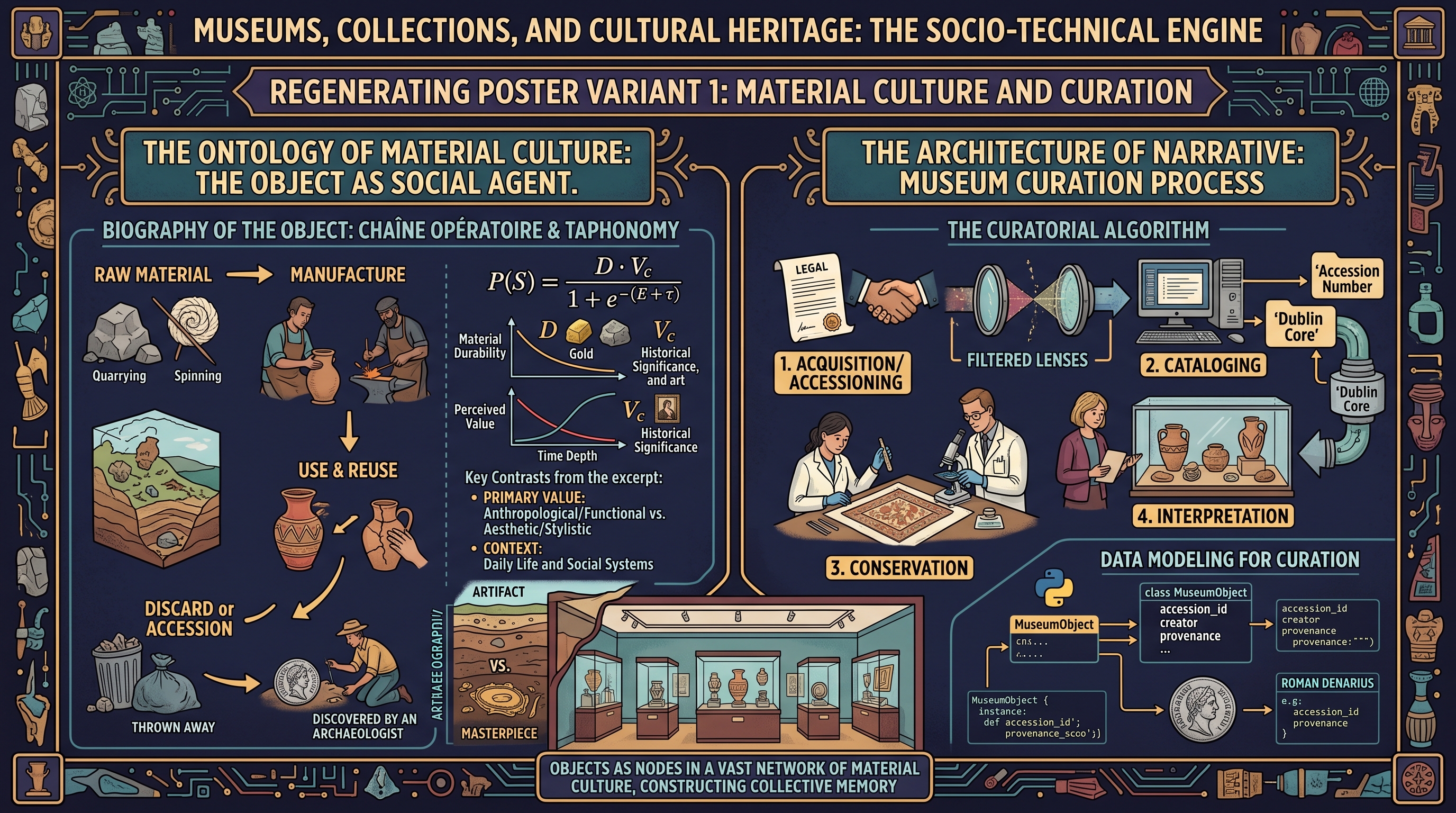
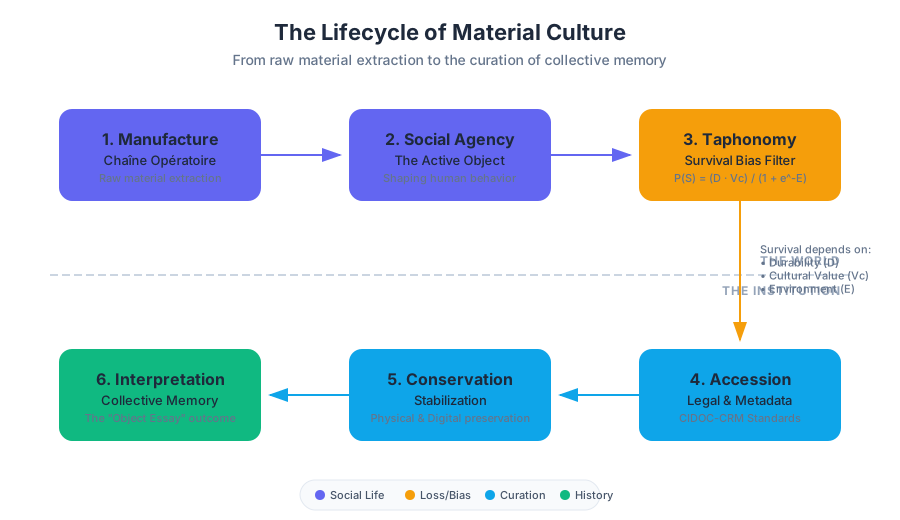
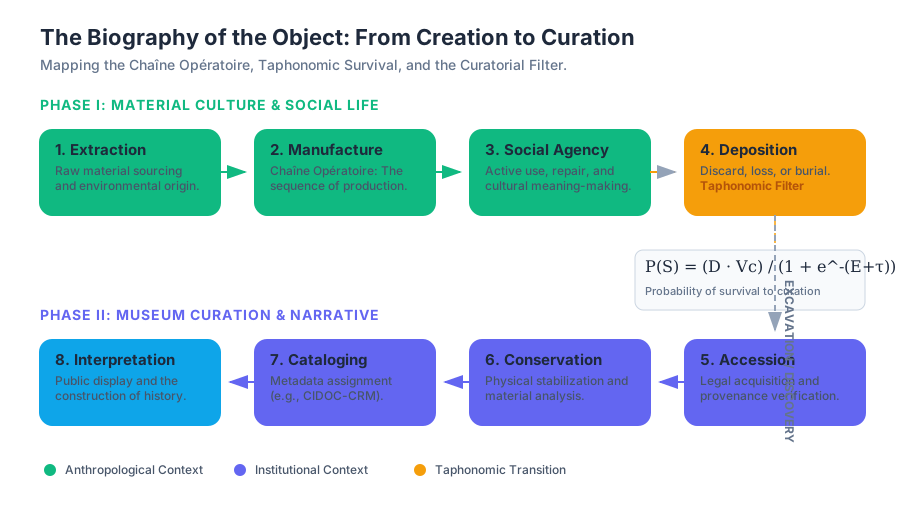
Art, Identity, and Power
Key concepts: Art and Identity · Art and Power · Art and Ethics · Propaganda · Censorship
Analyzing how art is used to assert authority, represent social groups, and navigate the ethics of ownership and censorship.
Art, Identity, and Power
Art is rarely a neutral act of creation. It exists within a complex ecosystem of social hierarchies, political agendas, and individual self-actualization. To study art through the lens of Identity and Power is to move beyond formal analysis—the study of line, color, and composition—and into the realm of Sociocultural Context. In this framework, art functions as a semiotic system: a collection of signs and symbols that communicate who we are, who holds authority, and what values a society deems worth preserving or suppressing.
Art and Power: The Visual Language of Authority
Power in art is often expressed through Propaganda, a term that, while modernly pejorative, historically refers to any systematic effort to propagate a set of beliefs or a specific image of a leader. The relationship between art and power is symbiotic: the patron (the State, the Church, or the Corporation) provides the resources, and the artist provides the visual legitimacy.
The Mechanics of Power Projection
The projection of power through art typically utilizes three primary strategies:
- Monumentality: Using scale to dwarf the viewer, suggesting an eternal and unshakeable authority (e.g., the Pyramids of Giza or the brutalist architecture of the Soviet era).
- Iconography of Rule: The use of specific symbols—crowns, scepters, or specific animals like lions—to denote rank and divine right.
- Idealization (Mimesis as Flattery): Portraying the ruler not as they are, but as a perfect, ageless, or heroic version of themselves to suggest biological or moral superiority.
| Strategy | Visual Tactic | Psychological Effect | Historical Example |
|---|---|---|---|
| Hieratic Scale | Making the most important figure the largest. | Establishes natural order and dominance. | Standard of Ur (Sumerian) |
| Divine Association | Depicting the leader alongside deities. | Suggests the ruler's power is divinely ordained. | Code of Hammurabi Stele |
| Architectural Framing | Placing the figure at the terminus of a long axis. | Focuses the viewer's attention and creates awe. | Palace of Versailles |
| Material Significance | Using rare materials (gold, lapis lazuli, purple dye). | Signals immense wealth and control over trade. | Byzantine Mosaics |
Propaganda and the State
Propaganda is the intentional manipulation of symbols to influence public opinion. In the 20th century, this became a highly technical field, blending art with mass-media psychology.
Definition: The Propaganda Function Let $P$ be the persuasive impact of a work of art. $P$ can be modeled as a function of its Reach ($R$), its Symbolic Density ($S$), and the Cultural Alignment ($A$) of the audience: $$P = \int (R \cdot S \cdot A) dt$$ Where $t$ represents the duration of exposure. High $P$ values indicate a successful shift in collective identity or political loyalty.
Art and Identity: The Construction of the Self
Identity in art is the exploration of the "Who am I?" and "Who are we?" questions. It is a dual process of Self-Representation (how we see ourselves) and External Representation (how others see us).
Individual vs. Collective Identity
Artists often use their work to navigate the tension between their personal experiences and the labels imposed upon them by society. This is particularly evident in the study of Visual Culture, where the "Gaze" plays a critical role.
- The Gaze: A term in critical theory describing how the act of looking is tied to power dynamics. The "Male Gaze," for instance, describes how visual arts have historically depicted the world and women from a masculine, heterosexual point of view.
- Subversion: When artists from marginalized groups use the tools of the dominant culture to challenge stereotypes. For example, Kehinde Wiley’s portraits use the conventions of European aristocratic portraiture to depict contemporary Black men, effectively "hacking" the visual language of power.
Technical Implementation: Analyzing Visual Attention
To understand how identity and power are communicated, researchers use saliency mapping to determine what parts of an image "grab" the viewer's attention. The following Python example demonstrates how one might use a simple computer vision approach to analyze the focal points of a portrait, which often correlate with the artist's intended "power center."
import cv2
import numpy as np
import matplotlib.pyplot as plt

def analyze_visual_power(image_path):
    """
    Uses a Static Saliency Spectral Residual algorithm to find
    the most 'powerful' visual regions in a work of art.
    """
    # Load the artwork
    img = cv2.imread(image_path)
    if img is None:
        return "Image not found."

    # Initialize the saliency detector
    saliency = cv2.saliency.StaticSaliencySpectralResidual_create()

    # Compute the saliency map
    success, saliency_map = saliency.computeSaliency(img)

    # Convert to 8-bit for visualization
    saliency_map = (saliency_map * 255).astype("uint8")

    # Threshold the map to find the 'hottest' regions
    _, thresh_map = cv2.threshold(saliency_map, 0, 255,
                                  cv2.THRESH_BINARY | cv2.THRESH_OTSU)

    # Display results
    plt.figure(figsize=(10, 5))
    plt.subplot(1, 2, 1)
    plt.title("Original Artwork")
    plt.imshow(cv2.cvtColor(img, cv2.COLOR_BGR2RGB))

    plt.subplot(1, 2, 2)
    plt.title("Power/Saliency Map")
    plt.imshow(thresh_map, cmap='inferno')
    plt.show()

# Example usage: analyze_visual_power('napoleon_crossing_the_alps.jpg')
Art and Ethics: Ownership, Repatriation, and Responsibility
The ethics of art involve the moral principles governing the creation, display, and ownership of artworks. As our global understanding of colonial history evolves, the ethics of Provenance (the history of ownership) have become a central conflict in the art world.
Repatriation and the "Spolia" of Empire
Repatriation is the return of art or cultural heritage to its country of origin. Many of the world's most famous museums (The British Museum, The Louvre) hold objects acquired during colonial expeditions, often under duress or through outright theft.
| Ethical Framework | Core Principle | Application to Art |
|---|---|---|
| Deontology | Duty-based ethics; some actions are inherently right or wrong. | Theft is wrong; therefore, the object must be returned regardless of the museum's ability to care for it. |
| Utilitarianism | The greatest good for the greatest number. | If more people can see the Parthenon Marbles in London than in Athens, they should stay in London. |
| Virtue Ethics | Focus on the character of the institution. | A museum should act with integrity and acknowledge the harm of colonial acquisition to maintain its moral authority. |
| Cultural Heritage Law | Legal frameworks (e.g., 1970 UNESCO Convention). | Objects exported illegally after a certain date must be returned. |
The Repatriation Logic (Pseudocode)
The decision-making process for repatriation can be modeled as a logical flow involving legal, ethical, and logistical variables.
FUNCTION Evaluate_Repatriation_Request(Artifact_A):
    IF Artifact_A.Provenance == "Illegal_Export" THEN
        RETURN "Mandatory_Return"

    IF Artifact_A.Cultural_Significance == "Sacred" AND Requesting_Party == "Origin_Culture" THEN
        IF Recipient_Facility.Is_Secure() THEN
            RETURN "Ethical_Return"
        ELSE
            RETURN "Collaborative_Custocdy_Agreement"

    IF Artifact_A.Acquisition_Context == "Colonial_War_Booty" THEN
        SET Negotiation_Status = "Active_Restitution"
        RETURN Negotiation_Status

    RETURN "Retain_and_Acknowledge_History"
Censorship: The Suppression of Art
Censorship is the suppression of speech, public communication, or other information. In art, censorship occurs when a work is deemed "dangerous" to the prevailing power structure or offensive to the collective identity of a dominant group.
Types of Censorship
- State Censorship: Direct government intervention (e.g., the Nazi "Degenerate Art" exhibition).
- Religious Censorship: Suppression based on blasphemy or violation of religious taboos (e.g., Aniconism in certain Islamic traditions).
- Market Censorship: When corporate interests or wealthy patrons refuse to fund or display work that threatens their brand or bottom line.
- Self-Censorship: When artists omit certain themes to avoid social ostracization or physical harm.
The "Streisand Effect" in Art
Censorship often backfires, a phenomenon known as the Streisand Effect. When a work is suppressed, the act of suppression itself draws more attention to the work than it would have received otherwise.
Theorem: The Inverse Visibility of Suppression Let $V$ be the visibility of a work and $C$ be the intensity of the censorship effort. $$V \propto \frac{1}{f(C)}$$ In a digitally connected society, as $C$ increases past a certain threshold, $V$ tends to increase exponentially rather than decrease, as the "forbidden" nature of the object increases its social currency.
Database Schema for Provenance and Ethics
Modern museums use complex databases to track the ethical status of their collections. A simplified SQL schema for managing these records might look like this:
CREATE TABLE Art_Collection (
    ArtifactID INT PRIMARY KEY,
    Title VARCHAR(255),
    Artist VARCHAR(255),
    Origin_Country VARCHAR(100),
    Acquisition_Date DATE,
    Acquisition_Method ENUM('Purchase', 'Gift', 'Excavation', 'War_Booty', 'Unknown'),
    Repatriation_Claim_Active BOOLEAN DEFAULT FALSE
);

CREATE TABLE Provenance_History (
    HistoryID INT PRIMARY KEY,
    ArtifactID INT,
    Owner_Name VARCHAR(255),
    Ownership_Start_Year INT,
    Ownership_End_Year INT,
    Legal_Status ENUM('Verified', 'Disputed', 'Looted'),
    FOREIGN KEY (ArtifactID) REFERENCES Art_Collection(ArtifactID)
);

-- Query to find all artifacts with disputed provenance from a specific region
SELECT Title, Artist, Acquisition_Method
FROM Art_Collection
JOIN Provenance_History ON Art_Collection.ArtifactID = Provenance_History.ArtifactID
WHERE Origin_Country = 'Nigeria' AND Legal_Status = 'Looted';
Case Study: The Palace of Versailles as a System of Control
To understand the intersection of all these concepts, we can look at the Palace of Versailles under Louis XIV (the "Sun King").
- Power: The entire palace was a machine for the projection of absolute monarchy. The gardens were designed to show that the King could control nature itself (geometry over organic growth).
- Identity: Louis XIV constructed his identity as the "Sun King," the center of the universe. Every courtier’s identity was defined by their proximity to the King’s person.
- Ethics: The cost of Versailles was astronomical, built on the labor and taxes of a starving peasantry. The ethical "cost" of the art was the social instability that eventually led to the French Revolution.
- Censorship: The court had strict rules about what could be depicted. Any art that did not glorify the King was effectively banned from the royal sphere.
Technical Metadata for Cultural Heritage
To ensure that identity and history are preserved correctly, the CIDOC-CRM (Conceptual Reference Model) is used by museums globally to provide a formal ontology for cultural heritage information.
# Example CIDOC-CRM mapping for a disputed artifact
artifact_record:
  id: "E22_Man-Made_Object_001"
  label: "Benin Bronze Plaque"
  was_produced_by:
    activity: "E12_Production"
    actor: "E39_Actor_Edo_Artisans"
    time_span: "16th_Century"
  has_current_owner: "E39_Actor_British_Museum"
  legal_status:
    type: "Disputed"
    claim_by: "Federal_Republic_of_Nigeria"
  historical_event:
    type: "E7_Activity_Punitive_Expedition_1897"
    description: "Removal of artifacts by British forces"
Common Pitfalls in Analyzing Art and Power
- Anachronism: Judging 16th-century power structures by 21st-century democratic standards. While critical analysis is necessary, understanding the original context is vital for historical accuracy.
- The "Great Man" Fallacy: Attributing the power of art solely to the artist or the ruler, while ignoring the thousands of laborers, craftspeople, and economic conditions that made the work possible.
- Binary Thinking: Viewing art as either propaganda or pure expression. Most art exists on a spectrum, containing elements of both.
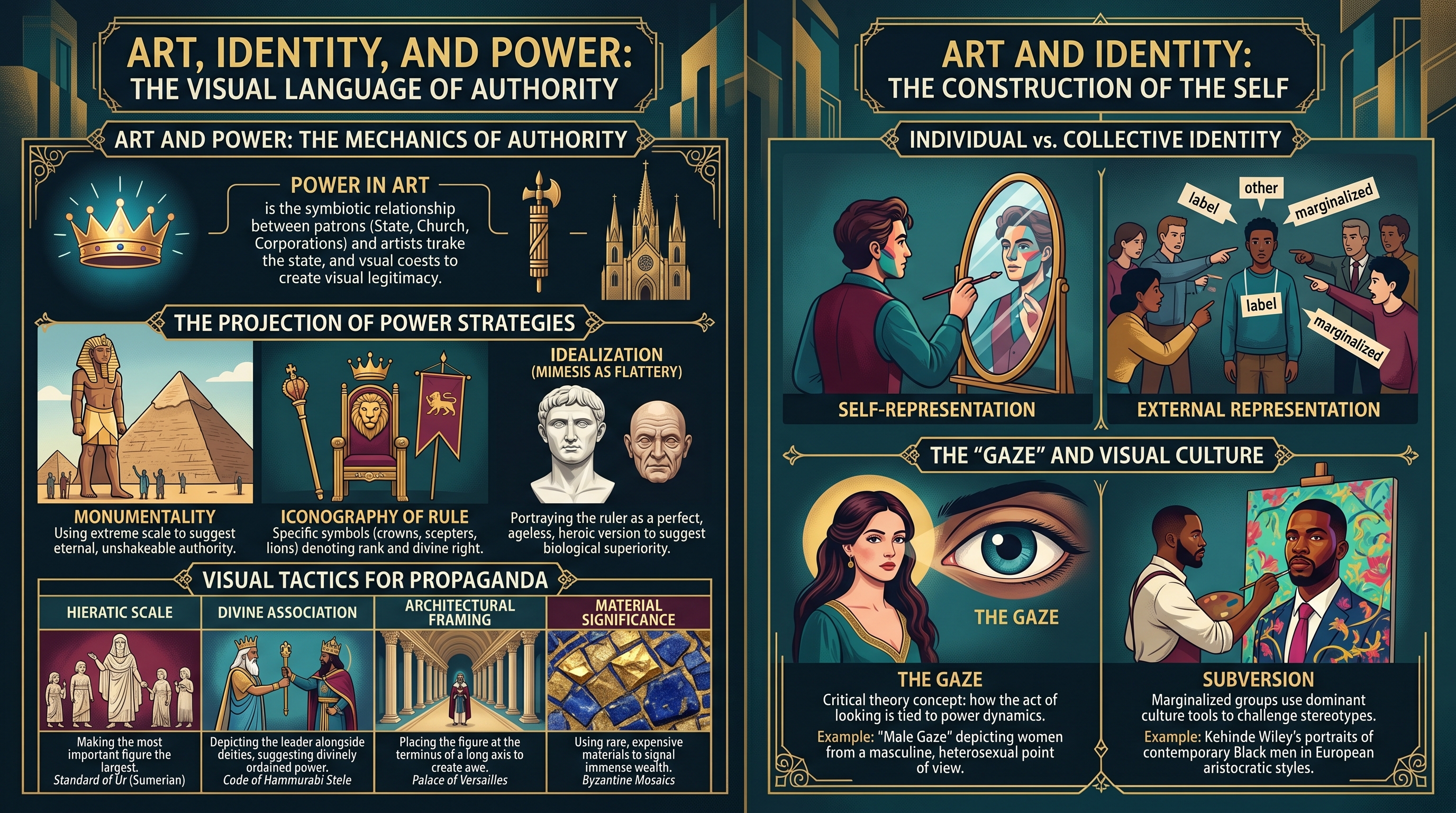
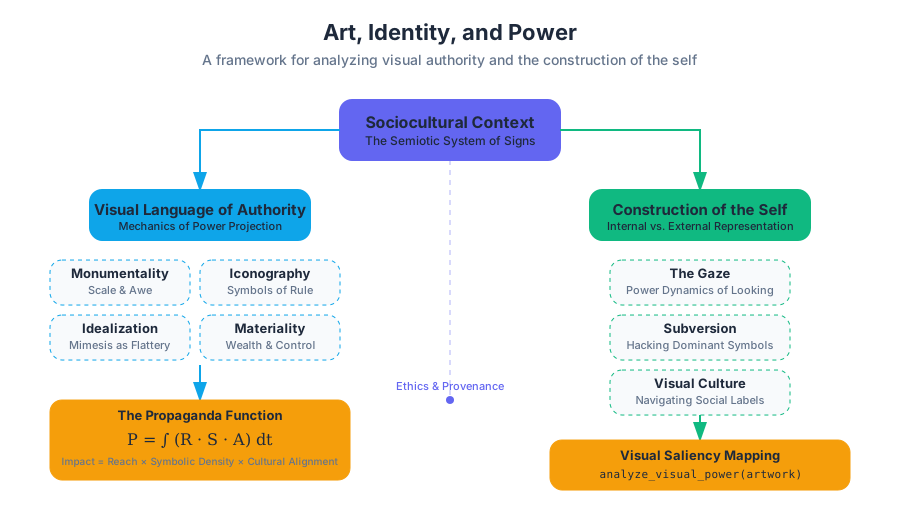
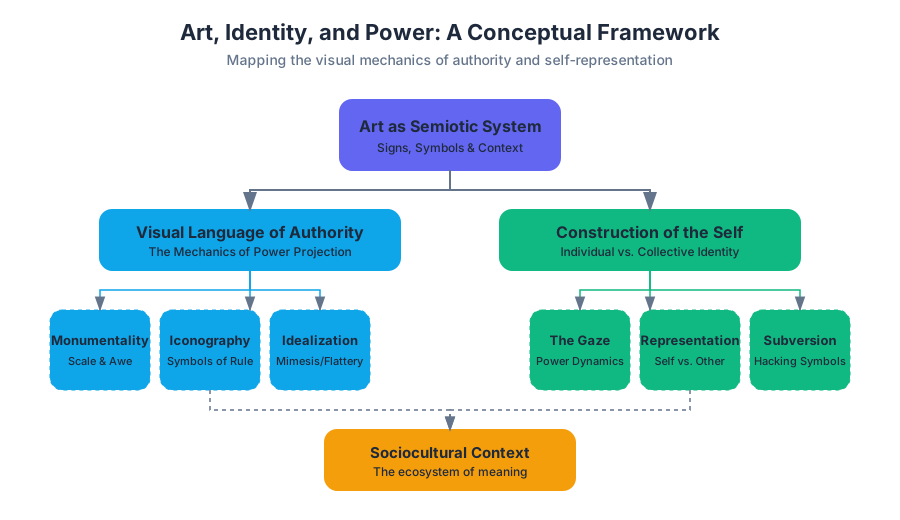
Art History: Ancient Times to the Late Colonial Era
Key concepts: Prehistoric Art · Global Inclusivity · Colonial Art · Cultural Exchange · Ancient Civilizations
A chronological survey of global art movements from prehistory through the 18th century, focusing on cultural encounters.
Art History: Ancient Times to the Late Colonial Era
The study of art history from antiquity through the late colonial era is not merely a chronological survey of aesthetic preferences; it is a forensic examination of human cognition, social hierarchy, and the evolution of symbolic communication. This era encompasses the transition from the first parietal markings in deep caves to the complex, often violent, syncretism of the "New World." To understand this progression, one must analyze art through the dual lenses of formal analysis (the "how") and socio-cultural context (the "why").
Prehistoric Art: The Genesis of Symbolic Representation
Prehistoric Art refers to all artifacts produced by pre-literate cultures, traditionally divided into the Paleolithic (Old Stone Age), Mesolithic (Middle Stone Age), and Neolithic (New Stone Age) periods. This era marks the biological and cognitive "leap" where Homo sapiens began to use external media to represent internal concepts.
What it is
Art in this period was rarely "art for art's sake." It functioned as a tool for survival, ritual, and social cohesion. Key forms include parietal art (cave paintings) and mobiliary art (small, portable sculptures like the Venus of Willendorf).
Why it matters
It represents the first evidence of abstract thought. By creating a representation of a bison, the prehistoric artist was performing a "data compression" of reality—stripping away the noise of the physical world to capture the essence of the animal, likely for sympathetic magic or educational purposes.
How it works: The Transition to Sedentism
The shift from the Paleolithic to the Neolithic (c. 10,000 BCE) changed the "architecture" of art. As humans moved from nomadic hunter-gatherer lifestyles to settled agricultural communities, art became larger, more permanent, and more focused on the relationship between humans and the land.
| Feature | Paleolithic Art | Neolithic Art |
|---|---|---|
| Primary Media | Cave walls, bone, ivory | Stone (Megaliths), ceramics, plaster |
| Subject Matter | Animals, hand stencils | Human figures, geometric patterns |
| Scale | Small/Portable or Deep Cave | Monumental (Stonehenge, Göbekli Tepe) |
| Function | Ritual/Hunting magic | Commemoration/Ancestral worship |
Common Pitfalls
A frequent mistake is viewing prehistoric artists as "primitive" or "unskilled." Technically, the use of chiaroscuro (shading to show volume) and the utilization of natural rock contours to suggest muscle mass in Altamira or Lascaux show a sophisticated understanding of three-dimensional form that would not be "rediscovered" in Western art until the Renaissance.
Ancient Civilizations: Art as an Instrument of Power
As civilizations emerged in the Fertile Crescent, the Nile Valley, and the Indus Valley, art became the primary medium for codifying power and identity. In these contexts, the artist was often an anonymous functionary working within a strict canon of proportions.
The Egyptian Canon
Ancient Egyptian art is perhaps the most rigid example of a "systematized" aesthetic. To ensure the efficacy of the Ka (soul) in the afterlife, the human body had to be represented with mathematical precision.
The Law of Frontality: In Egyptian statuary, figures are depicted looking straight ahead, with bodies oriented toward the viewer to project eternal stability and authority.
Mathematical Derivation: The Egyptian Grid System
Egyptian artists used a squared grid to maintain consistency across millennia. The standard unit was the "fist," and a standing figure was exactly 18 units high from the soles of the feet to the hairline.
\text{Height} = 18 \text{ units} \\
\text{Knees} = 6 \text{ units} \\
\text{Shoulders} = 15 \text{ units} \\
\text{Hairline} = 18 \text{ units}
Technical Implementation: Simulating the Grid
If we were to programmatically generate an Egyptian figure based on these proportions, we might use a low-level structure to define the vertices relative to the grid.
/*
 * Low-level representation of the Egyptian Canon of Proportions.
 * Each unit represents one 'fist' in the 18-unit grid.
 */

typedef struct {
    float x;
    float y;
} Point;

typedef struct {
    Point feet;      // Unit 0
    Point knees;     // Unit 6
    Point waist;     // Unit 10.5
    Point shoulders; // Unit 15
    Point hairline;  // Unit 18
} EgyptianProportions;

void calculate_canonical_points(float scale_factor, EgyptianProportions *p) {
    p->feet.y = 0.0f;
    p->knees.y = 6.0f * scale_factor;
    p->waist.y = 10.5f * scale_factor;
    p->shoulders.y = 15.0f * scale_factor;
    p->hairline.y = 18.0f * scale_factor;
}
Global Inclusivity: Beyond the Western Narrative
Traditional art history often suffers from "Eurocentrism," focusing on the Greco-Roman lineage while ignoring the sophisticated developments in the Americas, Africa, and Asia. A deep-dive requires examining these cultures on their own technical and philosophical terms.
Mesoamerican Monumentality
The Olmec and Maya civilizations utilized art to bridge the gap between the terrestrial and the divine. The Colossal Heads of the Olmec (c. 1200–400 BCE) are masterpieces of basalt carving, weighing up to 40 tons. These were not just portraits; they were physical manifestations of the ruler's "vital force."
Sub-Saharan African Sophistication
The Nok culture (Nigeria, c. 1000 BCE) produced complex terracotta sculptures that utilized advanced firing techniques to achieve structural integrity at large scales. Later, the Kingdom of Benin utilized the lost-wax casting (cire perdue) process to create bronze plaques that functioned as a visual archive of the royal court.
| Civilization | Key Innovation | Material Significance |
|---|---|---|
| Olmec | Colossal basalt carving | Volcanic stone = Earth power |
| Nok | Large-scale terracotta | Clay = Human origin/fertility |
| Benin | Lost-wax bronze casting | Brass/Bronze = Eternal kingship |
| Maya | Hieroglyphic stelae | Limestone = Historical record |
Common Pitfalls
Avoid the "Ethnographic Trap"—the tendency to view non-Western art as "timeless" or "tribal." These works were often highly specific to individual artists and political moments, just as a portrait of Louis XIV was specific to 17th-century France.
The Colonial Era: American Encounters and Syncretism
The "Colonial Era" (c. 1492–1820s) represents one of the most complex periods in art history. It is characterized by cultural exchange, but also by cultural erasure and the birth of new, hybrid visual languages.
Syncretism and Tequitqui
When Spanish friars arrived in Mexico, they employed Indigenous artists to decorate churches. The resulting style, often called Tequitqui, combined European Christian iconography with Indigenous carving techniques (flat surfaces, sharp edges, and floral motifs derived from pre-Columbian codices).
Material Significance: Spolia and Borrowed Glory
In the colonial context, materials often carried political weight. The use of spolia—repurposing stones from Indigenous temples to build Christian cathedrals—was a literal and symbolic act of dominance.
Spolia: The repurposing of building stone or decorative elements for new construction, typically as a sign of conquest or the continuity of power.
The Casta System: Art as Social Database
One of the most unique genres of the colonial era was Casta Painting. These were sets of 16 paintings that categorized the various racial combinations in the Spanish Americas (e.g., Español + Mora = Mulato). These functioned as a visual "API" for the colonial administration to maintain social hierarchy.
Data Representation of Casta Metadata
In a modern museum database, a Casta painting might be represented with the following metadata structure to track the complex relationships it depicts.
# Metadata schema for a Casta Painting (18th Century, Mexico)
artifact:
  id: "MEX-1750-CP-04"
  title: "De Español e India, Mestizo"
  artist: "Miguel Cabrera" (attributed)
  materials:
    support: "Canvas"
    medium: "Oil"
  taxonomy:
    father_caste: "Español"
    mother_caste: "India"
    offspring_caste: "Mestizo"
  context:
    location: "Viceroyalty of New Spain"
    purpose: "Social classification and hierarchy"
  provenance:
    - date: "1763"
      event: "Commissioned for private collection in Madrid"
Technical Analysis: The Elements and Principles of Design
To analyze any work from this vast timeline, scholars use a standardized "toolkit" of terms. This is the Structure of Art.
Elements of Art (The Building Blocks)
- Line: The path of a point moving through space.
- Shape: A two-dimensional area defined by an edge.
- Form: A three-dimensional object or the illusion of one.
- Color: Produced when light, striking an object, is reflected back to the eye.
- Texture: The surface quality of an artwork.
Principles of Design (The Rules of Engagement)
These principles govern how the elements are arranged to create a specific effect.
- Balance: The distribution of visual weight (Symmetrical, Asymmetrical, Radial).
- Emphasis: The focal point that catches the viewer's attention.
- Unity: The sense of harmony between all parts of the work.
Worked Example: Analyzing the Parthenon Frieze
If we apply these principles to the Parthenon Frieze (Ancient Greece):
- Element (Line): The rhythmic repetition of vertical lines in the drapery creates a sense of movement.
- Principle (Balance): The frieze uses isocephaly (the heads of the figures are at the same level), creating a sense of democratic equality and visual stability.
Database Query: Material Value Analysis
Museum curators often need to query the relationship between the "monetary value" and "cultural value" of materials.
-- Query to identify artifacts made of high-intrinsic-value materials
-- that also hold high cultural significance (e.g., Spolia or Sacred Gold)

SELECT
    artifact_name,
    material_type,
    intrinsic_value_rating, -- 1-10 scale
    cultural_significance_index,
    origin_period
FROM
    art_history_collection
WHERE
    (material_type = 'Gold' OR material_type = 'Ivory' OR material_type = 'Spolia')
    AND cultural_significance_index > 8
ORDER BY
    origin_period ASC;
The Role of the Viewer and Cultural Preservation
Art does not exist in a vacuum; it requires a viewer to complete the circuit of meaning. This is particularly true for colonial art, where the intended viewer (often a European monarch or a local convert) dictated the artistic choices.
Art vs. Craft
A recurring debate in this section of history is the distinction between "art" and "craft." In many ancient and colonial cultures, this distinction did not exist. A finely woven Inca tunic (T'oqapu) was not "craft"—it was a high-status political garment that conveyed the wearer's genealogy through geometric "code."
Ethics and Repatriation
Many of the works discussed—from the Benin Bronzes to the Parthenon Marbles—are currently the subject of intense ethical debate regarding repatriation. Because these items were often removed during colonial occupations, the question of "who owns history" remains a central tension in modern art history.
Repatriation: The process of returning an asset, an item of symbolic value, or a person—voluntarily or forcibly—to its owner or its place of origin or citizenship.
Conclusion: The Visual Record of Humanity
From the ochre-stained walls of prehistoric caves to the oil-on-canvas hierarchies of the Spanish Empire, art serves as our most durable record of human existence. It is a technology for memory, a weapon for power, and a bridge between disparate cultures. By mastering the formal elements and understanding the socio-political contexts of these eras, we gain the ability to "read" the past with the same precision we apply to modern data.
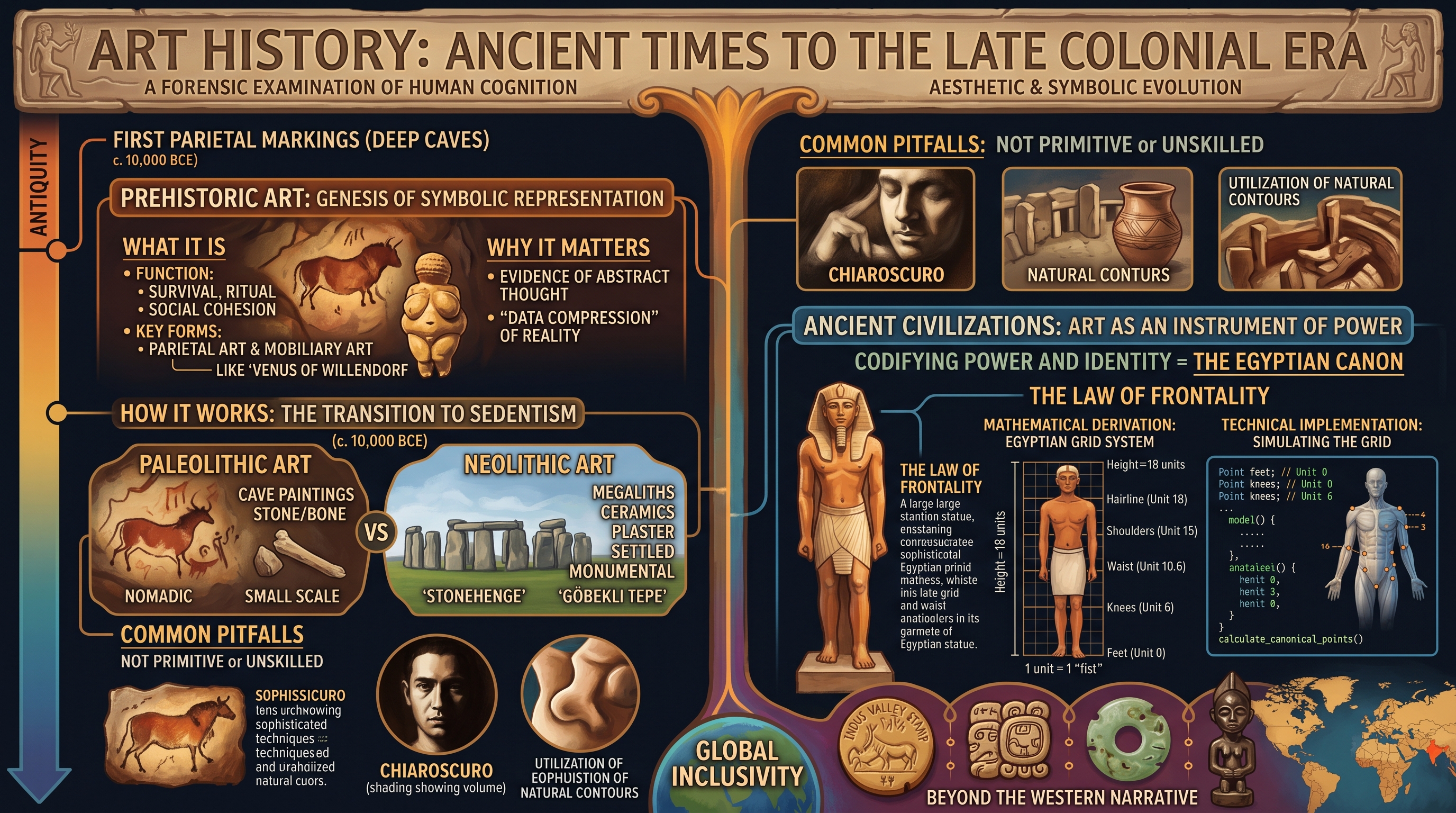
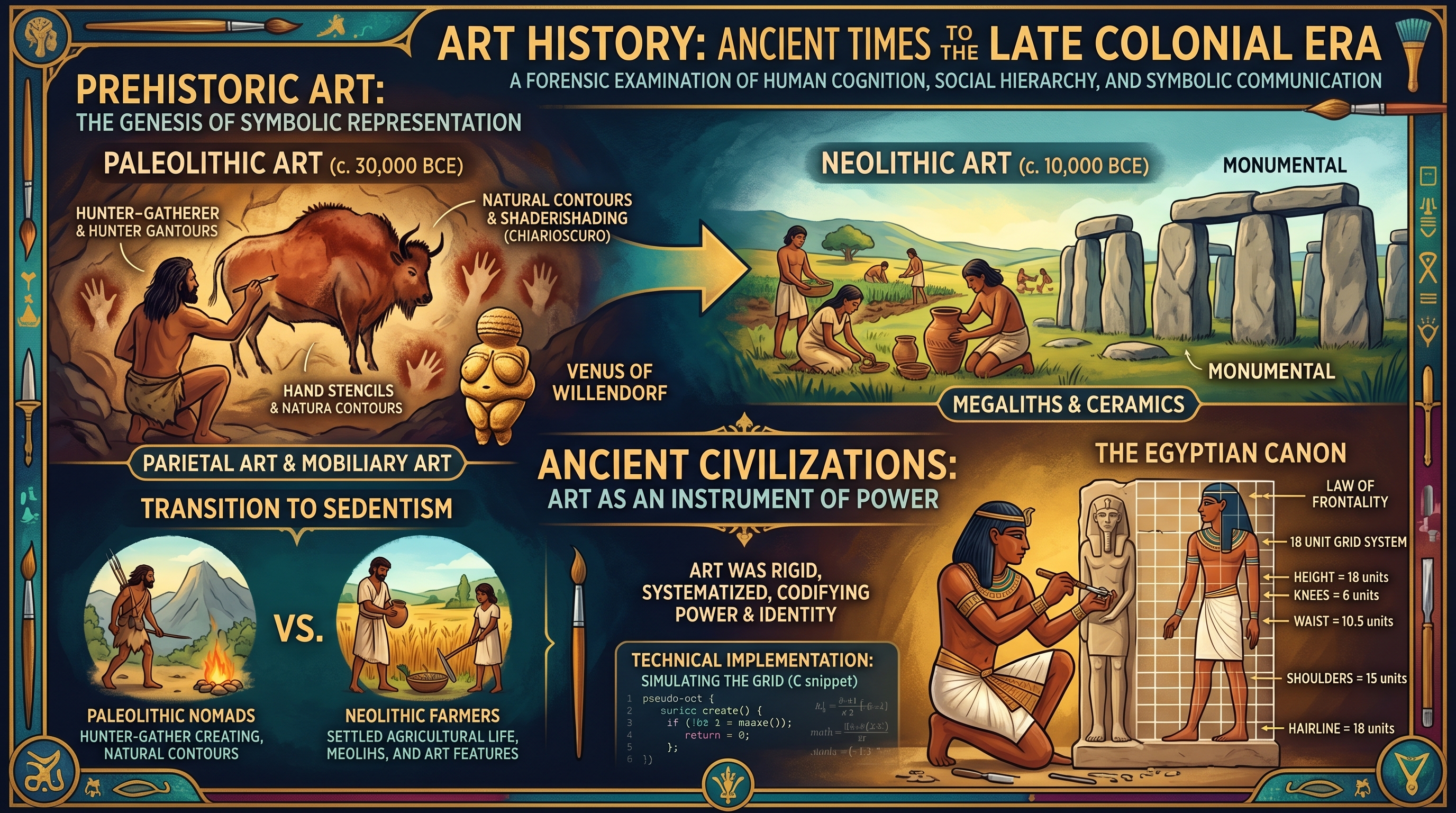
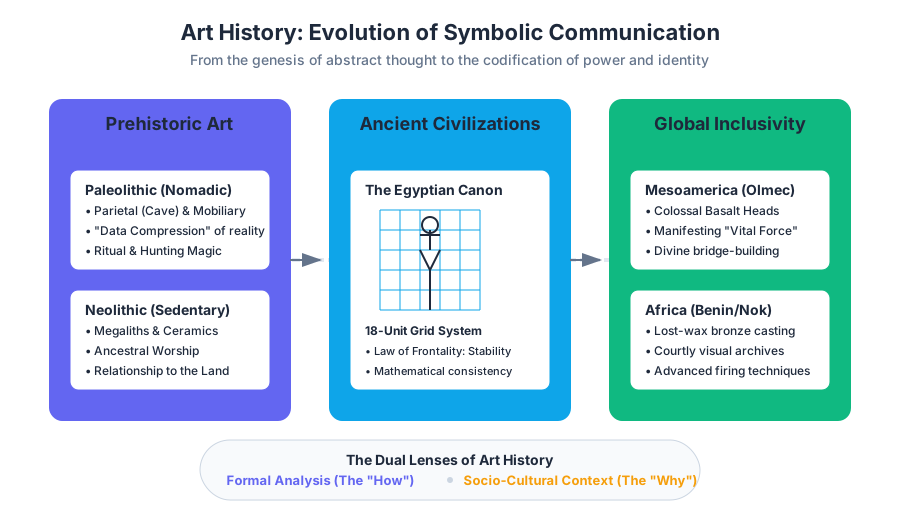
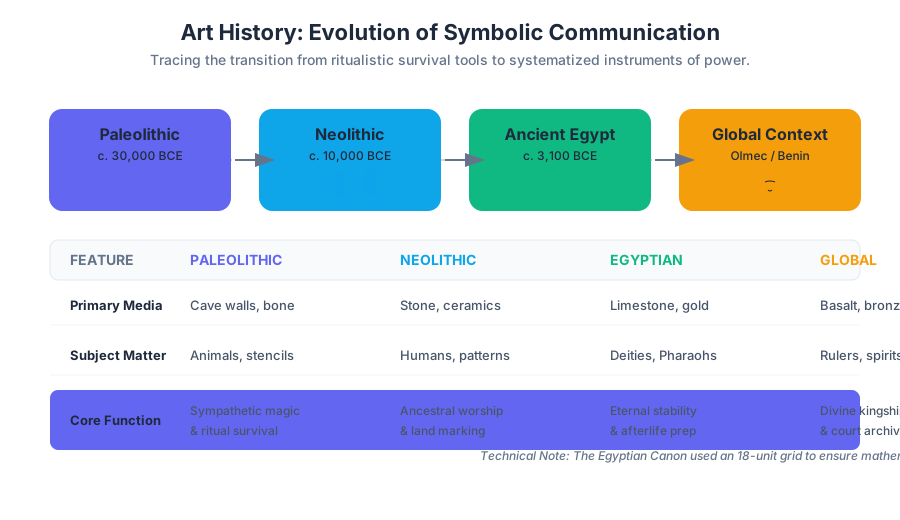
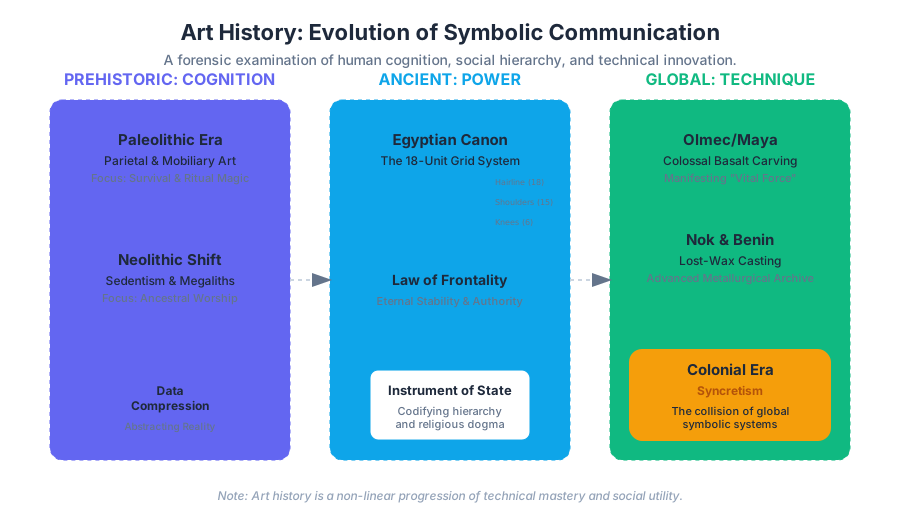
Art History: 1776 to the Present
Key concepts: Modernism · Post-Modernism · Contemporary Art · Industrialization · 21st Century Art
The evolution of art from the birth of modern nations through the industrial revolution to contemporary global practices.
Art History: 1776 to the Present
The period from 1776 to the present represents the most volatile and transformative era in the history of human expression. This epoch marks the transition from art as a tool of the state and church to art as an autonomous, self-reflexive, and often subversive medium. The trajectory is defined by the collapse of mimesis (the imitation of nature) and the rise of conceptualism, driven by the twin engines of the Industrial Revolution and the digital turn.
The Industrial Pivot and the Crisis of Representation (1776–1860)
The year 1776 serves as a symbolic boundary, coinciding with the American Revolution and the publication of Adam Smith’s The Wealth of Nations. In art, this period is defined by the tension between Neoclassicism—the visual language of the Enlightenment—and Romanticism—the reaction against industrial rationalization.
Neoclassicism: The Logic of Order
Neoclassicism sought to revive the "noble simplicity and quiet grandeur" of Greek and Roman antiquity. It was the "official" style of revolutions, used to instill civic virtue and rationalism.
Romanticism: The Sublime and the Individual
As factories began to mar the landscape, Romanticism emerged as a counter-movement. It prioritized the Sublime—an aesthetic quality of greatness, whether physical, moral, intellectual, or spiritual, that is beyond all possibility of calculation or imitation.
| Feature | Neoclassicism | Romanticism |
|---|---|---|
| Philosophical Base | Enlightenment Rationalism | Individualism & Emotion |
| Subject Matter | History, Mythology, Civic Duty | Nature, Horror, The Exotic |
| Visual Style | Linear, smooth finish, "invisible" brushwork | Painterly, expressive, high contrast |
| Goal | Moral instruction | Emotional transcendence |
The Impact of Industrialization
The invention of the Daguerreotype in 1839 (the birth of photography) created a fundamental "crisis of representation." If a machine could capture reality perfectly, what was the purpose of the painter? This question forced art to move away from what is seen toward how it is seen.
The Modernist Revolution (1860–1945)
Modernism is not just a style but a philosophical shift. It is characterized by Formalism—the idea that a work’s value is determined by its form (line, color, shape) rather than its narrative content.
The Logic of the Grid and Abstraction
Modernism sought to strip art down to its "essential" components. This culminated in movements like Cubism, which deconstructed objects into geometric primitives, and De Stijl, which reduced the visual world to the grid and primary colors.
Definition: The Greenbergian Flatness Art critic Clement Greenberg argued that the "unique and proper area of competence" of each art form coincided with all that was unique to the nature of its medium. For painting, this meant acknowledging the flatness of the canvas rather than trying to create the illusion of 3D space.
Technical Implementation: Color Theory and Quantization
The Modernists, particularly the Pointillists (Seurat), were early "engineers" of visual perception. They understood that the human eye performs spatial averaging. To represent this technically, we can look at how modern computer vision quantizes color spaces to mimic the "essential" palettes used by Modernist painters.
import numpy as np
from sklearn.cluster import KMeans
import cv2

def extract_modernist_palette(image_path, k=5):
    """
    Extracts the dominant color palette from an artwork using K-Means clustering.
    This simulates the formalist reduction of a complex scene into its
    essential chromatic components.
    """
    # Load image and convert from BGR to RGB
    image = cv2.imread(image_path)
    image = cv2.cvtColor(image, cv2.COLOR_BGR2RGB)

    # Reshape the image to be a list of pixels
    pixels = image.reshape((-1, 3))

    # Use K-Means to find the k most dominant colors
    clt = KMeans(n_clusters=k, n_init=10)
    clt.fit(pixels)

    # Return the cluster centers (the palette)
    palette = clt.cluster_centers_.astype("uint8")
    return palette

# Example usage:
# palette = extract_modernist_palette("monet_impression.jpg", k=8)
# print(f"Dominant Hex Codes: {[ '#%02x%02x%02x' % tuple(c) for c in palette]}")
Post-Modernism: The Collapse of Grand Narratives (1960–2000)
If Modernism was a search for "Truth" and "Purity," Post-Modernism is a celebration of "Irony," "Pastiche," and "Pluralism." It rejects the idea that art progresses in a linear fashion toward a goal.
Key Concepts of Post-Modernism
- Deconstruction: Breaking down the hierarchies within a work (e.g., high art vs. low craft).
- Intertextuality: The realization that every "new" work is actually a collage of previous influences.
- The Death of the Author: Roland Barthes’ theory that the meaning of a work is determined by the viewer, not the creator.
Mathematical Derivation: The Compositional Shift
Modernist composition often relied on the Golden Ratio ($\phi$) to find a "universal" harmony. Post-modernism often intentionally breaks these ratios to create "glitch" aesthetics or "anti-form."
\text{Golden Ratio } \phi = \frac{1 + \sqrt{5}}{2} \approx 1.61803398875

\text{Modernist Composition Constraint:}
\text{Let } W \text{ be width and } H \text{ be height.}
\text{Optimal Focal Point } (x, y) = (\frac{W}{\phi}, \frac{H}{\phi})

\text{Post-Modernist Subversion (Randomized/Decentered):}
(x, y) = (\text{rand}(0, W), \text{rand}(0, H)) \text{ where } (x, y) \notin \text{Centroid Area}
Comparison of Paradigms
| Aspect | Modernism (1900-1960) | Post-Modernism (1960-2000) |
|---|---|---|
| Core Value | Authenticity & Originality | Irony & Appropriation |
| Structure | Hierarchy & Order | Rhizome & Chaos |
| Medium | Specificity (Painting is Painting) | Intermedia (Installation, Video) |
| Narrative | The "Grand Narrative" (Progress) | "Petit Récits" (Local stories) |
Contemporary Art and the 21st Century (2000–Present)
Contemporary art is defined by Globalization and Digitality. The "object" of art has largely been replaced by the "experience" or the "data."
Relational Aesthetics
Proposed by Nicolas Bourriaud, this theory suggests that art is a set of practices which take as their theoretical and practical point of departure the whole of human relations and their social context, rather than an independent and private space.
The Algorithmic Turn
In the 21st century, the artist often acts as a system designer rather than a manual laborer. Generative art, AI-driven installations, and Bio-art use living systems or code as their primary medium.
Real-World Usage: Archival and Processing
Modern curators and digital artists use CLI tools to manage the massive influx of visual data. For example, processing a collection of 10,000 "Internet Art" screenshots requires automated pipelines.
# A CLI pipeline to normalize a directory of contemporary digital art
# 1. Resize to consistent 2K resolution
# 2. Strip metadata for privacy/anonymity (Post-modern 'Death of Author')
# 3. Apply a subtle sharpening filter for display

mkdir -p ./processed_exhibition

for img in ./raw_submissions/*.png; do
    convert "$img" \
        -resize 2048x2048^ \
        -gravity center \
        -extent 2048x2048 \
        -strip \
        -unsharp 0x1 \
        "./processed_exhibition/$(basename "$img")"
done

echo "Exhibition assets normalized and metadata purged."
Common Pitfalls in Art History Analysis
- The "Teleological" Fallacy: Assuming that art is "improving" over time. Art doesn't get "better"; its goals simply change.
- Ignoring Materiality: Focusing only on the "image" while ignoring what it's made of. A digital NFT has a different ontology than an oil painting, even if they look identical on a screen.
- Over-Categorization: Movements like "Impressionism" or "Pop Art" were often labels applied by critics, not the artists themselves. Many artists worked across multiple styles simultaneously.
Summary of Media Evolution
| Era | Primary Media | Technical Constraint | Role of the Artist |
|---|---|---|---|
| 1776-1850 | Oil, Marble, Print | Manual Dexterity | Master Craftsman |
| 1850-1950 | Industrial Paints, Photography | Chemical Stability | Visionary / Formalist |
| 1960-2000 | Video, Plastic, Found Objects | Durability of Synthetics | Philosopher / Critic |
| 2000-Present | Code, Bio-matter, Pixels | Computation / Ethics | System Architect |
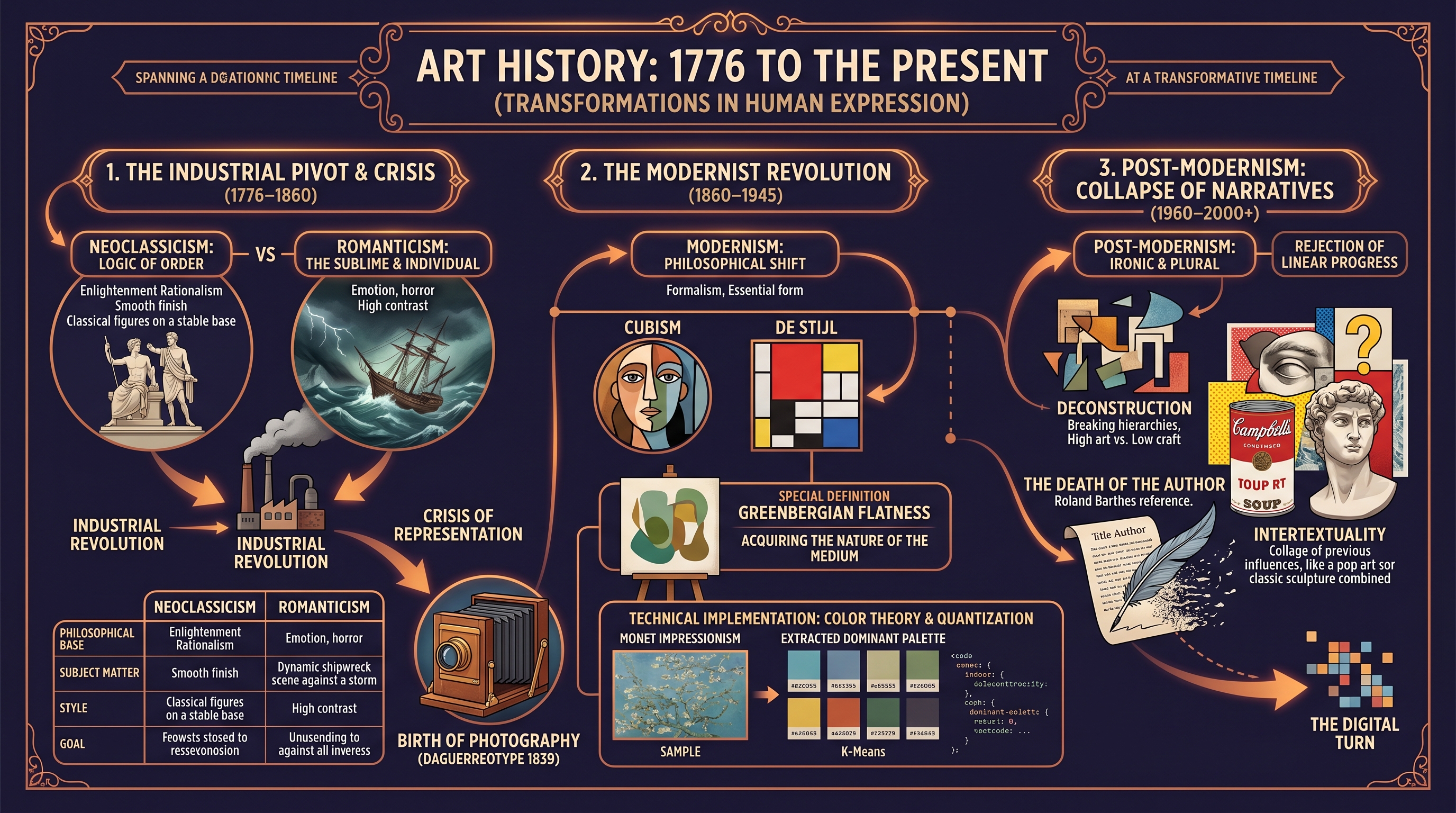
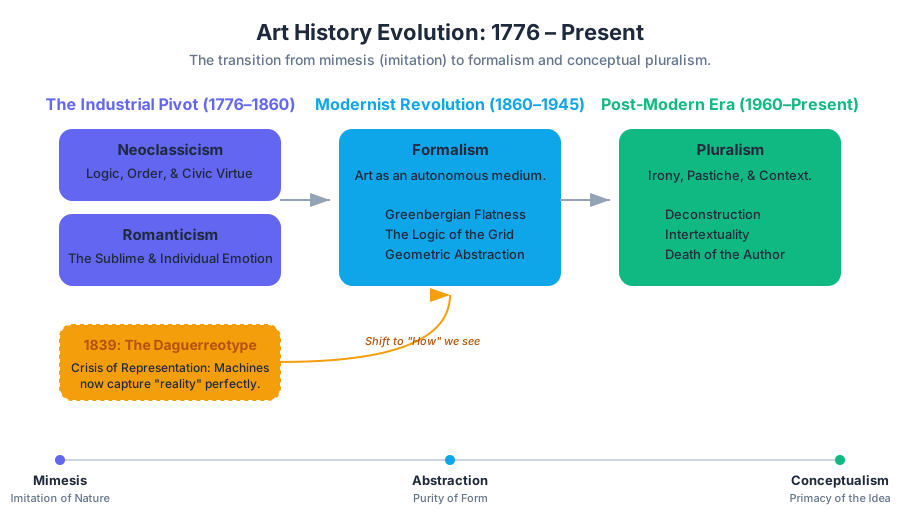
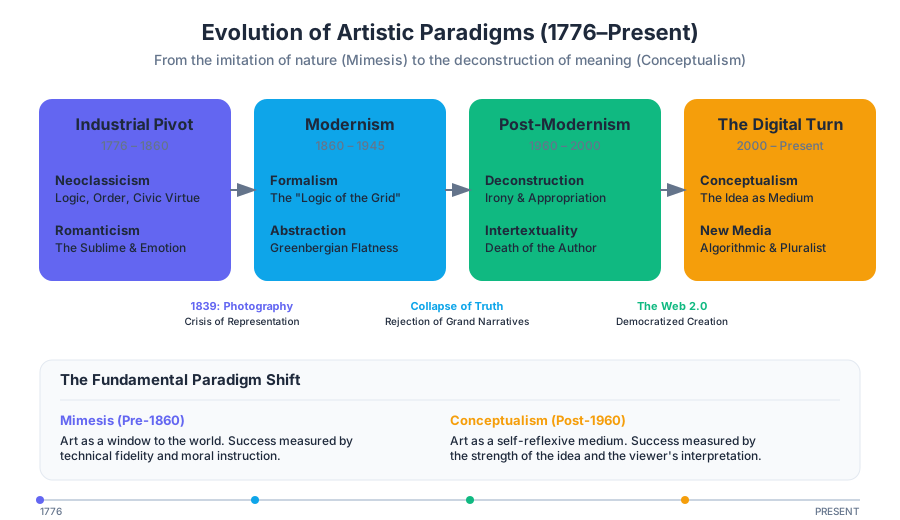
Source Materials
Study Art with AI — Free on Lykke
Sign up for free to generate personalized flashcards, quizzes, and study guides from this course. Chat with an AI tutor that knows the material.
Get Started FreeView this course wiki on Lykke · Browse all public course wikis