From the free course Anthropology on Lykke
Authority, Decisions, and Power: Political Anthropology
Key concepts: Acephalous Societies · Centralized Societies · Nation-States · Colonialism · Social Movements
Analyzes how societies organize power, decision-making, and authority from small bands to modern nation-states.
Authority, Decisions, and Power: Political Anthropology
Political anthropology is the systematic study of how human groups maintain social order, resolve conflict, and allocate power. While political science often focuses on formal institutions like parliaments and elections, political anthropology takes a broader, cross-cultural approach, examining everything from the informal "shaming" rituals of hunter-gatherer bands to the complex bureaucratic machinations of the modern nation-state.
At its core, this subfield investigates the tension between agency (the capacity of individuals to act independently) and structure (the social arrangements that limit or influence those actions). By analyzing political systems through the lenses of history, ecology, and culture, anthropologists reveal that "power" is not a monolithic force but a multifaceted phenomenon that can be centralized, diffused, or even invisible.
Acephalous Societies: The Power of Consensus
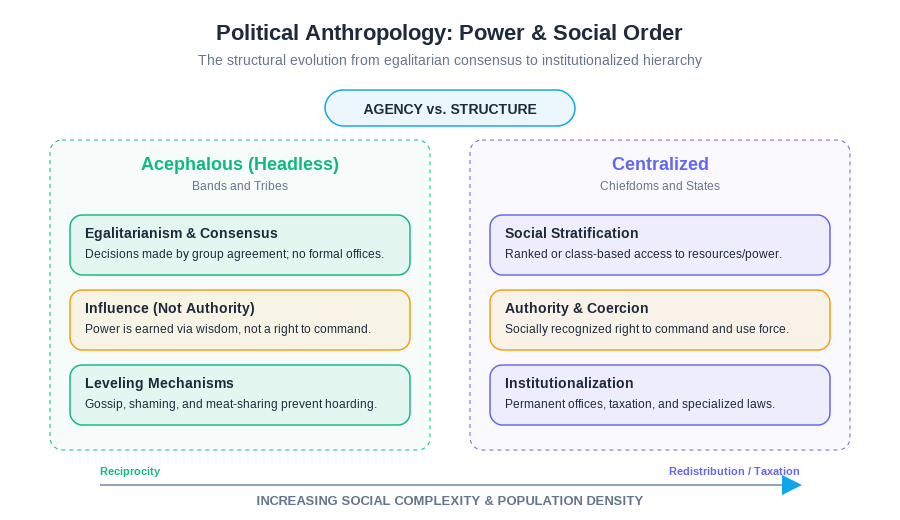
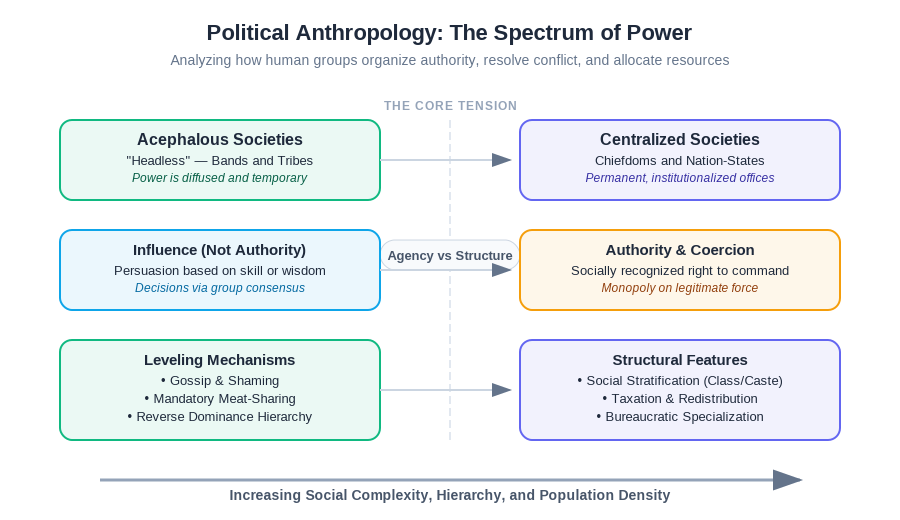
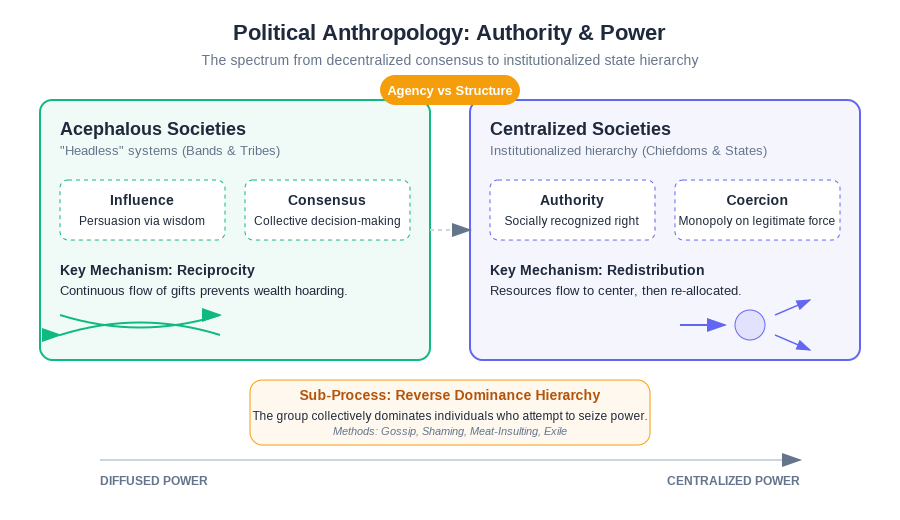
The term acephalous literally means "headless." In political anthropology, it refers to societies that lack a permanent, centralized leadership or a formal government apparatus. These are typically organized as bands or tribes.
What it is
Acephalous societies rely on egalitarianism, where power is diffused across the entire group. Decisions are made through consensus rather than command. While certain individuals may possess more influence (the ability to persuade) due to their wisdom or hunting prowess, they lack authority (the socially recognized right to command).
Why it matters
Understanding acephalous societies challenges the Western assumption that "human nature" is inherently hierarchical. It proves that social order can be maintained without a police force or a judicial system, relying instead on social pressure and reciprocity.
How it works: Social Leveling Mechanisms
To prevent any single individual from accumulating too much power, acephalous societies employ leveling mechanisms. These include:
- Gossip and Shaming: Publicly criticizing those who act arrogantly.
- Meat-Sharing Rules: Ensuring that successful hunters do not control the distribution of food.
- Reverse Dominance Hierarchy: A collective effort by the group to dominate any individual who attempts to lead.
Concrete Example: The !Kung San
Among the !Kung San of the Kalahari, a hunter who brings back a large kill is often met with "insulting the meat." The group belittles the size and quality of the kill to ensure the hunter remains humble and does not view the gift of food as a source of political leverage.
Variations and Pitfalls
- Segmentary Lineage Systems: A variation found in tribal societies (like the Nuer) where groups only unite during times of conflict, dissolving back into autonomous units afterward.
- Common Pitfall: Misinterpreting "egalitarian" as "perfectly equal." Even in acephalous societies, gender and age often create internal hierarchies, though they lack the coercive power of a state.
Centralized Societies: Chiefdoms and States
As populations grow and resources become more concentrated, societies often transition toward centralization. This involves the creation of permanent political offices and the institutionalization of inequality.
What it is
Centralized societies are characterized by a formal leadership structure. They are typically categorized into Chiefdoms and States.
| Feature | Chiefdom | State |
|---|---|---|
| Leadership | Hereditary Chief | Bureaucratic/Elected/Monarchical |
| Social Structure | Ranked (Kinship-based) | Stratified (Class/Caste-based) |
| Economy | Redistribution | Taxation and Markets |
| Force | Limited (Social pressure/Warriors) | Monopoly on Legitimate Force |
| Complexity | Moderate | High (Specialized departments) |
Why it matters
Centralization allows for large-scale coordination, such as building irrigation systems or maintaining standing armies. However, it also creates structural violence—inequalities built into the social system that prevent certain groups from meeting their basic needs.
How it works: The Transition to Statehood
The transition from a chiefdom to a state often involves the decoupling of leadership from kinship. In a chiefdom, you follow the leader because they are your "senior relative." In a state, you follow the leader because they represent an abstract institution (the "Crown" or the "Government").
Mathematical Derivation of Centralization (Gini Coefficient)
In centralized societies, wealth and power distribution can be measured using the Gini Coefficient ($G$). As a society moves from a band to a state, $G$ typically increases.
G = \frac{\sum_{i=1}^{n} \sum_{j=1}^{n} |x_i - x_j|}{2n^2 \bar{x}}
Where:
- $n$ is the number of individuals.
- $x$ is the resource (power or wealth) held by an individual.
- $\bar{x}$ is the mean resource value.
- $G = 0$ represents perfect equality (Acephalous).
- $G = 1$ represents perfect inequality (Totalitarian State).
Concrete Example: The Hawaiian Chiefdoms
Pre-colonial Hawaii featured a highly complex chiefdom system where Ali'i (chiefs) were believed to possess Mana (spiritual power). They controlled the land and the labor of commoners, redistributing resources through large-scale feasts and public works.
Common Pitfalls
- Teleological Bias: The mistaken belief that all societies are "evolving" toward the state. Many societies have historically resisted state formation (e.g., "The Art of Not Being Governed" by James C. Scott).
The Modern Nation-State
The Nation-State is a relatively recent historical development, emerging primarily after the Peace of Westphalia (1648). It combines a centralized political apparatus (the State) with a shared cultural identity (the Nation).
What it is
A nation-state claims sovereignty over a specific territory and its inhabitants. It utilizes "imagined communities" (a term coined by Benedict Anderson) to create a sense of belonging among millions of strangers who will never meet.
Why it matters
The nation-state is the primary actor in modern global politics. It manages citizenship, issues currency, and maintains the borders that define our movement and rights.
How it works: The Monopoly on Force
Max Weber famously defined the state as a "human community that (successfully) claims the monopoly of the legitimate use of physical force within a given territory." If a private citizen uses force, it is a crime; if the state uses force (police, military), it is "law enforcement."
Comparison: Pre-Modern vs. Modern States
| Attribute | Pre-Modern State | Modern Nation-State |
|---|---|---|
| Identity | Subject of a Ruler | Citizen of a Nation |
| Borders | Porous/Frontiers | Fixed/Hard Borders |
| Language | Diverse/Local Dialects | Standardized National Language |
| Legitimacy | Divine Right/Lineage | Popular Sovereignty/Constitution |
Colonialism: The Global Redistribution of Power
Colonialism is the policy or practice of acquiring full or partial political control over another country, occupying it with settlers, and exploiting it economically.
What it is
Anthropologically, colonialism is viewed as a massive project of cultural and political engineering. It didn't just extract gold; it forcibly reorganized local political systems to serve the metropole (the colonizing power).
Why it matters
Most modern political conflicts, borders, and economic inequalities are direct legacies of the colonial era. Colonialism introduced the "State" model to regions that were previously acephalous or organized as chiefdoms, often with disastrous results.
How it works: Indirect Rule
The British Empire frequently used Indirect Rule, where they governed through existing local power structures. If a society was acephalous, the British would often "invent" a chief (a Warrant Chief) to give orders to, fundamentally altering the local social fabric.
Table: Colonial Governance Models
| Model | Strategy | Example | Long-term Impact |
|---|---|---|---|
| Direct Rule | Centralized administration by colonizers | French West Africa | Assimilationist pressure |
| Indirect Rule | Governing through local elites | British Nigeria | Institutionalized ethnic tension |
| Settler Colonialism | Large-scale migration of colonizers | Australia/USA | Displacement/Genocide of Indigenous groups |
Concrete Example: The Scramble for Africa
The 1884 Berlin Conference saw European powers draw borders across Africa with no regard for existing ethnic, linguistic, or political boundaries. This created "poly-ethnic" states that struggled for stability post-independence.
Social Movements and Resistance
Where there is power, there is resistance. Social movements are purposeful, organized groups striving to work toward a common social goal.
What it is
Anthropologists study social movements not just as political events, but as cultural performances. They look at how movements create new identities, use symbols, and challenge the "hegemony" (the taken-for-granted dominance) of the state.
Why it matters
Social movements are the primary mechanism for political change in the modern world, from the Civil Rights Movement to the Arab Spring and environmental activism.
How it works: Weapons of the Weak
James C. Scott's concept of Everyday Resistance suggests that when open rebellion is too dangerous, oppressed groups use "infrapolitics":
- Foot-dragging
- False compliance
- Pilfering
- Slander
Variations: New Social Movements (NSMs)
Unlike older movements focused on labor or class, NSMs (like LGBTQ+ rights or Environmentalism) often focus on identity and quality of life. They seek cultural recognition as much as political representation.
Summary of Political Evolution
The Political Continuum: Human organization is not a ladder of progress, but a toolkit of strategies. While we live in an era dominated by the Nation-State, the principles of acephalous consensus and tribal loyalty continue to influence how we form communities and resist authority.
Key Terms for Review
- Hegemony: The internalizing of the dominant group's values by the oppressed, making the status quo seem "natural."
- Biopower: (Foucault) The state's power to regulate the bodies and lives of its citizens (e.g., birth rates, vaccinations).
- Sovereignty: The supreme authority of a state to govern itself.
- Reciprocity: The exchange of goods and services of approximately equal value between two parties.
- Structural Violence: Harm caused by social structures that prevent people from reaching their full potential.
Author's Note: This article serves as a foundational guide to Political Anthropology. For further exploration, students are encouraged to read Pierre Clastres' Society Against the State and Michel Foucault's Discipline and Punish.
Source Materials
Study Anthropology on Lykke
This course page is free to open: signed out, you can read its first two sections, and signing in, on any plan, opens the rest. The free Lykke Chrome extension syncs your own Canvas courses, so ChatGPT, Claude and Muse can answer from your classes and deadlines. It only reads Canvas.
Add the free extensionSign in to open every section