From the free course Anthropology on Lykke
Religion, Art, and Expressive Culture
Key concepts: Ritual · Symbolism · Expressive Culture · Anthropology of Media · Ritualistic Performance
Explores the anthropology of meaning through religion, ritual, art, music, and sport.
Religion, Art, and Expressive Culture
Expressive culture represents the aesthetic and symbolic dimension of social life, encompassing religion, ritual, the arts, and media. In anthropology, these are not merely "leisure" activities or "superstructures" of the economy; they are the primary mechanisms through which human beings construct meaning, negotiate power, and define their place in the cosmos. This section explores the technical frameworks used to analyze how symbols operate, how rituals transform social status, and how media technologies reshape the "social skin" of global communities.
The Architecture of Ritual
A ritual is a sequenced, repetitive social practice that is set apart from the routines of daily life. While often associated with religion, rituals can be secular (e.g., a graduation ceremony or a sporting event). Anthropologists analyze rituals not by their "truth" value, but by their functional and symbolic efficacy in transforming participants.
The Tripartite Structure of Rites of Passage
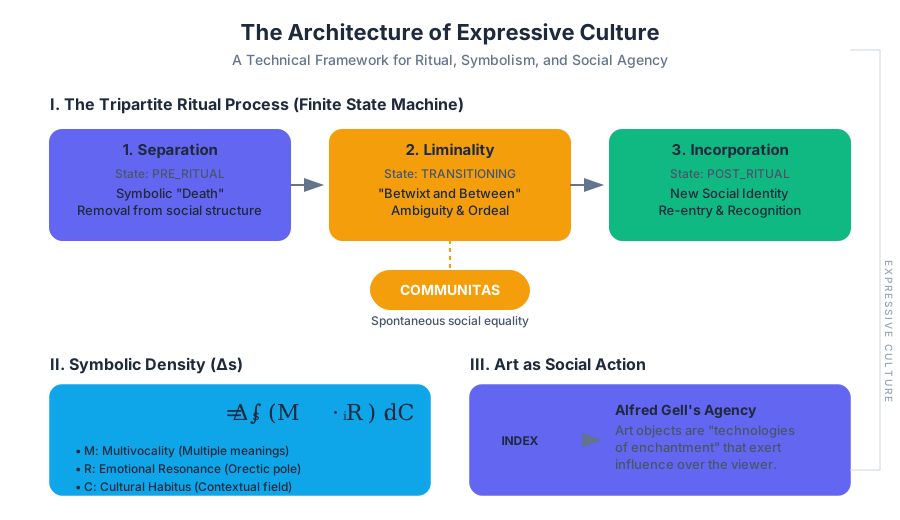
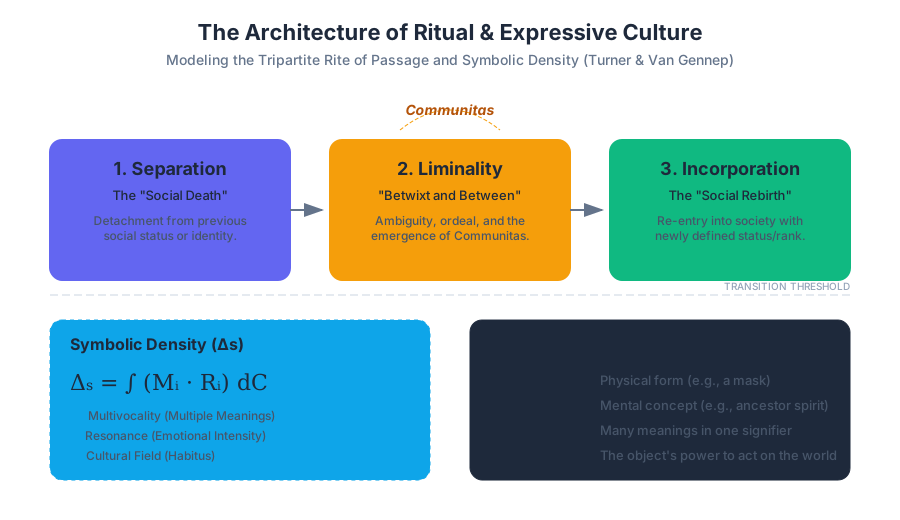
The most influential model of ritual comes from Arnold van Gennep and was later refined by Victor Turner. They identified a three-stage process known as a Rite of Passage, which facilitates the transition of an individual from one social state to another.
- Separation: The individual is stripped of their previous social identity. This often involves physical removal or symbolic "death."
- Liminality: The "betwixt and between" phase. The participant has no status, property, or rank. It is a period of ambiguity, ordeal, and heightened vulnerability.
- Incorporation: The individual re-enters society with a new status, often marked by a feast or public recognition.
Communitas: A term coined by Victor Turner to describe the intense feeling of social togetherness and equality that emerges among participants during the liminal phase of a ritual, transcending normal social hierarchies.
Ritual as a State Machine
From a systems perspective, a ritual can be modeled as a Finite State Machine (FSM) where transitions are triggered by specific symbolic inputs (sacred words, gestures, or objects).
Symbolism and Semiotics
Symbols are the building blocks of expressive culture. A symbol is something that stands for something else, but unlike a sign (which has a direct, often biological link to its meaning, like smoke signifying fire), a symbol's meaning is arbitrary and culturally defined.
Multivocality and Condensation
Victor Turner argued that ritual symbols possess multivocality—the ability to represent many different things at once. A single symbol, like a national flag or a sacred tree, can condense a vast array of meanings (history, blood, fertility, law) into one physical form.
The Mathematical Logic of Symbolic Density
We can conceptualize the "power" of a symbol through its Symbolic Density ($\Delta_s$), which is a function of its multivocality ($M$) and its emotional resonance ($R$) within a specific cultural context ($C$).
\Delta_s = \int_{i=1}^{n} (M_i \cdot R_i) \, dC
Where:
- $M_i$: The $i$-th distinct meaning assigned to the symbol.
- $R_i$: The intensity of the emotional response to that meaning.
- $C$: The cultural field or "habitus" in which the symbol is deployed.
| Concept | Definition | Example |
|---|---|---|
| Signifier | The physical form of the symbol (sound, image, object). | The word "Red". |
| Signified | The mental concept or meaning. | Danger, Passion, or Communism. |
| Condensation | The process of grouping multiple meanings into one signifier. | The Cross (Suffering + Redemption + Authority). |
| Polarization | Symbols having an "orectic" (physical) pole and a "normative" (social) pole. | Blood (Physical life vs. Social kinship). |
Art as Expressive Culture
Anthropologists reject the Western "Fine Arts" definition, which often isolates art in museums. Instead, they view art as social action. Art is not just an object to be looked at; it is a technology used to influence the world.
The Agency of Art
Alfred Gell proposed that art objects have agency. They are "indexes" of the maker's or the user's intentions. A mask in a ritual is not just a representation of a spirit; in the context of the performance, it is the spirit, capable of healing or punishing.
Deep Play in Sport
Clifford Geertz’s analysis of the Balinese Cockfight introduced the concept of Deep Play. This refers to activities where the stakes (honor, status, identity) are so high that it is "irrational" for people to engage in them from a purely economic standpoint. Sport serves as a "metasocial commentary"—a story a group tells itself about itself.
Anthropology of Media
The Anthropology of Media investigates how communication technologies (from print to TikTok) transform human sociality. Media is not a neutral pipe through which "culture" flows; the medium itself restructures the "social skin."
The Social Skin and Digital Ethnography
In the digital age, the "self" is no longer confined to the biological body. Our digital profiles and avatars constitute a "social skin" that we project into virtual spaces. Anthropologists use digital ethnography to study these spaces, treating them as real cultural sites rather than "fake" or "virtual" ones.
Media Infrastructure and Power
Media is also a matter of infrastructure. Who owns the cables? Who controls the algorithms? Anthropologists look at the Digital Divide not just as a lack of hardware, but as a form of social inequality that limits certain groups' ability to participate in the global "expressive culture."
Ritualistic Performance and Performativity
There is a technical distinction between "performance" (a staged event) and "performativity" (the power of language and gesture to create reality).
Speech Act Theory
Developed by J.L. Austin, Speech Act Theory posits that certain utterances do not just describe the world—they change it.
- Locutionary Act: The act of saying something.
- Illocutionary Act: The intent behind the saying (e.g., promising, threatening).
- Perlocutionary Act: The actual effect on the listener.
In a ritual, a priest saying "I now pronounce you married" is a performative utterance. It doesn't just describe a marriage; it creates it.
Comparison of Performance Modes
| Feature | Ritual Performance | Theatrical Performance | Daily Social Interaction |
|---|---|---|---|
| Primary Goal | Efficacy (Transformation) | Entertainment/Aesthetics | Communication/Utility |
| Audience Role | Participants/Co-creators | Observers/Consumers | Interactors |
| Time/Space | Sacred/Set Apart | Liminoid (Leisure) | Profane/Routine |
| Consequence | Permanent Social Change | Temporary Emotional Shift | Incremental Social Maintenance |
Globalized Media and Identity
In a globalized world, expressive culture is a primary site of resistance and identity formation. Indigenous Media, for example, allows marginalized groups to use film and the internet to challenge Western biases and document their own histories.
Visual Sovereignty
This term refers to the right of Indigenous peoples to self-represent. By controlling the camera, Indigenous filmmakers can subvert the "Western Gaze" and present their cultures not as static relics of the past, but as dynamic, evolving societies.
The "Winkiness" of Culture
Following Clifford Geertz, anthropologists look for the "thick description" of media. A "wink" and a "twitch" look the same physically, but their cultural meanings are worlds apart. Similarly, a "meme" shared in one culture might be a joke, while in another, it is a call to political revolution.
Common Pitfalls in Analysis
- Over-Intellectualizing Ritual: Assuming that every participant knows the "hidden meaning" of every symbol. Often, the doing of the ritual is more important than the knowing.
- The "Primitive" Trap: Viewing non-Western art or religion as "earlier stages" of human evolution. All expressive cultures are equally complex and contemporary.
- Technological Determinism: Believing that a new technology (like the internet) will automatically "ruin" or "save" a culture. Culture and technology co-evolve.
- Ignoring Materiality: Focusing so much on the "meaning" of a symbol that one forgets the physical constraints of the object (e.g., the weight of a mask or the cost of a digital camera).
Source Materials
Study Anthropology on Lykke
This course page is free to open: signed out, you can read its first two sections, and signing in, on any plan, opens the rest. The free Lykke Chrome extension syncs your own Canvas courses, so ChatGPT, Claude and Muse can answer from your classes and deadlines. It only reads Canvas.
Add the free extensionSign in to open every section