From the free course Anthropology on Lykke
Medical Anthropology and Indigenous Experiences
Key concepts: Medical Anthropology · Indigenous Anthropology · Biocultural Forces · Social Justice · Health Disparities
Focuses on the intersection of health, culture, and the specific challenges faced by Indigenous populations.
Medical Anthropology and Indigenous Experiences
Medical anthropology represents one of the most dynamic and critical subfields of the discipline, serving as the bridge between biological reality and cultural interpretation. It is the study of how health and illness are shaped, experienced, and understood across different cultures and social structures. When applied to Indigenous experiences, this field moves beyond mere observation into the realm of Social Justice and Decolonization, challenging the hegemony of Western biomedicine and addressing the systemic roots of Health Disparities.
The Biocultural Synthesis: Understanding Health as a Multi-Scalar System
At the heart of modern medical anthropology is the Biocultural Perspective. This framework rejects the Cartesian dualism that separates "mind" from "body" or "nature" from "culture." Instead, it posits that human health is a product of a feedback loop between biological systems and the social environments in which they exist.
What it is
The biocultural perspective is a holistic approach that examines the interaction between biological plasticity and cultural adaptation. It recognizes that while a pathogen (like Mycobacterium tuberculosis) is a biological entity, its ability to infect a host, the severity of the disease, and the patient's recovery are dictated by socioeconomic status, housing density, nutrition, and cultural stigmas.
Why it matters
Traditional biomedicine often treats the body as a machine to be repaired in isolation. Medical anthropology argues that this "decontextualized" medicine fails to address the "upstream" causes of illness. By understanding Biocultural Forces, practitioners can identify why certain populations—particularly Indigenous groups—experience disproportionately high rates of chronic conditions like Type 2 diabetes or hypertension.
How it works: The Syndemic Model
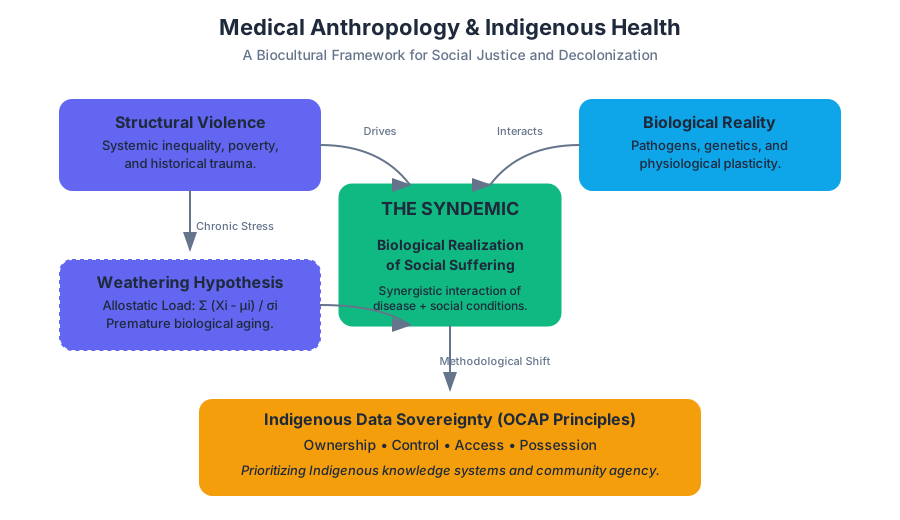
A key derivation of the biocultural perspective is the Syndemic. A syndemic occurs when two or more diseases interact in a way that exacerbates the prognosis of each, usually fueled by social inequality and environmental stressors.
| Concept | Definition | Focus |
|---|---|---|
| Epidemic | A sudden increase in disease cases. | Pathogen transmission. |
| Comorbidity | The co-occurrence of two diseases. | Individual clinical pathology. |
| Syndemic | Synergistic interaction of diseases + social conditions. | Population-level health disparities. |
Key Insight: A syndemic is not just "having two sicknesses." It is the biological realization of social suffering. For example, the interaction of malnutrition, depression, and infectious disease in marginalized communities is a syndemic driven by poverty.
Indigenous Anthropology and the Decolonial Turn
Indigenous Anthropology is both a subject of study and a methodological shift. Historically, anthropology was often a tool of colonialism—white researchers "studying" Indigenous people as relics of the past.
The Movement Toward Decolonization
Decolonizing anthropology involves dismantling the power structures that have historically marginalized Indigenous knowledge. This includes:
- Collaborative Ethnography: Research designed with and for the community, rather than on them.
- Indigenous Epistemologies: Recognizing that Indigenous ways of knowing (e.g., Traditional Ecological Knowledge or TEK) are as valid as Western scientific methods.
- Repatriation: The return of ancestral remains and cultural artifacts (e.g., via NAGPRA in the United States).
Worked Example: The OCAP Principles
In the context of health research, Indigenous communities often employ the OCAP principles to ensure social justice and prevent "helicopter research" (where researchers take data and never return).
| Principle | Technical Meaning | Practical Application |
|---|---|---|
| Ownership | The community owns the data collected. | Research results cannot be sold to pharma without consent. |
| Control | The community controls research processes. | Indigenous leaders approve the study design. |
| Access | The community must have access to their data. | Raw data must be stored in local repositories. |
| Possession | The community physically holds the data. | Servers are located on tribal lands. |
Quantifying Health Disparities: The Mechanics of Structural Violence
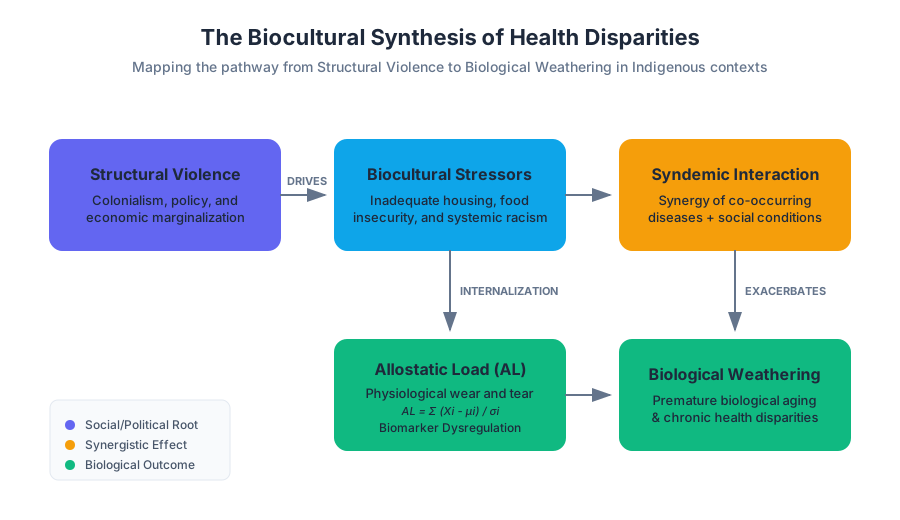
Health Disparities are not accidental; they are the biological outcomes of Structural Violence. This term, popularized by physician-anthropologist Paul Farmer, refers to social arrangements—economic, political, legal, and religious—that harm populations by preventing them from meeting their basic needs.
The "Weathering" Hypothesis
One of the most robust biocultural theories for health disparities is the Weathering Hypothesis. It suggests that the chronic stress of living in a marginalized state (experiencing racism, poverty, and displacement) causes premature biological aging.
Mathematical Derivation: Allostatic Load
Anthropologists measure "weathering" through Allostatic Load (AL), a composite index of physiological wear and tear.
AL = \sum_{i=1}^{n} \frac{(X_i - \mu_i)}{\sigma_i} \cdot W_i
Where:
- $X_i$ is the measured value of a biomarker (e.g., cortisol, blood pressure, BMI).
- $\mu_i$ and $\sigma_i$ are the population mean and standard deviation.
- $W_i$ is the weighting factor for the specific stressor's impact on long-term health.
Biocultural Forces and Epigenetics
A major breakthrough in medical anthropology is the study of Epigenetics—the study of changes in organisms caused by modification of gene expression rather than alteration of the genetic code itself.
How it works
Environmental stressors (like famine or historical trauma) can "tag" DNA through a process called DNA Methylation. These tags don't change the DNA sequence, but they change how the body reads those genes. Crucially, these tags can sometimes be passed down to offspring.
The Intergenerational Transmission of Trauma
For Indigenous populations, the "Biocultural Force" of historical trauma (residential schools, forced relocation) is not just a memory; it is a physiological reality. If a grandparent experienced severe nutritional stress and trauma, their descendants may have a predisposed sensitivity to stress hormones (cortisol) and a higher risk for metabolic disorders.
\text{Gene Expression} (E) = f(\text{Genotype} (G), \text{Environment} (Env), \text{Historical Context} (H))
This formula demonstrates that $E$ is not a static result of $G$, but a dynamic function where $H$ (Historical Context) acts as a persistent modifier across generations.
Applied Anthropology and Social Justice
Applied Anthropology is the use of anthropological data and methods to solve real-world problems. In the medical sphere, this means designing healthcare systems that are culturally competent and structurally aware.
Cultural Competency vs. Cultural Humility
While "Cultural Competency" suggests a checklist of traits to learn about a group, medical anthropologists advocate for Cultural Humility. This is a lifelong commitment to self-evaluation and redressing power imbalances in the patient-clinician relationship.
| Feature | Cultural Competency | Cultural Humility |
|---|---|---|
| Goal | Mastery of a "knowledge set" about a culture. | Ongoing self-critique and learning. |
| Power Dynamic | Clinician as the "expert" on the patient's culture. | Patient as the expert on their own experience. |
| Focus | "Others" and their differences. | Systemic power imbalances and bias. |
| Outcome | Static skills. | Dynamic relationship building. |
Case Study: The Navajo (Diné) and Uranium Mining
In the mid-20th century, uranium mining on Navajo land led to catastrophic health outcomes. Medical anthropologists worked to document the Biocultural Forces at play:
- Direct Exposure: Miners were not given protective gear.
- Environmental Contamination: Tailings piles contaminated local water sources.
- Linguistic Barriers: The Navajo language had no word for "radiation," making informed consent nearly impossible in a Western legal sense.
Applied anthropologists helped bridge this gap by creating culturally relevant health education and advocating for the Radiation Exposure Compensation Act (RECA).
Common Pitfalls and Misconceptions
- The "Genetic Determinism" Trap: Assuming that higher rates of disease in Indigenous groups are due to "bad genes." Medical anthropology proves that social conditions are almost always the primary driver.
- Essentializing Culture: Treating "Indigenous culture" as a monolith. There are thousands of distinct Indigenous groups with vastly different health practices and beliefs.
- Ignoring Agency: Viewing Indigenous people only as victims of structural violence. Indigenous communities are active agents of change, using traditional knowledge to build resilient health systems.
Conclusion: The Future of the Field
The intersection of medical anthropology and Indigenous experiences is moving toward a future of Health Sovereignty. This involves not just "better access" to Western medicine, but the revitalization of Indigenous healing practices alongside modern technology. By understanding the biocultural forces that shape our bodies, we can move toward a more just and equitable definition of global health.
Source Materials
Study Anthropology on Lykke
This course page is free to open: signed out, you can read its first two sections, and signing in, on any plan, opens the rest. The free Lykke Chrome extension syncs your own Canvas courses, so ChatGPT, Claude and Muse can answer from your classes and deadlines. It only reads Canvas.
Add the free extensionSign in to open every section