From the free course Anthropology on Lykke
Language and Communication
Key concepts: Linguistic Relativity · Performativity · Sociolinguistics · Power Dynamics · High and Low Contexts
Investigates the relationship between human communication, cultural identity, and social power dynamics.
Language and Communication
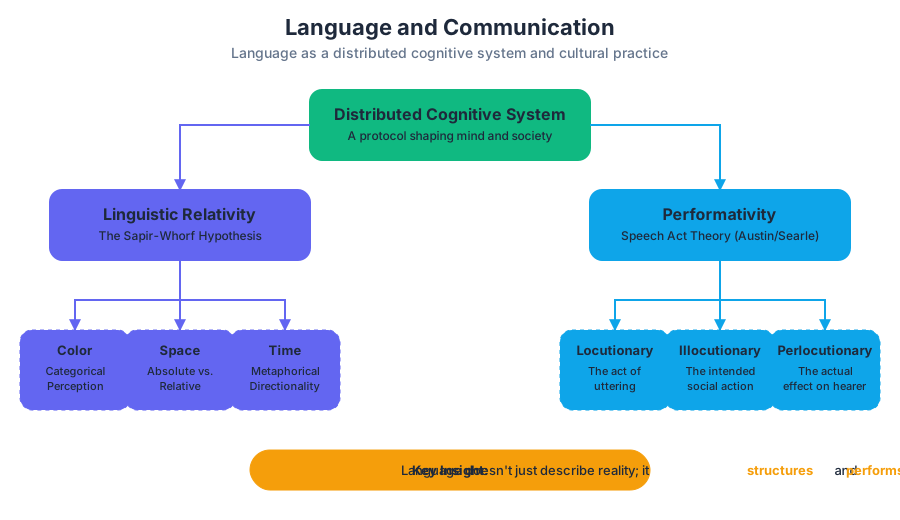
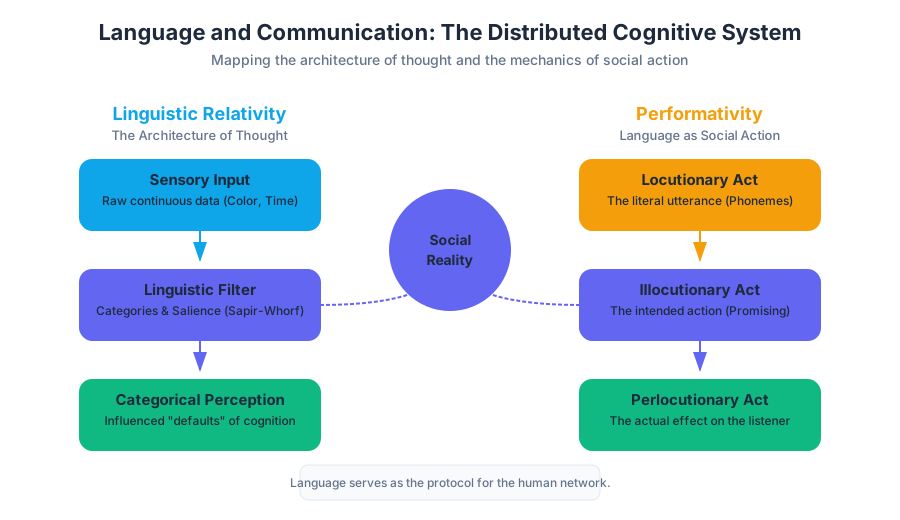
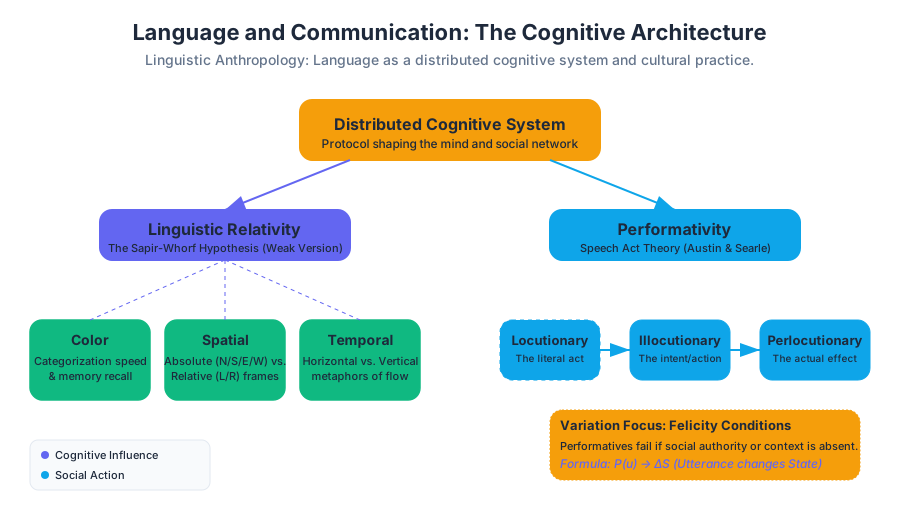
Linguistic anthropology is the interdisciplinary study of how language influences social life. It is not merely the study of grammar or vocabulary in isolation; rather, it is the investigation of language as a cultural resource and speaking as a cultural practice. In the "DeepWiki" framework, we treat language as a distributed cognitive system—a protocol that does not just transmit data but actively shapes the architecture of the processor (the human mind) and the network (society).
Linguistic Relativity: The Architecture of Thought
Linguistic Relativity, often referred to as the Sapir-Whorf Hypothesis, posits that the structure of a language affects its speakers' worldviews or cognition. This concept is frequently misunderstood as "linguistic determinism" (the idea that language limits what we can think), but modern anthropology favors a "weak" version: language influences thought by making certain categories more salient.
The Boas-Sapir-Whorf Lineage
The theory emerged from the work of Franz Boas, who noted that cultural experiences were categorized by language. His student, Edward Sapir, argued that language is a "guide to social reality." Benjamin Lee Whorf, a chemical engineer and linguist, extended this by comparing SAE (Standard Average European) languages with Indigenous languages like Hopi.
The Principle of Linguistic Relativity: No two languages are ever sufficiently similar to be considered as representing the same social reality. The worlds in which different societies live are distinct worlds, not merely the same world with different labels attached.
Empirical Dimensions of Relativity
To understand how this works in practice, we look at three primary domains:
- Color Perception: Languages with fewer color terms (e.g., Dani of New Guinea, which has only "light" and "dark") do not prevent speakers from seeing colors, but they do affect the speed of categorization and memory recall.
- Spatial Orientation: Some languages (like Guugu Yimithirr) use Absolute Frame of Reference (North, South, East, West) instead of Relative Frame of Reference (Left, Right, Front, Back). Speakers of these languages possess an internal "dead reckoning" compass that is functionally superior to those using relative systems.
- Temporal Conceptualization: English speakers often view time as a horizontal line (moving forward/backward), whereas Mandarin speakers may utilize vertical metaphors (up/down) for earlier/later events.
| Feature | Strong Determinism (Hard) | Weak Relativity (Soft) |
|---|---|---|
| Cognitive Constraint | Language dictates the limits of thought. | Language influences cognitive "defaults." |
| Translation | True translation is impossible. | Translation is difficult but achievable via circumlocution. |
| Scientific Standing | Largely discredited in its extreme form. | Widely accepted in cognitive linguistics. |
| Example | If a language has no word for "blue," the speaker cannot see blue. | If a language has no word for "blue," the speaker may group it with "green" in memory tasks. |
Performativity: Language as Action
In classical linguistics, language was viewed as constative—it describes a state of affairs. However, J.L. Austin and later John Searle introduced the concept of Speech Act Theory, arguing that many utterances do not describe reality; they perform it.
The Taxonomy of Speech Acts
Austin identified three layers of a speech act:
- Locutionary Act: The literal act of saying something (the phonemes and syntax).
- Illocutionary Act: The intended action (e.g., promising, ordering, baptizing).
- Perlocutionary Act: The actual effect on the listener (e.g., the listener feels persuaded or frightened).
Felicity Conditions
For a performative utterance to "work," it must meet certain felicity conditions. If a random person walks up to you and says, "I declare you under arrest," the act fails because the speaker lacks the social authority. Performativity is thus inherently tied to social structure.
The Performative Formula: $P(u) \rightarrow \Delta S$ Where an utterance $u$ under specific social conditions $C$ results in a change in social state $\Delta S$.
Formal Logic of Performative Utterances
We can represent the "success" of a performative act using a logic-gate style derivation.
LET U = Utterance
LET S = Speaker
LET A = Authority/Context
LET R = Result (Social State Change)

IF (U is "I do") AND (S is in Marriage Ceremony) AND (A is Valid Officiant):
    THEN R = MARRIED
ELSE:
    THEN R = NULL (Misfire)

DERIVATION:
1. Locution(U) = "I do"
2. Illocution(U) = Commitment to Contract
3. IF Context(A) == VALID:
      Perlocution(U) = Legal Union
   ELSE:
      Perlocution(U) = Confusion/Void
Sociolinguistics and Power Dynamics
Sociolinguistics examines the relationship between language and social variables like class, gender, ethnicity, and age. It posits that language is a tool for navigating Power Dynamics.
Linguistic Capital and Symbolic Violence
Pierre Bourdieu introduced the concept of Linguistic Capital. In any society, there is a "standard" dialect (often the dialect of the ruling class). Proficiency in this dialect acts as capital that can be traded for jobs, status, and education. Conversely, those who speak non-standard dialects (e.g., AAVE, Cockney, Appalachian English) face Symbolic Violence—the internalized feeling that their natural way of speaking is "incorrect" or "inferior."
Code-Switching
Code-switching is the practice of alternating between two or more languages or varieties of language in conversation. This is often a survival strategy or a tool for identity negotiation.
- Situational Code-Switching: Changing language based on the setting (e.g., Spanish at home, English at work).
- Metaphorical Code-Switching: Changing language to change the "tone" or "authority" of a statement within a single conversation.
| Concept | Definition | Example |
|---|---|---|
| Diglossia | Two languages/dialects existing side-by-side with distinct social functions. | High German (formal) vs. Swiss German (informal). |
| Prestige Dialect | The variety of a language associated with high social status. | "Received Pronunciation" in the UK. |
| Language Ideology | Beliefs about a language that justify social hierarchies. | The belief that "slang" indicates a lack of intelligence. |
| Hypercorrection | Over-applying a grammatical rule to appear higher class. | Using "between you and I" instead of "between you and me." |
High and Low Context Communication
Developed by Edward T. Hall, this framework explains how information is encoded in communication across different cultures. This is critical for Intercultural Communication and global systems design.
Low Context (LC) Communication
In LC cultures (e.g., Germany, USA, Scandinavia), the mass of information is vested in the explicit code. Communication must be precise, direct, and transparent.
- Logic: Linear, cause-and-effect.
- Responsibility: The sender is responsible for the message being understood.
- Contracts: Highly detailed; "the word is the bond."
High Context (HC) Communication
In HC cultures (e.g., Japan, China, Arab nations, many Indigenous cultures), most of the information is either in the physical context or internalized in the person. Very little is in the explicit, transmitted part of the message.
- Logic: Spiral, holistic.
- Responsibility: The receiver is responsible for "reading the air" (Japanese: Kuuki wo yomu).
- Contracts: Based on relationships and trust; the written word is secondary to the intent.
The "Winkiness" of Culture
Anthropologist Clifford Geertz used the example of a "wink" to explain context. A physical contraction of the eyelid (the thin description) could be a twitch, a flirtatious signal, or a conspiratorial sign (the thick description). Understanding the difference requires deep cultural context.
| Dimension | Low Context (LC) | High Context (HC) |
|---|---|---|
| Directness | High ("Say what you mean") | Low ("Read between the lines") |
| Conflict | Depersonalized; focus on the issue. | Personalized; focus on saving "face." |
| Time Orientation | Monochronic (Linear, scheduled) | Polychronic (Fluid, relationship-based) |
| Software Analogy | Explicit API documentation. | Implicit "Convention over Configuration." |
The Mechanics of Communication: The Linguistic Stack
To understand how these social forces manifest, we must look at the technical "stack" of language. Linguistic anthropologists analyze communication at every layer of this hierarchy.
- Phonology: The study of sounds (phonemes). A phoneme is the smallest unit of sound that changes meaning (e.g., /p/ vs /b/ in "pat" and "bat").
- Morphology: The study of word formation (morphemes). "Unbreakable" has three morphemes: un- (not), break (root), -able (capable of).
- Syntax: The rules for combining words into sentences.
- Semantics: The study of meaning.
- Pragmatics: The study of language in use—the "social" layer where performativity and context live.
The Four-Field Integration
Linguistic anthropology does not exist in a vacuum. It connects to the other three fields of anthropology:
- Biological: The evolution of the FOXP2 gene and the vocal apparatus.
- Archaeological: The development of writing systems (Cuneiform to Emojis).
- Cultural: How kinship terms (e.g., calling a cousin "brother") reflect social obligations.
Common Pitfalls and Misconceptions
- The "Eskimo Words for Snow" Myth: A common (and false) example of linguistic relativity. While Yup'ik and Inuit languages have many roots for snow, English also has many (slush, powder, sleet, flurry). The difference is morphological (polysynthetic vs. analytic), not necessarily a different "perception" of frozen water.
- Confusing Dialect with Slang: A dialect is a complete linguistic system with its own grammar and phonology. Slang is merely a subset of vocabulary used in specific social contexts.
- The "Universal Language" Fallacy: The idea that mathematics or music is a "universal language." While they have universal elements, their interpretation and application are deeply cultural.
Key Insight: Communication is not about the transmission of information; it is about the coordination of social action. If a message is sent but the social state does not change in the intended way, the communication has "failed" at the pragmatic level, regardless of how "correct" the grammar was.
Source Materials
Study Anthropology on Lykke
This course page is free to open: signed out, you can read its first two sections, and signing in, on any plan, opens the rest. The free Lykke Chrome extension syncs your own Canvas courses, so ChatGPT, Claude and Muse can answer from your classes and deadlines. It only reads Canvas.
Add the free extensionSign in to open every section