From the free course Anthropology on Lykke
Forming Family: Kinship, Gender, and Sexuality
Key concepts: Kinship · Gender Roles · Sexuality · Social Institutions · Cultural Variation
Investigates the cultural construction of family, gender roles, and sexual identities across different societies.
Forming Family: Kinship, Gender, and Sexuality
Kinship is the foundational "operating system" of human society. It is a formal social institution that defines the rights, obligations, and identities of individuals based on perceived biological and social connections. While often mistaken for a mere reflection of biology, kinship is a highly variable cultural construct that organizes labor, inheritance, political alliances, and emotional support. This section explores the mechanics of kinship systems, the social construction of gender, and the cultural regulation of sexuality through a holistic, anthropological lens.
Kinship Systems: The Logic of Social Connection
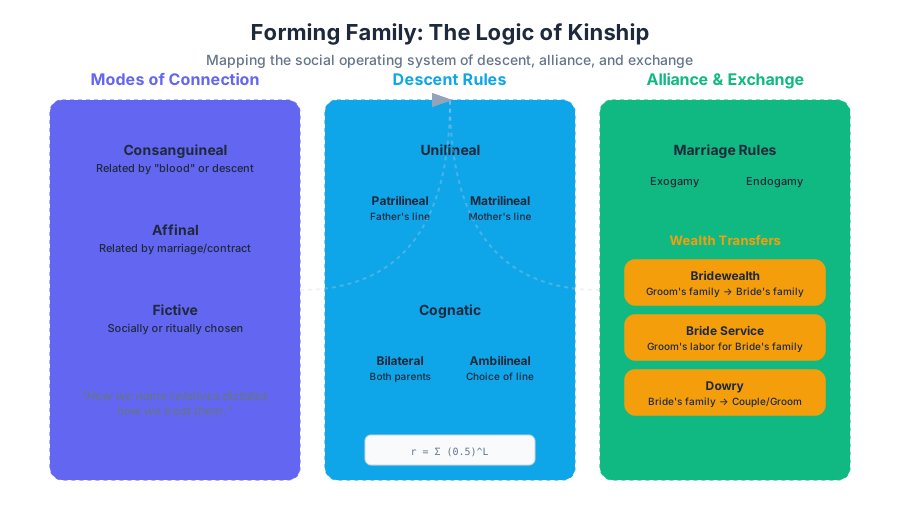
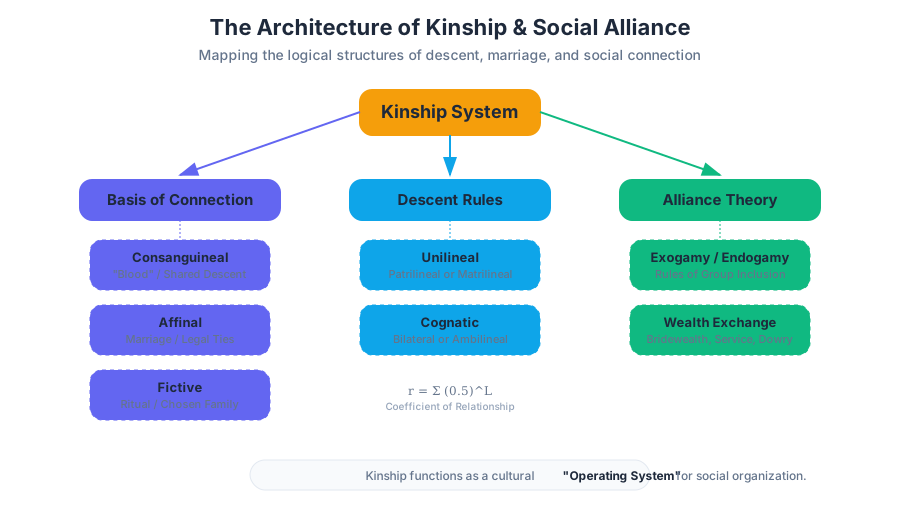
Kinship is defined as a system of social relationships that are constitutive of family. These relationships are generally categorized into two types: consanguineal (related by "blood" or shared descent) and affinal (related by marriage). However, many cultures also recognize fictive kinship, where individuals are granted family status through ritual or social choice (e.g., godparents or "chosen family").
Descent Groups and Lineage
Descent is the social recognition of the connection between ancestors and their descendants. Anthropologists distinguish between two primary modes of descent:
- Unilineal Descent: Tracing kinship through a single line—either the father's (patrilineal) or the mother's (matrilineal).
- Cognatic (Non-unilineal) Descent: Tracing kinship through both parents (bilateral) or choosing one line based on social circumstances (ambilineal).
The Principle of Descent: Let $D$ be the set of ancestors. A descent rule $R$ is a function that maps an individual $i$ to a subset of $D$ based on the cultural parameters of lineage. In a patrilineal system, $R(i) = {a \in D \mid \text{gender}(a) = \text{male} \land \text{path}(i, a) \text{ is strictly paternal}}$.
| Descent Type | Logic | Inheritance/Authority | Examples |
|---|---|---|---|
| Patrilineal | Traced through males. | Property and status pass from father to son. | Traditional Han Chinese, Nuer of Sudan. |
| Matrilineal | Traced through females. | Property passes from mother to daughter; authority often held by mother's brother. | Minangkabau of Indonesia, Hopi. |
| Bilateral | Traced through both parents. | Equal weight to both sides; common in foraging and industrial societies. | Modern Western societies, Ju/'hoansi. |
| Ambilineal | Choice of lineage. | Flexible; individuals choose which side to affiliate with based on resources. | Many Polynesian cultures. |
Kinship Terminology (The "Logic" of Labels)
How we name our relatives dictates how we treat them. Lewis Henry Morgan identified several "types" of kinship terminology based on how they group or distinguish relatives. For instance, the Eskimo system (common in the West) emphasizes the nuclear family, while the Hawaiian system uses the same term for "Mother" and "Aunt," effectively merging the nuclear family into a larger generational group.
Marriage and Alliance Theory
Marriage is a social contract that transforms the status of the participants, carries implications about sexual access, and establishes the legal parenthood of children. From a structuralist perspective (Claude Lévi-Strauss), marriage is a system of alliance between groups.
Rules of Exclusion and Inclusion
- Exogamy: The requirement to marry outside a specific social group (e.g., outside the clan). This builds external alliances.
- Endogamy: The requirement to marry within a specific group (e.g., within a caste or religion). This preserves group resources and identity.
- Incest Taboo: A near-universal cultural rule prohibiting sexual relations between certain close relatives. While the biological risks of inbreeding are real, anthropologists argue the taboo is primarily social, forcing individuals to seek partners outside their family to create wider social networks.
Marriage Exchanges
Marriage often involves the transfer of wealth, which serves as a "social glue" or a form of insurance for the stability of the union.
| Exchange Type | Direction of Wealth | Purpose |
|---|---|---|
| Bridewealth | Groom's family $\rightarrow$ Bride's family. | Compensates the bride's family for the loss of her labor and fertility. |
| Bride Service | Groom $\rightarrow$ Bride's family (Labor). | The groom works for the bride's family for a set period. |
| Dowry | Bride's family $\rightarrow$ New couple/Groom. | Provides the bride with her share of inheritance; often seen as a "groom price" in stratified societies. |
Gender: The Cultural Construction of Identity
Anthropology makes a critical distinction between sex (biological attributes such as chromosomes, hormones, and anatomy) and gender (the cultural meanings, roles, and identities assigned to those biological attributes).
The Sex/Gender Distinction
While sex is often viewed as a dimorphic biological category (Male/Female), biological reality includes intersex variations. Gender, however, is a spectrum. Anthropologist Judith Butler describes gender as performativity—not a fixed internal essence, but a series of acts and behaviors that are repeated and reinforced by social institutions.
Cultural Variation in Gender Roles
Gender roles are the tasks and activities a culture assigns to the sexes. These are not biologically determined; for example, in some cultures, women are the primary traders and merchants, while in others, they are restricted to the domestic sphere.
The Gender Vector Space: We can represent gender identity $G$ as a point in a multi-dimensional space where $G = (I, E, R)$, with $I$ representing internal identity, $E$ representing external expression, and $R$ representing social role expectations.
\text{Gender Identity } (G) = \sum_{i=1}^{n} w_i \cdot c_i
\text{ where } w_i \text{ is the cultural weight of trait } c_i
Plural Gender Systems
Many cultures recognize more than two genders. These "third gender" or "gender-variant" roles often hold specific ritual or social significance:
- Two-Spirit (Indigenous North America): Individuals who embody both masculine and feminine spirits, often serving as healers or mediators.
- Hijra (South Asia): A legally recognized third gender in India and Pakistan, often performing ritual roles at births and weddings.
- Muxe (Oaxaca, Mexico): Individuals assigned male at birth who adopt feminine roles and identities.
Sexuality: Regulation and Expression
Sexuality refers to the capacity for sexual feelings and the ways in which people experience and express themselves as sexual beings. Like gender, sexuality is governed by cultural norms and social institutions.
The Social Construction of Sexuality
Michel Foucault argued that "sexuality" is a modern Western construct. In many historical and non-Western contexts, sexual behavior was not necessarily tied to a permanent "identity" (like Heterosexual or Homosexual) but was viewed as a set of actions or roles.
Heteronormativity and Power
Heteronormativity is the institutionalized belief that heterosexuality is the only "natural" or "normal" expression of sexuality. This belief is reinforced through:
- Legal frameworks: Marriage laws, adoption rights.
- Economic incentives: Tax benefits for married couples.
- Socialization: Media representation and education.
Comparison of Sexual Norms
| Concept | Definition | Social Function |
|---|---|---|
| Sexual Dimorphism | Biological differences between males and females. | Reproductive potential. |
| Sexual Orientation | Enduring pattern of emotional/sexual attraction. | Personal identity and community formation. |
| Sexual Scripts | Cultural "blueprints" for sexual behavior. | Regulating social order and expectations. |
Social Institutions and the Family
The family does not exist in a vacuum; it is the building block of larger social, economic, and political structures.
The Domestic Cycle
Families are dynamic. The nuclear family (parents and children) may expand into an extended family (multiple generations) or dissolve and reform into blended families. The "Standard North American Family" (SNAF) is a specific cultural ideal that does not reflect the reality of many global or even domestic households.
Kinship and Political Economy
In many societies, kinship is the political system. In segmentary lineages, relatedness determines who fights whom and who supports whom in a conflict. In industrial societies, the state has taken over many functions previously held by kin groups (e.g., social security, legal arbitration), yet kinship remains the primary mechanism for the intergenerational transfer of wealth and class status.
To manage the complexity of these relationships in a modern context, data scientists and sociologists often use graph databases to map social networks.
Common Pitfalls in Studying Kinship and Gender
- Biological Determinism: Assuming that because women give birth, they are "naturally" suited for domestic work. This ignores the massive cultural variation in labor division.
- Ethnocentrism: Using Western categories (like "Aunt" or "Gay") to describe roles in other cultures that may have entirely different meanings.
- The "Nuclear Family" Bias: Assuming the nuclear family is the universal "natural" unit. In many cultures, the household is centered around a group of sisters or a man and his brothers.
- Static Analysis: Treating kinship as a rigid set of rules rather than a flexible strategy that people use to navigate their lives.
Summary of Key Concepts
Kinship, gender, and sexuality are intertwined systems that define the human experience. Kinship provides the structure, gender provides the identity, and sexuality provides the drive for reproduction and connection. Together, they form the "Forming Family" matrix that ensures the survival and continuity of human cultures.
- Kinship is about belonging and obligation.
- Gender is about meaning and performance.
- Sexuality is about desire and regulation.
-
Consanguineal: Related by descent ("blood").
-
Affinal: Related by marriage.
-
Matrilineal: Tracing descent through the female line.
-
Patrilineal: Tracing descent through the male line.
-
Exogamy: Marrying outside a specific group.
-
Endogamy: Marrying within a specific group.
-
Bridewealth: Wealth transferred from the groom's family to the bride's family.
-
Dowry: Wealth transferred from the bride's family to the groom or the new couple.
-
Gender Performativity: The idea that gender is created through repeated social actions.
-
Heteronormativity: The social assumption that heterosexuality is the default or "correct" orientation.
-
Which kinship system would use the same term for "Mother" and "Mother's Sister"?
- A) Eskimo
- B) Hawaiian
- C) Sudanese
- D) Descriptive
-
What is the primary social function of the Incest Taboo according to Alliance Theory?
- A) To prevent genetic mutations.
- B) To ensure parents focus on their children.
- C) To force the creation of social alliances outside the immediate family.
- D) To maintain religious purity.
-
True or False: "Two-Spirit" is a modern Western term for LGBTQ+ individuals.
- (False: It is a term used by some Indigenous North American cultures for specific gender-variant roles.)
-
In a matrilineal society, who is typically the most important male figure in a child's life?
- A) The biological father.
- B) The mother's brother (maternal uncle).
- C) The father's father.
- D) The village chief.
-
Explain the difference between Bridewealth and Dowry.
- (Bridewealth is paid to the bride's family; Dowry is brought by the bride into the new marriage.)
Core Learning Objectives:
- Distinguish between unilineal and cognatic descent systems.
- Analyze the social and economic functions of marriage exchanges (Bridewealth vs. Dowry).
- Deconstruct the difference between biological sex and cultural gender.
- Identify examples of gender-variant roles in non-Western societies.
- Understand how kinship acts as a political and economic institution in non-state societies.
Key Figures to Research:
- Claude Lévi-Strauss: For Alliance Theory and Structuralism.
- Judith Butler: For Gender Performativity.
- Lewis Henry Morgan: For early kinship classification.
- Margaret Mead: For early cross-cultural studies of gender roles.
Technical Skills to Practice:
- Drawing a kinship diagram (using standard symbols: Triangle for male, Circle for female, = for marriage).
- Calculating coefficients of relationship for different cousin types (parallel vs. cross-cousins).
Source Materials
Study Anthropology on Lykke
This course page is free to open: signed out, you can read its first two sections, and signing in, on any plan, opens the rest. The free Lykke Chrome extension syncs your own Canvas courses, so ChatGPT, Claude and Muse can answer from your classes and deadlines. It only reads Canvas.
Add the free extensionSign in to open every section