From the free course Anthropology on Lykke
Introduction to Anthropology and the Four-Field Approach
Key concepts: Holism · Four-field approach · Ethnocentrism · Cultural Relativism · Insider’s Point of View
Defines anthropology as a holistic discipline and introduces the four main subfields: cultural, biological, archaeology, and linguistics.
Introduction to Anthropology and the Four-Field Approach
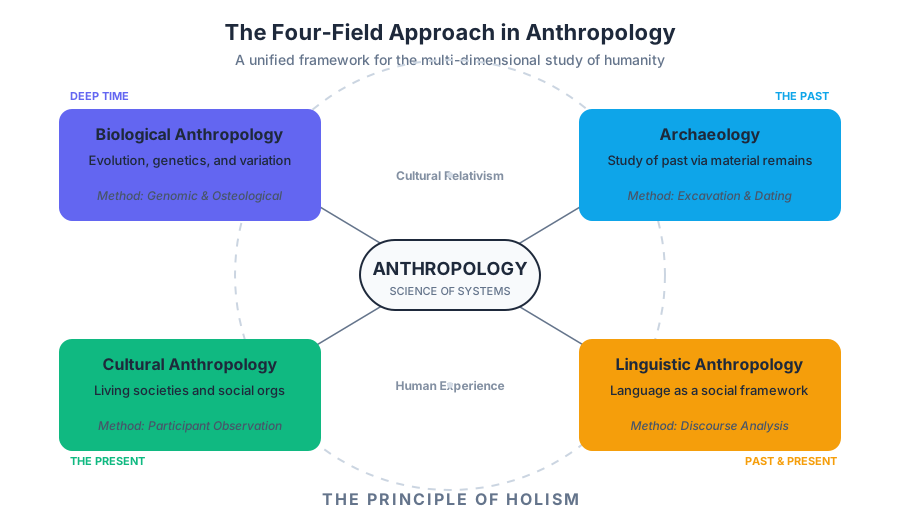
Anthropology is the comprehensive, multi-dimensional study of humanity across all time and space. Unlike disciplines that isolate specific variables of human behavior—such as economics focusing on markets or psychology on the individual mind—anthropology operates as a "science of systems." It seeks to understand the biological, social, linguistic, and historical forces that converge to create the human experience.
At its core, anthropology addresses the fundamental question: What does it mean to be human? To answer this, the discipline employs a rigorous framework known as the Four-Field Approach, anchored by the philosophical pillars of Holism and Cultural Relativism.
The Four-Field Approach: A Unified Framework
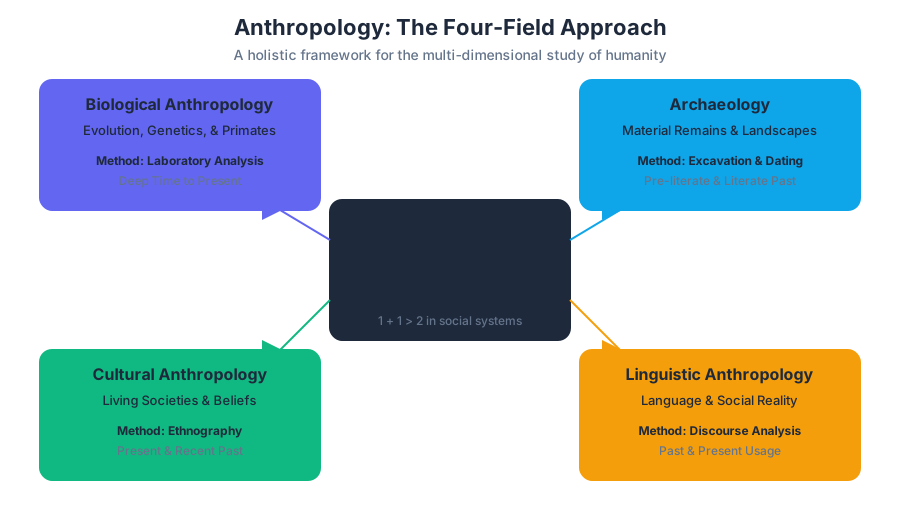
The modern structure of anthropology, particularly in North America, was largely codified by Franz Boas in the early 20th century. Boas argued that human culture and biology are inextricably linked and cannot be understood in isolation. This led to the division of the discipline into four primary sub-disciplines, each utilizing distinct methodologies to contribute to a singular narrative of humanity.
1. Biological Anthropology
Also known as physical anthropology, this field examines the biological origins, evolution, and variation of Homo sapiens. It treats humans as biological organisms subject to the laws of natural selection and genetics.
- Key Areas: Paleoanthropology (fossil record), Primatology (non-human primates), and Human Variation (genetics and adaptation).
- Methodology: Genomic sequencing, osteological analysis, and longitudinal behavioral studies of primates.
2. Archaeology
Archaeology is the study of the human past through material remains. It extends the human story back millions of years, covering the vast majority of human history that occurred before the invention of writing.
- Key Areas: Prehistoric archaeology, historical archaeology, and cultural resource management (CRM).
- Methodology: Stratigraphic excavation, radiocarbon dating, and spatial analysis of settlement patterns.
3. Cultural Anthropology
This subfield focuses on living human societies and the diversity of cultural expressions. It explores how people organize themselves, how they perceive the world, and how power dynamics (such as social inequality) are constructed.
- Key Areas: Economic anthropology, political anthropology, and medical anthropology.
- Methodology: Ethnography and Participant Observation.
4. Linguistic Anthropology
Linguistic anthropology investigates how language shapes social life. It views language not just as a tool for communication, but as a cognitive framework that influences how we categorize reality.
- Key Areas: Historical linguistics, sociolinguistics, and non-verbal communication.
- Methodology: Discourse analysis and phonetic transcription.
| Subfield | Primary Object of Study | Temporal Focus | Key Methodology |
|---|---|---|---|
| Biological | Human body, genes, and primates | Deep time to present | Laboratory analysis, Field observation |
| Archaeology | Artifacts, features, and landscapes | Past (Pre-literate & Literate) | Excavation, Remote sensing |
| Cultural | Beliefs, behaviors, and social orgs | Present / Recent past | Participant observation, Interviews |
| Linguistic | Language systems and usage | Past and Present | Linguistic recording, Discourse analysis |
Holism: The "System of Systems" Perspective
Holism is the defining characteristic of the anthropological perspective. It is the theoretical commitment to the idea that all aspects of human life are interconnected. A change in one variable—such as a shift in subsistence technology—will inevitably produce ripples across the social structure, religious beliefs, and even the biological health of a population.
The Mechanics of Holism
In an anthropological context, holism functions as a "top-down" and "bottom-up" integration. For example, to understand the impact of the COVID-19 pandemic, an anthropologist would not just look at the virus (Biological). They would look at:
- Cultural: How social distancing conflicts with cultural values of kinship.
- Linguistic: How the rhetoric of "essential workers" shapes social status.
- Archaeological/Historical: How previous pandemics (like the 1918 flu) left traces in the burial records and social memory.
- Biological: How systemic inequality leads to different health outcomes across populations.
The Principle of Holism: No single part of a culture can be understood unless it is related to the whole. The "whole" is greater than the sum of its parts ($1 + 1 > 2$ in social systems).
Worked Example: Radiocarbon Dating and Archaeological Context
In archaeology, holism is applied by combining chemical data with stratigraphic context.
Overcoming Ethnocentrism
Ethnocentrism is the universal human tendency to view one's own culture as the "natural" or "correct" way of living, using it as a benchmark to judge all other cultures. While it provides social cohesion within a group, it acts as a significant barrier to scientific inquiry.
The Problem of Western Bias
Anthropology originated within a Western colonial context. Early "armchair anthropologists" often ranked cultures on a ladder of "savagery" to "civilization," with Europe at the top. Modern anthropology is a discipline of decolonization, actively working to identify and remove these biases.
| Concept | Definition | Resulting Bias |
|---|---|---|
| Ethnocentrism | Judging others by your own cultural standards. | "They are doing it wrong/weirdly." |
| Xenocentrism | Valuing another culture over your own. | "They are more 'pure' or 'natural' than us." |
| Western Bias | Assuming Western categories (like 'Nuclear Family') are universal. | Misinterpreting kinship and economic systems. |
Cultural Relativism: The Methodological Tool
To counter ethnocentrism, anthropologists employ Cultural Relativism. This is the principle that a person's beliefs and activities should be understood based on that person's own culture.
Methodological vs. Moral Relativism
It is vital to distinguish between two types of relativism:
- Methodological Relativism: A research tool. To understand why a culture practices a specific ritual, the researcher must temporarily suspend their own judgments to see the internal logic of the practice.
- Moral Relativism: The philosophical belief that there are no universal moral truths.
Most anthropologists practice methodological relativism. They do not necessarily condone every practice they study (e.g., social inequality or violence), but they recognize that they cannot explain those practices if they start from a position of condemnation.
Mathematical Derivation: The Hardy-Weinberg Equilibrium
In Biological Anthropology, we use mathematical models to ensure we aren't biased by our expectations of "normal" traits. The Hardy-Weinberg Equilibrium (HWE) serves as a null hypothesis for evolution. If a population is not in HWE, we know an evolutionary force (like selection or migration) is at work.
$$ p^2 + 2pq + q^2 = 1 $$
Where:
- $p$ = frequency of the dominant allele
- $q$ = frequency of the recessive allele ($p + q = 1$)
- $p^2$ = frequency of homozygous dominant individuals
- $2pq$ = frequency of heterozygous individuals
- $q^2$ = frequency of homozygous recessive individuals
If the observed genotype frequencies in a field study deviate from this derivation, the anthropologist must investigate the environmental or social pressures (the "Holistic" context) causing the change.
The Insider’s Point of View: Emic vs. Etic
A critical goal of the four-field approach is to bridge the gap between how people see themselves and how an outside scientist sees them. This is described using the terms Emic and Etic.
- Emic (Insider): The perspective of the subject. It focuses on local explanations, meanings, and categories. "Why do you do this?" "Because it honors our ancestors."
- Etic (Outsider): The perspective of the observer. It applies external scientific theories and categories to the behavior. "The ritual functions as a mechanism for wealth redistribution."
Comparison of Perspectives
| Feature | Emic Perspective | Etic Perspective |
|---|---|---|
| Source of Meaning | The culture being studied | The scientific community |
| Goal | To understand the "Insider's" logic | To find cross-cultural patterns |
| Key Question | What does this mean to them? | How does this fit into theory? |
| Risk | Getting "lost" in the culture | Imposing external bias |
Applied Anthropology: The Practical Dimension
While the four fields provide the theoretical structure, Applied Anthropology is often considered the "fifth field." It involves using anthropological data and methods to solve real-world problems.
Common Pitfalls in Anthropological Thinking
- The "Noble Savage" Myth: A form of romanticized ethnocentrism where Indigenous cultures are viewed as inherently more "spiritual" or "in tune with nature." This denies these groups their complex history and agency.
- Reductionism: The opposite of holism. Attempting to explain complex human behavior through a single lens (e.g., "It's all in the genes").
- Ignoring Social Inequality: Early anthropology often ignored how power dynamics and colonialism shaped the cultures being studied. Modern anthropology places these issues at the center of the "Four-Field" narrative.
Summary of Key Principles
- Anthropology is the holistic study of humanity across four fields: Biological, Archaeological, Cultural, and Linguistic.
- Holism ensures that we see the "big picture," integrating biological facts with cultural meanings.
- Ethnocentrism is a bias we must actively work to overcome using Cultural Relativism as a methodological tool.
- The Emic perspective gives us the insider's meaning, while the Etic perspective allows for scientific comparison.
- The discipline is increasingly focused on Applied Anthropology, using these tools to address social inequality, climate change, and global health.
Source Materials
Study Anthropology on Lykke
This course page is free to open: signed out, you can read its first two sections, and signing in, on any plan, opens the rest. The free Lykke Chrome extension syncs your own Canvas courses, so ChatGPT, Claude and Muse can answer from your classes and deadlines. It only reads Canvas.
Add the free extensionSign in to open every section