From the free course Anthropology on Lykke
Social Inequality and Global Migration
Key concepts: Social Inequality · Socioeconomic Inequality · Human Migration · Globalization · Systemic Impact
Examines the systemic impacts of socioeconomic inequality and the global drivers of human migration.
Social Inequality and Global Migration
The intersection of social inequality and human migration represents one of the most complex feedback loops in the modern world. In the context of globalization, the movement of people is not merely a demographic shift but a response to systemic disparities in power, wealth, and opportunity. Anthropologically, this is studied through a holistic lens, examining how biological, cultural, and historical factors converge to drive individuals across borders.
The Architecture of Social Inequality
Social inequality is the condition wherein resources in a given society are distributed unevenly, typically through norms of allocation that create specific patterns along lines of socially defined categories. It is not a random distribution of "haves" and "have-nots" but a structured system—often referred to as systemic inequality—built into the institutional frameworks of nation-states and international bodies.
Socioeconomic Inequality and the Gini Coefficient
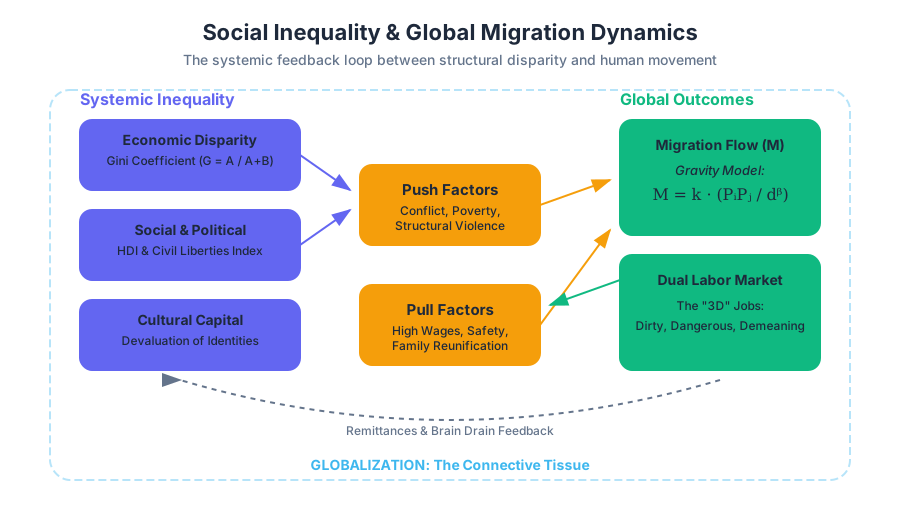
Socioeconomic inequality refers specifically to the disparate distribution of economic assets and income. To quantify this, economists and anthropologists often use the Gini Coefficient, a statistical measure of distribution.
Definition: The Gini Coefficient ($G$) A measure of statistical dispersion intended to represent the income or wealth inequality within a nation or any other group of people. It is defined based on the Lorenz curve, which plots the proportion of the total income of the population (y-axis) that is cumulatively earned by the bottom $x%$ of the population.
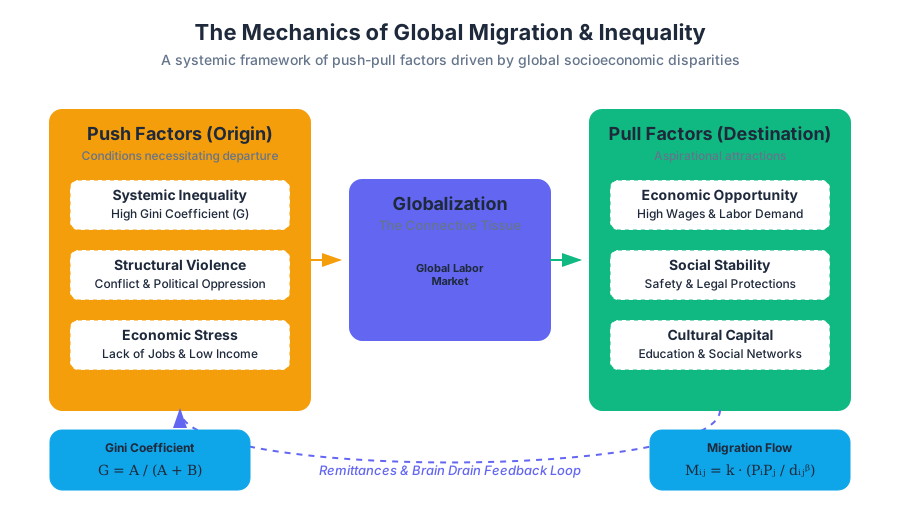
Mathematically, if the area between the line of perfect equality ($y = x$) and the Lorenz curve is $A$, and the area under the Lorenz curve is $B$, the Gini coefficient is: $$G = \frac{A}{A + B}$$
Dimensions of Inequality
Inequality is multidimensional. While economic metrics are vital, anthropologists emphasize that social status, political influence, and access to "cultural capital" are equally significant.
| Dimension | Description | Metric/Indicator |
|---|---|---|
| Economic | Disparity in wealth, income, and ownership of production. | Gini Index, GDP per capita (PPP). |
| Social | Unequal access to education, healthcare, and social networks. | Human Development Index (HDI). |
| Political | Differential ability to influence policy or access legal protections. | Voter participation, Civil Liberties Index. |
| Cultural | Devaluation of specific identities, languages, or traditions. | Linguistic vitality, Representation metrics. |
Mechanics of Human Migration
Human migration is the physical movement by people from one place to another, sometimes over long distances and in large groups. In the contemporary era, migration is rarely a simple choice; it is a survival strategy or an aspirational leap necessitated by the inequalities mentioned above.
The Push-Pull Framework
The most common model for understanding migration is the Push-Pull Model. Push factors are conditions in the place of origin that make it undesirable (e.g., war, poverty), while pull factors are attractions in the destination (e.g., high wages, safety).
| Factor Type | Examples | Systemic Driver |
|---|---|---|
| Push | Conflict, environmental degradation, lack of jobs, political oppression. | Structural Violence, Climate Change. |
| Pull | Labor demand, political stability, family reunification, educational access. | Global Labor Markets, Neoliberalism. |
Globalization and the Systemic Impact
Globalization acts as the connective tissue that accelerates both inequality and migration. It refers to the increasing integration of economies, cultures, and populations worldwide, driven by cross-border trade in goods and services, technology, and flows of investment, people, and information.
The Global Labor Market
In a globalized economy, labor becomes a commodity. However, unlike capital, which moves freely across borders via digital networks, human labor is restricted by the nation-state's borders. This creates a "dual labor market" where migrant workers often fill the "3D" jobs—Dirty, Dangerous, and Demeaning—that domestic workers avoid.
Derivation of the Migration Flow Formula
Gravity models are often used to predict the volume of migration between two points ($i$ and $j$). The basic form is derived from Newton’s Law of Universal Gravitation:
M_{ij} = k \cdot \frac{P_i \cdot P_j}{d_{ij}^\beta}
Where:
- $M_{ij}$ is the migration flow from $i$ to $j$.
- $P_i, P_j$ are the populations of the origin and destination.
- $d_{ij}$ is the distance between them.
- $k$ is a constant.
- $\beta$ is a parameter reflecting the friction of distance (usually $> 1$).
Anthropological Perspectives: Holism and the Insider's View
Anthropology brings a unique methodology to the study of inequality: Holism. Instead of looking at migration purely as an economic transaction, anthropologists examine the "total human experience."
Overcoming Western Bias
A significant pitfall in migration studies is Western bias—the assumption that the Western "developed" world is the natural or inevitable destination for all migrants. Anthropologists use cultural relativism to understand the specific motivations of migrants, which may include religious pilgrimage, ancestral connections, or indigenous concepts of land that do not align with Western borders.
The "Insider’s Point of View" (Emic Perspective)
By utilizing participant observation and ethnography, researchers gain an emic perspective. This reveals how systemic inequality is felt on a personal level—what Paul Farmer calls Structural Violence. This refers to social arrangements that put individuals and populations in harm's way. The arrangements are structural because they are embedded in the political and economic organization of our social world.
| Concept | Anthropological Definition | Application to Migration |
|---|---|---|
| Ethnocentrism | Judging another culture by the values of one's own. | Viewing migrants as "problems" to be solved rather than agents. |
| Transnationalism | Maintaining social/economic ties across borders. | Migrants sending remittances back home while living abroad. |
| Applied Anthropology | Using research to solve real-world problems. | Designing better refugee camp infrastructures or policy advocacy. |
Data Management in Migration Studies
Managing the vast amounts of data generated by global migration requires robust database schemas. Tracking individual movements, legal statuses, and socioeconomic outcomes is critical for both NGOs and governments.
Common Pitfalls and Misconceptions
- The "Brain Drain" Fallacy: While the migration of highly skilled individuals (doctors, engineers) can hurt origin countries, it is often offset by brain gain (remittances and the eventual return of skilled workers with new networks).
- Migration as a Choice: Many frameworks treat migration as a rational choice. However, for many, it is forced migration due to conflict or environmental collapse, where the "choice" is between migration and death.
- Homogenization of Migrants: Treating all migrants as a monolithic group ignores the intersectionality of race, gender, and class. A wealthy expatriate moving for a corporate promotion experiences globalization very differently than a refugee fleeing a civil war.
Variations and Extensions
Environmental Migration
A growing sub-field is Environmental Anthropology, which studies "climate refugees." As sea levels rise and arable land disappears, the drivers of migration shift from purely socioeconomic to biological and ecological.
Digital Diasporas
Globalization has enabled digital diasporas, where migrant communities maintain intense, real-time cultural and political connections with their homelands via the internet. This challenges the traditional idea that migration requires "assimilation" or the loss of original cultural identity.
Summary of Systemic Impacts
| System | Impact of Migration | Resulting Inequality |
|---|---|---|
| Labor Markets | Wage suppression in low-skill sectors; filling labor shortages. | Increased gap between capital owners and labor. |
| Urbanization | Rapid growth of "megacities" in the Global South. | Strain on infrastructure; growth of informal settlements (slums). |
| Culture | Hybridization of food, music, and language. | Backlash in the form of nativism or xenophobia. |
| Health | Spread of infectious diseases vs. "Medical Tourism." | Disparities in life expectancy and access to specialized care. |
Author Note: This article integrates the four-field approach of anthropology (biological, archaeological, linguistic, and cultural) to provide a comprehensive overview of how human movement is both a result of and a contributor to global social inequality. By moving beyond Western bias and employing rigorous quantitative and qualitative methods, we can better understand the "vastness" of the human story in an era of unprecedented change.
Source Materials
Study Anthropology on Lykke
This course page is free to open: signed out, you can read its first two sections, and signing in, on any plan, opens the rest. The free Lykke Chrome extension syncs your own Canvas courses, so ChatGPT, Claude and Muse can answer from your classes and deadlines. It only reads Canvas.
Add the free extensionSign in to open every section