From the free course Anthropology on Lykke
The Genus Homo and the Emergence of Modern Humans
Key concepts: Homo habilis · Homo erectus · Archaic Homo · Genomics · Tool Technology
Traces the transition from early hominins to the genus Homo, focusing on brain development, tool use, and genomics.
The Genus Homo and the Emergence of Modern Humans
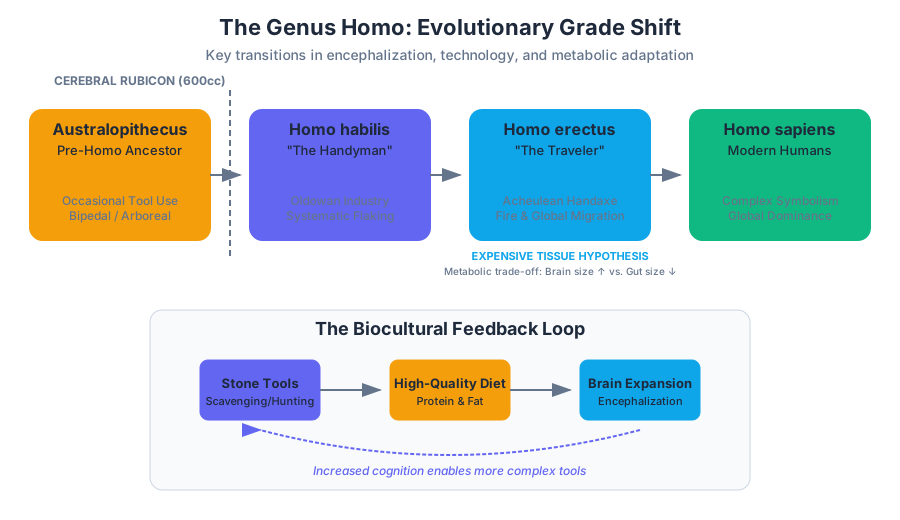
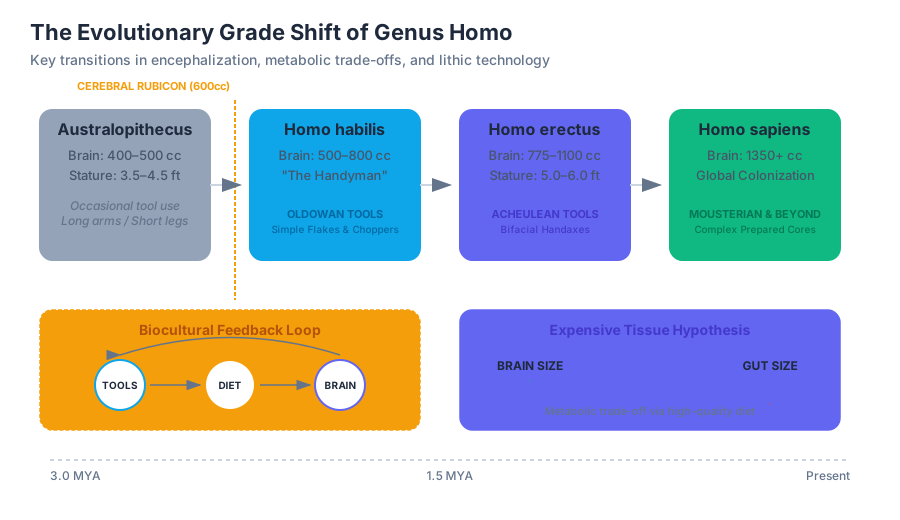
The transition from the late Pliocene to the Pleistocene marked a fundamental shift in hominin evolution. While earlier ancestors like Australopithecus exhibited bipedalism, the emergence of the genus Homo represents a "grade shift" characterized by significant encephalization (brain size increase), the systematic manufacture of stone tools, and eventually, the colonization of diverse global environments. This section explores the lineage from the earliest "handy" ancestors to the complex genomic tapestry of modern Homo sapiens.
Defining the Genus Homo
The classification of the genus Homo is traditionally based on the "Leakey criteria," which emphasize brain size, manual dexterity, and dental morphology. However, modern paleoanthropology recognizes that these traits did not emerge simultaneously. Instead, we observe a mosaic evolution where different systems—locomotor, masticatory, and neurological—evolved at different rates.
Definition: The Genus Homo A taxonomic group characterized by a significant increase in cranial capacity (typically >600 cc), a reduction in the size of the masticatory apparatus (teeth and jaws), the presence of a precision grip, and a reliance on cultural adaptations, specifically stone tool technology.
The "Cerebral Rubicon"
Historically, Sir Arthur Keith proposed a "Cerebral Rubicon" of 750 cc as the dividing line between apes/australopithecines and humans. This was later lowered to 600 cc by Louis Leakey to accommodate Homo habilis. Today, we view this transition through the lens of the Encephalization Quotient (EQ), a ratio of actual brain size to expected brain size for a mammal of a given body mass.
| Feature | Australopithecus | Early Homo (H. habilis) | Homo erectus |
|---|---|---|---|
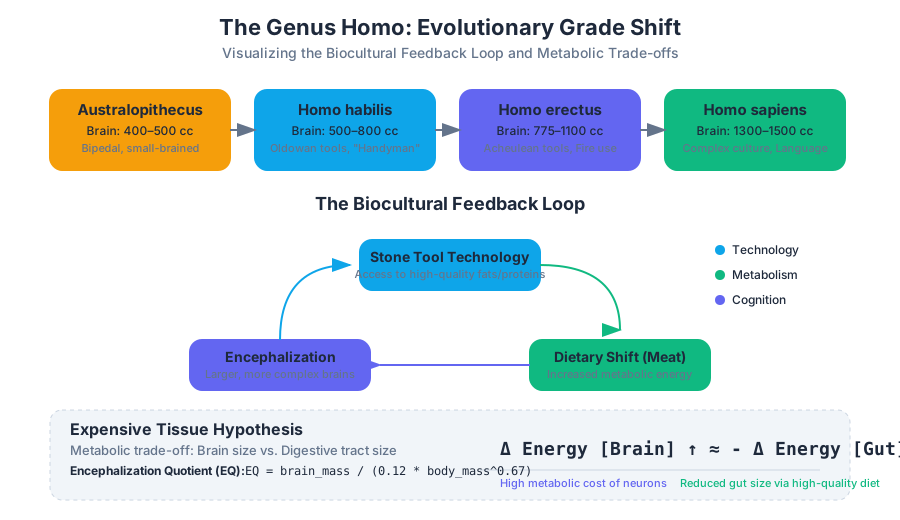
| Cranial Capacity | 400–500 cc | 500–800 cc | 775–1,100 cc |
| Dentition | Large molars, thick enamel | Reduced molars, parabolic arch | Small molars, modern arch |
| Stature | 3.5–4.5 ft | 3.5–4.5 ft | 5.0–6.0 ft |
| Tool Use | Occasional/Opportunistic | Systematic (Oldowan) | Advanced (Acheulean) |
| Postcrania | Long arms, short legs | Transitionary | Modern human proportions |
Homo habilis: The First "Handyman"
Appearing approximately 2.4 million years ago (mya), Homo habilis is the earliest widely recognized member of our genus. Found primarily in Olduvai Gorge (Tanzania) and Koobi Fora (Kenya), H. habilis represents the bridge between the small-brained australopithecines and the more robust Homo erectus.
The Biocultural Feedback Loop
The emergence of H. habilis is the first clear example of the Biocultural Feedback Loop. This theory posits that cultural innovations (like stone tools) allowed for a higher-protein diet (meat scavenging), which provided the metabolic energy required to grow and maintain a larger, more complex brain. A larger brain, in turn, allowed for more sophisticated tool manufacture and social organization.
Homo erectus and the Acheulean Revolution
Around 1.9 mya, Homo erectus (or Homo ergaster in Africa) appeared, marking a radical departure from previous forms. H. erectus was the first hominin to possess modern human-like body proportions, with elongated legs and shorter arms—an adaptation for long-distance trekking and persistence hunting in open savannahs.
The Expensive Tissue Hypothesis
A critical question in human evolution is how we afforded the metabolic cost of a large brain. The Expensive Tissue Hypothesis, proposed by Aiello and Wheeler, suggests a trade-off: as brain size increased, the size of the digestive tract (another metabolically "expensive" tissue) decreased. This was only possible through the consumption of high-quality, easily digestible foods, likely facilitated by the use of fire and advanced stone tools.
The metabolic scaling can be represented by the following derivation:
\text{Total Metabolic Rate (TMR)} = \sum (\text{Mass of Organ}_i \times \text{Specific Metabolic Rate}_i)

\text{In H. erectus:}
\Delta \text{Energy}_{\text{Brain}} \approx - \Delta \text{Energy}_{\text{Gut}}
Acheulean Technology
While H. habilis used the Oldowan industry (simple flakes and choppers), H. erectus developed the Acheulean industry. The hallmark of this industry is the Bifacial Handaxe, a multi-purpose tool shaped on both sides to create a sharp, durable edge. This required a "mental template"—the ability of the knapper to visualize the finished tool within the raw stone.
| Industry | Period | Key Tool | Technique | Cognitive Requirement |
|---|---|---|---|---|
| Oldowan | 2.6–1.7 mya | Chopper, Flake | Hard hammer percussion | Basic motor skills |
| Acheulean | 1.7 mya – 200 kya | Handaxe, Cleaver | Soft hammer (bone/antler) | Mental template, symmetry |
| Mousterian | 250–40 kya | Levallois points | Prepared core | Abstract planning, multi-step |
Archaic Homo and the Neanderthal Lineage
Between 600,000 and 200,000 years ago, a group of hominins often referred to as Archaic Homo sapiens (or Homo heidelbergensis) bridged the gap between H. erectus and modern humans. These populations moved into Europe and Asia, eventually diverging into Neanderthals (Homo neanderthalensis) in the West and Denisovans in the East.
Neanderthal Adaptations
Neanderthals were not the "brutes" of popular myth but highly sophisticated survivors of Ice Age Europe. Their anatomy reflects cold-weather adaptations:
- Stocky build: Reduced surface area to volume ratio to retain heat (Bergmann’s Rule).
- Large nasal cavity: To warm and humidify cold air.
- Large cranial capacity: Often exceeding the modern human average (1450 cc vs 1350 cc), though organized differently.
Genomics: Tracking the Human Story
The most significant recent advancement in understanding our emergence is Paleogenomics—the study of ancient DNA (aDNA). By sequencing the genomes of Neanderthals and Denisovans, scientists have discovered that the "Out of Africa" model was not a simple replacement, but a "Leaky Replacement."
Key Insight: Admixture Modern non-African populations carry approximately 1.5% to 2.1% Neanderthal DNA, while some Melanesian and East Asian populations carry up to 5% Denisovan DNA. This proves that archaic and modern humans interbred.
The Bioinformatics of Ancestry
The Emergence of Modern Homo sapiens
Homo sapiens emerged in Africa approximately 300,000 years ago (based on the Jebel Irhoud finds in Morocco). While early H. sapiens looked anatomically modern, "Behavioral Modernity" (the use of art, symbolic thought, and complex social networks) appears to have flourished later, around 50,000 to 100,000 years ago.
Characteristics of Modernity
- Anatomical: High, vertical forehead; small or absent brow ridges; a prominent chin (mental eminence); and a more gracile skeleton.
- Behavioral: The "Great Leap Forward" characterized by:
- Blade Technology: Producing long, thin flakes (blades) that are more efficient than flakes.
- Composite Tools: Spear-throwers (atlatls) and bows.
- Symbolism: Cave paintings (Lascaux, Chauvet), figurines (Venus statues), and intentional burials with grave goods.
Common Pitfalls in Understanding Human Evolution
- The "Ladder" Fallacy: Evolution is not a linear progression from "primitive" to "advanced." It is a branching bush where multiple species often coexisted (e.g., H. sapiens, H. neanderthalensis, H. floresiensis, and H. luzonensis all lived within the last 100,000 years).
- Brain Size vs. Intelligence: While brain size increased, organization and connectivity are equally important. Neanderthals had larger brains, but H. sapiens developed more expanded parietal and temporal lobes, associated with language and social networking.
Summary of Evolutionary Milestones
| Milestone | Approximate Date | Significance |
|---|---|---|
| First Homo | 2.4–2.8 mya | Transition from Australopithecine morphology; first tools. |
| Out of Africa I | 1.8 mya | H. erectus migrates to Dmanisi (Georgia) and Java. |
| Controlled Fire | ~1.0–0.4 mya | Cooking increases nutrient availability; social hearths. |
| Speciation of H. sapiens | 300 kya | Anatomical modernity emerges in Africa. |
| The Toba Supereruption | 74 kya | Potential genetic bottleneck for modern humans. |
| Out of Africa II | 60–90 kya | Major migration of modern humans into Eurasia. |
Source Materials
Study Anthropology on Lykke
This course page is free to open: signed out, you can read its first two sections, and signing in, on any plan, opens the rest. The free Lykke Chrome extension syncs your own Canvas courses, so ChatGPT, Claude and Muse can answer from your classes and deadlines. It only reads Canvas.
Add the free extensionSign in to open every section