From the free course Anthropology on Lykke
Work, Life, and Value: Economic Anthropology
Key concepts: Modes of Subsistence · Pastoralism · Horticulture · Exchange and Value · Modes of Production
Explores how societies organize production, exchange, and consumption across different cultural contexts.
Work, Life, and Value: Economic Anthropology
Economic anthropology is the study of how human societies provide the material goods and services necessary for biological and social reproduction. While classical economics often assumes a "rational actor" maximizing individual utility within a market, economic anthropology reveals that economic behavior is embedded within social, religious, and political institutions. To understand work, life, and value, we must look beyond the price tag to the social logic that dictates how resources are extracted, transformed, and shared.
The Embeddedness of Economy
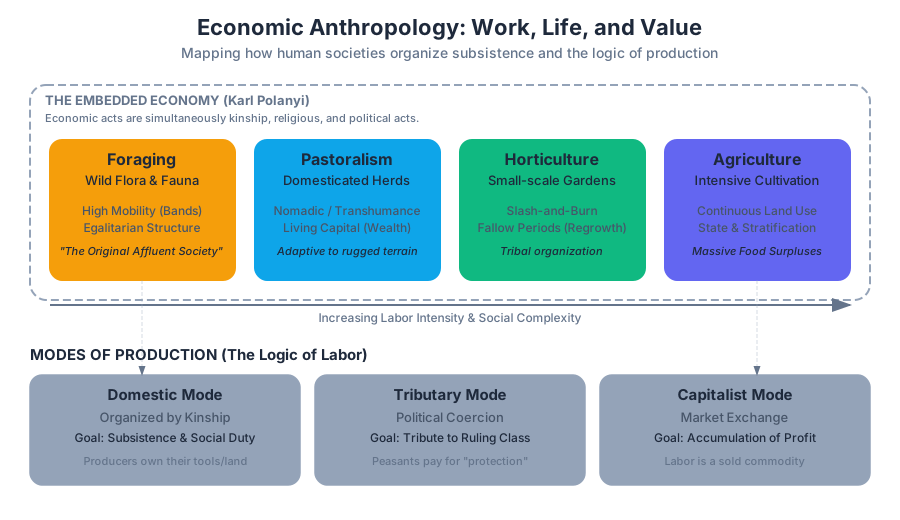
The foundational concept in this field, popularized by Karl Polanyi, is that the economy is not a separate sphere of life. In non-industrial societies, "economic" activities like planting a field or gifting a shell are simultaneously acts of kinship, religious devotion, and political alliance.
The Substantivist Definition: The economy is the process by which a society interacts with its environment and its members to provide the material means of need-satisfaction. This stands in contrast to the Formalist view, which applies neoclassical economic logic (scarcity and choice) to all human cultures regardless of their internal logic.
Modes of Subsistence: The Strategies of Survival
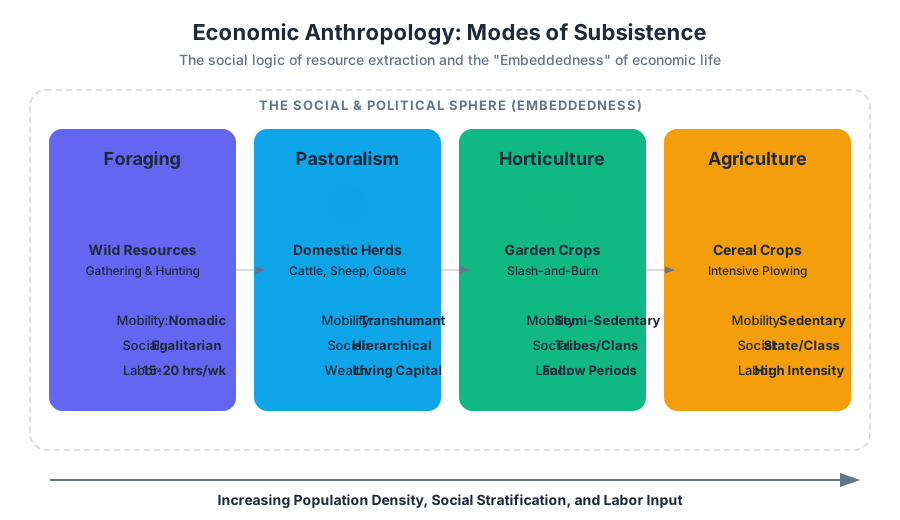
A Mode of Subsistence is the primary method a society uses to obtain food and resources. These are not merely "stages of evolution" but adaptive strategies tailored to specific environments and social histories.
1. Foraging (Gathering and Hunting)
Foraging relies on the collection of wild plants and the hunting of wild animals. For 95% of human history, this was the sole mode of subsistence.
- Mechanics: High mobility, small group sizes (bands), and an egalitarian social structure.
- The Original Affluent Society: Marshall Sahlins argued that foragers are "affluent" not because they have much, but because they want little and meet their needs with only 15–20 hours of work per week.
- Optimal Foraging Theory (OFT): A formal model used to predict how an animal (or human) behaves when searching for food. It maximizes the rate of energy intake per unit of time.
2. Pastoralism
Pastoralism is based on the domestication of herd animals (cattle, sheep, goats, camels). It is typically found in environments where the land is too dry or the terrain too rugged for agriculture.
- Nomadic Pastoralism: The entire group moves with the herds throughout the year.
- Transhumance: Part of the group moves the herds to seasonal pastures, while the rest remain in a permanent village.
- Wealth and Inequality: Unlike foragers, pastoralists can accumulate "living capital," leading to the emergence of social hierarchies and gendered divisions of labor.
3. Horticulture
Horticulture is small-scale, non-intensive cultivation of plants using simple tools like digging sticks and hoes.
- The Fallow Period: The defining feature of horticulture is the use of fallowing. Fields are cleared (often via Slash-and-Burn), planted for a few seasons, and then left to regrow for years to restore soil nutrients.
- Social Structure: Supports larger, more permanent settlements than foraging, often organized into tribes or chiefdoms.
4. Agriculture
Agriculture involves intensive cultivation using technologies like plows, irrigation, and fertilizers.
- Intensification: Agriculture eliminates the fallow period, allowing for continuous use of land. This leads to massive food surpluses but requires significantly more labor per unit of food than horticulture.
- Consequences: The "Urban Revolution," state formation, extreme social stratification, and the concept of private land ownership.
| Subsistence Mode | Primary Resource | Mobility | Social Stratification | Labor Intensity |
|---|---|---|---|---|
| Foraging | Wild Flora/Fauna | High (Nomadic) | Low (Egalitarian) | Low (15-20 hrs/week) |
| Pastoralism | Domesticated Herds | Seasonal/High | Moderate | Moderate |
| Horticulture | Garden Crops | Sedentary/Semi | Low to Moderate | Moderate |
| Agriculture | Cereal Crops | Sedentary | High (Class-based) | High |
| Industrialism | Manufactured Goods | Variable | Extreme | Variable/High |
Modes of Production: The Logic of Labor
While subsistence describes what people eat, the Mode of Production describes how labor is organized and who controls the means of production (land, tools, knowledge).
The Domestic Mode of Production
In this mode, labor is organized based on kinship. The goal is subsistence-oriented production—producing enough to feed the family and meet social obligations.
- Key Feature: Producers own their own tools and have direct access to land.
- Chayanov’s Rule: In domestic production, the intensity of labor decreases as the number of consumers in the household decreases relative to the number of workers.
The Tributary Mode of Production
Found in non-industrial states (like Feudal Europe or Imperial China), where a primary producer (peasant) pays a portion of their harvest to a ruler or lord in exchange for "protection" or access to land.
- Key Feature: Production is controlled through political or military coercion rather than market forces.
The Capitalist Mode of Production
Labor is a commodity sold on a market. The means of production are owned by a minority (the bourgeoisie), and the majority (the proletariat) must sell their labor-power to survive.
- Key Feature: The goal is the accumulation of surplus value (profit), not subsistence.
Exchange and Value: The Social Life of Things
How do things move from one person to another? Anthropologists identify three primary patterns of exchange, each carrying different social weights.
1. Reciprocity
Reciprocity is the exchange of goods and services between people of relatively equal status.
- Generalized Reciprocity: Giving without an immediate or specific expectation of return (e.g., parents feeding children, or hunters sharing meat in a band). This builds deep social "credit."
- Balanced Reciprocity: Giving with the expectation of a return of equal value within a specified timeframe (e.g., birthday gifts among friends).
- Negative Reciprocity: An attempt to get something for as little as possible (e.g., haggling, theft, or gambling). This occurs between strangers or enemies.
2. Redistribution
Goods flow from the local level to a central authority (a chief, a temple, or a tax office), where they are sorted, stored, and eventually returned to the population.
- Potlatch: A famous example among Indigenous peoples of the Pacific Northwest. Chiefs compete to give away or destroy vast amounts of wealth (blankets, copper, food) to demonstrate their status and redistribute resources to the community.
3. Market Exchange
Exchange governed by the "law of supply and demand," usually involving a standardized medium of exchange (money).
- Anonymity: Unlike reciprocity, market exchange is often impersonal. Once the transaction is complete, the social relationship may end.
Mathematical Derivation: The Labor Theory of Value vs. Marginal Utility
In economic anthropology, we often contrast how value is derived. Marx (following Ricardo) argued for the Labor Theory of Value, where the value of an object is determined by the "socially necessary labor time" required to produce it.
V = L + C + S
Where:
V= Total ValueL= Labor-power (Variable Capital)C= Constant Capital (Tools, Raw Materials)S= Surplus Value (Profit extracted by the owner)
In contrast, the Marginalist view suggests value is subjective and based on the utility of the next unit consumed.
MU = \frac{\Delta U}{\Delta Q}
Where:
MU= Marginal UtilityΔU= Change in Total UtilityΔQ= Change in Quantity consumed
Anthropologists argue that both formulas miss Cultural Value—the value assigned to an object because of its history, its role in a ritual, or its symbolic meaning (e.g., a wedding ring vs. a gold nugget of equal weight).
The Kula Ring: A Case Study in Exchange
One of the most famous studies in economic anthropology is Bronisław Malinowski’s analysis of the Kula Ring in the Trobriand Islands.
- The Artifacts: Red shell necklaces (soulava) travel clockwise around a circle of islands; white shell armbands (mwali) travel counter-clockwise.
- The Logic: These items have no "use value" in the traditional sense—you cannot eat them or use them as tools. However, they possess immense Exchange Value and Symbolic Value.
- The Function: The Kula creates lifelong partnerships between men on different islands. These partnerships provide a "social infrastructure" that allows for the secondary trade of utilitarian goods (yams, canoes, pottery) in a high-risk maritime environment.
Data Representation: Kula Exchange Log
If we were to track these transactions in a modern database, the schema would need to prioritize the history of the object, as the value of a Kula item increases with the fame of its previous owners.
Common Pitfalls in Economic Anthropology
- The "Primitive" Fallacy: Assuming that foraging or horticulture are "primitive" or "failed" versions of agriculture. In reality, they are highly successful adaptations that often provide better nutrition and more leisure time than early farming.
- Universalizing the Market: Assuming that because we use money, everyone wants to use money. Many societies actively resist the "monetization" of certain spheres of life (like blood or land) to protect social cohesion.
- Ignoring Gender: Traditional economic models often ignored "unpaid labor" (childcare, cooking, gathering), which in many horticultural and foraging societies provides the bulk of the calories and social stability.
- The Tragedy of the Commons Myth: Garrett Hardin’s famous "Tragedy of the Commons" assumes that shared resources will always be overexploited. Anthropologists like Elinor Ostrom proved that many societies have complex, non-market rules for managing "commons" effectively for centuries.
Summary of Exchange Types
| Type | Social Distance | Timing of Return | Example |
|---|---|---|---|
| Generalized Reciprocity | Close (Kin/Friends) | Indefinite | Sharing a meal |
| Balanced Reciprocity | Distant (Acquaintances) | Specific/Immediate | Trading a tool for a hide |
| Negative Reciprocity | Outsiders/Enemies | Immediate (Competitive) | Haggling at a tourist market |
| Redistribution | Centralized | Periodic | Income Tax / Social Security |
| Market Exchange | Anonymous | Immediate | Buying groceries with USD |
- Mode of Subsistence: The set of strategies a group uses to obtain food and resources from the environment.
- Chayanov’s Rule: The principle that households will work only as hard as necessary to meet their subsistence needs.
- Embeddedness: The idea that economic transactions are inseparable from social, religious, and political relationships.
- Generalized Reciprocity: Exchange where the value and timing of the return are not specified.
- Means of Production: The physical inputs required for production, such as land, tools, and raw materials.
- Relations of Production: The social relationships that govern how people work together and who controls the products of labor.
- Potlatch: A ceremonial feast of the Pacific Northwest used to redistribute wealth and assert status.
- Transhumance: A form of pastoralism where only part of the population moves with the herds.
- Which mode of subsistence is characterized by the "Original Affluent Society" argument?
- (A) Agriculture
- (B) Pastoralism
- (C) Foraging
- (D) Industrialism
- In the Kula Ring, what determines the value of a shell armband?
- (A) The weight of the shell
- (B) The labor time required to polish it
- (C) The history of its previous owners
- (D) The current market price of calcium carbonate
- How does horticulture differ from agriculture?
- (A) Horticulture uses irrigation; agriculture does not.
- (B) Horticulture uses fallow periods; agriculture is intensive.
- (C) Horticulture is only found in deserts.
- (D) There is no difference; they are synonyms.
- What is "Negative Reciprocity"?
- (A) Refusing to trade with anyone.
- (B) An exchange where one party tries to get the better of the other.
- (C) Giving a gift and expecting nothing in return.
- (D) The central collection of goods by a chief.
- According to Polanyi, a "market economy" is unique because:
- (A) It is the only system that uses tools.
- (B) It is the only system where people are rational.
- (C) It attempts to "disembed" the economy from social life.
- (D) It relies entirely on kinship.
Key Themes for Review:
- The Transition to Agriculture: Understand the trade-offs (more food, more work, more disease, more inequality).
- Social Logic of Gifting: Why is a gift never "free"? (Mauss's The Gift).
- Sustainability: How do different modes of subsistence impact the environment? (e.g., Slash-and-burn vs. Industrial farming).
- Modern Applications: How do concepts like "Generalized Reciprocity" explain the Open Source software movement or the "Sharing Economy"?
- Wealth vs. Capital: Distinguish between items used for survival/status and items used to generate more wealth.
Source Materials
Study Anthropology on Lykke
This course page is free to open: signed out, you can read its first two sections, and signing in, on any plan, opens the rest. The free Lykke Chrome extension syncs your own Canvas courses, so ChatGPT, Claude and Muse can answer from your classes and deadlines. It only reads Canvas.
Add the free extensionSign in to open every section