Anthropology
Institution: MIT
82 study materials · 13 sections
This course provides a comprehensive introduction to anthropology, the interdisciplinary study of humanity across time and space. It explores the four primary subfields—cultural, biological, archaeological, and linguistic anthropology—to understand human biological origins and cultural diversity. Students will examine foundational concepts such as holism, cultural relativism, and evolution while addressing contemporary global challenges like social inequality, migration, and indigenous rights.
Course Sections
Introduction to Anthropology and the Four-Field Approach
Key concepts: Holism · Four-field approach · Ethnocentrism · Cultural Relativism · Insider’s Point of View
Defines anthropology as a holistic discipline and introduces the four main subfields: cultural, biological, archaeology, and linguistics.
Introduction to Anthropology and the Four-Field Approach
Anthropology is the comprehensive, multi-dimensional study of humanity across all time and space. Unlike disciplines that isolate specific variables of human behavior—such as economics focusing on markets or psychology on the individual mind—anthropology operates as a "science of systems." It seeks to understand the biological, social, linguistic, and historical forces that converge to create the human experience.
At its core, anthropology addresses the fundamental question: What does it mean to be human? To answer this, the discipline employs a rigorous framework known as the Four-Field Approach, anchored by the philosophical pillars of Holism and Cultural Relativism.
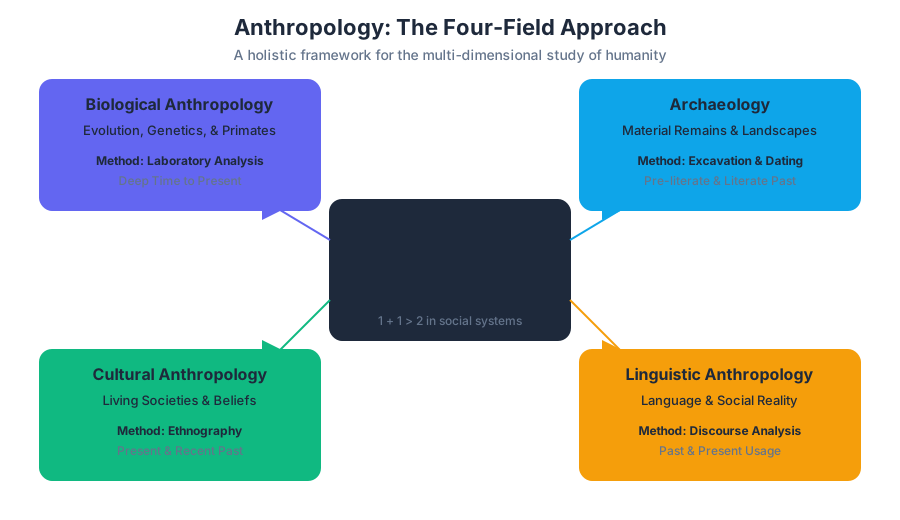
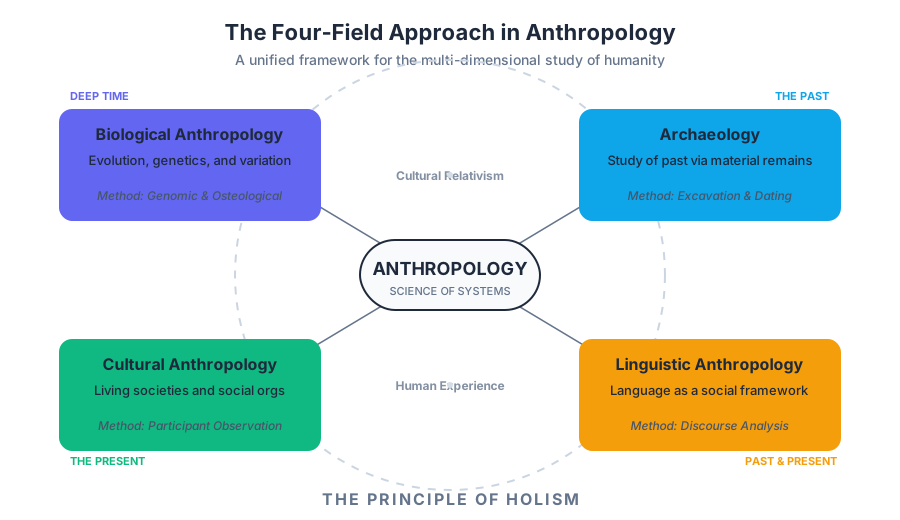
The Four-Field Approach: A Unified Framework
The modern structure of anthropology, particularly in North America, was largely codified by Franz Boas in the early 20th century. Boas argued that human culture and biology are inextricably linked and cannot be understood in isolation. This led to the division of the discipline into four primary sub-disciplines, each utilizing distinct methodologies to contribute to a singular narrative of humanity.
1. Biological Anthropology
Also known as physical anthropology, this field examines the biological origins, evolution, and variation of Homo sapiens. It treats humans as biological organisms subject to the laws of natural selection and genetics.
- Key Areas: Paleoanthropology (fossil record), Primatology (non-human primates), and Human Variation (genetics and adaptation).
- Methodology: Genomic sequencing, osteological analysis, and longitudinal behavioral studies of primates.
2. Archaeology
Archaeology is the study of the human past through material remains. It extends the human story back millions of years, covering the vast majority of human history that occurred before the invention of writing.
- Key Areas: Prehistoric archaeology, historical archaeology, and cultural resource management (CRM).
- Methodology: Stratigraphic excavation, radiocarbon dating, and spatial analysis of settlement patterns.
3. Cultural Anthropology
This subfield focuses on living human societies and the diversity of cultural expressions. It explores how people organize themselves, how they perceive the world, and how power dynamics (such as social inequality) are constructed.
- Key Areas: Economic anthropology, political anthropology, and medical anthropology.
- Methodology: Ethnography and Participant Observation.
4. Linguistic Anthropology
Linguistic anthropology investigates how language shapes social life. It views language not just as a tool for communication, but as a cognitive framework that influences how we categorize reality.
- Key Areas: Historical linguistics, sociolinguistics, and non-verbal communication.
- Methodology: Discourse analysis and phonetic transcription.
| Subfield | Primary Object of Study | Temporal Focus | Key Methodology |
|---|---|---|---|
| Biological | Human body, genes, and primates | Deep time to present | Laboratory analysis, Field observation |
| Archaeology | Artifacts, features, and landscapes | Past (Pre-literate & Literate) | Excavation, Remote sensing |
| Cultural | Beliefs, behaviors, and social orgs | Present / Recent past | Participant observation, Interviews |
| Linguistic | Language systems and usage | Past and Present | Linguistic recording, Discourse analysis |
Holism: The "System of Systems" Perspective
Holism is the defining characteristic of the anthropological perspective. It is the theoretical commitment to the idea that all aspects of human life are interconnected. A change in one variable—such as a shift in subsistence technology—will inevitably produce ripples across the social structure, religious beliefs, and even the biological health of a population.
The Mechanics of Holism
In an anthropological context, holism functions as a "top-down" and "bottom-up" integration. For example, to understand the impact of the COVID-19 pandemic, an anthropologist would not just look at the virus (Biological). They would look at:
- Cultural: How social distancing conflicts with cultural values of kinship.
- Linguistic: How the rhetoric of "essential workers" shapes social status.
- Archaeological/Historical: How previous pandemics (like the 1918 flu) left traces in the burial records and social memory.
- Biological: How systemic inequality leads to different health outcomes across populations.
The Principle of Holism: No single part of a culture can be understood unless it is related to the whole. The "whole" is greater than the sum of its parts ($1 + 1 > 2$ in social systems).
Worked Example: Radiocarbon Dating and Archaeological Context
In archaeology, holism is applied by combining chemical data with stratigraphic context. Below is a Python implementation of a basic radiocarbon dating calculation, which represents the "Biological/Chemical" input into the "Archaeological" whole.
import math

def calculate_radiocarbon_age(fraction_modern):
    """
    Calculates the conventional radiocarbon age (CRA) of a sample.
    Formula: t = -8033 * ln(Fm)
    where:
    - t is the age in years
    - Fm is the fraction of modern carbon remaining
    - 8033 is the mean life of Carbon-14 (Libby half-life / ln(2))
    """
    if fraction_modern <= 0 or fraction_modern > 1:
        raise ValueError("Fraction modern must be between 0 and 1.")

    # Libby half-life constant
    LIBBY_MEAN_LIFE = 8033

    # Calculate age
    age = -LIBBY_MEAN_LIFE * math.log(fraction_modern)

    return round(age, 2)

# Example: A sample from an Indigenous site shows 65% of C-14 remaining
sample_fm = 0.65
age_result = calculate_radiocarbon_age(sample_fm)

print(f"Sample Fraction Modern: {sample_fm}")
print(f"Calculated Radiocarbon Age: {age_result} BP (Before Present)")
Overcoming Ethnocentrism
Ethnocentrism is the universal human tendency to view one's own culture as the "natural" or "correct" way of living, using it as a benchmark to judge all other cultures. While it provides social cohesion within a group, it acts as a significant barrier to scientific inquiry.
The Problem of Western Bias
Anthropology originated within a Western colonial context. Early "armchair anthropologists" often ranked cultures on a ladder of "savagery" to "civilization," with Europe at the top. Modern anthropology is a discipline of decolonization, actively working to identify and remove these biases.
| Concept | Definition | Resulting Bias |
|---|---|---|
| Ethnocentrism | Judging others by your own cultural standards. | "They are doing it wrong/weirdly." |
| Xenocentrism | Valuing another culture over your own. | "They are more 'pure' or 'natural' than us." |
| Western Bias | Assuming Western categories (like 'Nuclear Family') are universal. | Misinterpreting kinship and economic systems. |
Cultural Relativism: The Methodological Tool
To counter ethnocentrism, anthropologists employ Cultural Relativism. This is the principle that a person's beliefs and activities should be understood based on that person's own culture.
Methodological vs. Moral Relativism
It is vital to distinguish between two types of relativism:
- Methodological Relativism: A research tool. To understand why a culture practices a specific ritual, the researcher must temporarily suspend their own judgments to see the internal logic of the practice.
- Moral Relativism: The philosophical belief that there are no universal moral truths.
Most anthropologists practice methodological relativism. They do not necessarily condone every practice they study (e.g., social inequality or violence), but they recognize that they cannot explain those practices if they start from a position of condemnation.
Mathematical Derivation: The Hardy-Weinberg Equilibrium
In Biological Anthropology, we use mathematical models to ensure we aren't biased by our expectations of "normal" traits. The Hardy-Weinberg Equilibrium (HWE) serves as a null hypothesis for evolution. If a population is not in HWE, we know an evolutionary force (like selection or migration) is at work.
$$ p^2 + 2pq + q^2 = 1 $$
Where:
- $p$ = frequency of the dominant allele
- $q$ = frequency of the recessive allele ($p + q = 1$)
- $p^2$ = frequency of homozygous dominant individuals
- $2pq$ = frequency of heterozygous individuals
- $q^2$ = frequency of homozygous recessive individuals
If the observed genotype frequencies in a field study deviate from this derivation, the anthropologist must investigate the environmental or social pressures (the "Holistic" context) causing the change.
The Insider’s Point of View: Emic vs. Etic
A critical goal of the four-field approach is to bridge the gap between how people see themselves and how an outside scientist sees them. This is described using the terms Emic and Etic.
- Emic (Insider): The perspective of the subject. It focuses on local explanations, meanings, and categories. "Why do you do this?" "Because it honors our ancestors."
- Etic (Outsider): The perspective of the observer. It applies external scientific theories and categories to the behavior. "The ritual functions as a mechanism for wealth redistribution."
Comparison of Perspectives
| Feature | Emic Perspective | Etic Perspective |
|---|---|---|
| Source of Meaning | The culture being studied | The scientific community |
| Goal | To understand the "Insider's" logic | To find cross-cultural patterns |
| Key Question | What does this mean to them? | How does this fit into theory? |
| Risk | Getting "lost" in the culture | Imposing external bias |
Applied Anthropology: The Practical Dimension
While the four fields provide the theoretical structure, Applied Anthropology is often considered the "fifth field." It involves using anthropological data and methods to solve real-world problems.
Real-World Usage: Archaeological Database Schema
In applied archaeology (Cultural Resource Management), data must be structured so that it can be used by government agencies and Indigenous groups. Below is a SQL schema representing how an anthropologist might organize data to ensure "Holism" is maintained between artifacts and their physical context.
-- Schema for Archaeological Provenience and Artifact Analysis
CREATE TABLE Sites (
    site_id INT PRIMARY KEY,
    site_name VARCHAR(100),
    latitude DECIMAL(9,6),
    longitude DECIMAL(9,6),
    cultural_affliation VARCHAR(50)
);

CREATE TABLE Stratigraphic_Units (
    unit_id INT PRIMARY KEY,
    site_id INT,
    layer_depth_cm INT,
    soil_type VARCHAR(50),
    chronology_label VARCHAR(50),
    FOREIGN KEY (site_id) REFERENCES Sites(site_id)
);

CREATE TABLE Artifacts (
    artifact_id INT PRIMARY KEY,
    unit_id INT,
    material_type VARCHAR(30), -- e.g., Ceramic, Lithic, Bone
    weight_grams DECIMAL(10,2),
    is_diagnostic BOOLEAN,
    description TEXT,
    FOREIGN KEY (unit_id) REFERENCES Stratigraphic_Units(unit_id)
);

-- Query to find all lithic artifacts in a specific time horizon
SELECT a.artifact_id, a.description, s.chronology_label
FROM Artifacts a
JOIN Stratigraphic_Units s ON a.unit_id = s.unit_id
WHERE a.material_type = 'Lithic' AND s.chronology_label = 'Late Archaic';
Common Pitfalls in Anthropological Thinking
- The "Noble Savage" Myth: A form of romanticized ethnocentrism where Indigenous cultures are viewed as inherently more "spiritual" or "in tune with nature." This denies these groups their complex history and agency.
- Reductionism: The opposite of holism. Attempting to explain complex human behavior through a single lens (e.g., "It's all in the genes").
- Ignoring Social Inequality: Early anthropology often ignored how power dynamics and colonialism shaped the cultures being studied. Modern anthropology places these issues at the center of the "Four-Field" narrative.
Summary of Key Principles
- Anthropology is the holistic study of humanity across four fields: Biological, Archaeological, Cultural, and Linguistic.
- Holism ensures that we see the "big picture," integrating biological facts with cultural meanings.
- Ethnocentrism is a bias we must actively work to overcome using Cultural Relativism as a methodological tool.
- The Emic perspective gives us the insider's meaning, while the Etic perspective allows for scientific comparison.
- The discipline is increasingly focused on Applied Anthropology, using these tools to address social inequality, climate change, and global health.
Research Methods: Cultural and Archaeological
Key concepts: Ethnography · Participant Observation · Excavation · Qualitative Analysis · Conservation
Explores the foundational research methodologies used to gather and analyze data in cultural anthropology and archaeology.
Research Methods: Cultural and Archaeological
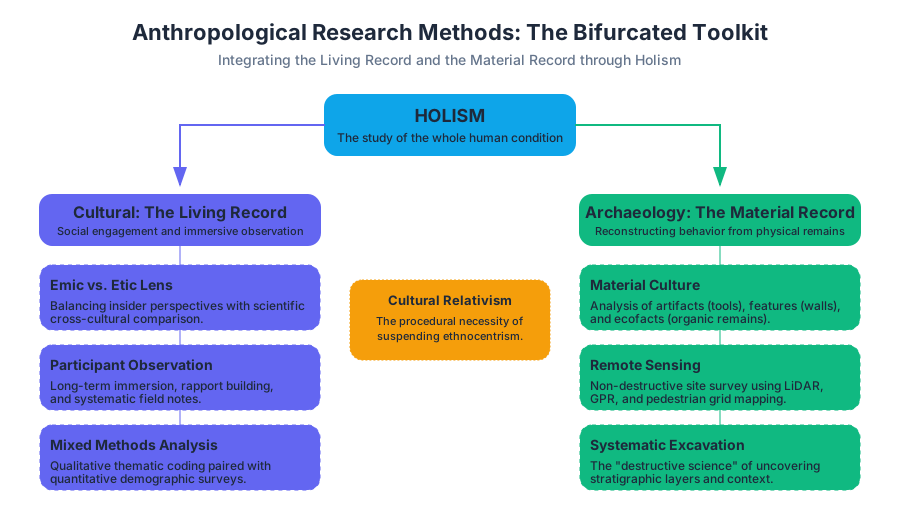
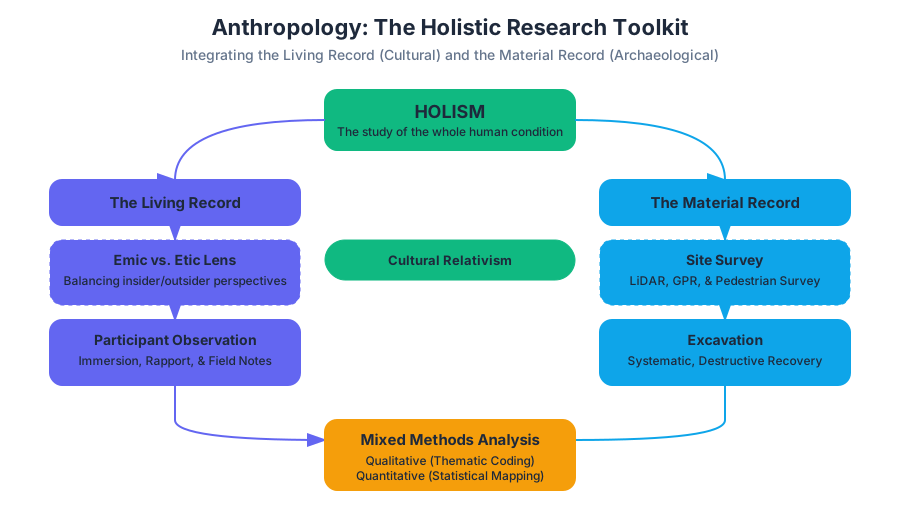
Anthropology is defined by its commitment to holism—the study of the whole of the human condition: past, present, and future; biology, society, language, and culture. To achieve this, researchers employ a bifurcated yet integrated toolkit of methodologies. While cultural anthropologists focus on the "living record" through immersive social engagement, archaeologists reconstruct human behavior through the "material record."
This section provides a technical deep dive into the rigorous protocols used to extract meaning from both human interaction and the physical remains of the past. We will examine the transition from raw data collection to the sophisticated qualitative and quantitative analyses that define modern social science.
The Epistemological Foundation: Emic vs. Etic
Before engaging in fieldwork, a researcher must establish their analytical lens. Anthropological methodology is built upon the tension between two perspectives:
- Emic Perspective: The "insider’s" point of view. The goal is to understand how local people think, perceive the world, and explain their own rules for behavior.
- Etic Perspective: The "outsider’s" or scientist’s point of view. This shifts the focus from local observations and categories to those of the anthropologist, emphasizing cross-cultural comparison and theoretical generalization.
The Principle of Cultural Relativism: The methodological requirement that a researcher suspend their own cultural biases and "ethnocentrism" to understand a culture on its own terms. It is not a moral judgment, but a procedural necessity for objective data collection.
Cultural Research Methods: The Living Record
Cultural anthropology relies heavily on Ethnography, a research strategy involving long-term immersion in a community. Unlike the "armchair anthropologists" of the 19th century, modern researchers utilize a suite of field-tested techniques.
Participant Observation
The "gold standard" of cultural methods, Participant Observation, requires the researcher to live within a community, participating in daily activities while simultaneously maintaining a systematic record of observations. This method bridges the gap between what people say they do and what they actually do.
| Method Component | Description | Primary Goal |
|---|---|---|
| Rapport Building | Establishing trust and a "place" within the social hierarchy. | Access to sensitive or private cultural data. |
| Field Notes | Continuous, detailed journaling of events, sensory data, and conversations. | Raw data for later qualitative coding. |
| Key Informants | Identifying individuals with specialized knowledge (elders, healers, leaders). | Deep-dive insights into specific cultural niches. |
| Genealogy | Mapping kinship, descent, and marriage patterns. | Understanding social structure and resource inheritance. |
Qualitative and Quantitative Analysis
Modern ethnography is rarely purely descriptive. It utilizes Mixed Methods to validate findings. Qualitative Analysis focuses on the "why" and "how" of human behavior (thematic coding of interviews), while Quantitative Analysis provides the "how many" or "how often" (statistical surveys, demographic mapping).
In the following example, we demonstrate how a researcher might use Python to perform a basic thematic analysis on a set of interview transcripts, identifying the frequency of specific cultural "nodes" or themes.
import collections
import re

def analyze_field_notes(transcript_data):
    """
    Performs a basic thematic frequency analysis on ethnographic field notes.
    Identifies 'Cultural Nodes' based on keyword density.
    """
    # Define thematic categories (Nodes)
    themes = {
        'kinship': ['family', 'marriage', 'clan', 'ancestor', 'lineage'],
        'subsistence': ['farm', 'hunt', 'market', 'trade', 'crop'],
        'ritual': ['ceremony', 'prayer', 'spirit', 'taboo', 'sacred']
    }

    # Normalize and tokenize text
    words = re.findall(r'\w+', transcript_data.lower())
    word_counts = collections.Counter(words)

    results = {}
    for theme, keywords in themes.items():
        # Calculate the density of each theme in the notes
        score = sum(word_counts[word] for word in keywords)
        results[theme] = score

    return results

# Example field note snippet
raw_notes = """The village elders gathered for the sacred ceremony near the ancestral shrine.
The lineage head discussed the upcoming marriage between the two clans,
ensuring the trade of crops and livestock remained within the family network."""

analysis = analyze_field_notes(raw_notes)
print(f"Thematic Density: {analysis}")
# Output: Thematic Density: {'kinship': 4, 'subsistence': 2, 'ritual': 2}
Archaeological Research Methods: The Material Record
Archaeology is essentially the "anthropology of the past." Because the subjects cannot be interviewed, archaeologists must use the Material Culture (artifacts, features, and ecofacts) to reconstruct social systems.
Site Survey and Remote Sensing
Before a shovel hits the ground, researchers must locate and map potential sites. Modern archaeology utilizes Non-Destructive Sensing to "see" beneath the surface.
- LiDAR (Light Detection and Ranging): Using laser pulses from aircraft to map terrain through dense vegetation.
- GPR (Ground Penetrating Radar): Using radar pulses to image subsurface structures like walls or burial pits.
- Pedestrian Survey: Walking across a landscape in a grid pattern to identify surface scatters of artifacts.
Excavation: The Destructive Science
Excavation is the systematic uncovering of remains. It is inherently destructive; once a site is excavated, it is gone forever. Therefore, meticulous recording is mandatory.
The core principle of excavation is Stratigraphy, based on the Law of Superposition: in an undisturbed sequence of strata, the oldest layers are at the bottom and the youngest are at the top.
The Wheeler-Kenyon Method: An excavation technique that involves digging deep vertical trenches to expose the stratigraphy of a site, while leaving "baulks" (walls of earth) between squares to preserve the vertical record of the layers.
Dating Methods: Relative vs. Absolute
Determining the age of an artifact is critical for establishing a timeline of cultural change.
| Method Type | Technique | Basis | Range/Precision |
|---|---|---|---|
| Relative | Stratigraphy | Position in soil layers | "Older than" or "Younger than" |
| Relative | Seriation | Styles of pottery/tools over time | Chronological ordering of assemblages |
| Absolute | Radiocarbon (C-14) | Decay of Carbon-14 isotopes | Up to 50,000 years ago |
| Absolute | Dendrochronology | Tree-ring growth patterns | Calendar-year precision |
| Absolute | Potassium-Argon | Decay of K-40 into Argon gas | 100,000 to billions of years (Volcanic rock) |
To calculate an absolute date using Radiocarbon dating, we use the radioactive decay formula. Carbon-14 has a half-life ($t_{1/2}$) of approximately 5,730 years.
N(t) = N_0 \cdot e^{-\lambda t}
Where:
- $N(t)$ is the remaining amount of the isotope.
- $N_0$ is the initial amount of the isotope.
- $\lambda$ (the decay constant) is $\frac{\ln(2)}{t_{1/2}}$.
- $t$ is the time elapsed.
To find the age ($t$):
t = \frac{\ln(N_0 / N(t))}{\lambda}
Conservation and Post-Fieldwork Analysis
The work does not end when the researcher leaves the field. In fact, for every hour spent in the field, approximately five to ten hours are spent in the lab.
Conservation
Conservation is the process of stabilizing artifacts to prevent further deterioration. Artifacts that have been buried for centuries are often in a state of equilibrium with their environment; sudden exposure to oxygen, light, or humidity can cause rapid decay.
- Organic Materials: Wood or leather from waterlogged sites must be treated with PEG (Polyethylene Glycol) to replace water in the cellular structure.
- Metals: Electrolysis is often used to remove salts and corrosion from iron or bronze objects.
Data Management and Curation
Modern archaeology and ethnography generate massive amounts of data. This data must be curated using standardized metadata schemas to ensure it is searchable and accessible for future generations of researchers.
The following YAML snippet represents a standardized metadata record for an archaeological artifact, following the Dublin Core and CIDOC-CRM (Conceptual Reference Model) standards.
artifact_record:
  id: "ARC-2023-0892"
  classification: "Ceramic"
  type: "Storage Jar"
  provenance:
    site: "Tel Megiddo"
    stratum: "Level VI"
    coordinates:
      lat: 32.585
      long: 35.184
  chronology:
    method: "C-14"
    date_range: "1200 BCE - 1150 BCE"
  material_analysis:
    composition: "Coarse-ware clay with quartz inclusions"
    firing_temp: "800C"
  conservation_status: "Stabilized - B72 Paraloid coating"
  current_location: "National Museum Repository, Shelf B-12"
Applied Anthropology and Ethics
Methodology is not just about "how" we study, but "why" and "for whom." Applied Anthropology uses these methods to solve contemporary problems, such as:
- Medical Anthropology: Studying how different cultures perceive disease to improve healthcare delivery.
- Cultural Resource Management (CRM): Assessing archaeological sites before construction projects (mandated by laws like Section 106 in the US).
- Indigenous Anthropology: Collaborating with Indigenous communities to ensure they have control over their own heritage and data (repatriation).
Common Pitfalls in Research
- The Hawthorne Effect: Participants may change their behavior because they know they are being observed.
- Taphonomic Bias: In archaeology, the "fossil record" is biased toward materials that preserve well (stone, bone) versus those that don't (wood, textiles, skin).
- Ethnocentric Projection: Assuming that ancient people or foreign cultures had the same motivations or logic as the researcher's own culture.
| Pitfall | Domain | Mitigation Strategy |
|---|---|---|
| Observer Bias | Cultural | Long-term immersion (12+ months) to become "background." |
| Sampling Bias | Archaeological | Random probability sampling and deep-trench testing. |
| Ethics Violations | Both | Institutional Review Board (IRB) oversight and Informed Consent. |
Summary of Key Concepts
In this deep dive, we have explored the rigorous methodologies that allow anthropologists to reconstruct human life. From the Participant Observation of the cultural anthropologist to the Stratigraphic Excavation of the archaeologist, these methods are designed to minimize bias and maximize the "insider’s" understanding. Whether through Python-based thematic analysis or the chemical stabilization of 3,000-year-old pottery, the goal remains the same: to document the vast diversity and shared heritage of the human species.
Culture Concept and Theories of Change
Key concepts: Culture Concept Theory · Homeyness of Culture · Winkiness of Culture · Cultural Change · Modes of Analysis
Introduces the theoretical frameworks used to define culture and analyze how societies evolve and transform over time.
Culture Concept and Theories of Change
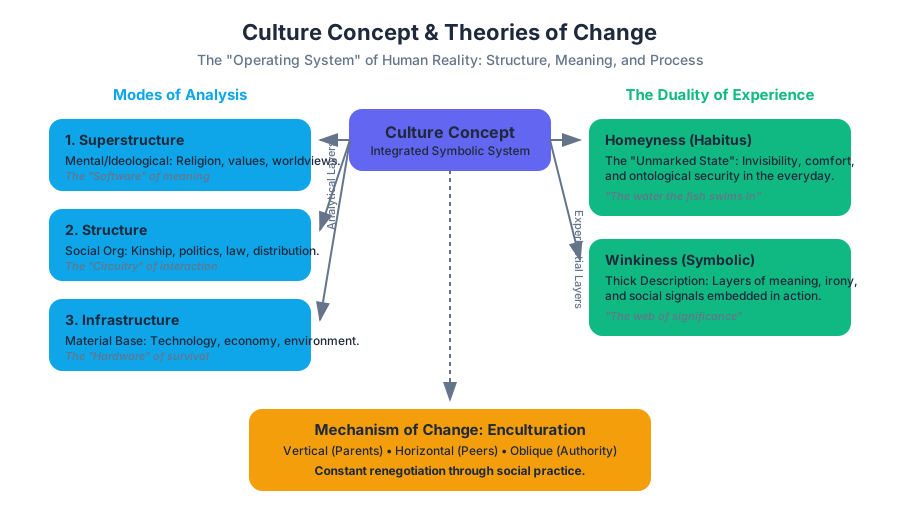
Culture is the primary analytical lens of anthropology, serving as the "operating system" through which human populations process reality, assign meaning, and interact with their environment. Far from being a static collection of traditions, culture is a dynamic, contested, and evolving system of symbols and practices. This section explores the Culture Concept Theory, the nuanced distinction between the Homeyness and Winkiness of culture, and the formal Modes of Analysis used to track cultural transformation over time.
The Culture Concept Theory: A Foundation
The Culture Concept Theory posits that culture is not merely a "thing" people have, but a process people do. It is the integrated system of learned behavior patterns which are characteristic of the members of a society and which are not a result of biological inheritance.
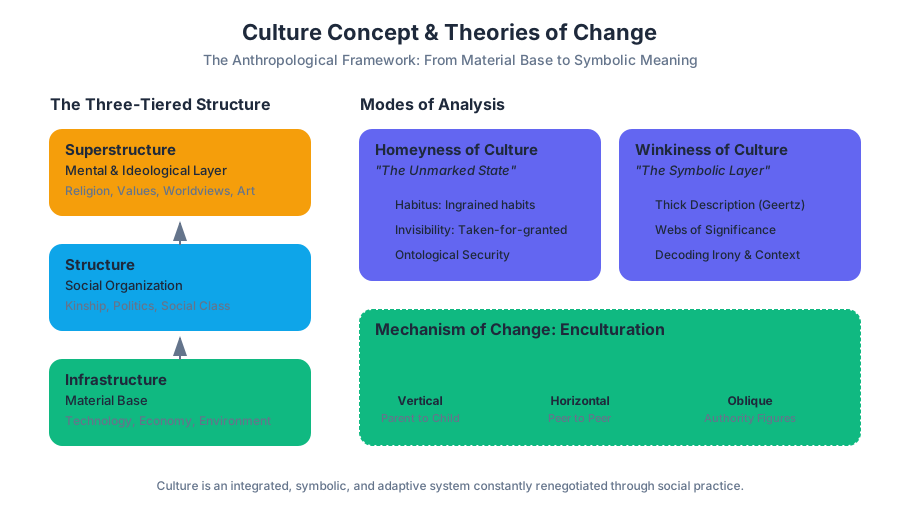
The Anthropological Axiom of Culture: Culture is an integrated, symbolic, and adaptive system of meaning that is shared by a group, transmitted through enculturation, and constantly renegotiated through social practice.
In this framework, culture is analyzed as a three-tiered structure:
- Infrastructure: The material base (technology, economy, environment).
- Structure: The social organization (kinship, political systems).
- Superstructure: The mental/ideological layer (religion, values, worldviews).
The Mechanism of Enculturation
The transmission of culture occurs through enculturation, a process of social learning where an individual internalizes the norms and values of their society. Unlike biological evolution, which relies on genetic inheritance (vertical transmission), cultural evolution can occur horizontally (peer-to-peer) and obliquely (from non-parental authority figures), allowing for much higher rates of change.
The Homeyness of Culture: The Unmarked State
The Homeyness of Culture refers to the "taken-for-granted" quality of everyday life. It is the feeling of comfort, predictability, and "naturalness" that individuals experience within their own cultural milieu. In sociological terms, this is often linked to Pierre Bourdieu’s concept of Habitus—the physical embodiment of cultural capital, consisting of deeply ingrained habits, skills, and dispositions.
Characteristics of Homeyness
- Invisibility: To the insider, homey culture is invisible. It is the "water" that the "fish" (the individual) swims in.
- Ontological Security: It provides a sense of order and continuity, reducing the cognitive load required to navigate social interactions.
- Normative Pressure: Deviations from "homey" behavior often result in visceral discomfort or social friction, even if the rules are not explicitly codified.
| Feature | Description | Example |
|---|---|---|
| Spatiality | The way we organize domestic and public space. | The "right" distance to stand from someone in a queue. |
| Temporality | The shared understanding of time and pace. | Whether "on time" means exactly at the hour or 15 minutes late. |
| Materiality | The emotional resonance of objects. | The specific "feel" of a childhood home or a local dish. |
| Linguistic Ease | The use of idioms and slang without translation. | Using "inside jokes" that require no explanation. |
The Winkiness of Culture: The Symbolic Layer
If homeyness is the background, Winkiness is the foreground. Derived from Clifford Geertz’s seminal essay "Thick Description: Toward an Interpretive Theory of Culture," the Winkiness of Culture refers to the layers of meaning, irony, and symbolism embedded in social action.
The Parable of the Wink
Geertz illustrates this by comparing a "twitch" (a physiological contraction of the eyelid) with a "wink" (a deliberate social signal).
- The Twitch: A biological event with no cultural meaning.
- The Wink: A symbolic gesture communicating a shared secret.
- The Fake Wink: A parody of a wink, adding another layer of complexity.
- The Rehearsed Wink: A practice session for a parody.
To understand the "winkiness" of a culture, an anthropologist must perform Thick Description—an analysis that accounts for the context, intent, and social interpretation of an action, rather than just the physical movement.
Semiotic Analysis of Culture
Culture is a "web of significance" that humans have spun for themselves. Analyzing the winkiness of culture requires decoding these webs.
| Layer of Meaning | Definition | Analytical Focus |
|---|---|---|
| Denotation | The literal meaning or action. | The physical movement of the eye. |
| Connotation | The associated cultural meanings. | The implication of a shared secret or conspiracy. |
| Myth/Ideology | The broader narrative supported by the symbol. | The cultural value placed on subversion or privacy. |
Elements and Aggregates of Culture
Culture is composed of discrete Elements that cluster into larger Aggregates. Understanding these components is essential for modeling cultural change.
Key Elements of Culture
- Values: Abstract standards of what is good, desirable, or correct (e.g., individualism vs. collectivism).
- Beliefs: Specific ideas that people hold to be true (e.g., religious doctrines or scientific theories).
- Norms: Rules and expectations by which a society guides the behavior of its members.
- Mores: Norms with great moral significance (e.g., taboos against incest).
- Folkways: Norms for routine or casual interaction (e.g., greeting styles).
- Symbols: Anything that carries a particular meaning recognized by people who share a culture.
Cultural Aggregates
Aggregates are the larger systems formed by the interaction of elements. These include:
- Subcultures: Cultural patterns that set apart some segment of a society's population (e.g., "hacker culture").
- Countercultures: Cultural patterns that strongly oppose those widely accepted within a society (e.g., the 1960s Hippie movement).
- Cultural Complexes: A group of interrelated cultural traits (e.g., the "car culture" in the US involves roads, laws, status symbols, and mechanical skills).
Modes of Cultural Analysis
Anthropologists use different "modes" or theoretical frameworks to analyze how culture functions and changes. These modes act as different lenses, highlighting different aspects of the human experience.
1. Functionalism
Developed by Bronisław Malinowski, Functionalism suggests that every cultural trait serves a purpose in maintaining the stability of the society or meeting the biological/psychological needs of the individual.
- Example: A ritual dance might function to build social cohesion (social need) or reduce anxiety about a harvest (psychological need).
2. Structuralism
Associated with Claude Lévi-Strauss, Structuralism argues that culture is a reflection of the universal structures of the human mind, particularly the tendency to think in binary oppositions (e.g., Raw vs. Cooked, Nature vs. Culture, Us vs. Them).
3. Cultural Materialism
Marvin Harris’s Cultural Materialism prioritizes the "Infrastructure" (material conditions). It argues that cultural practices are adaptive responses to the environment and resource availability.
- Example: The Hindu taboo against eating cows is explained not just by religion, but by the cow's vital role in agriculture (traction and manure) during times of scarcity.
4. Symbolic/Interpretive Anthropology
As discussed with "Winkiness," this mode (Geertz) focuses on how people interpret their own lives. It views culture as a "text" to be read and interpreted rather than a machine to be measured.
Theories of Cultural Change
Cultures are never static. They are subject to constant internal and external pressures. The following table summarizes the primary mechanisms of change:
| Mechanism | Definition | Driver |
|---|---|---|
| Innovation | The discovery or invention of new cultural elements. | Internal creativity or necessity. |
| Diffusion | The spread of cultural traits from one society to another. | Trade, migration, or communication. |
| Acculturation | The exchange of cultural features when groups have continuous first-hand contact. | Power dynamics, colonization, or globalization. |
| Assimilation | The process by which a minority group adopts the patterns of a dominant culture. | Social pressure or policy. |
| Syncretism | The blending of traits from two or more cultures into a new form. | Creative adaptation (e.g., Santería). |
The Paradoxes of Culture
Cultural change is often characterized by several paradoxes:
- Stability vs. Change: Culture provides the framework for stability, yet it is the primary engine of social change.
- Shared vs. Contested: While culture is "shared," it is also a site of struggle where different groups (classes, genders, ethnicities) fight over the "correct" meaning of symbols.
- Individual vs. Society: Individuals are shaped by culture, yet they are the agents who modify and recreate it.
Technical Implementation: Modeling Cultural Dynamics
In modern computational anthropology, we can model these theories using agent-based simulations or data structures. Below are three distinct ways to represent cultural concepts technically.
1. Low-Level Implementation: The Cultural Agent
This Python snippet demonstrates a basic agent-based model where "Homeyness" is represented as a state of equilibrium and "Winkiness" (Symbolic Interaction) is a function of shared state between agents.
import random

class CulturalAgent:
    def __init__(self, agent_id, values, habitus_threshold=0.8):
        self.agent_id = agent_id
        self.values = values  # Dictionary of cultural traits {trait: weight}
        self.habitus_threshold = habitus_threshold
        self.history = []

    def interact(self, other_agent):
        """
        Simulates a cultural interaction.
        If values are similar, 'Homeyness' is high.
        If values differ, 'Winkiness' (interpretation) is required.
        """
        similarity = self._calculate_similarity(other_agent)

        if similarity >= self.habitus_threshold:
            # Homeyness: Unmarked interaction
            return "Homey: Seamless interaction"
        else:
            # Winkiness: Negotiated meaning
            return self._negotiate_meaning(other_agent, similarity)

    def _calculate_similarity(self, other):
        common = set(self.values.keys()) & set(other.values.keys())
        if not common: return 0
        score = sum(1 - abs(self.values[k] - other.values[k]) for k in common)
        return score / len(common)

    def _negotiate_meaning(self, other, similarity):
        # Acculturation logic: traits might shift slightly
        for trait in self.values:
            if trait in other.values:
                # Move values closer together based on interaction
                self.values[trait] += (other.values[trait] - self.values[trait]) * 0.05
        return f"Winky: Meaning negotiated (Similarity: {similarity:.2f})"

# Example Usage
a1 = CulturalAgent(1, {"individualism": 0.9, "punctuality": 0.8})
a2 = CulturalAgent(2, {"individualism": 0.2, "punctuality": 0.9})
print(a1.interact(a2))
2. Mathematical Derivation: Cultural Diffusion Rate
The spread of a cultural trait (Innovation Diffusion) can be modeled using a variation of the Bass Diffusion Model. Let $N(t)$ be the number of adopters at time $t$.
The Cultural Diffusion Equation: $$\frac{dN(t)}{dt} = \left( p + q \frac{N(t)}{M} \right) [M - N(t)]$$
Where:
- $M$ = Total potential population (market/society size)
- $p$ = Coefficient of Innovation (external influence/media)
- $q$ = Coefficient of Imitation (internal diffusion/word-of-mouth)
- $N(t)$ = Cumulative number of adopters at time $t$
This formula shows that cultural change is non-linear. Early adoption is driven by $p$ (the "Winkiness" of the new trait being noticed), while mass adoption is driven by $q$ (the trait becoming part of the "Homeyness" or background).
3. Real-World Usage: Ethnographic Metadata Schema
In digital humanities, we often use YAML or JSON-LD to categorize cultural elements for cross-cultural comparison (e.g., the Human Relations Area Files - HRAF).
# cultural_trait_schema.yaml
culture_id: "HRAF_AA1"
group_name: "Standard Cross-Cultural Sample"
elements:
  - trait: "Matrilineal Descent"
    type: "Structure"
    stability_index: 0.85
    description: "Descent traced through the female line."
  - trait: "Gift Exchange"
    type: "Infrastructure/Economy"
    mode: "Reciprocity"
    symbolic_value: "High"
    winkiness_notes: "Often involves competitive potlatching to establish status."
change_vectors:
  - source: "Globalization"
    impact: "High"
    mechanism: "Acculturation"
    observed_shifts: ["Shift to wage labor", "Nuclear family adoption"]
Common Pitfalls in Cultural Analysis
- Essentialism: Treating a culture as a fixed, unchanging "essence" shared by everyone in a group. In reality, culture is diverse and internally contested.
- Ethnocentrism: Evaluating another culture based on the standards of one's own. This obscures the "Homeyness" of the other group.
- The "Primitive" Fallacy: Assuming that cultures with less technology are "simpler" or represent an earlier stage of human evolution. All living cultures are equally "modern" in their complexity.
- Over-Interpretation: Seeing "Winkiness" where there is only a "Twitch." Not every action is a deep symbolic statement; sometimes people just do things for convenience.
Biological Evolution and Early Human Evidence
Key concepts: Evolutionary Theory · Taxonomy · Genetics · Primatology · Hominin Origins
Examines the scientific principles of evolution, genetics, and the fossil record of early hominins.
Biological Evolution and Early Human Evidence
Biological anthropology—also known as physical anthropology—is the scientific discipline concerned with the biological and behavioral aspects of human beings, their related non-human primates, and their extinct hominin ancestors. It is a field that bridges the gap between the natural sciences and the social sciences, utilizing the rigorous frameworks of genetics, paleontology, and evolutionary biology to answer the fundamental question: How did we become human?
This article explores the mechanisms of biological evolution, the systematic classification of life, the genetic foundations of inheritance, and the fossil evidence that traces our lineage back to the earliest hominins.
Evolutionary Theory: The Engine of Change
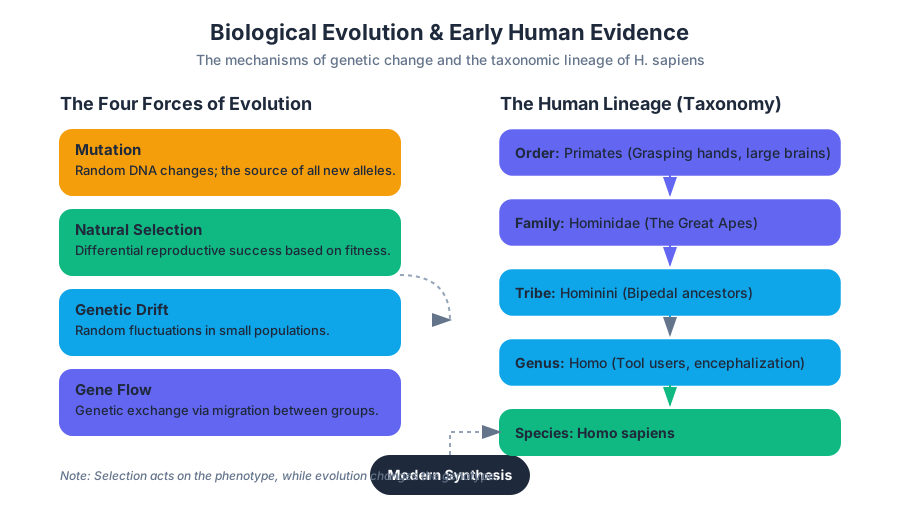
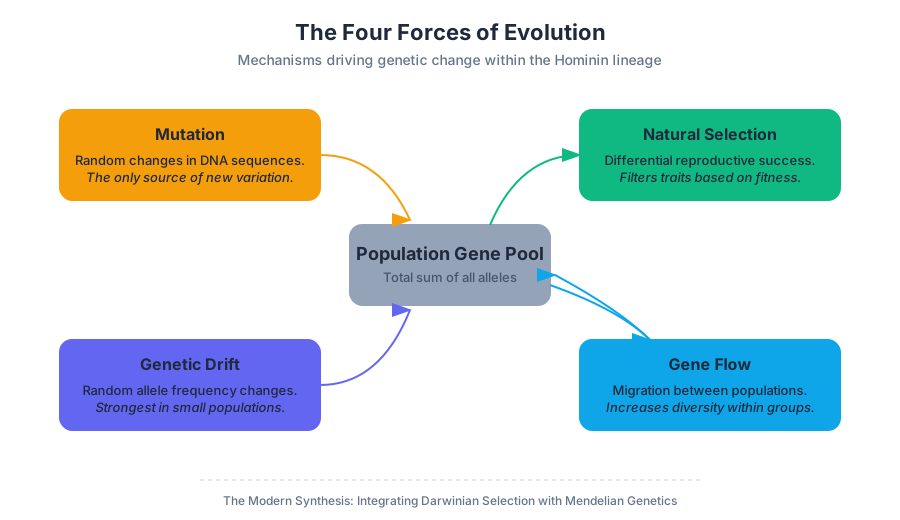
Evolution is the change in the heritable characteristics of biological populations over successive generations. While Charles Darwin and Alfred Russel Wallace are credited with the theory of Natural Selection, the modern understanding—often called the Modern Synthesis—integrates Darwinian selection with Mendelian genetics and population biology.
The Four Forces of Evolution
To understand how populations evolve, we must analyze the four primary mechanisms that alter allele frequencies within a gene pool.
| Force | Mechanism | Impact on Genetic Diversity |
|---|---|---|
| Mutation | Random changes in the DNA sequence. | Increases diversity; the only source of new alleles. |
| Natural Selection | Differential reproductive success based on heritable traits. | Generally decreases diversity by filtering "unfit" traits. |
| Genetic Drift | Random fluctuations in allele frequencies, especially in small populations. | Decreases diversity; can lead to the loss of rare alleles. |
| Gene Flow | The transfer of genetic material between populations (migration). | Increases diversity within a population; decreases differences between populations. |
Natural Selection and Fitness
Selection operates on the phenotype (the physical expression of traits) but changes the genotype (the underlying genetic makeup). Biological Fitness ($w$) is a measure of an individual's ability to survive and reproduce.
The Principle of Natural Selection: If a population has variation, if that variation is heritable, and if there is differential reproductive success, then the frequency of advantageous traits will increase over time.
Genetics: The Molecular Blueprint
The study of evolution is, at its core, the study of genetics. Genetics provides the "how" behind the "what" of physical change.
Mendelian vs. Population Genetics
Gregor Mendel’s work established the laws of inheritance: Segregation (alleles separate during gamete formation) and Independent Assortment (genes for different traits are inherited independently). Modern biological anthropology scales this up to Population Genetics, which examines the distribution of alleles across entire groups.
The Hardy-Weinberg Equilibrium
The Hardy-Weinberg Principle serves as a null hypothesis for evolutionary change. It states that allele and genotype frequencies in a population will remain constant from generation to generation in the absence of evolutionary influences.
The mathematical representation is: $$p^2 + 2pq + q^2 = 1$$ Where $p$ is the frequency of the dominant allele and $q$ is the frequency of the recessive allele.
Below is a Python implementation of a Wright-Fisher model, a stochastic simulation used to demonstrate how genetic drift affects allele frequencies in finite populations over time.
import numpy as np

def simulate_genetic_drift(pop_size, initial_p, generations):
    """
    Simulates the Wright-Fisher model for genetic drift.
    pop_size: Number of individuals (2N alleles)
    initial_p: Starting frequency of allele A
    generations: Number of generations to simulate
    """
    p_history = [initial_p]
    current_p = initial_p
    num_alleles = 2 * pop_size

    for _ in range(generations):
        # The number of 'A' alleles in the next generation is drawn
        # from a Binomial distribution based on the current frequency.
        successes = np.random.binomial(num_alleles, current_p)
        current_p = successes / num_alleles
        p_history.append(current_p)

        # Fixation or Loss
        if current_p == 0 or current_p == 1:
            break

    return p_history

# Example usage: 100 individuals, starting p=0.5, for 200 generations
history = simulate_genetic_drift(100, 0.5, 200)
print(f"Final allele frequency: {history[-1]}")
Taxonomy: The Science of Classification
Taxonomy is the branch of science concerned with classification, especially of organisms. In biological anthropology, we use Cladistics, a method of classification according to the proportion of measurable characteristics that they have in common.
Linnaean Hierarchy and Phylogenetics
While Carl Linnaeus created the hierarchical system (Kingdom, Phylum, Class, Order, Family, Genus, Species), modern anthropologists focus on Phylogeny—the evolutionary history of a species.
| Rank | Human Classification | Significance |
|---|---|---|
| Order | Primates | Grasping hands, forward-facing eyes, large brains. |
| Suborder | Haplorrhini | "Dry-nosed" primates; includes tarsiers, monkeys, apes. |
| Family | Hominidae | The "Great Apes"; includes orangutans, gorillas, chimps, humans. |
| Tribe | Hominini | Humans and our extinct bipedal ancestors. |
| Genus | Homo | Large-brained, tool-using bipeds. |
| Species | Homo sapiens | Modern humans. |
Cladograms and Derived Traits
In cladistics, we distinguish between Ancestral Traits (shared with a distant ancestor) and Derived Traits (newly evolved traits not present in the ancestor). For example, five fingers is an ancestral trait for primates, while bipedalism is a derived trait for hominins.
Primatology: Our Living Relatives
Primatology is the study of non-human primates. By studying chimpanzees, bonobos, gorillas, and lemurs, anthropologists can infer the behaviors and biological constraints of our shared ancestors.
Primate Characteristics
Primates are defined by a suite of adaptations, many of which evolved for an arboreal (tree-dwelling) lifestyle:
- Generalized Skeletal Structure: Retention of the clavicle (collarbone) for high shoulder mobility.
- Enhanced Vision: Binocular, stereoscopic vision with color perception.
- Reduced Olfaction: A smaller snout and decreased reliance on smell.
- Opposable Thumbs and Big Toes: For powerful grasping (prehensile) capabilities.
- Encephalization: A high brain-to-body mass ratio, particularly in the neocortex.
The Primate Divide: Strepsirrhini vs. Haplorrhini
The primate order is split into two major suborders based on nasal morphology and evolutionary history.
| Feature | Strepsirrhini (e.g., Lemurs, Lorises) | Haplorrhini (e.g., Monkeys, Apes, Humans) |
|---|---|---|
| Nose | Wet (Rhinarium) | Dry |
| Activity Pattern | Mostly Nocturnal | Mostly Diurnal |
| Brain Size | Smaller relative to body | Larger relative to body |
| Vitamin C | Can synthesize internally | Must consume via diet |
| Post-orbital Closure | Open (Post-orbital bar only) | Closed (Post-orbital plate) |
Insight: The transition from Strepsirrhini to Haplorrhini represents an evolutionary shift from a reliance on scent and night-vision to a reliance on complex social interaction and high-acuity daytime vision.
Hominin Origins: The Path to Bipedalism
The term Hominin refers to the group consisting of modern humans, extinct human species, and all our immediate ancestors (including members of the genera Homo, Australopithecus, Paranthropus, and Ardipithecus).
The Fossil Evidence of Bipedalism
The defining characteristic of the hominin lineage is obligate bipedalism (walking on two legs as the primary mode of locomotion). This shift required massive anatomical reorganization.
- Foramen Magnum: The hole at the base of the skull moves forward to sit directly atop the spine.
- S-Shaped Spinal Curvature: Acts as a shock absorber for upright weight.
- Pelvis Shape: Becomes shorter and broader (bowl-shaped) to support internal organs and provide attachment for gluteal muscles.
- Valgus Angle: The femur angles inward from the hip to the knee, keeping the center of gravity over the feet.
- Non-opposable Hallux: The big toe aligns with other toes to provide a "toe-off" lever during walking.
Early Hominin Candidates
The "missing link" is a misnomer; rather, the fossil record shows a "bushy" tree of evolution with many co-existing species.
- Sahelanthropus tchadensis (~7–6 mya): Found in Chad; possesses a surprisingly flat face and a forward-positioned foramen magnum.
- Orrorin tugenensis (~6 mya): Found in Kenya; femur morphology suggests bipedalism.
- Ardipithecus ramidus (~4.4 mya): "Ardi" shows a mosaic of traits—bipedal on the ground but possessed a grasping big toe for climbing.
The following LaTeX block derives the Selection Coefficient ($s$), which quantifies the intensity of selection against a specific phenotype, a critical calculation when analyzing how early hominin traits (like bipedalism) might have been favored.
% Derivation of Selection Coefficient (s)
% Let w_11, w_12, w_22 be the fitness of genotypes AA, Aa, and aa.
% If 'aa' is the deleterious phenotype:
w_11 = 1
w_12 = 1
w_22 = 1 - s

% The average fitness of the population (w_bar) is:
\bar{w} = p^2(1) + 2pq(1) + q^2(1 - s)
\bar{w} = 1 - sq^2

% The frequency of the 'a' allele in the next generation (q') is:
q' = \frac{pq + q^2(1 - s)}{1 - sq^2}
q' = \frac{q(1 - sq)}{1 - sq^2}

% The change in allele frequency (delta q) is:
\Delta q = q' - q = \frac{-spq^2}{1 - sq^2}
Evolution in Action: Case Studies
Evolution is not just a historical process; it is observable in the present.
Sickle Cell Anemia and Malaria
This is a classic example of Balanced Polymorphism and Heterozygote Advantage.
- Genotype SS: Normal hemoglobin, but susceptible to Malaria.
- Genotype ss: Sickle cell anemia (often fatal without treatment).
- Genotype Ss: "Sickle cell trait." These individuals do not have severe anemia and are resistant to Malaria.
In regions where Malaria is endemic, the
sallele is maintained in the population because the heterozygote (Ss) has the highest fitness.
Genomic Analysis
With the advent of Next-Generation Sequencing (NGS), we can now compare the entire genomes of humans and extinct relatives like Neanderthals and Denisovans.
To compare genetic sequences in a research environment, scientists often use command-line tools like blast or samtools. Below is a conceptual example of using a shell script to identify SNPs (Single Nucleotide Polymorphisms) between a sample and a reference genome.
#!/bin/bash
# A simplified pipeline for identifying genetic variants

REFERENCE="human_g1k_v37.fasta"
SAMPLE_BAM="early_hominin_sample.bam"
OUTPUT_VCF="variants.vcf"

echo "Starting Variant Calling Pipeline..."

# 1. Index the reference genome
samtools faidx $REFERENCE

# 2. Generate genotype likelihoods
bcftools mpileup -f $REFERENCE $SAMPLE_BAM | \
# 3. Call variants (SNPs and Indels)
bcftools call -mv -Ob -o calls.bcf

# 4. Convert to human-readable VCF format
bcftools view calls.bcf > $OUTPUT_VCF

echo "Analysis complete. Results saved to $OUTPUT_VCF."
Common Pitfalls and Misconceptions
- "Evolution is just a theory": In science, a theory is a well-substantiated explanation of some aspect of the natural world. It is not a "guess."
- The "March of Progress": Evolution is not a linear ladder leading to humans. It is a branching tree. Many hominin species went extinct without leaving descendants.
- Survival of the Fittest: This does not mean "survival of the strongest." It means survival of those best suited to their immediate environment who manage to reproduce.
- Teleology: Evolution has no goal. Humans are not the "intended" outcome of evolution; we are simply one surviving branch of a complex biological history.
The Genus Homo and the Emergence of Modern Humans
Key concepts: Homo habilis · Homo erectus · Archaic Homo · Genomics · Tool Technology
Traces the transition from early hominins to the genus Homo, focusing on brain development, tool use, and genomics.
The Genus Homo and the Emergence of Modern Humans
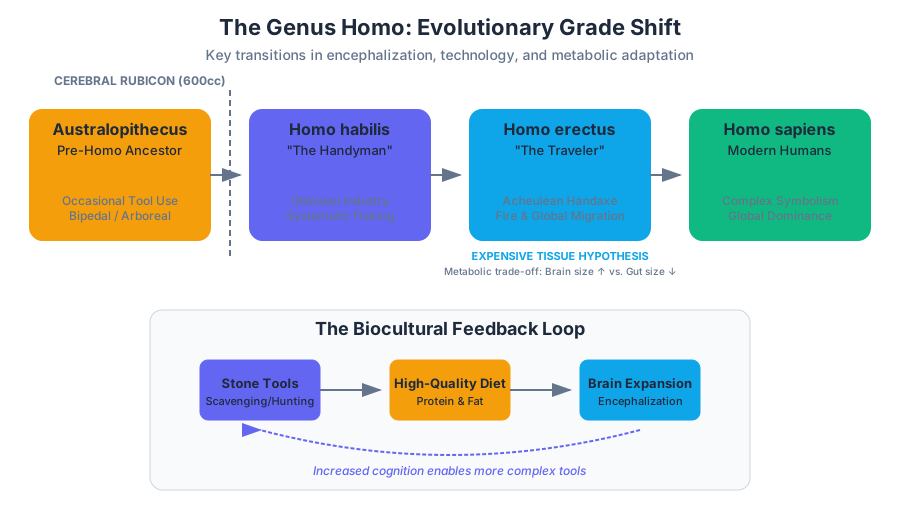
The transition from the late Pliocene to the Pleistocene marked a fundamental shift in hominin evolution. While earlier ancestors like Australopithecus exhibited bipedalism, the emergence of the genus Homo represents a "grade shift" characterized by significant encephalization (brain size increase), the systematic manufacture of stone tools, and eventually, the colonization of diverse global environments. This section explores the lineage from the earliest "handy" ancestors to the complex genomic tapestry of modern Homo sapiens.
Defining the Genus Homo
The classification of the genus Homo is traditionally based on the "Leakey criteria," which emphasize brain size, manual dexterity, and dental morphology. However, modern paleoanthropology recognizes that these traits did not emerge simultaneously. Instead, we observe a mosaic evolution where different systems—locomotor, masticatory, and neurological—evolved at different rates.
Definition: The Genus Homo A taxonomic group characterized by a significant increase in cranial capacity (typically >600 cc), a reduction in the size of the masticatory apparatus (teeth and jaws), the presence of a precision grip, and a reliance on cultural adaptations, specifically stone tool technology.
The "Cerebral Rubicon"
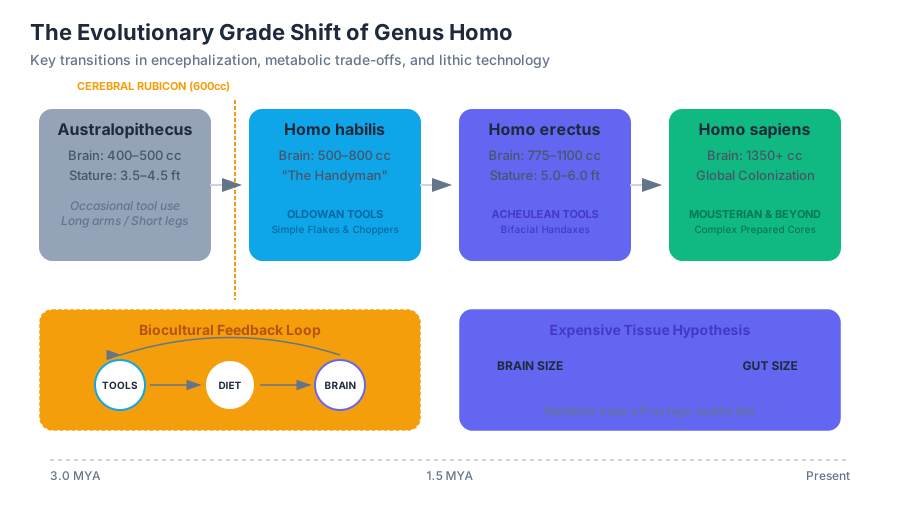
Historically, Sir Arthur Keith proposed a "Cerebral Rubicon" of 750 cc as the dividing line between apes/australopithecines and humans. This was later lowered to 600 cc by Louis Leakey to accommodate Homo habilis. Today, we view this transition through the lens of the Encephalization Quotient (EQ), a ratio of actual brain size to expected brain size for a mammal of a given body mass.
| Feature | Australopithecus | Early Homo (H. habilis) | Homo erectus |
|---|---|---|---|
| Cranial Capacity | 400–500 cc | 500–800 cc | 775–1,100 cc |
| Dentition | Large molars, thick enamel | Reduced molars, parabolic arch | Small molars, modern arch |
| Stature | 3.5–4.5 ft | 3.5–4.5 ft | 5.0–6.0 ft |
| Tool Use | Occasional/Opportunistic | Systematic (Oldowan) | Advanced (Acheulean) |
| Postcrania | Long arms, short legs | Transitionary | Modern human proportions |
Homo habilis: The First "Handyman"
Appearing approximately 2.4 million years ago (mya), Homo habilis is the earliest widely recognized member of our genus. Found primarily in Olduvai Gorge (Tanzania) and Koobi Fora (Kenya), H. habilis represents the bridge between the small-brained australopithecines and the more robust Homo erectus.
The Biocultural Feedback Loop
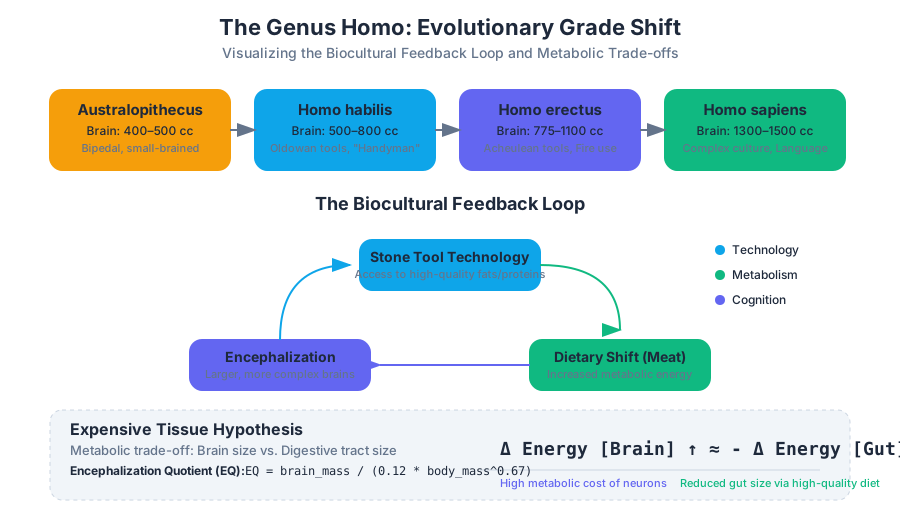
The emergence of H. habilis is the first clear example of the Biocultural Feedback Loop. This theory posits that cultural innovations (like stone tools) allowed for a higher-protein diet (meat scavenging), which provided the metabolic energy required to grow and maintain a larger, more complex brain. A larger brain, in turn, allowed for more sophisticated tool manufacture and social organization.
To quantify this relationship, we can model the Encephalization Quotient (EQ) using the following Python implementation, which compares various hominin species based on body mass and brain volume.
import math

def calculate_eq(brain_mass_g, body_mass_kg):
    """
    Calculates the Encephalization Quotient (EQ) using Jerison's formula:
    EQ = brain_mass / (0.12 * body_mass^0.67)
    """
    expected_brain_mass = 0.12 * math.pow(body_mass_kg * 1000, 0.67)
    return brain_mass_g / expected_brain_mass

# Hominin Data: (Name, Brain Mass in g, Body Mass in kg)
hominins = [
    ("A. afarensis", 450, 37),
    ("H. habilis", 610, 32),
    ("H. erectus", 950, 58),
    ("H. sapiens", 1350, 62)
]

print(f"{'Species':<15} | {'Brain (g)':<10} | {'Body (kg)':<10} | {'EQ':<5}")
print("-" * 50)

for name, brain, body in hominins:
    eq = calculate_eq(brain, body)
    print(f"{name:<15} | {brain:<10} | {body:<10} | {eq:.2f}")
Homo erectus and the Acheulean Revolution
Around 1.9 mya, Homo erectus (or Homo ergaster in Africa) appeared, marking a radical departure from previous forms. H. erectus was the first hominin to possess modern human-like body proportions, with elongated legs and shorter arms—an adaptation for long-distance trekking and persistence hunting in open savannahs.
The Expensive Tissue Hypothesis
A critical question in human evolution is how we afforded the metabolic cost of a large brain. The Expensive Tissue Hypothesis, proposed by Aiello and Wheeler, suggests a trade-off: as brain size increased, the size of the digestive tract (another metabolically "expensive" tissue) decreased. This was only possible through the consumption of high-quality, easily digestible foods, likely facilitated by the use of fire and advanced stone tools.
The metabolic scaling can be represented by the following derivation:
\text{Total Metabolic Rate (TMR)} = \sum (\text{Mass of Organ}_i \times \text{Specific Metabolic Rate}_i)

\text{In H. erectus:}
\Delta \text{Energy}_{\text{Brain}} \approx - \Delta \text{Energy}_{\text{Gut}}
Acheulean Technology
While H. habilis used the Oldowan industry (simple flakes and choppers), H. erectus developed the Acheulean industry. The hallmark of this industry is the Bifacial Handaxe, a multi-purpose tool shaped on both sides to create a sharp, durable edge. This required a "mental template"—the ability of the knapper to visualize the finished tool within the raw stone.
| Industry | Period | Key Tool | Technique | Cognitive Requirement |
|---|---|---|---|---|
| Oldowan | 2.6–1.7 mya | Chopper, Flake | Hard hammer percussion | Basic motor skills |
| Acheulean | 1.7 mya – 200 kya | Handaxe, Cleaver | Soft hammer (bone/antler) | Mental template, symmetry |
| Mousterian | 250–40 kya | Levallois points | Prepared core | Abstract planning, multi-step |
Archaic Homo and the Neanderthal Lineage
Between 600,000 and 200,000 years ago, a group of hominins often referred to as Archaic Homo sapiens (or Homo heidelbergensis) bridged the gap between H. erectus and modern humans. These populations moved into Europe and Asia, eventually diverging into Neanderthals (Homo neanderthalensis) in the West and Denisovans in the East.
Neanderthal Adaptations
Neanderthals were not the "brutes" of popular myth but highly sophisticated survivors of Ice Age Europe. Their anatomy reflects cold-weather adaptations:
- Stocky build: Reduced surface area to volume ratio to retain heat (Bergmann’s Rule).
- Large nasal cavity: To warm and humidify cold air.
- Large cranial capacity: Often exceeding the modern human average (1450 cc vs 1350 cc), though organized differently.
Genomics: Tracking the Human Story
The most significant recent advancement in understanding our emergence is Paleogenomics—the study of ancient DNA (aDNA). By sequencing the genomes of Neanderthals and Denisovans, scientists have discovered that the "Out of Africa" model was not a simple replacement, but a "Leaky Replacement."
Key Insight: Admixture Modern non-African populations carry approximately 1.5% to 2.1% Neanderthal DNA, while some Melanesian and East Asian populations carry up to 5% Denisovan DNA. This proves that archaic and modern humans interbred.
The Bioinformatics of Ancestry
To identify these archaic segments, researchers use statistical tools to look for "Introgressed Haplotypes." Below is a conceptual example of how a researcher might use a command-line tool like bcftools to filter variants that are shared between a Neanderthal reference and a modern human sample, but absent in a reference African population (who did not encounter Neanderthals).
# Filter for variants where the Neanderthal (VIN) and Modern Human (EUA)
# share an allele, but the Yoruba (YRI) reference has the ancestral allele.

bcftools view -h project_genotypes.vcf.gz | grep '##INFO'
bcftools filter -i 'GT[VIN]=="1/1" && GT[EUA]=="0/1" && GT[YRI]=="0/0"' \
    project_genotypes.vcf.gz -o introgressed_variants.vcf

# Calculate the D-statistic (ABBA-BABA test) to quantify gene flow
# This is typically done in R or Python using the filtered VCF.
python calculate_d_stat.py --vcf introgressed_variants.vcf --p1 YRI --p2 EUA --p3 VIN --outgroup CHIMP
The Emergence of Modern Homo sapiens
Homo sapiens emerged in Africa approximately 300,000 years ago (based on the Jebel Irhoud finds in Morocco). While early H. sapiens looked anatomically modern, "Behavioral Modernity" (the use of art, symbolic thought, and complex social networks) appears to have flourished later, around 50,000 to 100,000 years ago.
Characteristics of Modernity
- Anatomical: High, vertical forehead; small or absent brow ridges; a prominent chin (mental eminence); and a more gracile skeleton.
- Behavioral: The "Great Leap Forward" characterized by:
- Blade Technology: Producing long, thin flakes (blades) that are more efficient than flakes.
- Composite Tools: Spear-throwers (atlatls) and bows.
- Symbolism: Cave paintings (Lascaux, Chauvet), figurines (Venus statues), and intentional burials with grave goods.
Common Pitfalls in Understanding Human Evolution
- The "Ladder" Fallacy: Evolution is not a linear progression from "primitive" to "advanced." It is a branching bush where multiple species often coexisted (e.g., H. sapiens, H. neanderthalensis, H. floresiensis, and H. luzonensis all lived within the last 100,000 years).
- Brain Size vs. Intelligence: While brain size increased, organization and connectivity are equally important. Neanderthals had larger brains, but H. sapiens developed more expanded parietal and temporal lobes, associated with language and social networking.
Summary of Evolutionary Milestones
| Milestone | Approximate Date | Significance |
|---|---|---|
| First Homo | 2.4–2.8 mya | Transition from Australopithecine morphology; first tools. |
| Out of Africa I | 1.8 mya | H. erectus migrates to Dmanisi (Georgia) and Java. |
| Controlled Fire | ~1.0–0.4 mya | Cooking increases nutrient availability; social hearths. |
| Speciation of H. sapiens | 300 kya | Anatomical modernity emerges in Africa. |
| The Toba Supereruption | 74 kya | Potential genetic bottleneck for modern humans. |
| Out of Africa II | 60–90 kya | Major migration of modern humans into Eurasia. |
Language and Communication
Key concepts: Linguistic Relativity · Performativity · Sociolinguistics · Power Dynamics · High and Low Contexts
Investigates the relationship between human communication, cultural identity, and social power dynamics.
Language and Communication
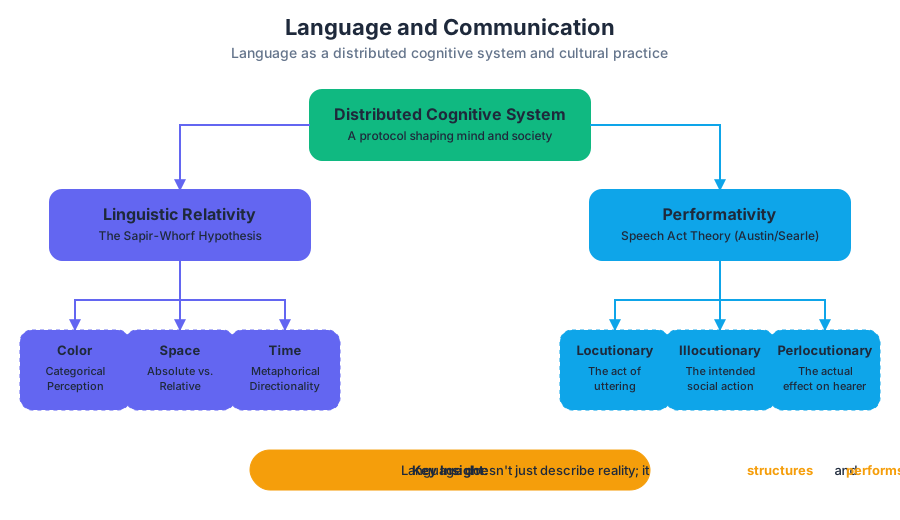
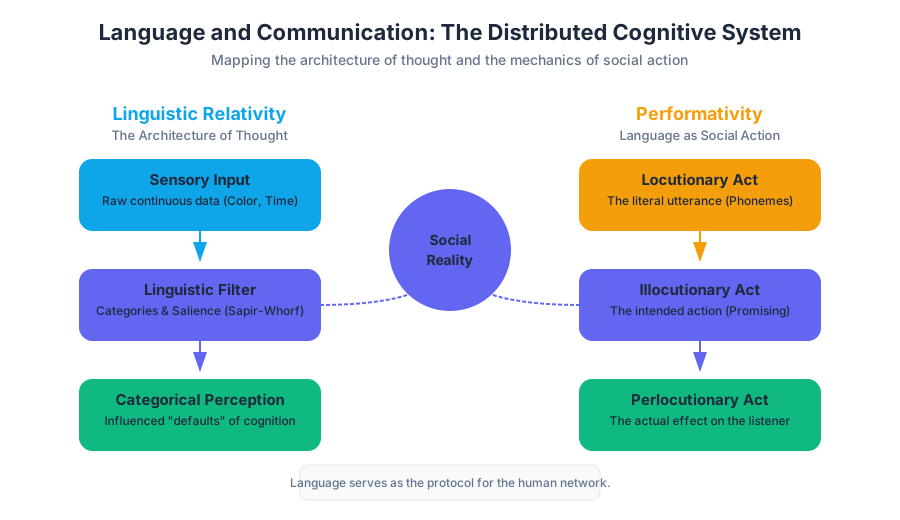
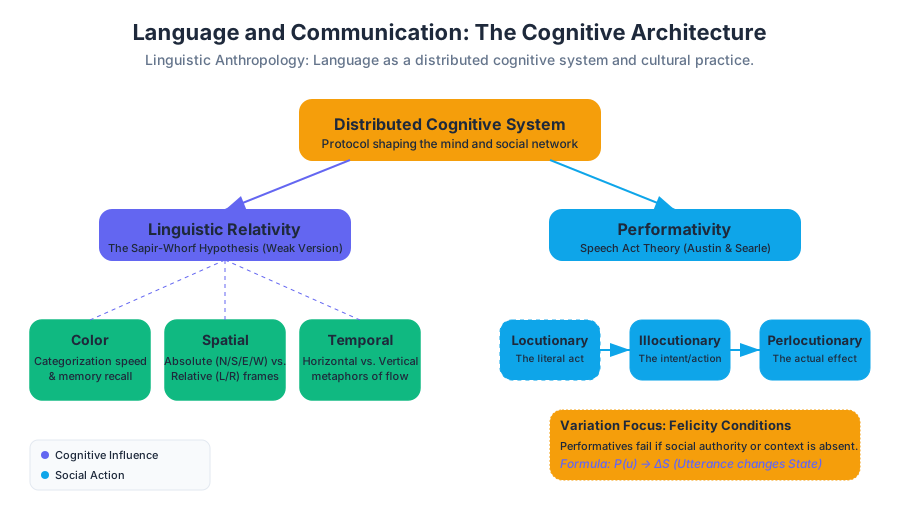
Linguistic anthropology is the interdisciplinary study of how language influences social life. It is not merely the study of grammar or vocabulary in isolation; rather, it is the investigation of language as a cultural resource and speaking as a cultural practice. In the "DeepWiki" framework, we treat language as a distributed cognitive system—a protocol that does not just transmit data but actively shapes the architecture of the processor (the human mind) and the network (society).
Linguistic Relativity: The Architecture of Thought
Linguistic Relativity, often referred to as the Sapir-Whorf Hypothesis, posits that the structure of a language affects its speakers' worldviews or cognition. This concept is frequently misunderstood as "linguistic determinism" (the idea that language limits what we can think), but modern anthropology favors a "weak" version: language influences thought by making certain categories more salient.
The Boas-Sapir-Whorf Lineage
The theory emerged from the work of Franz Boas, who noted that cultural experiences were categorized by language. His student, Edward Sapir, argued that language is a "guide to social reality." Benjamin Lee Whorf, a chemical engineer and linguist, extended this by comparing SAE (Standard Average European) languages with Indigenous languages like Hopi.
The Principle of Linguistic Relativity: No two languages are ever sufficiently similar to be considered as representing the same social reality. The worlds in which different societies live are distinct worlds, not merely the same world with different labels attached.
Empirical Dimensions of Relativity
To understand how this works in practice, we look at three primary domains:
- Color Perception: Languages with fewer color terms (e.g., Dani of New Guinea, which has only "light" and "dark") do not prevent speakers from seeing colors, but they do affect the speed of categorization and memory recall.
- Spatial Orientation: Some languages (like Guugu Yimithirr) use Absolute Frame of Reference (North, South, East, West) instead of Relative Frame of Reference (Left, Right, Front, Back). Speakers of these languages possess an internal "dead reckoning" compass that is functionally superior to those using relative systems.
- Temporal Conceptualization: English speakers often view time as a horizontal line (moving forward/backward), whereas Mandarin speakers may utilize vertical metaphors (up/down) for earlier/later events.
| Feature | Strong Determinism (Hard) | Weak Relativity (Soft) |
|---|---|---|
| Cognitive Constraint | Language dictates the limits of thought. | Language influences cognitive "defaults." |
| Translation | True translation is impossible. | Translation is difficult but achievable via circumlocution. |
| Scientific Standing | Largely discredited in its extreme form. | Widely accepted in cognitive linguistics. |
| Example | If a language has no word for "blue," the speaker cannot see blue. | If a language has no word for "blue," the speaker may group it with "green" in memory tasks. |
Implementation: Simulating Categorical Perception
In the following Python example, we simulate how a linguistic boundary (a "label") can influence the clustering of raw sensory data (RGB values), effectively "training" a model to perceive differences based on linguistic categories.
import numpy as np
from sklearn.cluster import KMeans

def simulate_linguistic_influence(colors_rgb, language_labels=None):
    """
    Simulates how linguistic categories influence the perception/clustering
    of a continuous color space.
    """
    # Standardize input
    data = np.array(colors_rgb)

    if language_labels is None:
        # "Universal" perception: pure K-means based on Euclidean distance
        model = KMeans(n_clusters=3, n_init=10)
        clusters = model.fit_predict(data)
    else:
        # "Linguistic" perception: Bias the distance metric by the label
        # We augment the feature vector with a weighted linguistic dimension
        bias_factor = 100.0
        augmented_data = np.hstack((data, np.array(language_labels).reshape(-1, 1) * bias_factor))
        model = KMeans(n_clusters=len(np.unique(language_labels)), n_init=10)
        clusters = model.fit_predict(augmented_data)

    return clusters

# Example: A spectrum of 10 colors from Green to Blue
color_spectrum = [[0, 255, i] for i in range(0, 255, 25)]
# Language A treats them all as 'Grue' (Label 0)
# Language B splits them at the 128 mark (Label 0 and 1)
lang_b_labels = [0, 0, 0, 0, 0, 1, 1, 1, 1, 1]

perception_a = simulate_linguistic_influence(color_spectrum)
perception_b = simulate_linguistic_influence(color_spectrum, lang_b_labels)

print(f"Perception A (No labels): {perception_a}")
print(f"Perception B (Linguistic split): {perception_b}")
Performativity: Language as Action
In classical linguistics, language was viewed as constative—it describes a state of affairs. However, J.L. Austin and later John Searle introduced the concept of Speech Act Theory, arguing that many utterances do not describe reality; they perform it.
The Taxonomy of Speech Acts
Austin identified three layers of a speech act:
- Locutionary Act: The literal act of saying something (the phonemes and syntax).
- Illocutionary Act: The intended action (e.g., promising, ordering, baptizing).
- Perlocutionary Act: The actual effect on the listener (e.g., the listener feels persuaded or frightened).
Felicity Conditions
For a performative utterance to "work," it must meet certain felicity conditions. If a random person walks up to you and says, "I declare you under arrest," the act fails because the speaker lacks the social authority. Performativity is thus inherently tied to social structure.
The Performative Formula: $P(u) \rightarrow \Delta S$ Where an utterance $u$ under specific social conditions $C$ results in a change in social state $\Delta S$.
Formal Logic of Performative Utterances
We can represent the "success" of a performative act using a logic-gate style derivation.
LET U = Utterance
LET S = Speaker
LET A = Authority/Context
LET R = Result (Social State Change)

IF (U is "I do") AND (S is in Marriage Ceremony) AND (A is Valid Officiant):
    THEN R = MARRIED
ELSE:
    THEN R = NULL (Misfire)

DERIVATION:
1. Locution(U) = "I do"
2. Illocution(U) = Commitment to Contract
3. IF Context(A) == VALID:
      Perlocution(U) = Legal Union
   ELSE:
      Perlocution(U) = Confusion/Void
Sociolinguistics and Power Dynamics
Sociolinguistics examines the relationship between language and social variables like class, gender, ethnicity, and age. It posits that language is a tool for navigating Power Dynamics.
Linguistic Capital and Symbolic Violence
Pierre Bourdieu introduced the concept of Linguistic Capital. In any society, there is a "standard" dialect (often the dialect of the ruling class). Proficiency in this dialect acts as capital that can be traded for jobs, status, and education. Conversely, those who speak non-standard dialects (e.g., AAVE, Cockney, Appalachian English) face Symbolic Violence—the internalized feeling that their natural way of speaking is "incorrect" or "inferior."
Code-Switching
Code-switching is the practice of alternating between two or more languages or varieties of language in conversation. This is often a survival strategy or a tool for identity negotiation.
- Situational Code-Switching: Changing language based on the setting (e.g., Spanish at home, English at work).
- Metaphorical Code-Switching: Changing language to change the "tone" or "authority" of a statement within a single conversation.
| Concept | Definition | Example |
|---|---|---|
| Diglossia | Two languages/dialects existing side-by-side with distinct social functions. | High German (formal) vs. Swiss German (informal). |
| Prestige Dialect | The variety of a language associated with high social status. | "Received Pronunciation" in the UK. |
| Language Ideology | Beliefs about a language that justify social hierarchies. | The belief that "slang" indicates a lack of intelligence. |
| Hypercorrection | Over-applying a grammatical rule to appear higher class. | Using "between you and I" instead of "between you and me." |
High and Low Context Communication
Developed by Edward T. Hall, this framework explains how information is encoded in communication across different cultures. This is critical for Intercultural Communication and global systems design.
Low Context (LC) Communication
In LC cultures (e.g., Germany, USA, Scandinavia), the mass of information is vested in the explicit code. Communication must be precise, direct, and transparent.
- Logic: Linear, cause-and-effect.
- Responsibility: The sender is responsible for the message being understood.
- Contracts: Highly detailed; "the word is the bond."
High Context (HC) Communication
In HC cultures (e.g., Japan, China, Arab nations, many Indigenous cultures), most of the information is either in the physical context or internalized in the person. Very little is in the explicit, transmitted part of the message.
- Logic: Spiral, holistic.
- Responsibility: The receiver is responsible for "reading the air" (Japanese: Kuuki wo yomu).
- Contracts: Based on relationships and trust; the written word is secondary to the intent.
The "Winkiness" of Culture
Anthropologist Clifford Geertz used the example of a "wink" to explain context. A physical contraction of the eyelid (the thin description) could be a twitch, a flirtatious signal, or a conspiratorial sign (the thick description). Understanding the difference requires deep cultural context.
| Dimension | Low Context (LC) | High Context (HC) |
|---|---|---|
| Directness | High ("Say what you mean") | Low ("Read between the lines") |
| Conflict | Depersonalized; focus on the issue. | Personalized; focus on saving "face." |
| Time Orientation | Monochronic (Linear, scheduled) | Polychronic (Fluid, relationship-based) |
| Software Analogy | Explicit API documentation. | Implicit "Convention over Configuration." |
Real-World Implementation: Internationalization (i18n)
When designing global systems, engineers must account for context. A "Low Context" error message is explicit; a "High Context" UI might rely more on iconography and established social metaphors.
# localization_config.yaml
# Demonstrating the difference in communicative "density"

en_US: # Low Context / Explicit
  auth_error: "Authentication failed: The password you entered is incorrect for the user 'admin'."
  action_prompt: "Please click the button below to submit your application."

ja_JP: # High Context / Implicit / Politeness-driven
  auth_error: "申し訳ありません。入力内容をご確認ください。"
  # (Translation: "We are sorry. Please confirm the input details." - Less direct)
  action_prompt: "よろしければ、こちらからお願いいたします。"
  # (Translation: "If it is okay, please [proceed] from here." - Highly contextual)

de_DE: # Low Context / Technical Precision
  auth_error: "Fehler 401: Ungültige Anmeldedaten. Zugriff verweigert."
  action_prompt: "Antrag durch Drücken der Schaltfläche einreichen."
The Mechanics of Communication: The Linguistic Stack
To understand how these social forces manifest, we must look at the technical "stack" of language. Linguistic anthropologists analyze communication at every layer of this hierarchy.
- Phonology: The study of sounds (phonemes). A phoneme is the smallest unit of sound that changes meaning (e.g., /p/ vs /b/ in "pat" and "bat").
- Morphology: The study of word formation (morphemes). "Unbreakable" has three morphemes: un- (not), break (root), -able (capable of).
- Syntax: The rules for combining words into sentences.
- Semantics: The study of meaning.
- Pragmatics: The study of language in use—the "social" layer where performativity and context live.
The Four-Field Integration
Linguistic anthropology does not exist in a vacuum. It connects to the other three fields of anthropology:
- Biological: The evolution of the FOXP2 gene and the vocal apparatus.
- Archaeological: The development of writing systems (Cuneiform to Emojis).
- Cultural: How kinship terms (e.g., calling a cousin "brother") reflect social obligations.
Common Pitfalls and Misconceptions
- The "Eskimo Words for Snow" Myth: A common (and false) example of linguistic relativity. While Yup'ik and Inuit languages have many roots for snow, English also has many (slush, powder, sleet, flurry). The difference is morphological (polysynthetic vs. analytic), not necessarily a different "perception" of frozen water.
- Confusing Dialect with Slang: A dialect is a complete linguistic system with its own grammar and phonology. Slang is merely a subset of vocabulary used in specific social contexts.
- The "Universal Language" Fallacy: The idea that mathematics or music is a "universal language." While they have universal elements, their interpretation and application are deeply cultural.
Key Insight: Communication is not about the transmission of information; it is about the coordination of social action. If a message is sent but the social state does not change in the intended way, the communication has "failed" at the pragmatic level, regardless of how "correct" the grammar was.
Work, Life, and Value: Economic Anthropology
Key concepts: Modes of Subsistence · Pastoralism · Horticulture · Exchange and Value · Modes of Production
Explores how societies organize production, exchange, and consumption across different cultural contexts.
Work, Life, and Value: Economic Anthropology
Economic anthropology is the study of how human societies provide the material goods and services necessary for biological and social reproduction. While classical economics often assumes a "rational actor" maximizing individual utility within a market, economic anthropology reveals that economic behavior is embedded within social, religious, and political institutions. To understand work, life, and value, we must look beyond the price tag to the social logic that dictates how resources are extracted, transformed, and shared.
The Embeddedness of Economy
The foundational concept in this field, popularized by Karl Polanyi, is that the economy is not a separate sphere of life. In non-industrial societies, "economic" activities like planting a field or gifting a shell are simultaneously acts of kinship, religious devotion, and political alliance.
The Substantivist Definition: The economy is the process by which a society interacts with its environment and its members to provide the material means of need-satisfaction. This stands in contrast to the Formalist view, which applies neoclassical economic logic (scarcity and choice) to all human cultures regardless of their internal logic.
Modes of Subsistence: The Strategies of Survival
A Mode of Subsistence is the primary method a society uses to obtain food and resources. These are not merely "stages of evolution" but adaptive strategies tailored to specific environments and social histories.
1. Foraging (Gathering and Hunting)
Foraging relies on the collection of wild plants and the hunting of wild animals. For 95% of human history, this was the sole mode of subsistence.
- Mechanics: High mobility, small group sizes (bands), and an egalitarian social structure.
- The Original Affluent Society: Marshall Sahlins argued that foragers are "affluent" not because they have much, but because they want little and meet their needs with only 15–20 hours of work per week.
- Optimal Foraging Theory (OFT): A formal model used to predict how an animal (or human) behaves when searching for food. It maximizes the rate of energy intake per unit of time.
2. Pastoralism
Pastoralism is based on the domestication of herd animals (cattle, sheep, goats, camels). It is typically found in environments where the land is too dry or the terrain too rugged for agriculture.
- Nomadic Pastoralism: The entire group moves with the herds throughout the year.
- Transhumance: Part of the group moves the herds to seasonal pastures, while the rest remain in a permanent village.
- Wealth and Inequality: Unlike foragers, pastoralists can accumulate "living capital," leading to the emergence of social hierarchies and gendered divisions of labor.
3. Horticulture
Horticulture is small-scale, non-intensive cultivation of plants using simple tools like digging sticks and hoes.
- The Fallow Period: The defining feature of horticulture is the use of fallowing. Fields are cleared (often via Slash-and-Burn), planted for a few seasons, and then left to regrow for years to restore soil nutrients.
- Social Structure: Supports larger, more permanent settlements than foraging, often organized into tribes or chiefdoms.
4. Agriculture
Agriculture involves intensive cultivation using technologies like plows, irrigation, and fertilizers.
- Intensification: Agriculture eliminates the fallow period, allowing for continuous use of land. This leads to massive food surpluses but requires significantly more labor per unit of food than horticulture.
- Consequences: The "Urban Revolution," state formation, extreme social stratification, and the concept of private land ownership.
| Subsistence Mode | Primary Resource | Mobility | Social Stratification | Labor Intensity |
|---|---|---|---|---|
| Foraging | Wild Flora/Fauna | High (Nomadic) | Low (Egalitarian) | Low (15-20 hrs/week) |
| Pastoralism | Domesticated Herds | Seasonal/High | Moderate | Moderate |
| Horticulture | Garden Crops | Sedentary/Semi | Low to Moderate | Moderate |
| Agriculture | Cereal Crops | Sedentary | High (Class-based) | High |
| Industrialism | Manufactured Goods | Variable | Extreme | Variable/High |
Modes of Production: The Logic of Labor
While subsistence describes what people eat, the Mode of Production describes how labor is organized and who controls the means of production (land, tools, knowledge).
The Domestic Mode of Production
In this mode, labor is organized based on kinship. The goal is subsistence-oriented production—producing enough to feed the family and meet social obligations.
- Key Feature: Producers own their own tools and have direct access to land.
- Chayanov’s Rule: In domestic production, the intensity of labor decreases as the number of consumers in the household decreases relative to the number of workers.
The Tributary Mode of Production
Found in non-industrial states (like Feudal Europe or Imperial China), where a primary producer (peasant) pays a portion of their harvest to a ruler or lord in exchange for "protection" or access to land.
- Key Feature: Production is controlled through political or military coercion rather than market forces.
The Capitalist Mode of Production
Labor is a commodity sold on a market. The means of production are owned by a minority (the bourgeoisie), and the majority (the proletariat) must sell their labor-power to survive.
- Key Feature: The goal is the accumulation of surplus value (profit), not subsistence.
Implementation: Modeling Wealth Inequality (Gini Coefficient)
To understand how different modes of production affect social structure, we can implement a Gini Coefficient calculator to measure wealth distribution in a simulated population.
import numpy as np

def calculate_gini(wealth_array):
    """
    Calculates the Gini Coefficient of a wealth distribution.
    0 = Perfect Equality, 1 = Perfect Inequality.
    """
    if len(wealth_array) == 0:
        return 0

    # Sort wealth in ascending order
    wealth = np.sort(wealth_array)
    n = len(wealth)
    index = np.arange(1, n + 1)

    # Gini formula: (2 * sum(i * yi) / (n * sum(yi))) - (n + 1) / n
    return (np.sum((2 * index - n - 1) * wealth) / (n * np.sum(wealth)))

# Simulated Data: Foraging Band vs. Agricultural State
foraging_wealth = [10, 12, 9, 11, 10, 13, 8, 11]
agri_wealth = [1, 2, 1, 5, 10, 50, 200, 1000] # High concentration in elite

print(f"Foraging Gini: {calculate_gini(foraging_wealth):.4f}")
print(f"Agricultural Gini: {calculate_gini(agri_wealth):.4f}")
Exchange and Value: The Social Life of Things
How do things move from one person to another? Anthropologists identify three primary patterns of exchange, each carrying different social weights.
1. Reciprocity
Reciprocity is the exchange of goods and services between people of relatively equal status.
- Generalized Reciprocity: Giving without an immediate or specific expectation of return (e.g., parents feeding children, or hunters sharing meat in a band). This builds deep social "credit."
- Balanced Reciprocity: Giving with the expectation of a return of equal value within a specified timeframe (e.g., birthday gifts among friends).
- Negative Reciprocity: An attempt to get something for as little as possible (e.g., haggling, theft, or gambling). This occurs between strangers or enemies.
2. Redistribution
Goods flow from the local level to a central authority (a chief, a temple, or a tax office), where they are sorted, stored, and eventually returned to the population.
- Potlatch: A famous example among Indigenous peoples of the Pacific Northwest. Chiefs compete to give away or destroy vast amounts of wealth (blankets, copper, food) to demonstrate their status and redistribute resources to the community.
3. Market Exchange
Exchange governed by the "law of supply and demand," usually involving a standardized medium of exchange (money).
- Anonymity: Unlike reciprocity, market exchange is often impersonal. Once the transaction is complete, the social relationship may end.
Mathematical Derivation: The Labor Theory of Value vs. Marginal Utility
In economic anthropology, we often contrast how value is derived. Marx (following Ricardo) argued for the Labor Theory of Value, where the value of an object is determined by the "socially necessary labor time" required to produce it.
V = L + C + S
Where:
V= Total ValueL= Labor-power (Variable Capital)C= Constant Capital (Tools, Raw Materials)S= Surplus Value (Profit extracted by the owner)
In contrast, the Marginalist view suggests value is subjective and based on the utility of the next unit consumed.
MU = \frac{\Delta U}{\Delta Q}
Where:
MU= Marginal UtilityΔU= Change in Total UtilityΔQ= Change in Quantity consumed
Anthropologists argue that both formulas miss Cultural Value—the value assigned to an object because of its history, its role in a ritual, or its symbolic meaning (e.g., a wedding ring vs. a gold nugget of equal weight).
The Kula Ring: A Case Study in Exchange
One of the most famous studies in economic anthropology is Bronisław Malinowski’s analysis of the Kula Ring in the Trobriand Islands.
- The Artifacts: Red shell necklaces (soulava) travel clockwise around a circle of islands; white shell armbands (mwali) travel counter-clockwise.
- The Logic: These items have no "use value" in the traditional sense—you cannot eat them or use them as tools. However, they possess immense Exchange Value and Symbolic Value.
- The Function: The Kula creates lifelong partnerships between men on different islands. These partnerships provide a "social infrastructure" that allows for the secondary trade of utilitarian goods (yams, canoes, pottery) in a high-risk maritime environment.
Data Representation: Kula Exchange Log
If we were to track these transactions in a modern database, the schema would need to prioritize the history of the object, as the value of a Kula item increases with the fame of its previous owners.
-- Schema for tracking high-value ceremonial exchange items
CREATE TABLE Kula_Items (
    item_id UUID PRIMARY KEY,
    item_type ENUM('soulava', 'mwali'),
    current_owner_id INT,
    fame_score INT DEFAULT 0,
    creation_date TIMESTAMP
);

CREATE TABLE Exchange_History (
    transaction_id SERIAL PRIMARY KEY,
    item_id UUID REFERENCES Kula_Items(item_id),
    giver_id INT,
    receiver_id INT,
    direction ENUM('clockwise', 'counter-clockwise'),
    social_context TEXT, -- e.g., "Funeral", "Marriage", "Alliance"
    timestamp TIMESTAMP DEFAULT CURRENT_TIMESTAMP
);

-- Query to find the 'pedigree' of a specific shell
SELECT giver_id, receiver_id, timestamp
FROM Exchange_History
WHERE item_id = '550e8400-e29b-41d4-a716-446655440000'
ORDER BY timestamp DESC;
Common Pitfalls in Economic Anthropology
- The "Primitive" Fallacy: Assuming that foraging or horticulture are "primitive" or "failed" versions of agriculture. In reality, they are highly successful adaptations that often provide better nutrition and more leisure time than early farming.
- Universalizing the Market: Assuming that because we use money, everyone wants to use money. Many societies actively resist the "monetization" of certain spheres of life (like blood or land) to protect social cohesion.
- Ignoring Gender: Traditional economic models often ignored "unpaid labor" (childcare, cooking, gathering), which in many horticultural and foraging societies provides the bulk of the calories and social stability.
- The Tragedy of the Commons Myth: Garrett Hardin’s famous "Tragedy of the Commons" assumes that shared resources will always be overexploited. Anthropologists like Elinor Ostrom proved that many societies have complex, non-market rules for managing "commons" effectively for centuries.
Summary of Exchange Types
| Type | Social Distance | Timing of Return | Example |
|---|---|---|---|
| Generalized Reciprocity | Close (Kin/Friends) | Indefinite | Sharing a meal |
| Balanced Reciprocity | Distant (Acquaintances) | Specific/Immediate | Trading a tool for a hide |
| Negative Reciprocity | Outsiders/Enemies | Immediate (Competitive) | Haggling at a tourist market |
| Redistribution | Centralized | Periodic | Income Tax / Social Security |
| Market Exchange | Anonymous | Immediate | Buying groceries with USD |
- Mode of Subsistence: The set of strategies a group uses to obtain food and resources from the environment.
- Chayanov’s Rule: The principle that households will work only as hard as necessary to meet their subsistence needs.
- Embeddedness: The idea that economic transactions are inseparable from social, religious, and political relationships.
- Generalized Reciprocity: Exchange where the value and timing of the return are not specified.
- Means of Production: The physical inputs required for production, such as land, tools, and raw materials.
- Relations of Production: The social relationships that govern how people work together and who controls the products of labor.
- Potlatch: A ceremonial feast of the Pacific Northwest used to redistribute wealth and assert status.
- Transhumance: A form of pastoralism where only part of the population moves with the herds.
- Which mode of subsistence is characterized by the "Original Affluent Society" argument?
- (A) Agriculture
- (B) Pastoralism
- (C) Foraging
- (D) Industrialism
- In the Kula Ring, what determines the value of a shell armband?
- (A) The weight of the shell
- (B) The labor time required to polish it
- (C) The history of its previous owners
- (D) The current market price of calcium carbonate
- How does horticulture differ from agriculture?
- (A) Horticulture uses irrigation; agriculture does not.
- (B) Horticulture uses fallow periods; agriculture is intensive.
- (C) Horticulture is only found in deserts.
- (D) There is no difference; they are synonyms.
- What is "Negative Reciprocity"?
- (A) Refusing to trade with anyone.
- (B) An exchange where one party tries to get the better of the other.
- (C) Giving a gift and expecting nothing in return.
- (D) The central collection of goods by a chief.
- According to Polanyi, a "market economy" is unique because:
- (A) It is the only system that uses tools.
- (B) It is the only system where people are rational.
- (C) It attempts to "disembed" the economy from social life.
- (D) It relies entirely on kinship.
Key Themes for Review:
- The Transition to Agriculture: Understand the trade-offs (more food, more work, more disease, more inequality).
- Social Logic of Gifting: Why is a gift never "free"? (Mauss's The Gift).
- Sustainability: How do different modes of subsistence impact the environment? (e.g., Slash-and-burn vs. Industrial farming).
- Modern Applications: How do concepts like "Generalized Reciprocity" explain the Open Source software movement or the "Sharing Economy"?
- Wealth vs. Capital: Distinguish between items used for survival/status and items used to generate more wealth.
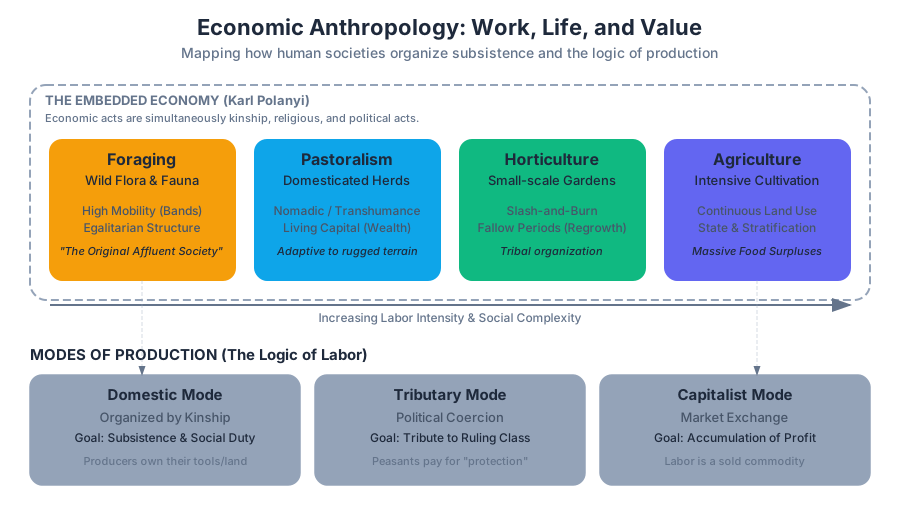
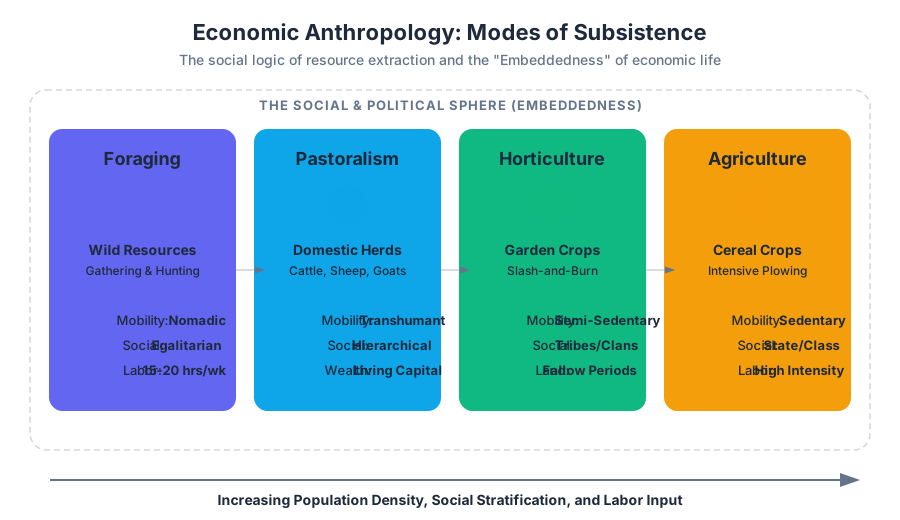
Authority, Decisions, and Power: Political Anthropology
Key concepts: Acephalous Societies · Centralized Societies · Nation-States · Colonialism · Social Movements
Analyzes how societies organize power, decision-making, and authority from small bands to modern nation-states.
Authority, Decisions, and Power: Political Anthropology
Political anthropology is the systematic study of how human groups maintain social order, resolve conflict, and allocate power. While political science often focuses on formal institutions like parliaments and elections, political anthropology takes a broader, cross-cultural approach, examining everything from the informal "shaming" rituals of hunter-gatherer bands to the complex bureaucratic machinations of the modern nation-state.
At its core, this subfield investigates the tension between agency (the capacity of individuals to act independently) and structure (the social arrangements that limit or influence those actions). By analyzing political systems through the lenses of history, ecology, and culture, anthropologists reveal that "power" is not a monolithic force but a multifaceted phenomenon that can be centralized, diffused, or even invisible.
Acephalous Societies: The Power of Consensus
The term acephalous literally means "headless." In political anthropology, it refers to societies that lack a permanent, centralized leadership or a formal government apparatus. These are typically organized as bands or tribes.
What it is
Acephalous societies rely on egalitarianism, where power is diffused across the entire group. Decisions are made through consensus rather than command. While certain individuals may possess more influence (the ability to persuade) due to their wisdom or hunting prowess, they lack authority (the socially recognized right to command).
Why it matters
Understanding acephalous societies challenges the Western assumption that "human nature" is inherently hierarchical. It proves that social order can be maintained without a police force or a judicial system, relying instead on social pressure and reciprocity.
How it works: Social Leveling Mechanisms
To prevent any single individual from accumulating too much power, acephalous societies employ leveling mechanisms. These include:
- Gossip and Shaming: Publicly criticizing those who act arrogantly.
- Meat-Sharing Rules: Ensuring that successful hunters do not control the distribution of food.
- Reverse Dominance Hierarchy: A collective effort by the group to dominate any individual who attempts to lead.
Concrete Example: The !Kung San
Among the !Kung San of the Kalahari, a hunter who brings back a large kill is often met with "insulting the meat." The group belittles the size and quality of the kill to ensure the hunter remains humble and does not view the gift of food as a source of political leverage.
Code Block 1: Low-Level Simulation of Reciprocity
In acephalous societies, "power" is often managed through a complex web of debt and gift-giving. The following Python script simulates a Generalized Reciprocity model where social capital is maintained through the continuous flow of resources, preventing wealth accumulation.
import random

class Member:
    def __init__(self, name):
        self.name = name
        self.resources = 10
        self.social_capital = 0

    def hunt(self):
        # Success is stochastic; surplus must be shared
        yield_amount = random.randint(0, 50)
        if yield_amount > 20:
            self.share_surplus(yield_amount - 10)
        else:
            self.resources += yield_amount

    def share_surplus(self, surplus):
        # Leveling mechanism: Surplus is distributed to the group
        # Increasing social capital instead of hoarding wealth
        self.social_capital += surplus * 0.5
        print(f"{self.name} shared {surplus} units. Social Capital: {self.social_capital}")

def simulate_band(cycles=5):
    band = [Member("A"), Member("B"), Member("C")]
    for i in range(cycles):
        print(f"--- Cycle {i+1} ---")
        for member in band:
            member.hunt()

simulate_band()
Variations and Pitfalls
- Segmentary Lineage Systems: A variation found in tribal societies (like the Nuer) where groups only unite during times of conflict, dissolving back into autonomous units afterward.
- Common Pitfall: Misinterpreting "egalitarian" as "perfectly equal." Even in acephalous societies, gender and age often create internal hierarchies, though they lack the coercive power of a state.
Centralized Societies: Chiefdoms and States
As populations grow and resources become more concentrated, societies often transition toward centralization. This involves the creation of permanent political offices and the institutionalization of inequality.
What it is
Centralized societies are characterized by a formal leadership structure. They are typically categorized into Chiefdoms and States.
| Feature | Chiefdom | State |
|---|---|---|
| Leadership | Hereditary Chief | Bureaucratic/Elected/Monarchical |
| Social Structure | Ranked (Kinship-based) | Stratified (Class/Caste-based) |
| Economy | Redistribution | Taxation and Markets |
| Force | Limited (Social pressure/Warriors) | Monopoly on Legitimate Force |
| Complexity | Moderate | High (Specialized departments) |
Why it matters
Centralization allows for large-scale coordination, such as building irrigation systems or maintaining standing armies. However, it also creates structural violence—inequalities built into the social system that prevent certain groups from meeting their basic needs.
How it works: The Transition to Statehood
The transition from a chiefdom to a state often involves the decoupling of leadership from kinship. In a chiefdom, you follow the leader because they are your "senior relative." In a state, you follow the leader because they represent an abstract institution (the "Crown" or the "Government").
Code Block 2: Mathematical Derivation of Centralization (Gini Coefficient)
In centralized societies, wealth and power distribution can be measured using the Gini Coefficient ($G$). As a society moves from a band to a state, $G$ typically increases.
G = \frac{\sum_{i=1}^{n} \sum_{j=1}^{n} |x_i - x_j|}{2n^2 \bar{x}}
Where:
- $n$ is the number of individuals.
- $x$ is the resource (power or wealth) held by an individual.
- $\bar{x}$ is the mean resource value.
- $G = 0$ represents perfect equality (Acephalous).
- $G = 1$ represents perfect inequality (Totalitarian State).
Concrete Example: The Hawaiian Chiefdoms
Pre-colonial Hawaii featured a highly complex chiefdom system where Ali'i (chiefs) were believed to possess Mana (spiritual power). They controlled the land and the labor of commoners, redistributing resources through large-scale feasts and public works.
Common Pitfalls
- Teleological Bias: The mistaken belief that all societies are "evolving" toward the state. Many societies have historically resisted state formation (e.g., "The Art of Not Being Governed" by James C. Scott).
The Modern Nation-State
The Nation-State is a relatively recent historical development, emerging primarily after the Peace of Westphalia (1648). It combines a centralized political apparatus (the State) with a shared cultural identity (the Nation).
What it is
A nation-state claims sovereignty over a specific territory and its inhabitants. It utilizes "imagined communities" (a term coined by Benedict Anderson) to create a sense of belonging among millions of strangers who will never meet.
Why it matters
The nation-state is the primary actor in modern global politics. It manages citizenship, issues currency, and maintains the borders that define our movement and rights.
How it works: The Monopoly on Force
Max Weber famously defined the state as a "human community that (successfully) claims the monopoly of the legitimate use of physical force within a given territory." If a private citizen uses force, it is a crime; if the state uses force (police, military), it is "law enforcement."
Comparison: Pre-Modern vs. Modern States
| Attribute | Pre-Modern State | Modern Nation-State |
|---|---|---|
| Identity | Subject of a Ruler | Citizen of a Nation |
| Borders | Porous/Frontiers | Fixed/Hard Borders |
| Language | Diverse/Local Dialects | Standardized National Language |
| Legitimacy | Divine Right/Lineage | Popular Sovereignty/Constitution |
Colonialism: The Global Redistribution of Power
Colonialism is the policy or practice of acquiring full or partial political control over another country, occupying it with settlers, and exploiting it economically.
What it is
Anthropologically, colonialism is viewed as a massive project of cultural and political engineering. It didn't just extract gold; it forcibly reorganized local political systems to serve the metropole (the colonizing power).
Why it matters
Most modern political conflicts, borders, and economic inequalities are direct legacies of the colonial era. Colonialism introduced the "State" model to regions that were previously acephalous or organized as chiefdoms, often with disastrous results.
How it works: Indirect Rule
The British Empire frequently used Indirect Rule, where they governed through existing local power structures. If a society was acephalous, the British would often "invent" a chief (a Warrant Chief) to give orders to, fundamentally altering the local social fabric.
Table: Colonial Governance Models
| Model | Strategy | Example | Long-term Impact |
|---|---|---|---|
| Direct Rule | Centralized administration by colonizers | French West Africa | Assimilationist pressure |
| Indirect Rule | Governing through local elites | British Nigeria | Institutionalized ethnic tension |
| Settler Colonialism | Large-scale migration of colonizers | Australia/USA | Displacement/Genocide of Indigenous groups |
Concrete Example: The Scramble for Africa
The 1884 Berlin Conference saw European powers draw borders across Africa with no regard for existing ethnic, linguistic, or political boundaries. This created "poly-ethnic" states that struggled for stability post-independence.
Social Movements and Resistance
Where there is power, there is resistance. Social movements are purposeful, organized groups striving to work toward a common social goal.
What it is
Anthropologists study social movements not just as political events, but as cultural performances. They look at how movements create new identities, use symbols, and challenge the "hegemony" (the taken-for-granted dominance) of the state.
Why it matters
Social movements are the primary mechanism for political change in the modern world, from the Civil Rights Movement to the Arab Spring and environmental activism.
How it works: Weapons of the Weak
James C. Scott's concept of Everyday Resistance suggests that when open rebellion is too dangerous, oppressed groups use "infrapolitics":
- Foot-dragging
- False compliance
- Pilfering
- Slander
Code Block 3: Modern Activism (Decentralized Communication)
In the digital age, social movements often use decentralized protocols to avoid state surveillance. The following YAML configuration represents a simplified setup for a decentralized node in a communication network (like Matrix or IPFS).
# Decentralized Node Configuration for Activist Network
node_metadata:
  name: "liberty-node-01"
  location: "distributed"
  encryption: "AES-256-GCM"

network_settings:
  p2p_enabled: true
  bootstrap_nodes:
    - "192.168.1.50:4001"
    - "203.0.113.12:4001"
  max_peers: 50

security_policy:
  allow_anonymous_connections: true
  log_retention_days: 0 # Zero logs to protect participants
  auto_kill_switch:
    trigger: "unauthorized_access_detected"
    action: "wipe_ephemeral_keys"
Variations: New Social Movements (NSMs)
Unlike older movements focused on labor or class, NSMs (like LGBTQ+ rights or Environmentalism) often focus on identity and quality of life. They seek cultural recognition as much as political representation.
Summary of Political Evolution
The Political Continuum: Human organization is not a ladder of progress, but a toolkit of strategies. While we live in an era dominated by the Nation-State, the principles of acephalous consensus and tribal loyalty continue to influence how we form communities and resist authority.
Key Terms for Review
- Hegemony: The internalizing of the dominant group's values by the oppressed, making the status quo seem "natural."
- Biopower: (Foucault) The state's power to regulate the bodies and lives of its citizens (e.g., birth rates, vaccinations).
- Sovereignty: The supreme authority of a state to govern itself.
- Reciprocity: The exchange of goods and services of approximately equal value between two parties.
- Structural Violence: Harm caused by social structures that prevent people from reaching their full potential.
Author's Note: This article serves as a foundational guide to Political Anthropology. For further exploration, students are encouraged to read Pierre Clastres' Society Against the State and Michel Foucault's Discipline and Punish.
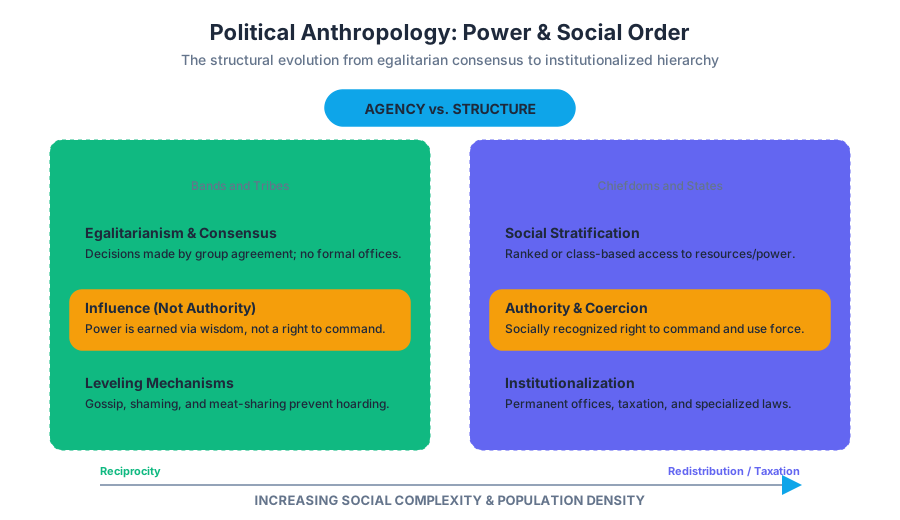
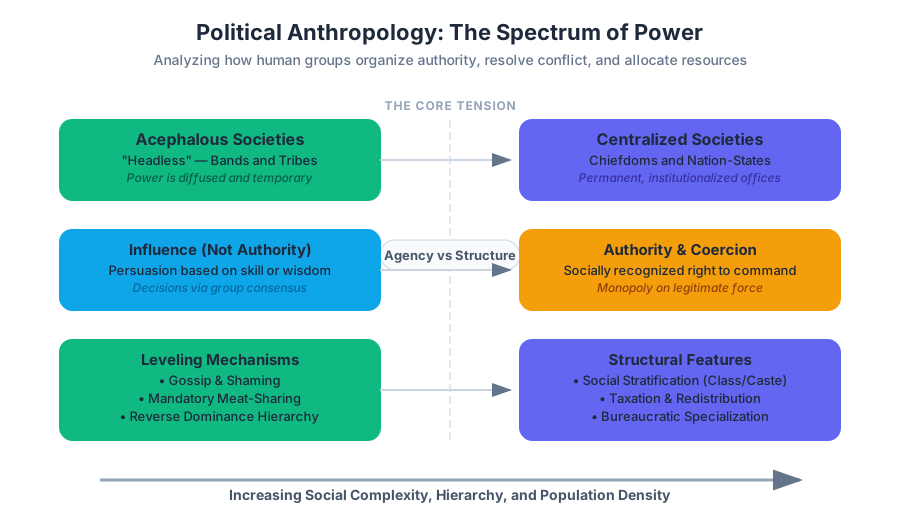
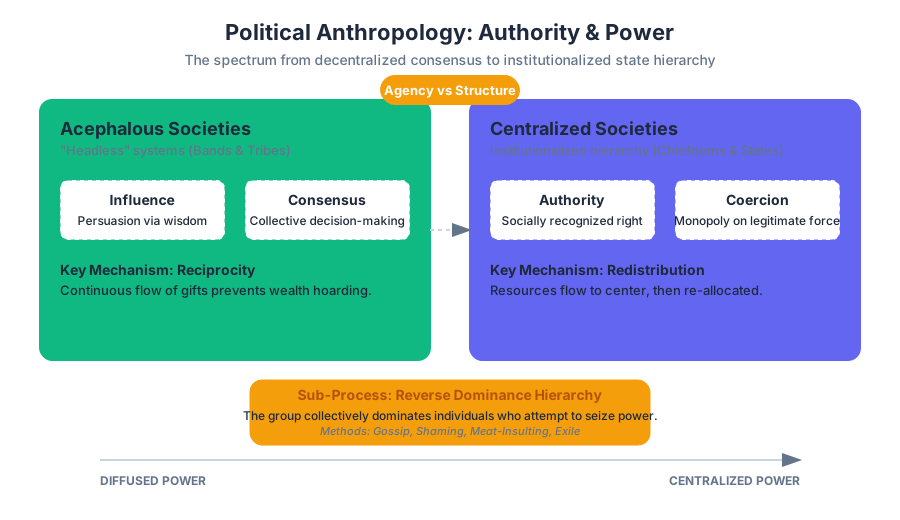
Social Inequality and Global Migration
Key concepts: Social Inequality · Socioeconomic Inequality · Human Migration · Globalization · Systemic Impact
Examines the systemic impacts of socioeconomic inequality and the global drivers of human migration.
Social Inequality and Global Migration
The intersection of social inequality and human migration represents one of the most complex feedback loops in the modern world. In the context of globalization, the movement of people is not merely a demographic shift but a response to systemic disparities in power, wealth, and opportunity. Anthropologically, this is studied through a holistic lens, examining how biological, cultural, and historical factors converge to drive individuals across borders.
The Architecture of Social Inequality
Social inequality is the condition wherein resources in a given society are distributed unevenly, typically through norms of allocation that create specific patterns along lines of socially defined categories. It is not a random distribution of "haves" and "have-nots" but a structured system—often referred to as systemic inequality—built into the institutional frameworks of nation-states and international bodies.
Socioeconomic Inequality and the Gini Coefficient
Socioeconomic inequality refers specifically to the disparate distribution of economic assets and income. To quantify this, economists and anthropologists often use the Gini Coefficient, a statistical measure of distribution.
Definition: The Gini Coefficient ($G$) A measure of statistical dispersion intended to represent the income or wealth inequality within a nation or any other group of people. It is defined based on the Lorenz curve, which plots the proportion of the total income of the population (y-axis) that is cumulatively earned by the bottom $x%$ of the population.
Mathematically, if the area between the line of perfect equality ($y = x$) and the Lorenz curve is $A$, and the area under the Lorenz curve is $B$, the Gini coefficient is: $$G = \frac{A}{A + B}$$
Dimensions of Inequality
Inequality is multidimensional. While economic metrics are vital, anthropologists emphasize that social status, political influence, and access to "cultural capital" are equally significant.
| Dimension | Description | Metric/Indicator |
|---|---|---|
| Economic | Disparity in wealth, income, and ownership of production. | Gini Index, GDP per capita (PPP). |
| Social | Unequal access to education, healthcare, and social networks. | Human Development Index (HDI). |
| Political | Differential ability to influence policy or access legal protections. | Voter participation, Civil Liberties Index. |
| Cultural | Devaluation of specific identities, languages, or traditions. | Linguistic vitality, Representation metrics. |
Mechanics of Human Migration
Human migration is the physical movement by people from one place to another, sometimes over long distances and in large groups. In the contemporary era, migration is rarely a simple choice; it is a survival strategy or an aspirational leap necessitated by the inequalities mentioned above.
The Push-Pull Framework
The most common model for understanding migration is the Push-Pull Model. Push factors are conditions in the place of origin that make it undesirable (e.g., war, poverty), while pull factors are attractions in the destination (e.g., high wages, safety).
| Factor Type | Examples | Systemic Driver |
|---|---|---|
| Push | Conflict, environmental degradation, lack of jobs, political oppression. | Structural Violence, Climate Change. |
| Pull | Labor demand, political stability, family reunification, educational access. | Global Labor Markets, Neoliberalism. |
Implementation: Analyzing Migration Trends with Python
To understand these patterns at scale, researchers use computational tools to process demographic data. The following Python snippet demonstrates how to calculate a simplified "Migration Pressure Index" based on socioeconomic variables.
import pandas as pd
import numpy as np

def calculate_migration_pressure(df, alpha=0.6, beta=0.4):
    """
    Calculates a Migration Pressure Index (MPI) for various regions.
    MPI = alpha * (Unemployment_Rate) + beta * (1 / Relative_Income)
    """
    # Normalize inputs to 0-1 scale
    df['norm_unemployment'] = df['unemployment'] / df['unemployment'].max()
    df['norm_income_inv'] = (1 / df['income']) / (1 / df['income']).max()

    # Weighted sum of factors
    df['MPI'] = (alpha * df['norm_unemployment']) + (beta * df['norm_income_inv'])

    return df.sort_values(by='MPI', ascending=False)

# Example Data: Region, Unemployment Rate (%), Median Income (USD)
data = {
    'Region': ['Sub-Saharan Africa', 'Western Europe', 'South Asia', 'North America'],
    'unemployment': [15.2, 5.4, 11.8, 4.2],
    'income': [1500, 45000, 2200, 55000]
}

migration_df = pd.DataFrame(data)
results = calculate_migration_pressure(migration_df)
print(results[['Region', 'MPI']])
Globalization and the Systemic Impact
Globalization acts as the connective tissue that accelerates both inequality and migration. It refers to the increasing integration of economies, cultures, and populations worldwide, driven by cross-border trade in goods and services, technology, and flows of investment, people, and information.
The Global Labor Market
In a globalized economy, labor becomes a commodity. However, unlike capital, which moves freely across borders via digital networks, human labor is restricted by the nation-state's borders. This creates a "dual labor market" where migrant workers often fill the "3D" jobs—Dirty, Dangerous, and Demeaning—that domestic workers avoid.
Derivation of the Migration Flow Formula
Gravity models are often used to predict the volume of migration between two points ($i$ and $j$). The basic form is derived from Newton’s Law of Universal Gravitation:
M_{ij} = k \cdot \frac{P_i \cdot P_j}{d_{ij}^\beta}
Where:
- $M_{ij}$ is the migration flow from $i$ to $j$.
- $P_i, P_j$ are the populations of the origin and destination.
- $d_{ij}$ is the distance between them.
- $k$ is a constant.
- $\beta$ is a parameter reflecting the friction of distance (usually $> 1$).
Anthropological Perspectives: Holism and the Insider's View
Anthropology brings a unique methodology to the study of inequality: Holism. Instead of looking at migration purely as an economic transaction, anthropologists examine the "total human experience."
Overcoming Western Bias
A significant pitfall in migration studies is Western bias—the assumption that the Western "developed" world is the natural or inevitable destination for all migrants. Anthropologists use cultural relativism to understand the specific motivations of migrants, which may include religious pilgrimage, ancestral connections, or indigenous concepts of land that do not align with Western borders.
The "Insider’s Point of View" (Emic Perspective)
By utilizing participant observation and ethnography, researchers gain an emic perspective. This reveals how systemic inequality is felt on a personal level—what Paul Farmer calls Structural Violence. This refers to social arrangements that put individuals and populations in harm's way. The arrangements are structural because they are embedded in the political and economic organization of our social world.
| Concept | Anthropological Definition | Application to Migration |
|---|---|---|
| Ethnocentrism | Judging another culture by the values of one's own. | Viewing migrants as "problems" to be solved rather than agents. |
| Transnationalism | Maintaining social/economic ties across borders. | Migrants sending remittances back home while living abroad. |
| Applied Anthropology | Using research to solve real-world problems. | Designing better refugee camp infrastructures or policy advocacy. |
Data Management in Migration Studies
Managing the vast amounts of data generated by global migration requires robust database schemas. Tracking individual movements, legal statuses, and socioeconomic outcomes is critical for both NGOs and governments.
-- Schema for tracking Migrant Demographics and Economic Impact
CREATE TABLE MigrantProfiles (
    MigrantID INT PRIMARY KEY,
    OriginCountry VARCHAR(100),
    DestinationCountry VARCHAR(100),
    EntryDate DATE,
    LegalStatus ENUM('Refugee', 'Work_Visa', 'Student', 'Undocumented'),
    EducationLevel VARCHAR(50)
);

CREATE TABLE Remittances (
    TransactionID UUID PRIMARY KEY,
    MigrantID INT,
    Amount DECIMAL(15, 2),
    Currency CHAR(3),
    DateSent TIMESTAMP,
    FOREIGN KEY (MigrantID) REFERENCES MigrantProfiles(MigrantID)
);

-- Query to find total remittances sent by country of origin
SELECT
    OriginCountry,
    SUM(Amount) AS TotalRemitted
FROM MigrantProfiles
JOIN Remittances ON MigrantProfiles.MigrantID = Remittances.MigrantID
GROUP BY OriginCountry
ORDER BY TotalRemitted DESC;
Common Pitfalls and Misconceptions
- The "Brain Drain" Fallacy: While the migration of highly skilled individuals (doctors, engineers) can hurt origin countries, it is often offset by brain gain (remittances and the eventual return of skilled workers with new networks).
- Migration as a Choice: Many frameworks treat migration as a rational choice. However, for many, it is forced migration due to conflict or environmental collapse, where the "choice" is between migration and death.
- Homogenization of Migrants: Treating all migrants as a monolithic group ignores the intersectionality of race, gender, and class. A wealthy expatriate moving for a corporate promotion experiences globalization very differently than a refugee fleeing a civil war.
Variations and Extensions
Environmental Migration
A growing sub-field is Environmental Anthropology, which studies "climate refugees." As sea levels rise and arable land disappears, the drivers of migration shift from purely socioeconomic to biological and ecological.
Digital Diasporas
Globalization has enabled digital diasporas, where migrant communities maintain intense, real-time cultural and political connections with their homelands via the internet. This challenges the traditional idea that migration requires "assimilation" or the loss of original cultural identity.
Summary of Systemic Impacts
| System | Impact of Migration | Resulting Inequality |
|---|---|---|
| Labor Markets | Wage suppression in low-skill sectors; filling labor shortages. | Increased gap between capital owners and labor. |
| Urbanization | Rapid growth of "megacities" in the Global South. | Strain on infrastructure; growth of informal settlements (slums). |
| Culture | Hybridization of food, music, and language. | Backlash in the form of nativism or xenophobia. |
| Health | Spread of infectious diseases vs. "Medical Tourism." | Disparities in life expectancy and access to specialized care. |
Author Note: This article integrates the four-field approach of anthropology (biological, archaeological, linguistic, and cultural) to provide a comprehensive overview of how human movement is both a result of and a contributor to global social inequality. By moving beyond Western bias and employing rigorous quantitative and qualitative methods, we can better understand the "vastness" of the human story in an era of unprecedented change.
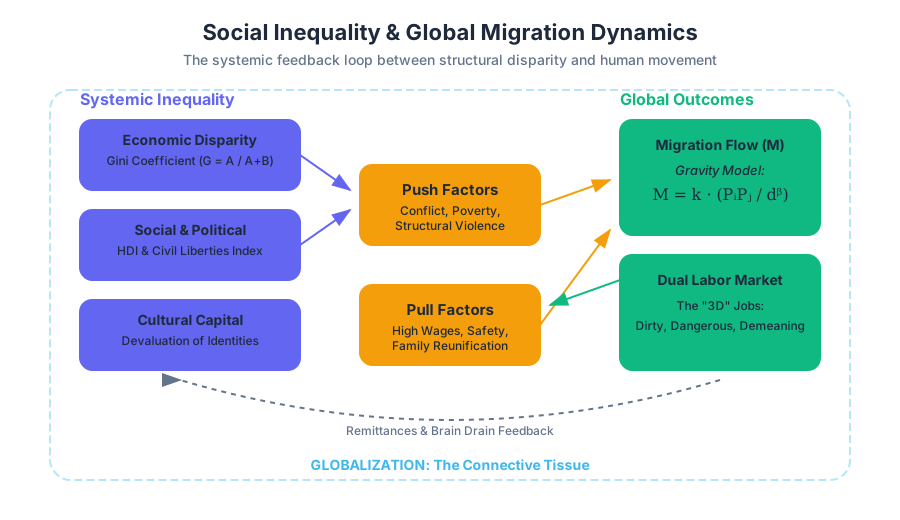
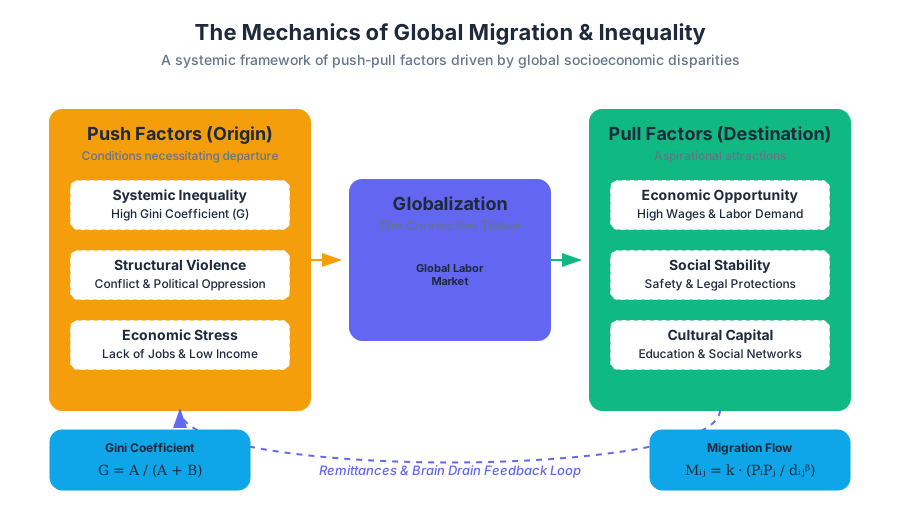
Forming Family: Kinship, Gender, and Sexuality
Key concepts: Kinship · Gender Roles · Sexuality · Social Institutions · Cultural Variation
Investigates the cultural construction of family, gender roles, and sexual identities across different societies.
Forming Family: Kinship, Gender, and Sexuality
Kinship is the foundational "operating system" of human society. It is a formal social institution that defines the rights, obligations, and identities of individuals based on perceived biological and social connections. While often mistaken for a mere reflection of biology, kinship is a highly variable cultural construct that organizes labor, inheritance, political alliances, and emotional support. This section explores the mechanics of kinship systems, the social construction of gender, and the cultural regulation of sexuality through a holistic, anthropological lens.
Kinship Systems: The Logic of Social Connection
Kinship is defined as a system of social relationships that are constitutive of family. These relationships are generally categorized into two types: consanguineal (related by "blood" or shared descent) and affinal (related by marriage). However, many cultures also recognize fictive kinship, where individuals are granted family status through ritual or social choice (e.g., godparents or "chosen family").
Descent Groups and Lineage
Descent is the social recognition of the connection between ancestors and their descendants. Anthropologists distinguish between two primary modes of descent:
- Unilineal Descent: Tracing kinship through a single line—either the father's (patrilineal) or the mother's (matrilineal).
- Cognatic (Non-unilineal) Descent: Tracing kinship through both parents (bilateral) or choosing one line based on social circumstances (ambilineal).
The Principle of Descent: Let $D$ be the set of ancestors. A descent rule $R$ is a function that maps an individual $i$ to a subset of $D$ based on the cultural parameters of lineage. In a patrilineal system, $R(i) = {a \in D \mid \text{gender}(a) = \text{male} \land \text{path}(i, a) \text{ is strictly paternal}}$.
| Descent Type | Logic | Inheritance/Authority | Examples |
|---|---|---|---|
| Patrilineal | Traced through males. | Property and status pass from father to son. | Traditional Han Chinese, Nuer of Sudan. |
| Matrilineal | Traced through females. | Property passes from mother to daughter; authority often held by mother's brother. | Minangkabau of Indonesia, Hopi. |
| Bilateral | Traced through both parents. | Equal weight to both sides; common in foraging and industrial societies. | Modern Western societies, Ju/'hoansi. |
| Ambilineal | Choice of lineage. | Flexible; individuals choose which side to affiliate with based on resources. | Many Polynesian cultures. |
Kinship Terminology (The "Logic" of Labels)
How we name our relatives dictates how we treat them. Lewis Henry Morgan identified several "types" of kinship terminology based on how they group or distinguish relatives. For instance, the Eskimo system (common in the West) emphasizes the nuclear family, while the Hawaiian system uses the same term for "Mother" and "Aunt," effectively merging the nuclear family into a larger generational group.
Below is a Python implementation of a kinship distance calculator, illustrating how different systems might calculate the "coefficient of relationship" ($r$) between two individuals.
def calculate_coefficient_of_relationship(ego_path, alter_path):
    """
    Calculates the coefficient of relationship (r) between two individuals
    based on a shared ancestor.
    Formula: r = sum( (0.5) ^ L ) where L is the path length through the ancestor.
    """
    shared_ancestors = set(ego_path.keys()) & set(alter_path.keys())
    if not shared_ancestors:
        return 0.0

    r_total = 0.0
    for ancestor in shared_ancestors:
        # L is the number of steps from ego to ancestor + steps from ancestor to alter
        L = ego_path[ancestor] + alter_path[ancestor]
        r_total += (0.5) ** L

    return r_total

# Example: Siblings sharing two parents
# Path to Mother: 1 step, Path to Father: 1 step
ego = {"Mother": 1, "Father": 1}
alter = {"Mother": 1, "Father": 1}

r_value = calculate_coefficient_of_relationship(ego, alter)
print(f"Coefficient of Relationship (Siblings): {r_value}") # Output: 0.5
Marriage and Alliance Theory
Marriage is a social contract that transforms the status of the participants, carries implications about sexual access, and establishes the legal parenthood of children. From a structuralist perspective (Claude Lévi-Strauss), marriage is a system of alliance between groups.
Rules of Exclusion and Inclusion
- Exogamy: The requirement to marry outside a specific social group (e.g., outside the clan). This builds external alliances.
- Endogamy: The requirement to marry within a specific group (e.g., within a caste or religion). This preserves group resources and identity.
- Incest Taboo: A near-universal cultural rule prohibiting sexual relations between certain close relatives. While the biological risks of inbreeding are real, anthropologists argue the taboo is primarily social, forcing individuals to seek partners outside their family to create wider social networks.
Marriage Exchanges
Marriage often involves the transfer of wealth, which serves as a "social glue" or a form of insurance for the stability of the union.
| Exchange Type | Direction of Wealth | Purpose |
|---|---|---|
| Bridewealth | Groom's family $\rightarrow$ Bride's family. | Compensates the bride's family for the loss of her labor and fertility. |
| Bride Service | Groom $\rightarrow$ Bride's family (Labor). | The groom works for the bride's family for a set period. |
| Dowry | Bride's family $\rightarrow$ New couple/Groom. | Provides the bride with her share of inheritance; often seen as a "groom price" in stratified societies. |
Gender: The Cultural Construction of Identity
Anthropology makes a critical distinction between sex (biological attributes such as chromosomes, hormones, and anatomy) and gender (the cultural meanings, roles, and identities assigned to those biological attributes).
The Sex/Gender Distinction
While sex is often viewed as a dimorphic biological category (Male/Female), biological reality includes intersex variations. Gender, however, is a spectrum. Anthropologist Judith Butler describes gender as performativity—not a fixed internal essence, but a series of acts and behaviors that are repeated and reinforced by social institutions.
Cultural Variation in Gender Roles
Gender roles are the tasks and activities a culture assigns to the sexes. These are not biologically determined; for example, in some cultures, women are the primary traders and merchants, while in others, they are restricted to the domestic sphere.
The Gender Vector Space: We can represent gender identity $G$ as a point in a multi-dimensional space where $G = (I, E, R)$, with $I$ representing internal identity, $E$ representing external expression, and $R$ representing social role expectations.
\text{Gender Identity } (G) = \sum_{i=1}^{n} w_i \cdot c_i
\text{ where } w_i \text{ is the cultural weight of trait } c_i
Plural Gender Systems
Many cultures recognize more than two genders. These "third gender" or "gender-variant" roles often hold specific ritual or social significance:
- Two-Spirit (Indigenous North America): Individuals who embody both masculine and feminine spirits, often serving as healers or mediators.
- Hijra (South Asia): A legally recognized third gender in India and Pakistan, often performing ritual roles at births and weddings.
- Muxe (Oaxaca, Mexico): Individuals assigned male at birth who adopt feminine roles and identities.
Sexuality: Regulation and Expression
Sexuality refers to the capacity for sexual feelings and the ways in which people experience and express themselves as sexual beings. Like gender, sexuality is governed by cultural norms and social institutions.
The Social Construction of Sexuality
Michel Foucault argued that "sexuality" is a modern Western construct. In many historical and non-Western contexts, sexual behavior was not necessarily tied to a permanent "identity" (like Heterosexual or Homosexual) but was viewed as a set of actions or roles.
Heteronormativity and Power
Heteronormativity is the institutionalized belief that heterosexuality is the only "natural" or "normal" expression of sexuality. This belief is reinforced through:
- Legal frameworks: Marriage laws, adoption rights.
- Economic incentives: Tax benefits for married couples.
- Socialization: Media representation and education.
Comparison of Sexual Norms
| Concept | Definition | Social Function |
|---|---|---|
| Sexual Dimorphism | Biological differences between males and females. | Reproductive potential. |
| Sexual Orientation | Enduring pattern of emotional/sexual attraction. | Personal identity and community formation. |
| Sexual Scripts | Cultural "blueprints" for sexual behavior. | Regulating social order and expectations. |
Social Institutions and the Family
The family does not exist in a vacuum; it is the building block of larger social, economic, and political structures.
The Domestic Cycle
Families are dynamic. The nuclear family (parents and children) may expand into an extended family (multiple generations) or dissolve and reform into blended families. The "Standard North American Family" (SNAF) is a specific cultural ideal that does not reflect the reality of many global or even domestic households.
Kinship and Political Economy
In many societies, kinship is the political system. In segmentary lineages, relatedness determines who fights whom and who supports whom in a conflict. In industrial societies, the state has taken over many functions previously held by kin groups (e.g., social security, legal arbitration), yet kinship remains the primary mechanism for the intergenerational transfer of wealth and class status.
To manage the complexity of these relationships in a modern context, data scientists and sociologists often use graph databases to map social networks.
-- Schema for a Kinship and Social Alliance Database
CREATE TABLE individuals (
    id INT PRIMARY KEY,
    name VARCHAR(100),
    biological_sex ENUM('male', 'female', 'intersex'),
    gender_identity VARCHAR(50)
);

CREATE TABLE relationships (
    ego_id INT,
    alter_id INT,
    relationship_type ENUM('parent', 'sibling', 'spouse', 'clan_member'),
    start_date DATE,
    FOREIGN KEY (ego_id) REFERENCES individuals(id),
    FOREIGN KEY (alter_id) REFERENCES individuals(id)
);

-- Querying for "Matrilineal" relatives (simplified)
SELECT alter_id
FROM relationships
WHERE ego_id = 101
AND relationship_type = 'parent'
AND alter_id IN (SELECT id FROM individuals WHERE biological_sex = 'female');
Common Pitfalls in Studying Kinship and Gender
- Biological Determinism: Assuming that because women give birth, they are "naturally" suited for domestic work. This ignores the massive cultural variation in labor division.
- Ethnocentrism: Using Western categories (like "Aunt" or "Gay") to describe roles in other cultures that may have entirely different meanings.
- The "Nuclear Family" Bias: Assuming the nuclear family is the universal "natural" unit. In many cultures, the household is centered around a group of sisters or a man and his brothers.
- Static Analysis: Treating kinship as a rigid set of rules rather than a flexible strategy that people use to navigate their lives.
Summary of Key Concepts
Kinship, gender, and sexuality are intertwined systems that define the human experience. Kinship provides the structure, gender provides the identity, and sexuality provides the drive for reproduction and connection. Together, they form the "Forming Family" matrix that ensures the survival and continuity of human cultures.
- Kinship is about belonging and obligation.
- Gender is about meaning and performance.
- Sexuality is about desire and regulation.
-
Consanguineal: Related by descent ("blood").
-
Affinal: Related by marriage.
-
Matrilineal: Tracing descent through the female line.
-
Patrilineal: Tracing descent through the male line.
-
Exogamy: Marrying outside a specific group.
-
Endogamy: Marrying within a specific group.
-
Bridewealth: Wealth transferred from the groom's family to the bride's family.
-
Dowry: Wealth transferred from the bride's family to the groom or the new couple.
-
Gender Performativity: The idea that gender is created through repeated social actions.
-
Heteronormativity: The social assumption that heterosexuality is the default or "correct" orientation.
-
Which kinship system would use the same term for "Mother" and "Mother's Sister"?
- A) Eskimo
- B) Hawaiian
- C) Sudanese
- D) Descriptive
-
What is the primary social function of the Incest Taboo according to Alliance Theory?
- A) To prevent genetic mutations.
- B) To ensure parents focus on their children.
- C) To force the creation of social alliances outside the immediate family.
- D) To maintain religious purity.
-
True or False: "Two-Spirit" is a modern Western term for LGBTQ+ individuals.
- (False: It is a term used by some Indigenous North American cultures for specific gender-variant roles.)
-
In a matrilineal society, who is typically the most important male figure in a child's life?
- A) The biological father.
- B) The mother's brother (maternal uncle).
- C) The father's father.
- D) The village chief.
-
Explain the difference between Bridewealth and Dowry.
- (Bridewealth is paid to the bride's family; Dowry is brought by the bride into the new marriage.)
Core Learning Objectives:
- Distinguish between unilineal and cognatic descent systems.
- Analyze the social and economic functions of marriage exchanges (Bridewealth vs. Dowry).
- Deconstruct the difference between biological sex and cultural gender.
- Identify examples of gender-variant roles in non-Western societies.
- Understand how kinship acts as a political and economic institution in non-state societies.
Key Figures to Research:
- Claude Lévi-Strauss: For Alliance Theory and Structuralism.
- Judith Butler: For Gender Performativity.
- Lewis Henry Morgan: For early kinship classification.
- Margaret Mead: For early cross-cultural studies of gender roles.
Technical Skills to Practice:
- Drawing a kinship diagram (using standard symbols: Triangle for male, Circle for female, = for marriage).
- Calculating coefficients of relationship for different cousin types (parallel vs. cross-cousins).
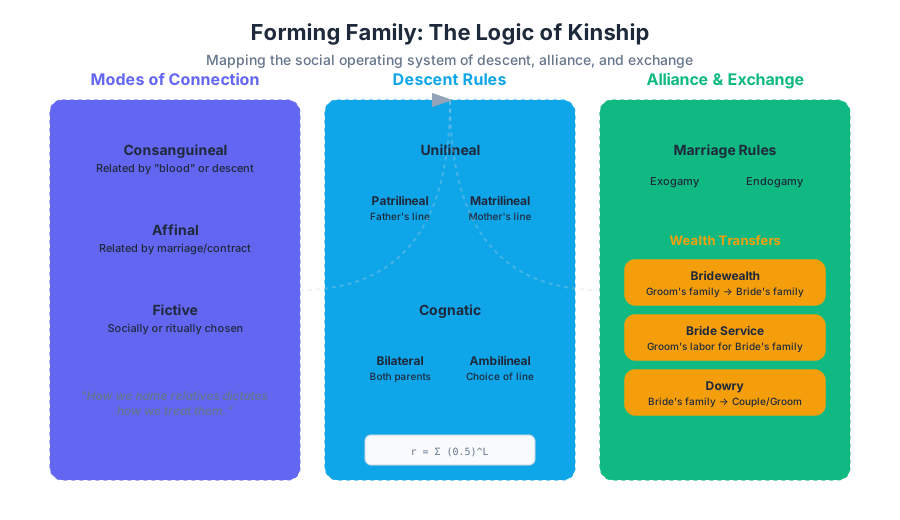
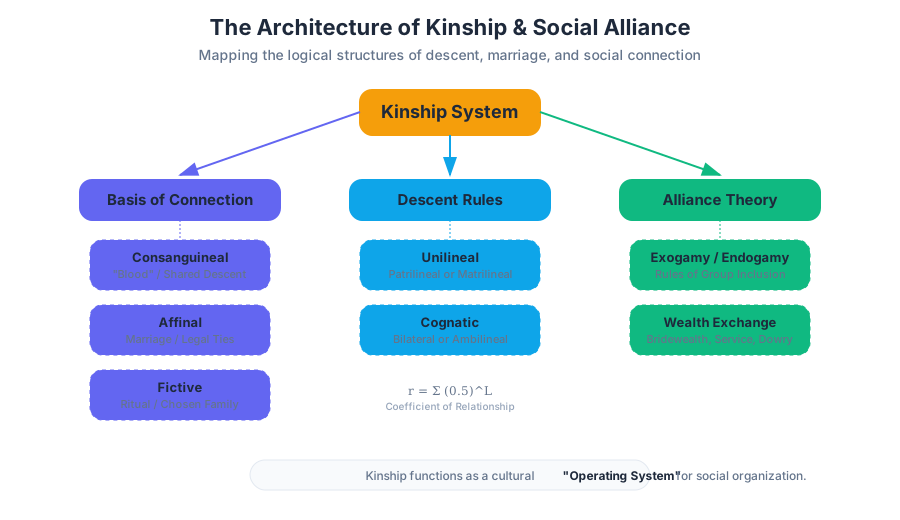
Religion, Art, and Expressive Culture
Key concepts: Ritual · Symbolism · Expressive Culture · Anthropology of Media · Ritualistic Performance
Explores the anthropology of meaning through religion, ritual, art, music, and sport.
Religion, Art, and Expressive Culture
Expressive culture represents the aesthetic and symbolic dimension of social life, encompassing religion, ritual, the arts, and media. In anthropology, these are not merely "leisure" activities or "superstructures" of the economy; they are the primary mechanisms through which human beings construct meaning, negotiate power, and define their place in the cosmos. This section explores the technical frameworks used to analyze how symbols operate, how rituals transform social status, and how media technologies reshape the "social skin" of global communities.
The Architecture of Ritual
A ritual is a sequenced, repetitive social practice that is set apart from the routines of daily life. While often associated with religion, rituals can be secular (e.g., a graduation ceremony or a sporting event). Anthropologists analyze rituals not by their "truth" value, but by their functional and symbolic efficacy in transforming participants.
The Tripartite Structure of Rites of Passage
The most influential model of ritual comes from Arnold van Gennep and was later refined by Victor Turner. They identified a three-stage process known as a Rite of Passage, which facilitates the transition of an individual from one social state to another.
- Separation: The individual is stripped of their previous social identity. This often involves physical removal or symbolic "death."
- Liminality: The "betwixt and between" phase. The participant has no status, property, or rank. It is a period of ambiguity, ordeal, and heightened vulnerability.
- Incorporation: The individual re-enters society with a new status, often marked by a feast or public recognition.
Communitas: A term coined by Victor Turner to describe the intense feeling of social togetherness and equality that emerges among participants during the liminal phase of a ritual, transcending normal social hierarchies.
Ritual as a State Machine
From a systems perspective, a ritual can be modeled as a Finite State Machine (FSM) where transitions are triggered by specific symbolic inputs (sacred words, gestures, or objects).
class RitualProcess:
    """
    A low-level implementation of a Rite of Passage state machine.
    Models the transition of a 'SocialActor' through ritual phases.
    """
    def __init__(self, actor_name):
        self.actor = actor_name
        self.state = "PRE_RITUAL"
        self.status = "Layperson"

    def transition(self, phase):
        if self.state == "PRE_RITUAL" and phase == "SEPARATION":
            self.state = "LIMINAL"
            self.status = "None (The Invisible)"
            print(f"{self.actor} has entered the forest. Status: {self.status}")

        elif self.state == "LIMINAL" and phase == "ORDEAL_COMPLETE":
            # The liminal phase is where 'Communitas' is generated
            self.state = "TRANSITIONING"
            print(f"{self.actor} has passed the threshold.")

        elif self.state == "TRANSITIONING" and phase == "INCORPORATION":
            self.state = "POST_RITUAL"
            self.status = "Initiated/Elder"
            print(f"{self.actor} returns to the village. Status: {self.status}")

        else:
            raise ValueError("Invalid ritual sequence. Social friction detected.")

# Execution example
initiate = RitualProcess("Kofi")
initiate.transition("SEPARATION")
initiate.transition("ORDEAL_COMPLETE")
initiate.transition("INCORPORATION")
Symbolism and Semiotics
Symbols are the building blocks of expressive culture. A symbol is something that stands for something else, but unlike a sign (which has a direct, often biological link to its meaning, like smoke signifying fire), a symbol's meaning is arbitrary and culturally defined.
Multivocality and Condensation
Victor Turner argued that ritual symbols possess multivocality—the ability to represent many different things at once. A single symbol, like a national flag or a sacred tree, can condense a vast array of meanings (history, blood, fertility, law) into one physical form.
The Mathematical Logic of Symbolic Density
We can conceptualize the "power" of a symbol through its Symbolic Density ($\Delta_s$), which is a function of its multivocality ($M$) and its emotional resonance ($R$) within a specific cultural context ($C$).
\Delta_s = \int_{i=1}^{n} (M_i \cdot R_i) \, dC
Where:
- $M_i$: The $i$-th distinct meaning assigned to the symbol.
- $R_i$: The intensity of the emotional response to that meaning.
- $C$: The cultural field or "habitus" in which the symbol is deployed.
| Concept | Definition | Example |
|---|---|---|
| Signifier | The physical form of the symbol (sound, image, object). | The word "Red". |
| Signified | The mental concept or meaning. | Danger, Passion, or Communism. |
| Condensation | The process of grouping multiple meanings into one signifier. | The Cross (Suffering + Redemption + Authority). |
| Polarization | Symbols having an "orectic" (physical) pole and a "normative" (social) pole. | Blood (Physical life vs. Social kinship). |
Art as Expressive Culture
Anthropologists reject the Western "Fine Arts" definition, which often isolates art in museums. Instead, they view art as social action. Art is not just an object to be looked at; it is a technology used to influence the world.
The Agency of Art
Alfred Gell proposed that art objects have agency. They are "indexes" of the maker's or the user's intentions. A mask in a ritual is not just a representation of a spirit; in the context of the performance, it is the spirit, capable of healing or punishing.
Deep Play in Sport
Clifford Geertz’s analysis of the Balinese Cockfight introduced the concept of Deep Play. This refers to activities where the stakes (honor, status, identity) are so high that it is "irrational" for people to engage in them from a purely economic standpoint. Sport serves as a "metasocial commentary"—a story a group tells itself about itself.
Anthropology of Media
The Anthropology of Media investigates how communication technologies (from print to TikTok) transform human sociality. Media is not a neutral pipe through which "culture" flows; the medium itself restructures the "social skin."
The Social Skin and Digital Ethnography
In the digital age, the "self" is no longer confined to the biological body. Our digital profiles and avatars constitute a "social skin" that we project into virtual spaces. Anthropologists use digital ethnography to study these spaces, treating them as real cultural sites rather than "fake" or "virtual" ones.
Media Infrastructure and Power
Media is also a matter of infrastructure. Who owns the cables? Who controls the algorithms? Anthropologists look at the Digital Divide not just as a lack of hardware, but as a form of social inequality that limits certain groups' ability to participate in the global "expressive culture."
# Metadata Schema for an Ethnographic Media Archive
# Used to categorize digital fieldnotes and media artifacts
artifact_metadata:
  id: "ETHNO_2023_001"
  type: "Digital_Video"
  context:
    location: "Amazon Basin"
    community: "Kayapo"
    event: "Indigenous Media Workshop"
  technical_specs:
    codec: "H.264"
    resolution: "4K"
    bitrate: "50Mbps"
  anthropological_tags:
    - "Visual Sovereignty"
    - "Indigenous Agency"
    - "Cultural Preservation"
  access_protocol:
    level: "Restricted"
    reason: "Sacred Knowledge - Community Consent Required"
Ritualistic Performance and Performativity
There is a technical distinction between "performance" (a staged event) and "performativity" (the power of language and gesture to create reality).
Speech Act Theory
Developed by J.L. Austin, Speech Act Theory posits that certain utterances do not just describe the world—they change it.
- Locutionary Act: The act of saying something.
- Illocutionary Act: The intent behind the saying (e.g., promising, threatening).
- Perlocutionary Act: The actual effect on the listener.
In a ritual, a priest saying "I now pronounce you married" is a performative utterance. It doesn't just describe a marriage; it creates it.
Comparison of Performance Modes
| Feature | Ritual Performance | Theatrical Performance | Daily Social Interaction |
|---|---|---|---|
| Primary Goal | Efficacy (Transformation) | Entertainment/Aesthetics | Communication/Utility |
| Audience Role | Participants/Co-creators | Observers/Consumers | Interactors |
| Time/Space | Sacred/Set Apart | Liminoid (Leisure) | Profane/Routine |
| Consequence | Permanent Social Change | Temporary Emotional Shift | Incremental Social Maintenance |
Globalized Media and Identity
In a globalized world, expressive culture is a primary site of resistance and identity formation. Indigenous Media, for example, allows marginalized groups to use film and the internet to challenge Western biases and document their own histories.
Visual Sovereignty
This term refers to the right of Indigenous peoples to self-represent. By controlling the camera, Indigenous filmmakers can subvert the "Western Gaze" and present their cultures not as static relics of the past, but as dynamic, evolving societies.
The "Winkiness" of Culture
Following Clifford Geertz, anthropologists look for the "thick description" of media. A "wink" and a "twitch" look the same physically, but their cultural meanings are worlds apart. Similarly, a "meme" shared in one culture might be a joke, while in another, it is a call to political revolution.
# A hypothetical CLI tool for analyzing symbolic frequency in media transcripts
# Usage: ./ethno-analyze.sh --input field_notes.txt --target "ritual_symbol"

grep -oE '\b(blood|water|sacrifice|ancestor)\b' $1 | \
sort | \
uniq -c | \
sort -nr | \
awk '{print "Symbol: " $2 " | Frequency: " $1}'
Common Pitfalls in Analysis
- Over-Intellectualizing Ritual: Assuming that every participant knows the "hidden meaning" of every symbol. Often, the doing of the ritual is more important than the knowing.
- The "Primitive" Trap: Viewing non-Western art or religion as "earlier stages" of human evolution. All expressive cultures are equally complex and contemporary.
- Technological Determinism: Believing that a new technology (like the internet) will automatically "ruin" or "save" a culture. Culture and technology co-evolve.
- Ignoring Materiality: Focusing so much on the "meaning" of a symbol that one forgets the physical constraints of the object (e.g., the weight of a mask or the cost of a digital camera).
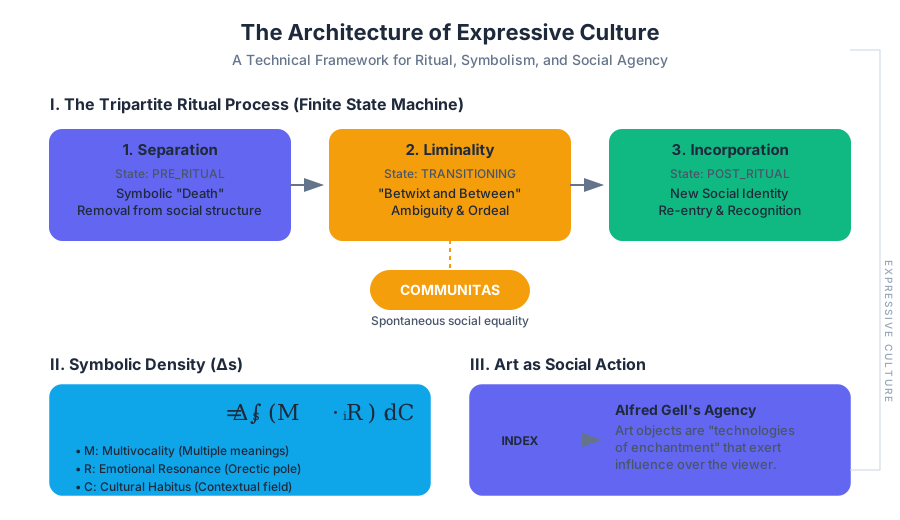
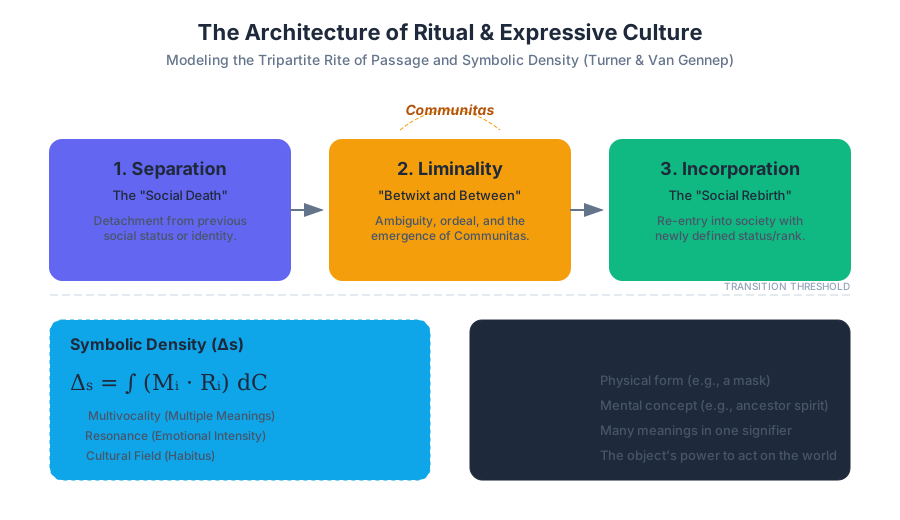
Medical Anthropology and Indigenous Experiences
Key concepts: Medical Anthropology · Indigenous Anthropology · Biocultural Forces · Social Justice · Health Disparities
Focuses on the intersection of health, culture, and the specific challenges faced by Indigenous populations.
Medical Anthropology and Indigenous Experiences
Medical anthropology represents one of the most dynamic and critical subfields of the discipline, serving as the bridge between biological reality and cultural interpretation. It is the study of how health and illness are shaped, experienced, and understood across different cultures and social structures. When applied to Indigenous experiences, this field moves beyond mere observation into the realm of Social Justice and Decolonization, challenging the hegemony of Western biomedicine and addressing the systemic roots of Health Disparities.
The Biocultural Synthesis: Understanding Health as a Multi-Scalar System
At the heart of modern medical anthropology is the Biocultural Perspective. This framework rejects the Cartesian dualism that separates "mind" from "body" or "nature" from "culture." Instead, it posits that human health is a product of a feedback loop between biological systems and the social environments in which they exist.
What it is
The biocultural perspective is a holistic approach that examines the interaction between biological plasticity and cultural adaptation. It recognizes that while a pathogen (like Mycobacterium tuberculosis) is a biological entity, its ability to infect a host, the severity of the disease, and the patient's recovery are dictated by socioeconomic status, housing density, nutrition, and cultural stigmas.
Why it matters
Traditional biomedicine often treats the body as a machine to be repaired in isolation. Medical anthropology argues that this "decontextualized" medicine fails to address the "upstream" causes of illness. By understanding Biocultural Forces, practitioners can identify why certain populations—particularly Indigenous groups—experience disproportionately high rates of chronic conditions like Type 2 diabetes or hypertension.
How it works: The Syndemic Model
A key derivation of the biocultural perspective is the Syndemic. A syndemic occurs when two or more diseases interact in a way that exacerbates the prognosis of each, usually fueled by social inequality and environmental stressors.
| Concept | Definition | Focus |
|---|---|---|
| Epidemic | A sudden increase in disease cases. | Pathogen transmission. |
| Comorbidity | The co-occurrence of two diseases. | Individual clinical pathology. |
| Syndemic | Synergistic interaction of diseases + social conditions. | Population-level health disparities. |
Key Insight: A syndemic is not just "having two sicknesses." It is the biological realization of social suffering. For example, the interaction of malnutrition, depression, and infectious disease in marginalized communities is a syndemic driven by poverty.
Indigenous Anthropology and the Decolonial Turn
Indigenous Anthropology is both a subject of study and a methodological shift. Historically, anthropology was often a tool of colonialism—white researchers "studying" Indigenous people as relics of the past. Modern Indigenous anthropology flips this script, prioritizing Indigenous voices, knowledge systems, and Data Sovereignty.
The Movement Toward Decolonization
Decolonizing anthropology involves dismantling the power structures that have historically marginalized Indigenous knowledge. This includes:
- Collaborative Ethnography: Research designed with and for the community, rather than on them.
- Indigenous Epistemologies: Recognizing that Indigenous ways of knowing (e.g., Traditional Ecological Knowledge or TEK) are as valid as Western scientific methods.
- Repatriation: The return of ancestral remains and cultural artifacts (e.g., via NAGPRA in the United States).
Worked Example: The OCAP Principles
In the context of health research, Indigenous communities often employ the OCAP principles to ensure social justice and prevent "helicopter research" (where researchers take data and never return).
| Principle | Technical Meaning | Practical Application |
|---|---|---|
| Ownership | The community owns the data collected. | Research results cannot be sold to pharma without consent. |
| Control | The community controls research processes. | Indigenous leaders approve the study design. |
| Access | The community must have access to their data. | Raw data must be stored in local repositories. |
| Possession | The community physically holds the data. | Servers are located on tribal lands. |
Quantifying Health Disparities: The Mechanics of Structural Violence
Health Disparities are not accidental; they are the biological outcomes of Structural Violence. This term, popularized by physician-anthropologist Paul Farmer, refers to social arrangements—economic, political, legal, and religious—that harm populations by preventing them from meeting their basic needs.
The "Weathering" Hypothesis
One of the most robust biocultural theories for health disparities is the Weathering Hypothesis. It suggests that the chronic stress of living in a marginalized state (experiencing racism, poverty, and displacement) causes premature biological aging.
Mathematical Derivation: Allostatic Load
Anthropologists measure "weathering" through Allostatic Load (AL), a composite index of physiological wear and tear.
AL = \sum_{i=1}^{n} \frac{(X_i - \mu_i)}{\sigma_i} \cdot W_i
Where:
- $X_i$ is the measured value of a biomarker (e.g., cortisol, blood pressure, BMI).
- $\mu_i$ and $\sigma_i$ are the population mean and standard deviation.
- $W_i$ is the weighting factor for the specific stressor's impact on long-term health.
Implementation in Research
To analyze these disparities, researchers use computational models to separate genetic factors from environmental/social factors.
import pandas as pd
import statsmodels.api as sm

# Simulating the impact of Structural Violence on Health Outcomes
# Variables: years_of_displacement, access_to_traditional_diet, healthcare_proximity
data = {
    'health_score': [85, 70, 45, 30, 90, 20, 55], # 100 is perfect health
    'displacement_years': [0, 5, 20, 40, 0, 50, 15],
    'dietary_autonomy': [1, 0.8, 0.3, 0.1, 1, 0.05, 0.5], # Scale 0-1
    'is_indigenous': [0, 1, 1, 1, 0, 1, 1]
}

df = pd.DataFrame(data)

# Multivariable Regression: How much does displacement predict health decline?
X = df[['displacement_years', 'dietary_autonomy', 'is_indigenous']]
X = sm.add_constant(X)
y = df['health_score']

model = sm.OLS(y, X).fit()
print(model.summary())
Biocultural Forces and Epigenetics
A major breakthrough in medical anthropology is the study of Epigenetics—the study of changes in organisms caused by modification of gene expression rather than alteration of the genetic code itself.
How it works
Environmental stressors (like famine or historical trauma) can "tag" DNA through a process called DNA Methylation. These tags don't change the DNA sequence, but they change how the body reads those genes. Crucially, these tags can sometimes be passed down to offspring.
The Intergenerational Transmission of Trauma
For Indigenous populations, the "Biocultural Force" of historical trauma (residential schools, forced relocation) is not just a memory; it is a physiological reality. If a grandparent experienced severe nutritional stress and trauma, their descendants may have a predisposed sensitivity to stress hormones (cortisol) and a higher risk for metabolic disorders.
\text{Gene Expression} (E) = f(\text{Genotype} (G), \text{Environment} (Env), \text{Historical Context} (H))
This formula demonstrates that $E$ is not a static result of $G$, but a dynamic function where $H$ (Historical Context) acts as a persistent modifier across generations.
Applied Anthropology and Social Justice
Applied Anthropology is the use of anthropological data and methods to solve real-world problems. In the medical sphere, this means designing healthcare systems that are culturally competent and structurally aware.
Cultural Competency vs. Cultural Humility
While "Cultural Competency" suggests a checklist of traits to learn about a group, medical anthropologists advocate for Cultural Humility. This is a lifelong commitment to self-evaluation and redressing power imbalances in the patient-clinician relationship.
| Feature | Cultural Competency | Cultural Humility |
|---|---|---|
| Goal | Mastery of a "knowledge set" about a culture. | Ongoing self-critique and learning. |
| Power Dynamic | Clinician as the "expert" on the patient's culture. | Patient as the expert on their own experience. |
| Focus | "Others" and their differences. | Systemic power imbalances and bias. |
| Outcome | Static skills. | Dynamic relationship building. |
Case Study: The Navajo (Diné) and Uranium Mining
In the mid-20th century, uranium mining on Navajo land led to catastrophic health outcomes. Medical anthropologists worked to document the Biocultural Forces at play:
- Direct Exposure: Miners were not given protective gear.
- Environmental Contamination: Tailings piles contaminated local water sources.
- Linguistic Barriers: The Navajo language had no word for "radiation," making informed consent nearly impossible in a Western legal sense.
Applied anthropologists helped bridge this gap by creating culturally relevant health education and advocating for the Radiation Exposure Compensation Act (RECA).
Common Pitfalls and Misconceptions
- The "Genetic Determinism" Trap: Assuming that higher rates of disease in Indigenous groups are due to "bad genes." Medical anthropology proves that social conditions are almost always the primary driver.
- Essentializing Culture: Treating "Indigenous culture" as a monolith. There are thousands of distinct Indigenous groups with vastly different health practices and beliefs.
- Ignoring Agency: Viewing Indigenous people only as victims of structural violence. Indigenous communities are active agents of change, using traditional knowledge to build resilient health systems.
Technical Implementation: Data Sovereignty Schema
When building systems for Indigenous health data, engineers must implement "Granular Consent" models to respect sovereignty.
-- Schema for an Indigenous-Controlled Health Research Database
CREATE TABLE community_members (
    member_id UUID PRIMARY KEY,
    tribal_affiliation VARCHAR(255),
    health_data_json JSONB,
    consent_level INT CHECK (consent_level BETWEEN 1 AND 5)
);

CREATE TABLE research_projects (
    project_id UUID PRIMARY KEY,
    principal_investigator VARCHAR(255),
    tribal_council_approval_date DATE,
    data_usage_limitations TEXT
);

-- Policy: Only allow access if the Tribal Council has approved the specific project
CREATE VIEW authorized_research_data AS
SELECT m.member_id, m.health_data_json
FROM community_members m
JOIN research_projects p ON p.tribal_council_approval_date IS NOT NULL
WHERE m.consent_level >= 3;
Conclusion: The Future of the Field
The intersection of medical anthropology and Indigenous experiences is moving toward a future of Health Sovereignty. This involves not just "better access" to Western medicine, but the revitalization of Indigenous healing practices alongside modern technology. By understanding the biocultural forces that shape our bodies, we can move toward a more just and equitable definition of global health.
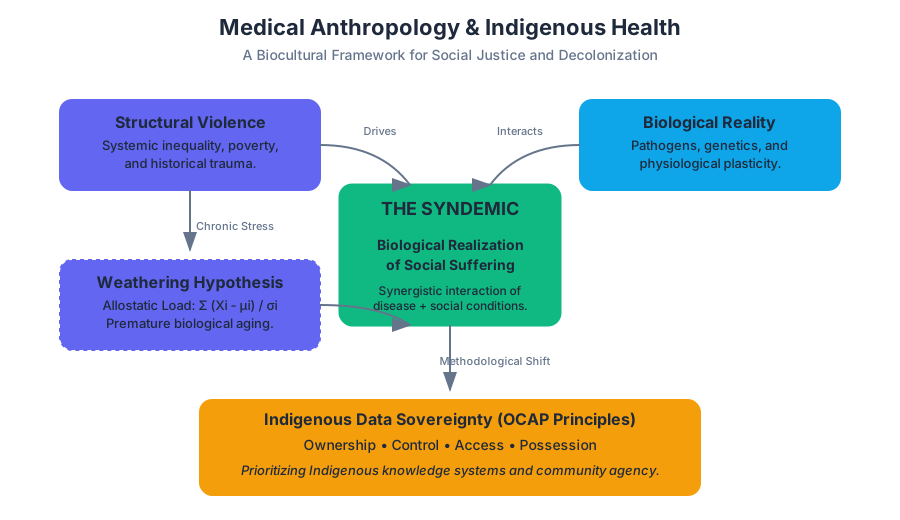
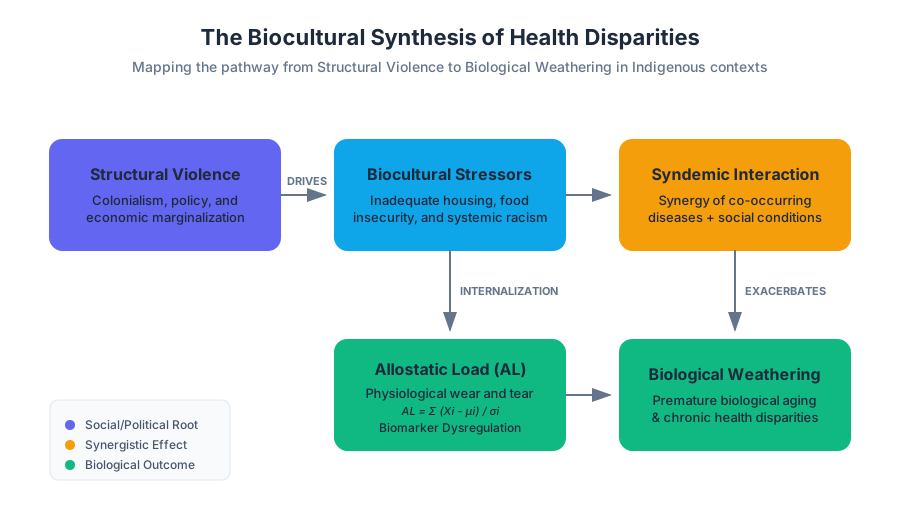
Anthropology on the Ground: Applied Research
Key concepts: Applied Anthropology · Ethical Considerations · Global Challenges · Public Policy · Community Engagement
Concludes the course by looking at how anthropological knowledge is applied to solve real-world problems.
Anthropology on the Ground: Applied Research
Applied anthropology represents the "praxis" of the discipline—the point where theoretical frameworks, ethnographic methods, and evolutionary insights intersect with real-world problem-solving. While academic anthropology focuses on the expansion of human knowledge for its own sake, Applied Anthropology is defined by its commitment to utility, intervention, and the mitigation of contemporary global challenges. Often referred to as the "fifth field," applied research utilizes the holistic, four-field approach (biological, archaeological, linguistic, and cultural) to inform public policy, improve healthcare outcomes, drive corporate innovation, and protect indigenous rights.
The Epistemology of Praxis: Defining Applied Research
At its core, applied research is the application of anthropological data, perspectives, theory, and methods to identify, assess, and solve social problems. Unlike pure research, which may prioritize the longue durée of human evolution or the abstract nuances of kinship systems, applied research is typically client-driven or community-oriented.
Definition: Applied Anthropology The sub-discipline of anthropology that uses the theories, methods, and ethnographic findings of the four traditional fields to solve practical problems, often involving collaboration with non-academic stakeholders such as NGOs, government agencies, and private corporations.
The transition from "ivory tower" observation to "on the ground" intervention requires a shift in focus from Etic (outsider) categorization to a synthesis of Emic (insider) understanding and policy-driven outcomes. This process is not merely a simplification of theory but a rigorous adaptation of it.
Table 1: Academic vs. Applied Anthropology
| Feature | Academic Anthropology | Applied Anthropology |
|---|---|---|
| Primary Goal | Knowledge production and theory building. | Problem-solving and policy intervention. |
| Audience | Fellow scholars and students. | Clients, stakeholders, and communities. |
| Timeframe | Long-term (years of longitudinal study). | Rapid (weeks to months; project-based). |
| Funding | Grants (NSF, Wenner-Gren) and universities. | Contracts, NGOs, and government budgets. |
| Output | Peer-reviewed journals and monographs. | Technical reports, policy briefs, and designs. |
Methodological Adaptations: Rapid Ethnographic Assessment (REA)
In the applied sector, researchers rarely have the luxury of the traditional "year in the field." To remain effective, applied anthropologists have developed Rapid Ethnographic Assessment Procedures (REAP). This methodology maintains the rigor of participant observation but compresses the timeline through targeted sampling and multi-disciplinary teams.
The REA pipeline typically follows a structured sequence:
- Iterative Reconnaissance: Preliminary site visits to identify key gatekeepers.
- Triangulation: Using multiple data sources (interviews, surveys, and spatial data) to cross-verify findings.
- Thematic Coding: Rapidly identifying recurring cultural patterns that impact the project goal.
Implementation: Analyzing Field Data with Python
In modern applied research, especially in large-scale public health or corporate projects, qualitative data is often processed using computational tools to identify trends across thousands of interview transcripts.
import pandas as pd
from collections import Counter
import re

def analyze_ethnographic_notes(filepath, keywords):
    """
    Processes raw field notes to extract frequency of specific
    cultural indicators or 'pain points' in a community project.
    """
    try:
        with open(filepath, 'r', encoding='utf-8') as f:
            text = f.read().lower()

        # Clean text: remove non-alphanumeric except spaces
        clean_text = re.sub(r'[^a-z\s]', '', text)
        words = clean_text.split()

        # Calculate term frequency for target indicators
        stats = {key: words.count(key.lower()) for key in keywords}
        total_words = len(words)

        # Normalize data: Frequency per 1000 words
        normalized = {k: (v / total_words) * 1000 for k, v in stats.items()}

        return pd.DataFrame([stats, normalized], index=['Raw Count', 'Frequency/1k'])
    except FileNotFoundError:
        return "Error: Field note file not found."

# Example Usage: Assessing water rights concerns in a rural district
indicators = ["water", "land", "boundary", "ancestral", "government"]
results = analyze_ethnographic_notes('field_notes_district_7.txt', indicators)
print(results)
Domains of Application
Applied anthropology is not a monolith; it manifests differently depending on the "host" field. The following subsections detail the most prominent domains where anthropological expertise is currently utilized.
Medical Anthropology and Public Health
Applied medical anthropologists work to bridge the gap between biomedicine (the Western clinical model) and ethnomedicine (local health beliefs). They are essential in managing epidemics, such as the Ebola outbreaks in West Africa, where cultural burial practices clashed with sanitary protocols. By identifying the "cultural logic" behind local practices, anthropologists can design interventions that are both medically sound and culturally respectful.
Corporate and Design Anthropology
In the private sector, anthropologists are hired to understand User Experience (UX). Companies like Intel, Microsoft, and Google employ anthropologists to observe how people actually use technology in their daily lives, rather than how they say they use it in focus groups. This is the study of the "Winkiness of Culture"—the subtle, often unconscious meanings behind human behavior.
Cultural Resource Management (CRM)
Rooted in archaeology, CRM is the most common form of applied anthropology in the United States. It involves the identification and protection of cultural heritage sites in the face of infrastructure development. This work is governed by laws such as the National Historic Preservation Act (NHPA).
Table 2: Methodological Tools in Applied Domains
| Domain | Primary Tool | Key Objective |
|---|---|---|
| Medical | Biocultural Analysis | Improving health equity and treatment adherence. |
| Corporate | Participant Observation | Identifying unmet consumer needs and UX friction. |
| Environmental | Political Ecology | Balancing conservation with indigenous land rights. |
| Forensic | Osteological Profiling | Identifying human remains in legal/disaster contexts. |
| Development | Social Impact Assessment | Evaluating the human cost of large-scale projects. |
The Ethics of Intervention: Navigating Power and Consent
The most significant challenge in applied research is the ethical complexity of "intervention." When an anthropologist works for a government or a corporation, their primary loyalty may be split between the employer and the community being studied.
The "Do No Harm" Principle
The American Anthropological Association (AAA) emphasizes that the researcher's first obligation is to the people they study. In applied settings, this is often complicated by Informed Consent—ensuring that participants understand not just that they are being studied, but how the data will be used by the sponsoring organization.
The Ethics of Representation Anthropologists must grapple with the "Western Bias" inherent in many development projects. Applied research often involves "translating" local needs into the language of bureaucracy, a process that risks stripping away the very cultural nuance the anthropologist was hired to preserve.
Mathematical Derivation: The Cost of Cultural Misalignment
In applied development, we can model the "Success Probability" ($P_s$) of a project as a function of technical resources ($R$) and Cultural Alignment ($A$). If cultural alignment is ignored (approaching zero), the entire project fails regardless of the resources invested.
P_s = R \cdot e^{-(1 - A)^2}
Where:
- $R \in [0, 1]$ represents resource efficiency.
- $A \in [0, 1]$ represents the degree of cultural alignment (1 = perfect alignment).
- As $A \to 0$, the exponential decay term $e^{-(1-A)^2}$ approaches $e^{-1} \approx 0.36$, significantly penalizing the project's success. In high-friction environments, the penalty is even steeper.
### Public Policy and Community Engagement

Applied anthropologists serve as mediators between marginalized communities and policy-makers. This involves **Advocacy Anthropology**, where the researcher takes an active stance in helping a community achieve its goals, such as securing land titles or linguistic recognition.

#### Case Study: Indigenous Land Rights and GIS
In many parts of the Amazon and Sub-Saharan Africa, indigenous groups lack formal maps of their ancestral territories. Applied anthropologists use **Geographic Information Systems (GIS)** to help these groups map their lands, combining oral histories with satellite data to create "counter-maps" that hold up in legal courts.

#### Real-World Usage: SQL for Cultural Heritage Management
A CRM professional might use a database to track the status of archaeological sites during a highway construction project.

```sql
-- Querying endangered sites within a 5km buffer of a construction zone
SELECT
    site_id,
    site_name,
    cultural_affiliation,
    protection_status,
    ST_Distance(geom, ST_GeomFromText('LINESTRING(0 0, 10 10)', 4326)) AS distance_to_road
FROM
    archaeological_sites
WHERE
    ST_DWithin(geom, ST_GeomFromText('LINESTRING(0 0, 10 10)', 4326), 5000)
    AND protection_status = 'Vulnerable'
ORDER BY
    distance_to_road ASC;
Challenges and Pitfalls in Applied Research
Applied research is fraught with "wicked problems"—challenges that are difficult to solve because of incomplete, contradictory, and changing requirements.
- The "Vulture" Critique: The risk that applied anthropologists extract data for corporate gain without returning value to the community.
- Compromised Objectivity: Working for a client can create pressure to produce results that favor the client's agenda.
- The Translation Gap: Policy-makers often want "hard numbers," while anthropologists provide "thick description." Bridging this gap without losing the "insider's point of view" is the hallmark of a skilled applied researcher.
Table 3: Common Pitfalls and Mitigations
| Pitfall | Description | Mitigation Strategy |
|---|---|---|
| Ethnocentric Imposition | Assuming Western solutions work in all contexts. | Employing Cultural Relativism during the design phase. |
| Stakeholder Conflict | Divergent interests between government and locals. | Acting as a neutral mediator/translator. |
| Data Privacy | Sensitive cultural knowledge being leaked. | Implementing strict anonymization and data sovereignty protocols. |
| Short-termism | Ignoring the long-term social consequences of an intervention. | Conducting Social Impact Assessments (SIA). |
Future Directions: The Digital and Environmental Frontier
As we move further into the 21st century, applied anthropology is evolving to meet new crises. Digital Anthropology now examines how online communities form and how algorithmic bias affects social inequality. Meanwhile, Climate Anthropology works with coastal communities to manage the cultural loss associated with rising sea levels, treating "managed retreat" not just as a logistical problem, but as a profound cultural trauma.
The discipline remains rooted in the Holistic Approach, recognizing that a change in one part of a system (e.g., a new economic policy) will inevitably ripple through the biological, linguistic, and social structures of a people. Applied research is the mechanism by which anthropology proves its relevance in a rapidly changing world, transforming the study of humanity into the service of humanity.
- Applied Anthropology: The use of anthropological methods and theories to solve practical, real-world problems.
- Praxis: The process by which a theory, lesson, or skill is enacted, embodied, or realized.
- REA (Rapid Ethnographic Assessment): A time-compressed version of traditional ethnography used in applied settings.
- Emic/Etic: The distinction between an insider's perspective (emic) and an outsider's analytical perspective (etic).
- CRM (Cultural Resource Management): The practice of managing cultural heritage, such as archaeological sites, usually required by law.
- Biocultural Approach: A research perspective that considers the interaction between biology and culture in human health and evolution.
- Informed Consent: The ethical requirement that research participants be fully aware of the study's goals and potential impacts.
- Advocacy Anthropology: A branch of applied anthropology where the researcher actively works to support the interests of the community being studied.
-
What is the primary difference between Academic and Applied Anthropology?
- A) Academic uses the four-field approach, while Applied does not.
- B) Academic focuses on theory production, while Applied focuses on problem-solving.
- C) Applied anthropology only uses archaeological methods.
- D) Academic anthropology is always funded by corporations. Answer: B
-
In the context of Medical Anthropology, what is "Biomedicine"?
- A) The study of herbal remedies.
- B) The Western clinical model of health based on biology and biochemistry.
- C) A form of indigenous healing.
- D) The study of ancient DNA. Answer: B
-
Why is "Informed Consent" particularly complex in Applied Anthropology?
- A) Because anthropologists don't like talking to people.
- B) Because the data may be owned by a third-party client like a corporation or government.
- C) Because it is not required by the AAA Code of Ethics.
- D) Because indigenous groups do not have the concept of consent. Answer: B
-
Which methodology is most likely to be used when a researcher has only three weeks to assess a community's water needs?
- A) Longitudinal Ethnography
- B) Participant Observation for 12 months
- C) Rapid Ethnographic Assessment (REA)
- D) Paleoanthropological Excavation Answer: C
-
What is the goal of Cultural Resource Management (CRM)?
- A) To sell artifacts to museums.
- B) To identify and protect heritage sites during construction and development.
- C) To manage the HR department of large cultural institutions.
- D) To translate ancient languages into English. Answer: B
Study Guide: Applied Anthropology
Key Themes
- The Fifth Field: Understand why applied research is considered the practical extension of the four traditional fields.
- The Role of the Anthropologist: Moving from "observer" to "facilitator," "mediator," and "advocate."
- Ethics vs. Utility: How to balance the "Do No Harm" principle with the demands of a paying client.
- Cross-Disciplinary Work: How anthropologists collaborate with engineers, doctors, and lawyers.
Critical Thinking Questions
- How does the concept of Cultural Relativism help an applied anthropologist working in a corporate setting?
- Can an anthropologist remain "objective" if they are being paid by a government to implement a specific policy?
- In what ways does Social Inequality manifest in the way development projects are designed and executed?
- How can Indigenous Knowledge be integrated into modern environmental conservation without being "colonized" or exploited?
Practical Skills to Master
- Thematic Coding: Learning to extract patterns from qualitative interviews.
- Policy Analysis: Translating ethnographic data into actionable recommendations.
- Spatial Analysis (GIS): Using mapping tools to represent cultural and ancestral boundaries.
- Ethical Reasoning: Applying the AAA Code of Ethics to complex, real-world scenarios.
Source Materials
- 1: What Is Anthropology?
- Introduction to Anthropology (OpenStax)
- Introductory Anthropology
- Cultural Anthropology
- Anthropology
- 7: Work, Life, and Value- Economic Anthropology
- Biological Anthropology
- Linguistic Anthropology
- 2: Methods- Cultural and Archaeological
- Archaeology
- 3: Culture Concept Theory- Theories of Cultural Change
- 4: Biological Evolution and Early Human Evidence
Study Anthropology with AI — Free on Lykke
Sign up for free to generate personalized flashcards, quizzes, and study guides from this course. Chat with an AI tutor that knows the material.
Get Started FreeView this course wiki on Lykke · Browse all public course wikis