From the free course Anthropology on Lykke
Biological Evolution and Early Human Evidence
Key concepts: Evolutionary Theory · Taxonomy · Genetics · Primatology · Hominin Origins
Examines the scientific principles of evolution, genetics, and the fossil record of early hominins.
Biological Evolution and Early Human Evidence
Biological anthropology—also known as physical anthropology—is the scientific discipline concerned with the biological and behavioral aspects of human beings, their related non-human primates, and their extinct hominin ancestors. It is a field that bridges the gap between the natural sciences and the social sciences, utilizing the rigorous frameworks of genetics, paleontology, and evolutionary biology to answer the fundamental question: How did we become human?
This article explores the mechanisms of biological evolution, the systematic classification of life, the genetic foundations of inheritance, and the fossil evidence that traces our lineage back to the earliest hominins.
Evolutionary Theory: The Engine of Change
Evolution is the change in the heritable characteristics of biological populations over successive generations. While Charles Darwin and Alfred Russel Wallace are credited with the theory of Natural Selection, the modern understanding—often called the Modern Synthesis—integrates Darwinian selection with Mendelian genetics and population biology.
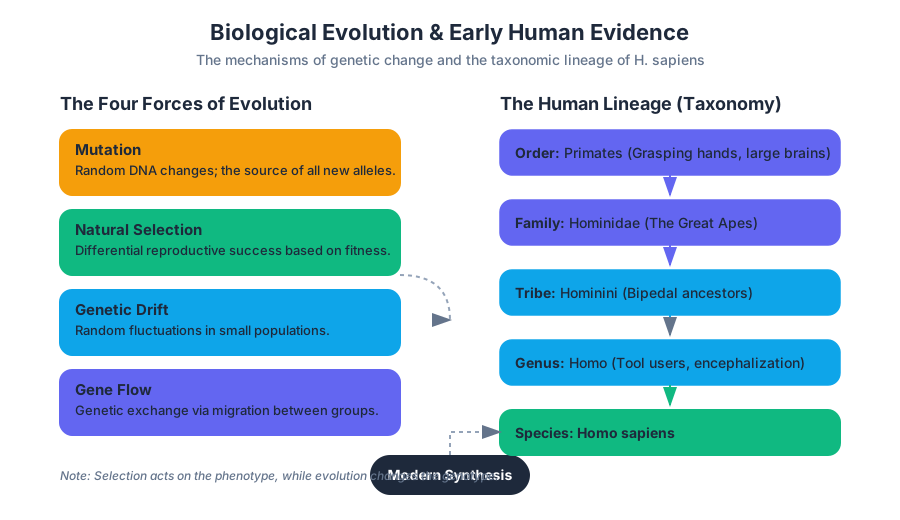
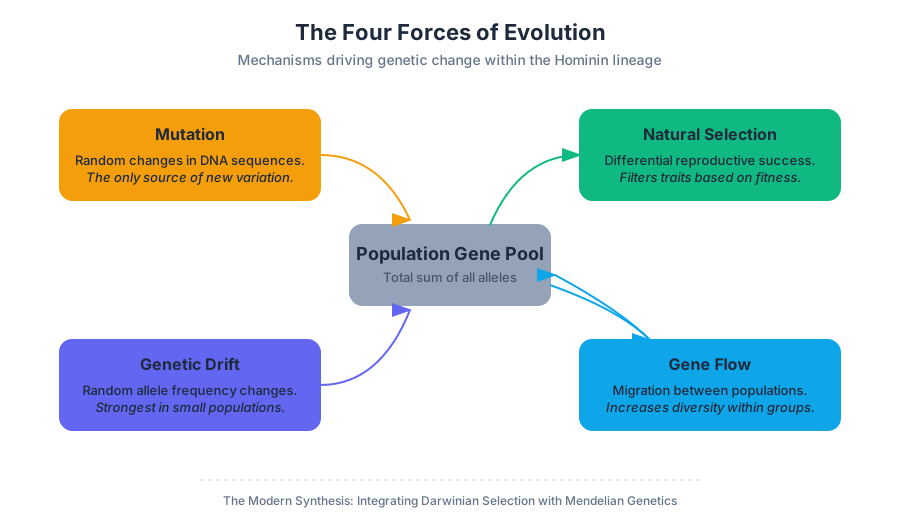
The Four Forces of Evolution
To understand how populations evolve, we must analyze the four primary mechanisms that alter allele frequencies within a gene pool.
| Force | Mechanism | Impact on Genetic Diversity |
|---|---|---|
| Mutation | Random changes in the DNA sequence. | Increases diversity; the only source of new alleles. |
| Natural Selection | Differential reproductive success based on heritable traits. | Generally decreases diversity by filtering "unfit" traits. |
| Genetic Drift | Random fluctuations in allele frequencies, especially in small populations. | Decreases diversity; can lead to the loss of rare alleles. |
| Gene Flow | The transfer of genetic material between populations (migration). | Increases diversity within a population; decreases differences between populations. |
Natural Selection and Fitness
Selection operates on the phenotype (the physical expression of traits) but changes the genotype (the underlying genetic makeup). Biological Fitness ($w$) is a measure of an individual's ability to survive and reproduce.
The Principle of Natural Selection: If a population has variation, if that variation is heritable, and if there is differential reproductive success, then the frequency of advantageous traits will increase over time.
Genetics: The Molecular Blueprint
The study of evolution is, at its core, the study of genetics. Genetics provides the "how" behind the "what" of physical change.
Mendelian vs. Population Genetics
Gregor Mendel’s work established the laws of inheritance: Segregation (alleles separate during gamete formation) and Independent Assortment (genes for different traits are inherited independently). Modern biological anthropology scales this up to Population Genetics, which examines the distribution of alleles across entire groups.
The Hardy-Weinberg Equilibrium
The Hardy-Weinberg Principle serves as a null hypothesis for evolutionary change. It states that allele and genotype frequencies in a population will remain constant from generation to generation in the absence of evolutionary influences.
The mathematical representation is: $$p^2 + 2pq + q^2 = 1$$ Where $p$ is the frequency of the dominant allele and $q$ is the frequency of the recessive allele.
Taxonomy: The Science of Classification
Taxonomy is the branch of science concerned with classification, especially of organisms. In biological anthropology, we use Cladistics, a method of classification according to the proportion of measurable characteristics that they have in common.
Linnaean Hierarchy and Phylogenetics
While Carl Linnaeus created the hierarchical system (Kingdom, Phylum, Class, Order, Family, Genus, Species), modern anthropologists focus on Phylogeny—the evolutionary history of a species.
| Rank | Human Classification | Significance |
|---|---|---|
| Order | Primates | Grasping hands, forward-facing eyes, large brains. |
| Suborder | Haplorrhini | "Dry-nosed" primates; includes tarsiers, monkeys, apes. |
| Family | Hominidae | The "Great Apes"; includes orangutans, gorillas, chimps, humans. |
| Tribe | Hominini | Humans and our extinct bipedal ancestors. |
| Genus | Homo | Large-brained, tool-using bipeds. |
| Species | Homo sapiens | Modern humans. |
Cladograms and Derived Traits
In cladistics, we distinguish between Ancestral Traits (shared with a distant ancestor) and Derived Traits (newly evolved traits not present in the ancestor). For example, five fingers is an ancestral trait for primates, while bipedalism is a derived trait for hominins.
Primatology: Our Living Relatives
Primatology is the study of non-human primates. By studying chimpanzees, bonobos, gorillas, and lemurs, anthropologists can infer the behaviors and biological constraints of our shared ancestors.
Primate Characteristics
Primates are defined by a suite of adaptations, many of which evolved for an arboreal (tree-dwelling) lifestyle:
- Generalized Skeletal Structure: Retention of the clavicle (collarbone) for high shoulder mobility.
- Enhanced Vision: Binocular, stereoscopic vision with color perception.
- Reduced Olfaction: A smaller snout and decreased reliance on smell.
- Opposable Thumbs and Big Toes: For powerful grasping (prehensile) capabilities.
- Encephalization: A high brain-to-body mass ratio, particularly in the neocortex.
The Primate Divide: Strepsirrhini vs. Haplorrhini
The primate order is split into two major suborders based on nasal morphology and evolutionary history.
| Feature | Strepsirrhini (e.g., Lemurs, Lorises) | Haplorrhini (e.g., Monkeys, Apes, Humans) |
|---|---|---|
| Nose | Wet (Rhinarium) | Dry |
| Activity Pattern | Mostly Nocturnal | Mostly Diurnal |
| Brain Size | Smaller relative to body | Larger relative to body |
| Vitamin C | Can synthesize internally | Must consume via diet |
| Post-orbital Closure | Open (Post-orbital bar only) | Closed (Post-orbital plate) |
Insight: The transition from Strepsirrhini to Haplorrhini represents an evolutionary shift from a reliance on scent and night-vision to a reliance on complex social interaction and high-acuity daytime vision.
Hominin Origins: The Path to Bipedalism
The term Hominin refers to the group consisting of modern humans, extinct human species, and all our immediate ancestors (including members of the genera Homo, Australopithecus, Paranthropus, and Ardipithecus).
The Fossil Evidence of Bipedalism
The defining characteristic of the hominin lineage is obligate bipedalism (walking on two legs as the primary mode of locomotion). This shift required massive anatomical reorganization.
- Foramen Magnum: The hole at the base of the skull moves forward to sit directly atop the spine.
- S-Shaped Spinal Curvature: Acts as a shock absorber for upright weight.
- Pelvis Shape: Becomes shorter and broader (bowl-shaped) to support internal organs and provide attachment for gluteal muscles.
- Valgus Angle: The femur angles inward from the hip to the knee, keeping the center of gravity over the feet.
- Non-opposable Hallux: The big toe aligns with other toes to provide a "toe-off" lever during walking.
Early Hominin Candidates
The "missing link" is a misnomer; rather, the fossil record shows a "bushy" tree of evolution with many co-existing species.
- Sahelanthropus tchadensis (~7–6 mya): Found in Chad; possesses a surprisingly flat face and a forward-positioned foramen magnum.
- Orrorin tugenensis (~6 mya): Found in Kenya; femur morphology suggests bipedalism.
- Ardipithecus ramidus (~4.4 mya): "Ardi" shows a mosaic of traits—bipedal on the ground but possessed a grasping big toe for climbing.
The following LaTeX block derives the Selection Coefficient ($s$), which quantifies the intensity of selection against a specific phenotype, a critical calculation when analyzing how early hominin traits (like bipedalism) might have been favored.
% Derivation of Selection Coefficient (s)
% Let w_11, w_12, w_22 be the fitness of genotypes AA, Aa, and aa.
% If 'aa' is the deleterious phenotype:
w_11 = 1
w_12 = 1
w_22 = 1 - s

% The average fitness of the population (w_bar) is:
\bar{w} = p^2(1) + 2pq(1) + q^2(1 - s)
\bar{w} = 1 - sq^2

% The frequency of the 'a' allele in the next generation (q') is:
q' = \frac{pq + q^2(1 - s)}{1 - sq^2}
q' = \frac{q(1 - sq)}{1 - sq^2}

% The change in allele frequency (delta q) is:
\Delta q = q' - q = \frac{-spq^2}{1 - sq^2}
Evolution in Action: Case Studies
Evolution is not just a historical process; it is observable in the present.
Sickle Cell Anemia and Malaria
This is a classic example of Balanced Polymorphism and Heterozygote Advantage.
- Genotype SS: Normal hemoglobin, but susceptible to Malaria.
- Genotype ss: Sickle cell anemia (often fatal without treatment).
- Genotype Ss: "Sickle cell trait." These individuals do not have severe anemia and are resistant to Malaria.
In regions where Malaria is endemic, the
sallele is maintained in the population because the heterozygote (Ss) has the highest fitness.
Genomic Analysis
With the advent of Next-Generation Sequencing (NGS), we can now compare the entire genomes of humans and extinct relatives like Neanderthals and Denisovans.
Common Pitfalls and Misconceptions
- "Evolution is just a theory": In science, a theory is a well-substantiated explanation of some aspect of the natural world. It is not a "guess."
- The "March of Progress": Evolution is not a linear ladder leading to humans. It is a branching tree. Many hominin species went extinct without leaving descendants.
- Survival of the Fittest: This does not mean "survival of the strongest." It means survival of those best suited to their immediate environment who manage to reproduce.
- Teleology: Evolution has no goal. Humans are not the "intended" outcome of evolution; we are simply one surviving branch of a complex biological history.
Source Materials
Study Anthropology on Lykke
This course page is free to open: signed out, you can read its first two sections, and signing in, on any plan, opens the rest. The free Lykke Chrome extension syncs your own Canvas courses, so ChatGPT, Claude and Muse can answer from your classes and deadlines. It only reads Canvas.
Add the free extensionSign in to open every section