From the free course Anthropology on Lykke
Research Methods: Cultural and Archaeological
Key concepts: Ethnography · Participant Observation · Excavation · Qualitative Analysis · Conservation
Explores the foundational research methodologies used to gather and analyze data in cultural anthropology and archaeology.
Research Methods: Cultural and Archaeological
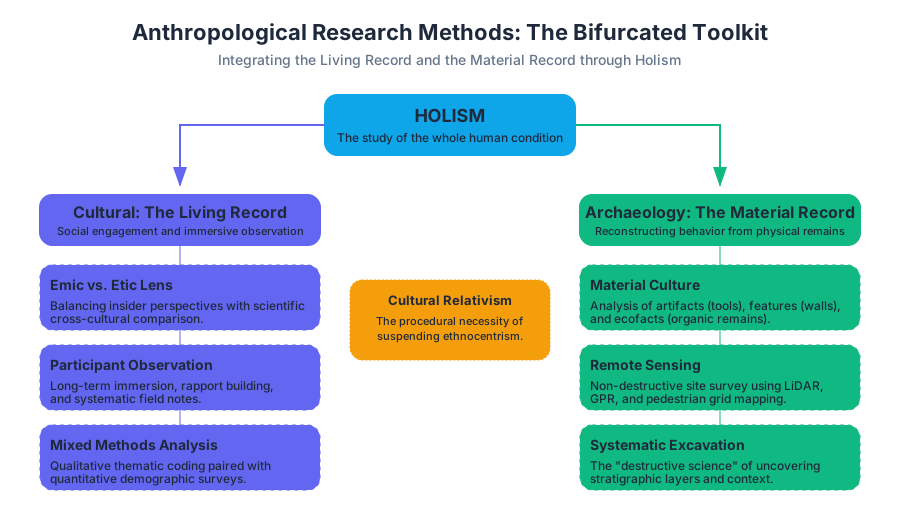
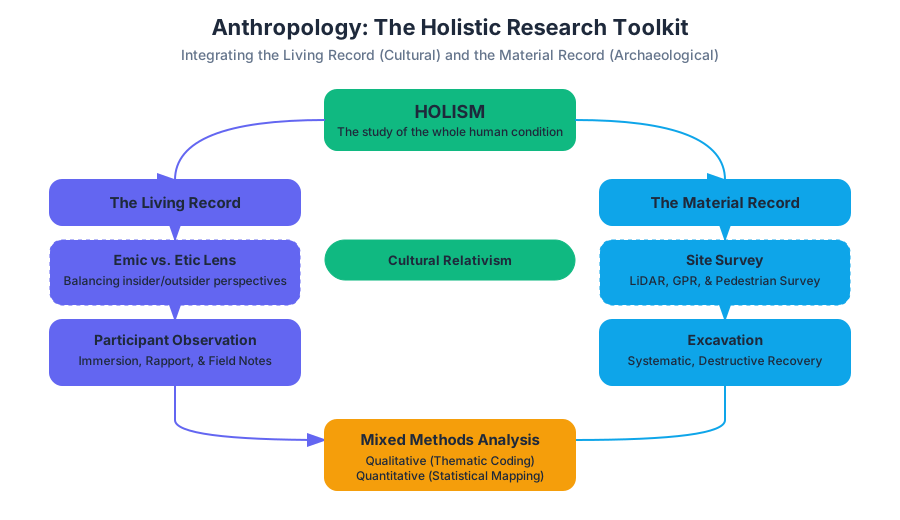
Anthropology is defined by its commitment to holism—the study of the whole of the human condition: past, present, and future; biology, society, language, and culture. To achieve this, researchers employ a bifurcated yet integrated toolkit of methodologies. While cultural anthropologists focus on the "living record" through immersive social engagement, archaeologists reconstruct human behavior through the "material record."
This section provides a technical deep dive into the rigorous protocols used to extract meaning from both human interaction and the physical remains of the past. We will examine the transition from raw data collection to the sophisticated qualitative and quantitative analyses that define modern social science.
The Epistemological Foundation: Emic vs. Etic
Before engaging in fieldwork, a researcher must establish their analytical lens. Anthropological methodology is built upon the tension between two perspectives:
- Emic Perspective: The "insider’s" point of view. The goal is to understand how local people think, perceive the world, and explain their own rules for behavior.
- Etic Perspective: The "outsider’s" or scientist’s point of view. This shifts the focus from local observations and categories to those of the anthropologist, emphasizing cross-cultural comparison and theoretical generalization.
The Principle of Cultural Relativism: The methodological requirement that a researcher suspend their own cultural biases and "ethnocentrism" to understand a culture on its own terms. It is not a moral judgment, but a procedural necessity for objective data collection.
Cultural Research Methods: The Living Record
Cultural anthropology relies heavily on Ethnography, a research strategy involving long-term immersion in a community. Unlike the "armchair anthropologists" of the 19th century, modern researchers utilize a suite of field-tested techniques.
Participant Observation
The "gold standard" of cultural methods, Participant Observation, requires the researcher to live within a community, participating in daily activities while simultaneously maintaining a systematic record of observations. This method bridges the gap between what people say they do and what they actually do.
| Method Component | Description | Primary Goal |
|---|---|---|
| Rapport Building | Establishing trust and a "place" within the social hierarchy. | Access to sensitive or private cultural data. |
| Field Notes | Continuous, detailed journaling of events, sensory data, and conversations. | Raw data for later qualitative coding. |
| Key Informants | Identifying individuals with specialized knowledge (elders, healers, leaders). | Deep-dive insights into specific cultural niches. |
| Genealogy | Mapping kinship, descent, and marriage patterns. | Understanding social structure and resource inheritance. |
Qualitative and Quantitative Analysis
Modern ethnography is rarely purely descriptive. It utilizes Mixed Methods to validate findings. Qualitative Analysis focuses on the "why" and "how" of human behavior (thematic coding of interviews), while Quantitative Analysis provides the "how many" or "how often" (statistical surveys, demographic mapping).
Archaeological Research Methods: The Material Record
Archaeology is essentially the "anthropology of the past." Because the subjects cannot be interviewed, archaeologists must use the Material Culture (artifacts, features, and ecofacts) to reconstruct social systems.
Site Survey and Remote Sensing
Before a shovel hits the ground, researchers must locate and map potential sites. Modern archaeology utilizes Non-Destructive Sensing to "see" beneath the surface.
- LiDAR (Light Detection and Ranging): Using laser pulses from aircraft to map terrain through dense vegetation.
- GPR (Ground Penetrating Radar): Using radar pulses to image subsurface structures like walls or burial pits.
- Pedestrian Survey: Walking across a landscape in a grid pattern to identify surface scatters of artifacts.
Excavation: The Destructive Science
Excavation is the systematic uncovering of remains. It is inherently destructive; once a site is excavated, it is gone forever. Therefore, meticulous recording is mandatory.
The core principle of excavation is Stratigraphy, based on the Law of Superposition: in an undisturbed sequence of strata, the oldest layers are at the bottom and the youngest are at the top.
The Wheeler-Kenyon Method: An excavation technique that involves digging deep vertical trenches to expose the stratigraphy of a site, while leaving "baulks" (walls of earth) between squares to preserve the vertical record of the layers.
Dating Methods: Relative vs. Absolute
Determining the age of an artifact is critical for establishing a timeline of cultural change.
| Method Type | Technique | Basis | Range/Precision |
|---|---|---|---|
| Relative | Stratigraphy | Position in soil layers | "Older than" or "Younger than" |
| Relative | Seriation | Styles of pottery/tools over time | Chronological ordering of assemblages |
| Absolute | Radiocarbon (C-14) | Decay of Carbon-14 isotopes | Up to 50,000 years ago |
| Absolute | Dendrochronology | Tree-ring growth patterns | Calendar-year precision |
| Absolute | Potassium-Argon | Decay of K-40 into Argon gas | 100,000 to billions of years (Volcanic rock) |
To calculate an absolute date using Radiocarbon dating, we use the radioactive decay formula. Carbon-14 has a half-life ($t_{1/2}$) of approximately 5,730 years.
N(t) = N_0 \cdot e^{-\lambda t}
Where:
- $N(t)$ is the remaining amount of the isotope.
- $N_0$ is the initial amount of the isotope.
- $\lambda$ (the decay constant) is $\frac{\ln(2)}{t_{1/2}}$.
- $t$ is the time elapsed.
To find the age ($t$):
t = \frac{\ln(N_0 / N(t))}{\lambda}
Conservation and Post-Fieldwork Analysis
The work does not end when the researcher leaves the field. In fact, for every hour spent in the field, approximately five to ten hours are spent in the lab.
Conservation
Conservation is the process of stabilizing artifacts to prevent further deterioration. Artifacts that have been buried for centuries are often in a state of equilibrium with their environment; sudden exposure to oxygen, light, or humidity can cause rapid decay.
- Organic Materials: Wood or leather from waterlogged sites must be treated with PEG (Polyethylene Glycol) to replace water in the cellular structure.
- Metals: Electrolysis is often used to remove salts and corrosion from iron or bronze objects.
Data Management and Curation
Modern archaeology and ethnography generate massive amounts of data. This data must be curated using standardized metadata schemas to ensure it is searchable and accessible for future generations of researchers.
Applied Anthropology and Ethics
Methodology is not just about "how" we study, but "why" and "for whom." Applied Anthropology uses these methods to solve contemporary problems, such as:
- Medical Anthropology: Studying how different cultures perceive disease to improve healthcare delivery.
- Cultural Resource Management (CRM): Assessing archaeological sites before construction projects (mandated by laws like Section 106 in the US).
- Indigenous Anthropology: Collaborating with Indigenous communities to ensure they have control over their own heritage and data (repatriation).
Common Pitfalls in Research
- The Hawthorne Effect: Participants may change their behavior because they know they are being observed.
- Taphonomic Bias: In archaeology, the "fossil record" is biased toward materials that preserve well (stone, bone) versus those that don't (wood, textiles, skin).
- Ethnocentric Projection: Assuming that ancient people or foreign cultures had the same motivations or logic as the researcher's own culture.
| Pitfall | Domain | Mitigation Strategy |
|---|---|---|
| Observer Bias | Cultural | Long-term immersion (12+ months) to become "background." |
| Sampling Bias | Archaeological | Random probability sampling and deep-trench testing. |
| Ethics Violations | Both | Institutional Review Board (IRB) oversight and Informed Consent. |
Summary of Key Concepts
In this deep dive, we have explored the rigorous methodologies that allow anthropologists to reconstruct human life. From the Participant Observation of the cultural anthropologist to the Stratigraphic Excavation of the archaeologist, these methods are designed to minimize bias and maximize the "insider’s" understanding. Whether through Python-based thematic analysis or the chemical stabilization of 3,000-year-old pottery, the goal remains the same: to document the vast diversity and shared heritage of the human species.
Source Materials
Study Anthropology on Lykke
This course page is free to open: signed out, you can read its first two sections, and signing in, on any plan, opens the rest. The free Lykke Chrome extension syncs your own Canvas courses, so ChatGPT, Claude and Muse can answer from your classes and deadlines. It only reads Canvas.
Add the free extensionSign in to open every section