From the free course Writing Guide on Lykke
The Writing Process and Rhetorical Strategies
Key concepts: Writing process and strategies · Rhetorical strategies · Empathy in composition
Exploration of the recursive writing process and the application of rhetorical strategies rooted in empathy.
The Writing Process and Rhetorical Strategies
The act of composition is often misunderstood as a linear progression from thought to paper. In reality, professional writing is a recursive system—a complex feedback loop of cognitive processes, social awareness, and technical execution. To master writing is to master the "Rhetorical Situation," a framework that balances the needs of the writer, the audience, and the subject matter within a specific context.
The Recursive Writing Process: A Systems View
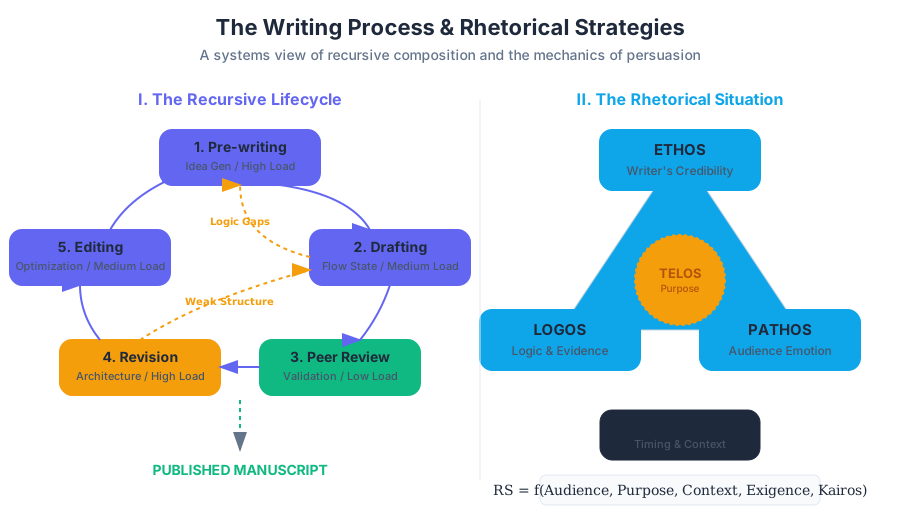
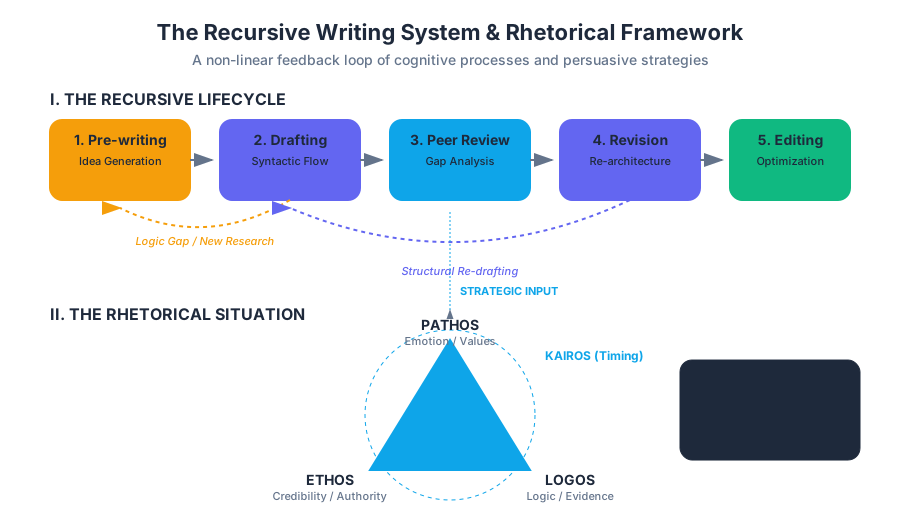
Writing is not a assembly line; it is a series of overlapping cycles. A writer does not simply "finish" pre-writing and move to drafting; they may find during the drafting phase that their thesis is untenable, requiring a return to the pre-writing phase to re-examine evidence.
Definition: Recursion in Composition The property of a process where the output of one stage serves as the input for a previous stage, allowing for continuous refinement and the emergence of complex ideas that were not visible at the start.
The Five Stages of the Lifecycle
| Stage | Primary Objective | Key Deliverable | Cognitive Load |
|---|---|---|---|
| Pre-writing | Idea generation and constraint mapping | Outline, Brainstorm, Research notes | High (Creative/Generative) |
| Drafting | Converting abstract ideas into syntax | "Shitty First Draft" (SFD) | Medium (Flow-state focused) |
| Peer Review | External validation and gap analysis | Feedback matrix, Critique | Low (Receptive) |
| Revision | Structural re-architecture | Substantive rewrite, logic check | High (Analytical/Critical) |
| Editing | Surface-level optimization | Polished manuscript | Medium (Detail-oriented) |
Modeling the Process
To understand the recursive nature of writing, we can model the transition between states using a state-machine logic.
Rhetorical Strategies: The Mechanics of Persuasion
Rhetoric is the art of identifying the available means of persuasion in any given case. It is the "API" through which a writer interacts with the reader's cognitive and emotional architecture.
The Rhetorical Triangle and the "Big Three"
Aristotle’s classical appeals—Ethos, Pathos, and Logos—remain the foundational pillars of effective communication. However, modern rhetoric adds Kairos (timing) and Telos (purpose) to this mix.
- Ethos (Credibility): Establishing the writer's authority and character. It answers the reader's question: Why should I trust you?
- Logos (Logic): The internal consistency of the argument. It utilizes data, syllogisms, and inductive/deductive reasoning.
- Pathos (Emotion): Tapping into the audience's values and feelings. It creates a "bridge" of shared experience.
The Rhetorical Situation Formula
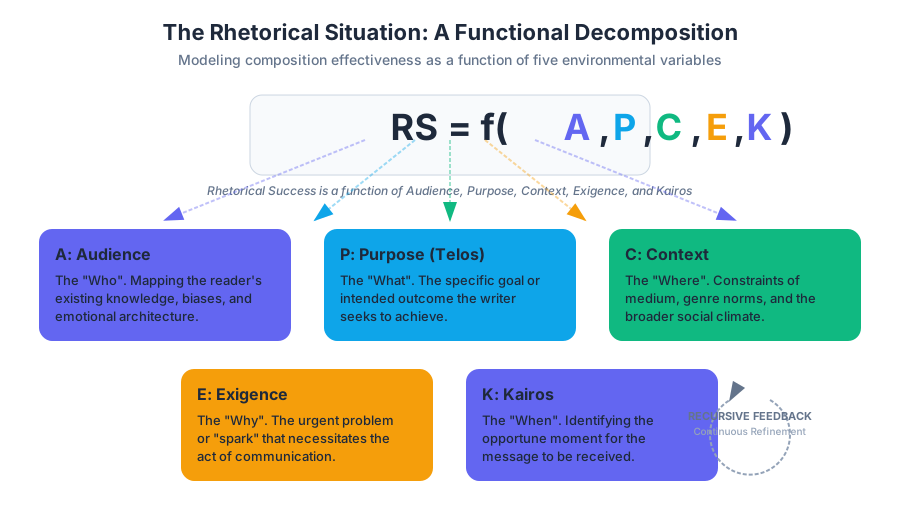
The effectiveness of a piece of writing can be modeled as a function of its alignment with the Rhetorical Situation ($RS$):
$$RS = f(A, P, C, E, K)$$
Where:
- $A$ = Audience (Who is reading?)
- $P$ = Purpose (What is the goal?)
- $C$ = Context (What are the surrounding circumstances?)
- $E$ = Exigence (What is the immediate "spark" or need for this writing?)
- $K$ = Kairos (Is the timing optimal?)
Comparative Analysis of Rhetorical Appeals
| Appeal | Domain | Primary Tools | Risk of Overuse |
|---|---|---|---|
| Ethos | Character | Citations, professional tone, credentials | Arrogance, elitism |
| Logos | Intellect | Statistics, logical proofs, case studies | Dryness, "Analysis Paralysis" |
| Pathos | Heart | Narrative, vivid imagery, metaphors | Manipulation, sentimentality |
| Kairos | Time | Current events, urgency, relevance | Opportunism, "Hot takes" |
Empathy in Composition: Intersectional Rhetoric
Empathy is often dismissed as a "soft" skill, but in composition, it is a high-level cognitive strategy. It involves Audience Mapping—the process of identifying the reader's existing mental models, biases, and emotional state.
The Empathy Gap
The "Empathy Gap" occurs when a writer assumes the reader possesses the same foundational knowledge or values as they do. To bridge this, writers must employ Inclusive Rhetoric, which acknowledges intersectional identities (race, gender, class, ability) and avoids alienating language.
Theorem of Audience Alignment The probability of persuasion ($P_p$) is inversely proportional to the distance ($d$) between the writer's assumptions and the reader's lived reality. As $d \to 0$, $P_p \to 1$.
Worked Example: Audience Mapping
Suppose you are writing a proposal for a new municipal bike lane.
- Audience A (Commuters): Focus on time-saving (Logos) and safety (Pathos).
- Audience B (Business Owners): Focus on increased foot traffic and property value (Logos/Ethos).
- Audience C (City Council): Focus on budget efficiency and environmental mandates (Logos/Kairos).
Genre-Based Writing and Conventions
A Genre is not just a category (like "horror" or "technical manual"); it is a set of social conventions that act as a "contract" between writer and reader. When you write within a genre, you are using a pre-existing template of expectations.
Genre Constraints
Different genres prioritize different rhetorical appeals. A scientific paper is heavily weighted toward Logos and Ethos, while a political speech may lean into Pathos and Kairos.
\text{Genre Weighting (W)} = \{ \omega_{ethos}, \omega_{logos}, \omega_{pathos}, \omega_{kairos} \}
\\
\text{Scientific Paper: } W = \{ 0.4, 0.5, 0.05, 0.05 \}
\text{Political Manifesto: } W = \{ 0.2, 0.2, 0.4, 0.2 \}
Common Pitfalls in Genre Adherence
- Tone Mismatch: Using academic jargon in a blog post for laypeople.
- Structural Violation: Failing to include an abstract in a formal report.
- Convention Blindness: Ignoring the "Inclusive Rhetoric" standards of a modern field (e.g., using gendered pronouns in a technical manual).
Visual Learning and Multimodal Rhetoric
Modern writing is rarely just text. Multimodal Rhetoric involves the integration of images, charts, and interactive elements to support the written word.
The Role of Visuals
Visuals serve three primary rhetorical functions:
- Cognitive Offloading: Using a diagram to explain a complex system (Logos).
- Emotional Impact: Using a photograph to evoke sympathy (Pathos).
- Professionalism: High-quality design signals authority (Ethos).
Common Pitfalls and Anti-Patterns
Even with a strong process, writers often fall into "rhetorical traps."
| Pitfall | Description | Correction |
|---|---|---|
| The "Echo Chamber" Effect | Writing only for those who already agree with you. | Use Rogerian Argument techniques to acknowledge counter-arguments. |
| The "Thesaurus" Trap | Using overly complex words to sound "smarter" (False Ethos). | Prioritize clarity; use the simplest word that maintains the precise meaning. |
| Linear Rigidity | Refusing to change the outline once drafting has begun. | Embrace the recursive nature; if the data contradicts the outline, change the outline. |
| Logical Fallacies | Errors in reasoning (e.g., Ad Hominem, Strawman). | Peer review specifically for "Logos" integrity. |
Summary of the Writing Lifecycle
The transition from a novice writer to an expert involves moving from a "knowledge-telling" model (simply dumping facts) to a "knowledge-transforming" model (shaping facts to achieve a specific rhetorical goal). By treating the writing process as a recursive engineering task and applying the principles of empathy and classical rhetoric, writers can produce work that is not only clear but deeply influential.
Source Materials
Study Writing Guide on Lykke
This course page is free to open: signed out, you can read its first two sections, and signing in, on any plan, opens the rest. The free Lykke Chrome extension syncs your own Canvas courses, so ChatGPT, Claude and Muse can answer from your classes and deadlines. It only reads Canvas.
Add the free extensionSign in to open every section