From the free course Writing Guide on Lykke
Genre-Based Writing and Inclusive Rhetoric
Key concepts: Genre-based writing · Inclusive rhetoric · Intersectional identities
An introduction to writing through the lens of specific genres and the importance of inclusive, intersectional communication in modern composition.
Genre-Based Writing and Inclusive Rhetoric
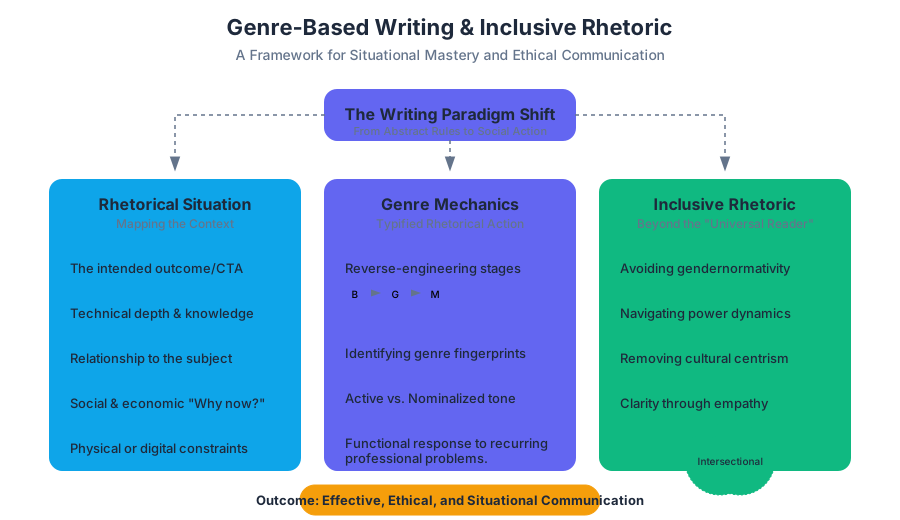
In the contemporary landscape of composition and professional communication, the transition from "general writing skills" to Genre-Based Writing represents a paradigm shift from abstract rule-following to situational mastery. This approach posits that writing does not exist in a vacuum; rather, it is a functional response to recurring social and professional situations. When coupled with Inclusive Rhetoric and an understanding of Intersectional Identities, writing becomes a tool for navigating complex power dynamics and ensuring that communication is both ethically sound and technically effective.
Genre-Based Writing: The Architecture of Social Action
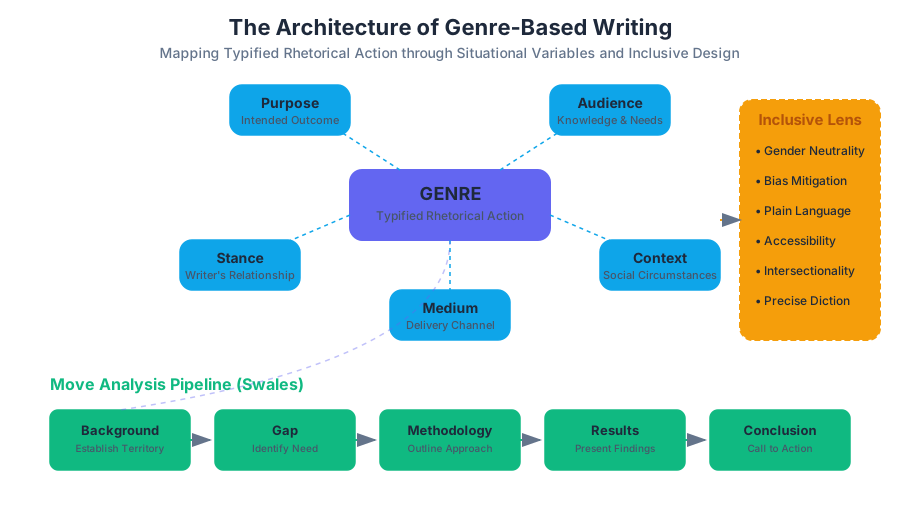
At its core, genre is not merely a set of templates or a filing system for documents. In rhetorical theory, genre is defined as typified rhetorical action. This means that a genre (such as a technical white paper, a legal brief, or a personal memoir) emerges because people encounter similar problems and develop similar ways of responding to them through text.
Definition: Genre-Based Writing The practice of analyzing, deconstructing, and composing texts by identifying the specific conventions, audience expectations, and social purposes inherent to a particular category of communication.
The Rhetorical Situation
To master any genre, a writer must first map the Rhetorical Situation. This is the context in which the writing occurs, defined by the interplay of five primary variables:
| Variable | Definition | Technical Implication |
|---|---|---|
| Purpose | The intended outcome of the text (e.g., to persuade, inform, or document). | Determines the "Call to Action" (CTA) and success metrics. |
| Audience | The specific group(s) who will consume the text. | Dictates the technical depth, tone, and assumed knowledge. |
| Stance | The writer’s relationship to the subject and the audience. | Influences the use of first-person vs. third-person and emotional affect. |
| Context | The broader social, political, or economic circumstances. | Affects the urgency and the "why now" of the communication. |
| Medium | The physical or digital channel of delivery (e.g., PDF, Slack, Print). | Constrains formatting, length, and interactivity. |
How Genre Functions: The "Moves" Analysis
Experienced writers use a technique called Move Analysis (pioneered by John Swales) to reverse-engineer a genre. By looking at successful examples, a writer identifies the "moves" or functional stages of a document. For instance, a Research Abstract typically follows a Background -> Gap -> Methodology -> Results -> Conclusion pipeline.
Analyzing Genre Constraints
When a writer approaches a new genre, they must perform a constraint audit.
Inclusive Rhetoric: Beyond Neutrality
Inclusive Rhetoric is the intentional use of language that recognizes diversity, avoids the perpetuation of stereotypes, and actively seeks to include marginalized perspectives. It challenges the "Universal Reader" myth—the idea that there is a default, neutral audience member (often historically conceptualized as white, male, cisgender, and able-bodied).
The Mechanics of Empathy and Bias Mitigation
Inclusive rhetoric is not about "political correctness"; it is about rhetorical precision. Using vague or biased language reduces the clarity of the message and alienates segments of the audience, thereby failing the primary goal of communication.
| Bias Type | Definition | Inclusive Alternative |
|---|---|---|
| Gendernormativity | Assuming a binary or specific gender for roles (e.g., "The doctor... he"). | Use gender-neutral singular "they" or pluralize the subject. |
| Ableism | Using disability-related terms as metaphors for negative traits (e.g., "blind to the facts"). | Use precise descriptors: "unaware of," "ignoring," or "limited." |
| Ageism | Generalizing capabilities based on age (e.g., "digital natives" vs. "technologically challenged"). | Describe specific skills or behaviors without attributing them to age. |
| Cultural Centrism | Assuming local idioms or cultural references are universal. | Use "Plain Language" and avoid metaphors that require specific cultural capital. |
Mathematical Modeling of Rhetorical Impact
We can conceptualize the effectiveness of a text ($E$) as a function of its Genre Alignment ($G$) and its Inclusivity Coefficient ($I$), modulated by the Audience Receptivity ($R$).
E = \int_{0}^{t} (G \cdot I) \cdot R(t) \, dt
Where:
- $G \in [0, 1]$ represents how well the text adheres to or effectively subverts genre conventions.
- $I \in [0, 1]$ represents the degree to which the language is inclusive and accessible.
- $R(t)$ is a time-dependent function of audience attention and bias.
If $I$ approaches zero (highly exclusive or biased language), the total effectiveness $E$ drops precipitously, regardless of how "perfect" the genre alignment $G$ might be.
Intersectional Identities in Composition
Intersectionality, a term coined by Kimberlé Crenshaw, describes how various social identities (race, class, gender, sexuality, ability, etc.) overlap to create unique modes of discrimination and privilege. In the context of writing, intersectionality applies to both the writer's positionality and the audience's lived experience.
Positionality and the Writer's Voice
A writer’s identity influences their "voice"—the personality and authority they project on the page. An intersectional approach to writing requires reflexivity: acknowledging how one's own background shapes their perspective and the power dynamics inherent in the act of writing.
Key Insight: The Myth of the Objective Narrator No writer is truly objective. Every text is situated within the writer's intersectional identity. Acknowledging this positionality often increases a writer's credibility (ethos) rather than diminishing it.
Intersectional Audience Analysis
When writing for a diverse audience, an intersectional lens prevents "flattening." For example, a policy proposal regarding "women's health" that fails to consider how race and socioeconomic status affect healthcare access is rhetorically incomplete.
Synthesis: The Integrated Writing Process
The most effective writing occurs at the intersection of these three concepts. A writer uses Genre-Based techniques to structure the document, Inclusive Rhetoric to ensure the language is accessible and respectful, and an Intersectional lens to ensure the content reflects the complexity of the real world.
The Workflow Pipeline
- Discovery: Identify the genre and the rhetorical situation.
- Research: Gather data, paying specific attention to intersectional variables.
- Drafting: Use "Move Analysis" to build the skeleton of the document.
- Audit: Review the draft using an inclusivity checklist or automated tool.
- Refinement: Adjust tone and stance based on audience feedback.
Case Study: The Technical Progress Report
Consider a Senior Engineer writing a progress report for a multinational board of directors.
- Genre: Progress Report. (Expectations: Brevity, data-driven, clear milestones).
- Inclusive Rhetoric: The engineer avoids jargon that might exclude non-technical board members (accessibility) and uses gender-neutral language when referring to the development team.
- Intersectionality: The report notes that the new software feature was tested for accessibility across different regions, acknowledging that users in low-bandwidth areas (class/geography) face different challenges than those in high-speed hubs.
Common Pitfalls and Misconceptions
Writing with these frameworks is complex and prone to specific errors.
| Pitfall | Description | Correction |
|---|---|---|
| Genre Rigidity | Following genre "rules" so strictly that the writing becomes robotic or fails to adapt to a unique situation. | Treat genre as a "flexible toolkit" rather than a "straitjacket." |
| Tokenism | Including a single mention of a marginalized group to appear inclusive without changing the underlying biased logic. | Integrate intersectional analysis into the core data and arguments of the text. |
| Performative Inclusivity | Using "inclusive" buzzwords while the actual content remains inaccessible or exclusionary. | Focus on "Plain Language" and functional accessibility over trendy terminology. |
| The "Neutral" Trap | Believing that technical or scientific writing is "above" identity politics. | Recognize that even data visualization choices (e.g., color palettes) can be exclusionary. |
Advanced Perspectives: Rhetorical Empathy
Beyond simple word choice, Rhetorical Empathy involves a deep cognitive shift. It requires the writer to move from "writing about an audience" to "writing with an audience." This is particularly critical in genres like the Proposal or the Community Impact Statement, where the writer's stance can either build a bridge or create a barrier.
The "Empathy Map" in Writing
Before drafting, writers can use an Empathy Map to align their intersectional understanding with their genre moves:
- What does the reader SEE? (The visual layout, the professional branding).
- What does the reader HEAR? (The tone of voice, the subtext of the stance).
- What does the reader THINK/FEEL? (Their anxieties about the project, their hopes for a solution).
- What does the reader DO? (The specific action the genre is designed to trigger).
Conclusion: The Future of Composition
As AI-generated text becomes more prevalent, the human element of Genre-Based Writing and Inclusive Rhetoric becomes more valuable. Machines are excellent at mimicking genre patterns (the "what"), but they often struggle with the nuanced ethical and intersectional demands of inclusive communication (the "how" and "why"). The modern writer must be a "Rhetorical Architect"—someone who can design communication systems that are not only structurally sound but also socially responsible and universally accessible.
Source Materials
Study Writing Guide on Lykke
This course page is free to open: signed out, you can read its first two sections, and signing in, on any plan, opens the rest. The free Lykke Chrome extension syncs your own Canvas courses, so ChatGPT, Claude and Muse can answer from your classes and deadlines. It only reads Canvas.
Add the free extensionSign in to open every section