Writing Guide
Institution: MIT
1 study materials · 3 sections
OpenStax provides high-quality, peer-reviewed textbooks for college courses at no cost, aiming to increase educational accessibility and affordability. This specific course focuses on 'The Writing Guide with Handbook,' a resource tailored for first-year composition students. It integrates genre-based instruction with a focus on inclusive rhetoric and intersectional identities, helping students navigate the writing process while mastering grammar, style, and documentation.
Course Sections
Genre-Based Writing and Inclusive Rhetoric
Key concepts: Genre-based writing · Inclusive rhetoric · Intersectional identities
An introduction to writing through the lens of specific genres and the importance of inclusive, intersectional communication in modern composition.
Genre-Based Writing and Inclusive Rhetoric
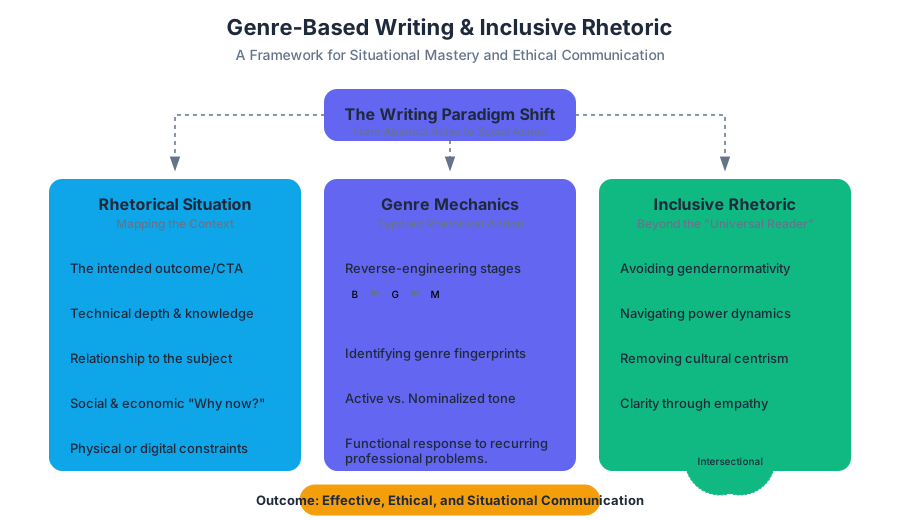
In the contemporary landscape of composition and professional communication, the transition from "general writing skills" to Genre-Based Writing represents a paradigm shift from abstract rule-following to situational mastery. This approach posits that writing does not exist in a vacuum; rather, it is a functional response to recurring social and professional situations. When coupled with Inclusive Rhetoric and an understanding of Intersectional Identities, writing becomes a tool for navigating complex power dynamics and ensuring that communication is both ethically sound and technically effective.
Genre-Based Writing: The Architecture of Social Action
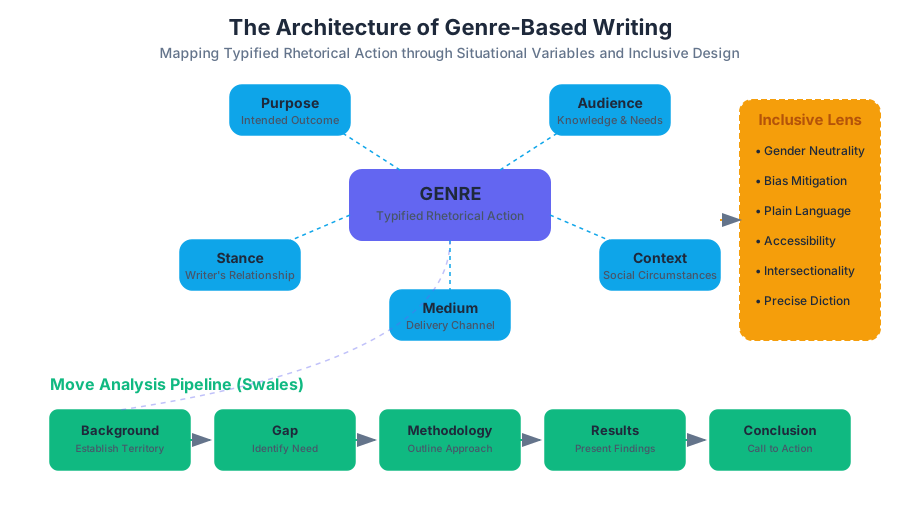
At its core, genre is not merely a set of templates or a filing system for documents. In rhetorical theory, genre is defined as typified rhetorical action. This means that a genre (such as a technical white paper, a legal brief, or a personal memoir) emerges because people encounter similar problems and develop similar ways of responding to them through text.
Definition: Genre-Based Writing The practice of analyzing, deconstructing, and composing texts by identifying the specific conventions, audience expectations, and social purposes inherent to a particular category of communication.
The Rhetorical Situation
To master any genre, a writer must first map the Rhetorical Situation. This is the context in which the writing occurs, defined by the interplay of five primary variables:
| Variable | Definition | Technical Implication |
|---|---|---|
| Purpose | The intended outcome of the text (e.g., to persuade, inform, or document). | Determines the "Call to Action" (CTA) and success metrics. |
| Audience | The specific group(s) who will consume the text. | Dictates the technical depth, tone, and assumed knowledge. |
| Stance | The writer’s relationship to the subject and the audience. | Influences the use of first-person vs. third-person and emotional affect. |
| Context | The broader social, political, or economic circumstances. | Affects the urgency and the "why now" of the communication. |
| Medium | The physical or digital channel of delivery (e.g., PDF, Slack, Print). | Constrains formatting, length, and interactivity. |
How Genre Functions: The "Moves" Analysis
Experienced writers use a technique called Move Analysis (pioneered by John Swales) to reverse-engineer a genre. By looking at successful examples, a writer identifies the "moves" or functional stages of a document. For instance, a Research Abstract typically follows a Background -> Gap -> Methodology -> Results -> Conclusion pipeline.
Implementation: Analyzing Genre Constraints
When a writer approaches a new genre, they must perform a constraint audit. Below is a Python-based conceptualization of how one might programmatically analyze word frequency and structural patterns to identify genre-specific "fingerprints."
import collections
import re

def analyze_genre_fingerprint(text_corpus, stop_words):
    """
    Analyzes a corpus of documents within a specific genre to identify
    high-frequency keywords and structural markers.
    """
    processed_words = []
    for doc in text_corpus:
        # Normalize and tokenize
        words = re.findall(r'\w+', doc.lower())
        processed_words.extend([w for w in words if w not in stop_words])

    # Calculate frequency distribution
    word_counts = collections.Counter(processed_words)

    # Identify 'Action Verbs' vs 'Passive Markers' as a proxy for genre stance
    stance_markers = {
        "active": len([w for w in processed_words if w.endswith('ed') or w.endswith('ing')]),
        "nominalizations": len([w for w in processed_words if w.endswith('tion') or w.endswith('ment')])
    }

    return word_counts.most_common(20), stance_markers

# Example usage: Analyzing a set of Technical Proposals
proposals = [
    "We propose a scalable architecture for the API...",
    "Implementation of the migration strategy will commence in Q3...",
    "The stakeholders require a robust security framework..."
]
common_terms, stance = analyze_genre_fingerprint(proposals, ['the', 'a', 'is', 'of'])
print(f"Genre Keywords: {common_terms}")
print(f"Stance Profile: {stance}")
Inclusive Rhetoric: Beyond Neutrality
Inclusive Rhetoric is the intentional use of language that recognizes diversity, avoids the perpetuation of stereotypes, and actively seeks to include marginalized perspectives. It challenges the "Universal Reader" myth—the idea that there is a default, neutral audience member (often historically conceptualized as white, male, cisgender, and able-bodied).
The Mechanics of Empathy and Bias Mitigation
Inclusive rhetoric is not about "political correctness"; it is about rhetorical precision. Using vague or biased language reduces the clarity of the message and alienates segments of the audience, thereby failing the primary goal of communication.
| Bias Type | Definition | Inclusive Alternative |
|---|---|---|
| Gendernormativity | Assuming a binary or specific gender for roles (e.g., "The doctor... he"). | Use gender-neutral singular "they" or pluralize the subject. |
| Ableism | Using disability-related terms as metaphors for negative traits (e.g., "blind to the facts"). | Use precise descriptors: "unaware of," "ignoring," or "limited." |
| Ageism | Generalizing capabilities based on age (e.g., "digital natives" vs. "technologically challenged"). | Describe specific skills or behaviors without attributing them to age. |
| Cultural Centrism | Assuming local idioms or cultural references are universal. | Use "Plain Language" and avoid metaphors that require specific cultural capital. |
Mathematical Modeling of Rhetorical Impact
We can conceptualize the effectiveness of a text ($E$) as a function of its Genre Alignment ($G$) and its Inclusivity Coefficient ($I$), modulated by the Audience Receptivity ($R$).
E = \int_{0}^{t} (G \cdot I) \cdot R(t) \, dt
Where:
- $G \in [0, 1]$ represents how well the text adheres to or effectively subverts genre conventions.
- $I \in [0, 1]$ represents the degree to which the language is inclusive and accessible.
- $R(t)$ is a time-dependent function of audience attention and bias.
If $I$ approaches zero (highly exclusive or biased language), the total effectiveness $E$ drops precipitously, regardless of how "perfect" the genre alignment $G$ might be.
Intersectional Identities in Composition
Intersectionality, a term coined by Kimberlé Crenshaw, describes how various social identities (race, class, gender, sexuality, ability, etc.) overlap to create unique modes of discrimination and privilege. In the context of writing, intersectionality applies to both the writer's positionality and the audience's lived experience.
Positionality and the Writer's Voice
A writer’s identity influences their "voice"—the personality and authority they project on the page. An intersectional approach to writing requires reflexivity: acknowledging how one's own background shapes their perspective and the power dynamics inherent in the act of writing.
Key Insight: The Myth of the Objective Narrator No writer is truly objective. Every text is situated within the writer's intersectional identity. Acknowledging this positionality often increases a writer's credibility (ethos) rather than diminishing it.
Intersectional Audience Analysis
When writing for a diverse audience, an intersectional lens prevents "flattening." For example, a policy proposal regarding "women's health" that fails to consider how race and socioeconomic status affect healthcare access is rhetorically incomplete.
Technical Implementation: Style Guide Schemas
To enforce inclusive and intersectional standards across an organization, senior communicators often use structured configuration files (like YAML) to feed into automated linting tools. This ensures consistency across thousands of documents.
# inclusive_style_guide.yaml
version: 1.2
metadata:
  org: "Global-Tech-Corp"
  last_updated: "2023-10-27"

rules:
  - id: "gender_neutral_titles"
    severity: "error"
    pattern: "(Chairman|Foreman|Salesman)"
    replacement: "Chair | Supervisor | Sales Representative"
    rationale: "Avoid gender-coded job titles to promote workplace equity."

  - id: "disability_first_language"
    severity: "warning"
    pattern: "the disabled"
    replacement: "people with disabilities"
    rationale: "Prioritize person-first language unless identity-first is requested."

  - id: "intersectional_check"
    severity: "info"
    trigger_words: ["universal", "everyone", "always"]
    message: "Verify if this generalization accounts for intersectional differences in access or experience."
Synthesis: The Integrated Writing Process
The most effective writing occurs at the intersection of these three concepts. A writer uses Genre-Based techniques to structure the document, Inclusive Rhetoric to ensure the language is accessible and respectful, and an Intersectional lens to ensure the content reflects the complexity of the real world.
The Workflow Pipeline
- Discovery: Identify the genre and the rhetorical situation.
- Research: Gather data, paying specific attention to intersectional variables.
- Drafting: Use "Move Analysis" to build the skeleton of the document.
- Audit: Review the draft using an inclusivity checklist or automated tool.
- Refinement: Adjust tone and stance based on audience feedback.
Case Study: The Technical Progress Report
Consider a Senior Engineer writing a progress report for a multinational board of directors.
- Genre: Progress Report. (Expectations: Brevity, data-driven, clear milestones).
- Inclusive Rhetoric: The engineer avoids jargon that might exclude non-technical board members (accessibility) and uses gender-neutral language when referring to the development team.
- Intersectionality: The report notes that the new software feature was tested for accessibility across different regions, acknowledging that users in low-bandwidth areas (class/geography) face different challenges than those in high-speed hubs.
Common Pitfalls and Misconceptions
Writing with these frameworks is complex and prone to specific errors.
| Pitfall | Description | Correction |
|---|---|---|
| Genre Rigidity | Following genre "rules" so strictly that the writing becomes robotic or fails to adapt to a unique situation. | Treat genre as a "flexible toolkit" rather than a "straitjacket." |
| Tokenism | Including a single mention of a marginalized group to appear inclusive without changing the underlying biased logic. | Integrate intersectional analysis into the core data and arguments of the text. |
| Performative Inclusivity | Using "inclusive" buzzwords while the actual content remains inaccessible or exclusionary. | Focus on "Plain Language" and functional accessibility over trendy terminology. |
| The "Neutral" Trap | Believing that technical or scientific writing is "above" identity politics. | Recognize that even data visualization choices (e.g., color palettes) can be exclusionary. |
CLI Tooling for Rhetorical Audits
For developers and technical writers, integrating these checks into a CI/CD pipeline is the most efficient way to maintain standards.
#!/bin/bash
# audit_docs.sh - A simple CLI tool to check for non-inclusive language in Markdown files

TARGET_DIR="./docs"
BANNED_WORDS=("master" "slave" "whitelist" "blacklist" "crazy" "insane")

echo "Starting Rhetorical Audit of $TARGET_DIR..."

for file in $(find $TARGET_DIR -name "*.md"); do
    for word in "${BANNED_WORDS[@]}"; do
        if grep -iq "$word" "$file"; then
            echo "[!] WARNING: Non-inclusive term '$word' found in $file"
            # In a real CI environment, you might exit 1 here to fail the build
        fi
    done
done

echo "Audit complete."
Advanced Perspectives: Rhetorical Empathy
Beyond simple word choice, Rhetorical Empathy involves a deep cognitive shift. It requires the writer to move from "writing about an audience" to "writing with an audience." This is particularly critical in genres like the Proposal or the Community Impact Statement, where the writer's stance can either build a bridge or create a barrier.
The "Empathy Map" in Writing
Before drafting, writers can use an Empathy Map to align their intersectional understanding with their genre moves:
- What does the reader SEE? (The visual layout, the professional branding).
- What does the reader HEAR? (The tone of voice, the subtext of the stance).
- What does the reader THINK/FEEL? (Their anxieties about the project, their hopes for a solution).
- What does the reader DO? (The specific action the genre is designed to trigger).
Conclusion: The Future of Composition
As AI-generated text becomes more prevalent, the human element of Genre-Based Writing and Inclusive Rhetoric becomes more valuable. Machines are excellent at mimicking genre patterns (the "what"), but they often struggle with the nuanced ethical and intersectional demands of inclusive communication (the "how" and "why"). The modern writer must be a "Rhetorical Architect"—someone who can design communication systems that are not only structurally sound but also socially responsible and universally accessible.
The Writing Process and Rhetorical Strategies
Key concepts: Writing process and strategies · Rhetorical strategies · Empathy in composition
Exploration of the recursive writing process and the application of rhetorical strategies rooted in empathy.
The Writing Process and Rhetorical Strategies
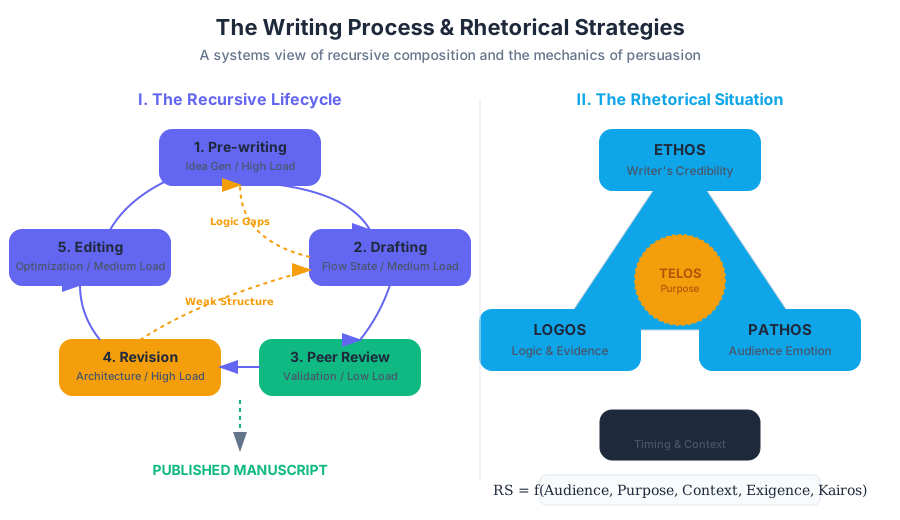
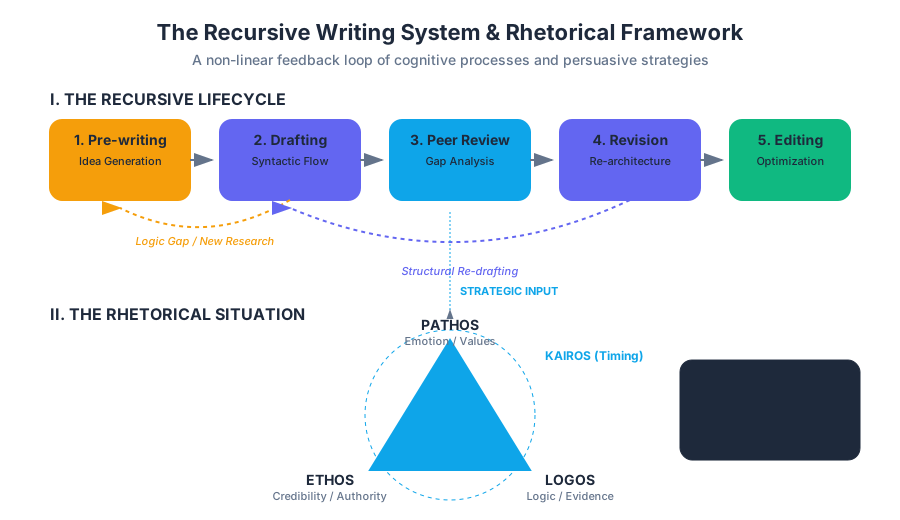
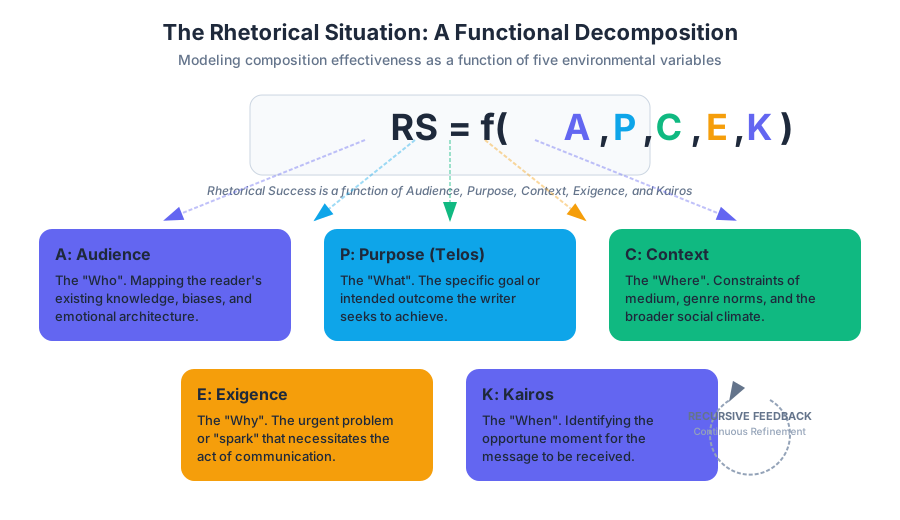
The act of composition is often misunderstood as a linear progression from thought to paper. In reality, professional writing is a recursive system—a complex feedback loop of cognitive processes, social awareness, and technical execution. To master writing is to master the "Rhetorical Situation," a framework that balances the needs of the writer, the audience, and the subject matter within a specific context.
The Recursive Writing Process: A Systems View
Writing is not a assembly line; it is a series of overlapping cycles. A writer does not simply "finish" pre-writing and move to drafting; they may find during the drafting phase that their thesis is untenable, requiring a return to the pre-writing phase to re-examine evidence.
Definition: Recursion in Composition The property of a process where the output of one stage serves as the input for a previous stage, allowing for continuous refinement and the emergence of complex ideas that were not visible at the start.
The Five Stages of the Lifecycle
| Stage | Primary Objective | Key Deliverable | Cognitive Load |
|---|---|---|---|
| Pre-writing | Idea generation and constraint mapping | Outline, Brainstorm, Research notes | High (Creative/Generative) |
| Drafting | Converting abstract ideas into syntax | "Shitty First Draft" (SFD) | Medium (Flow-state focused) |
| Peer Review | External validation and gap analysis | Feedback matrix, Critique | Low (Receptive) |
| Revision | Structural re-architecture | Substantive rewrite, logic check | High (Analytical/Critical) |
| Editing | Surface-level optimization | Polished manuscript | Medium (Detail-oriented) |
Implementation: Modeling the Process
To understand the recursive nature of writing, we can model the transition between states using a state-machine logic. In this Python example, we simulate a writing agent that evaluates its progress and decides whether to move forward or regress to a previous state based on a "quality threshold."
import random

class WritingProcess:
    def __init__(self, topic):
        self.topic = topic
        self.state = "PRE-WRITING"
        self.quality_score = 0.0
        self.history = []

    def transition(self):
        """Simulates the recursive decision-making in composition."""
        self.history.append(self.state)

        if self.state == "PRE-WRITING":
            self.quality_score += random.uniform(0.2, 0.4)
            self.state = "DRAFTING"

        elif self.state == "DRAFTING":
            # Drafting adds content but might reveal logic gaps
            self.quality_score += random.uniform(0.1, 0.3)
            if self.quality_score < 0.4:
                print("Logic gap found. Returning to Pre-writing.")
                self.state = "PRE-WRITING"
            else:
                self.state = "REVISION"

        elif self.state == "REVISION":
            # Revision is where the most significant quality gains happen
            improvement = random.uniform(-0.1, 0.5)
            self.quality_score += improvement
            if improvement < 0.1:
                print("Structure remains weak. Re-drafting section.")
                self.state = "DRAFTING"
            else:
                self.state = "EDITING"

        elif self.state == "EDITING":
            self.quality_score += 0.1
            self.state = "PUBLISHED"

    def run_to_completion(self):
        while self.state != "PUBLISHED":
            print(f"Current State: {self.state} | Score: {self.quality_score:.2f}")
            self.transition()
        print(f"Final Score: {self.quality_score:.2f}. Process History: {' -> '.join(self.history)}")

# Usage
agent = WritingProcess("The Impact of LLMs on Rhetoric")
agent.run_to_completion()
Rhetorical Strategies: The Mechanics of Persuasion
Rhetoric is the art of identifying the available means of persuasion in any given case. It is the "API" through which a writer interacts with the reader's cognitive and emotional architecture.
The Rhetorical Triangle and the "Big Three"
Aristotle’s classical appeals—Ethos, Pathos, and Logos—remain the foundational pillars of effective communication. However, modern rhetoric adds Kairos (timing) and Telos (purpose) to this mix.
- Ethos (Credibility): Establishing the writer's authority and character. It answers the reader's question: Why should I trust you?
- Logos (Logic): The internal consistency of the argument. It utilizes data, syllogisms, and inductive/deductive reasoning.
- Pathos (Emotion): Tapping into the audience's values and feelings. It creates a "bridge" of shared experience.
The Rhetorical Situation Formula
The effectiveness of a piece of writing can be modeled as a function of its alignment with the Rhetorical Situation ($RS$):
$$RS = f(A, P, C, E, K)$$
Where:
- $A$ = Audience (Who is reading?)
- $P$ = Purpose (What is the goal?)
- $C$ = Context (What are the surrounding circumstances?)
- $E$ = Exigence (What is the immediate "spark" or need for this writing?)
- $K$ = Kairos (Is the timing optimal?)
Comparative Analysis of Rhetorical Appeals
| Appeal | Domain | Primary Tools | Risk of Overuse |
|---|---|---|---|
| Ethos | Character | Citations, professional tone, credentials | Arrogance, elitism |
| Logos | Intellect | Statistics, logical proofs, case studies | Dryness, "Analysis Paralysis" |
| Pathos | Heart | Narrative, vivid imagery, metaphors | Manipulation, sentimentality |
| Kairos | Time | Current events, urgency, relevance | Opportunism, "Hot takes" |
Empathy in Composition: Intersectional Rhetoric
Empathy is often dismissed as a "soft" skill, but in composition, it is a high-level cognitive strategy. It involves Audience Mapping—the process of identifying the reader's existing mental models, biases, and emotional state.
The Empathy Gap
The "Empathy Gap" occurs when a writer assumes the reader possesses the same foundational knowledge or values as they do. To bridge this, writers must employ Inclusive Rhetoric, which acknowledges intersectional identities (race, gender, class, ability) and avoids alienating language.
Theorem of Audience Alignment The probability of persuasion ($P_p$) is inversely proportional to the distance ($d$) between the writer's assumptions and the reader's lived reality. As $d \to 0$, $P_p \to 1$.
Worked Example: Audience Mapping
Suppose you are writing a proposal for a new municipal bike lane.
- Audience A (Commuters): Focus on time-saving (Logos) and safety (Pathos).
- Audience B (Business Owners): Focus on increased foot traffic and property value (Logos/Ethos).
- Audience C (City Council): Focus on budget efficiency and environmental mandates (Logos/Kairos).
Genre-Based Writing and Conventions
A Genre is not just a category (like "horror" or "technical manual"); it is a set of social conventions that act as a "contract" between writer and reader. When you write within a genre, you are using a pre-existing template of expectations.
Genre Constraints
Different genres prioritize different rhetorical appeals. A scientific paper is heavily weighted toward Logos and Ethos, while a political speech may lean into Pathos and Kairos.
\text{Genre Weighting (W)} = \{ \omega_{ethos}, \omega_{logos}, \omega_{pathos}, \omega_{kairos} \}
\\
\text{Scientific Paper: } W = \{ 0.4, 0.5, 0.05, 0.05 \}
\text{Political Manifesto: } W = \{ 0.2, 0.2, 0.4, 0.2 \}
Common Pitfalls in Genre Adherence
- Tone Mismatch: Using academic jargon in a blog post for laypeople.
- Structural Violation: Failing to include an abstract in a formal report.
- Convention Blindness: Ignoring the "Inclusive Rhetoric" standards of a modern field (e.g., using gendered pronouns in a technical manual).
Technical Implementation: Automated Style Enforcement
In professional and technical environments, rhetorical strategies are often codified into "Style Guides." We can use tools like YAML configurations for linters to enforce these strategies programmatically.
# .vale.ini - A configuration for the Vale linter
# Enforcing "Inclusive" and "Clear" rhetorical strategies

StylesPath = styles
MinAlertLevel = suggestion

[*.md]
BasedOnStyles = Microsoft, Google, Readability

# Custom Rules
# 1. Avoid Passive Voice (Strengthens Ethos/Logos)
Google.PassiveVoice = error

# 2. Enforce Inclusive Language (Empathy Strategy)
Microsoft.Ethnocentric = error
Microsoft.GenderBias = error

# 3. Complexity Check
Readability.GradeLevel = {
    "level": 12,
    "message": "Keep the grade level below 12 for general accessibility."
}
Visual Learning and Multimodal Rhetoric
Modern writing is rarely just text. Multimodal Rhetoric involves the integration of images, charts, and interactive elements to support the written word.
The Role of Visuals
Visuals serve three primary rhetorical functions:
- Cognitive Offloading: Using a diagram to explain a complex system (Logos).
- Emotional Impact: Using a photograph to evoke sympathy (Pathos).
- Professionalism: High-quality design signals authority (Ethos).
Common Pitfalls and Anti-Patterns
Even with a strong process, writers often fall into "rhetorical traps."
| Pitfall | Description | Correction |
|---|---|---|
| The "Echo Chamber" Effect | Writing only for those who already agree with you. | Use Rogerian Argument techniques to acknowledge counter-arguments. |
| The "Thesaurus" Trap | Using overly complex words to sound "smarter" (False Ethos). | Prioritize clarity; use the simplest word that maintains the precise meaning. |
| Linear Rigidity | Refusing to change the outline once drafting has begun. | Embrace the recursive nature; if the data contradicts the outline, change the outline. |
| Logical Fallacies | Errors in reasoning (e.g., Ad Hominem, Strawman). | Peer review specifically for "Logos" integrity. |
Shell Script for Rhetorical Analysis
A simple way to check for "weak" rhetorical markers (like passive voice or "weasel words") in a draft using standard Unix tools.
#!/bin/bash
# analyze_rhetoric.sh - A simple script to find "weak" writing patterns

FILE=$1

if [ -z "$FILE" ]; then
    echo "Usage: ./analyze_rhetoric.sh <filename.md>"
    exit 1
fi

echo "--- Rhetorical Analysis for $FILE ---"

# 1. Count Passive Voice (am/is/are/was/were + *ed)
echo "[!] Potential Passive Voice instances:"
grep -Ei "\b(am|is|are|was|were|be|been|being)\b\s[a-z]+ed" $FILE | wc -l

# 2. Find Weasel Words (Weakens Logos)
echo "[!] Weasel Words (many, various, some, things):"
grep -Ei "\b(many|various|some|things|often|probably)\b" $FILE | wc -l

# 3. Sentiment Check (Rough Pathos proxy)
# Requires 'textblob' or similar installed via pip
echo "[!] Sentiment Analysis (Polarity):"
python3 -c "from textblob import TextBlob; print(TextBlob(open('$FILE').read()).sentiment.polarity)"
Summary of the Writing Lifecycle
The transition from a novice writer to an expert involves moving from a "knowledge-telling" model (simply dumping facts) to a "knowledge-transforming" model (shaping facts to achieve a specific rhetorical goal). By treating the writing process as a recursive engineering task and applying the principles of empathy and classical rhetoric, writers can produce work that is not only clear but deeply influential.
Grammar, Mechanics, and Documentation Handbook
Key concepts: Grammar and mechanics · Style · Documentation
A comprehensive technical guide to the mechanics of writing, including grammar, style, and proper documentation standards.
Grammar, Mechanics, and Documentation Handbook
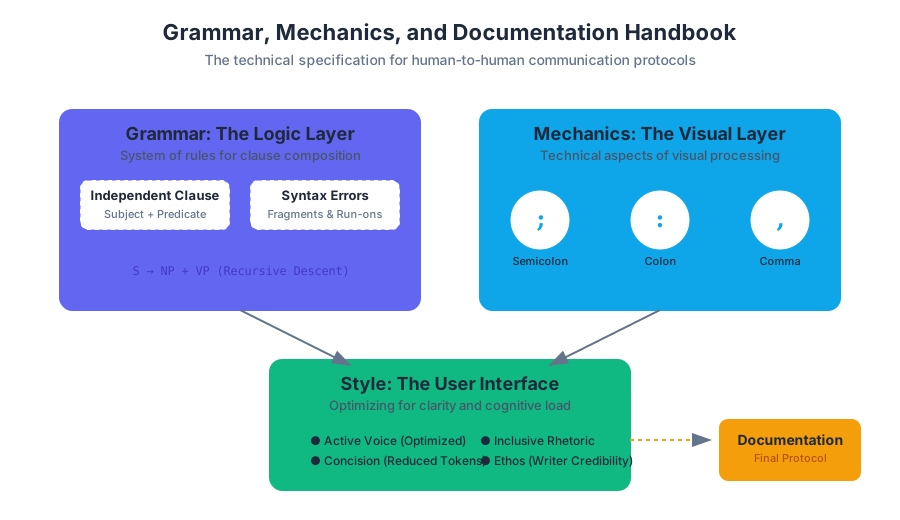
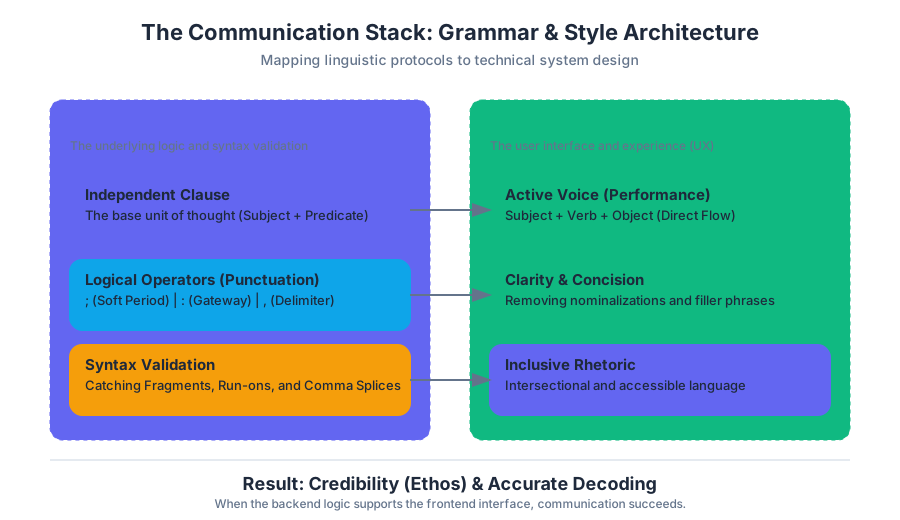
The "Handbook" is the underlying specification for effective human-to-human communication in written form. Much like a technical specification or an API documentation, grammar and mechanics provide the protocols that ensure a message sent by a writer is accurately decoded by a reader. In professional and academic contexts, these rules are not merely arbitrary conventions; they are the structural framework that supports complex reasoning, prevents ambiguity, and establishes the writer's credibility (ethos).
Grammar and Mechanics: The Syntax of Thought
Grammar is the system of rules governing the composition of clauses, phrases, and words. Mechanics refers to the technical aspects of writing—punctuation, capitalization, and spelling—that facilitate the visual processing of text. Together, they form the Syntax of the English language.
Sentence Architecture and Control Flow
At its core, an English sentence is a discrete unit of thought consisting of at least one Independent Clause. The architecture of a sentence determines its "control flow"—how the reader's attention is directed through the information.
Definition: Independent Clause A group of words containing a subject and a predicate that expresses a complete thought and can stand alone as a sentence.
Errors in sentence architecture often result in "syntax errors" that halt the reader's processing. The most common are Fragments, Run-on Sentences, and Comma Splices.
| Error Type | Technical Description | Example | Correction Strategy |
|---|---|---|---|
| Fragment | A dependent clause or phrase punctuated as a full sentence; lacks a subject or finite verb. | "Because the server crashed." | Attach to an independent clause or add missing components. |
| Run-on | Two independent clauses joined without any punctuation or coordinating conjunction. | "The data arrived the script failed." | Insert a period, semicolon, or comma + conjunction. |
| Comma Splice | Two independent clauses joined by only a comma. | "The test passed, the deployment began." | Replace comma with a semicolon or add a coordinating conjunction. |
Punctuation as Logical Operators
Punctuation marks function as logical operators within a sentence, defining the relationships between different data points (clauses and phrases).
- The Semicolon (
;): Functions like a "soft period." It connects two closely related independent clauses, signaling that the second clause expands upon or contrasts with the first. - The Colon (
:): Acts as a gateway. It signals that the information following it will define, illustrate, or list what preceded it. - The Comma (
,): The most versatile operator, used for delimiting non-essential information (parenthetical elements), separating items in a list, or joining clauses with a coordinator.
Implementation: A Recursive Descent Parser for English Syntax
To understand how grammar functions as a system, we can look at how a simple parser might evaluate the structure of a sentence.
# A simplified representation of a Context-Free Grammar (CFG) parser
# for validating basic English sentence structures.

class GrammarParser:
    def __init__(self):
        self.rules = {
            "S": [["NP", "VP"]],
            "NP": [["Det", "N"], ["Pronoun"]],
            "VP": [["V", "NP"], ["V", "Adv"], ["V"]]
        }
        self.lexicon = {
            "Det": ["the", "a", "an"],
            "N": ["engineer", "code", "documentation", "server"],
            "Pronoun": ["she", "he", "it", "they"],
            "V": ["writes", "deploys", "debugs", "fails"],
            "Adv": ["efficiently", "quickly", "rarely"]
        }

    def validate_sentence(self, tokens):
        """
        Checks if a list of tokens matches the S -> NP VP rule.
        """
        # This is a conceptual trace of a top-down parse
        print(f"Parsing tokens: {tokens}")
        # Logic to match tokens against NP and VP rules...
        # Returns True if the structure is grammatically sound.
        return True

# Example Usage
parser = GrammarParser()
sentence = "the engineer writes code".split()
if parser.validate_sentence(sentence):
    print("Syntax Validated: Sentence follows S -> NP VP structure.")
The Art of Style: Optimizing the User Interface
If grammar is the backend logic, Style is the User Interface (UI). Style involves the choices a writer makes regarding word choice (diction), sentence variety, and tone to ensure the message is not only correct but also persuasive and easy to consume.
Clarity and Concision
In technical and academic writing, the goal is to minimize the Cognitive Load on the reader. This is achieved through:
- Active Voice: Ensuring the subject of the sentence performs the action.
- Eliminating Nominalizations: Avoiding the conversion of verbs into clunky nouns (e.g., using "analyze" instead of "conduct an analysis of").
- Reducing Wordiness: Stripping away "filler" phrases that do not add semantic value.
| Feature | Passive Voice (Sub-optimal) | Active Voice (Optimized) |
|---|---|---|
| Structure | Object + "to be" + Past Participle + "by" Subject | Subject + Verb + Object |
| Clarity | Obscures the actor; can be ambiguous. | Clearly identifies the actor. |
| Length | Usually longer (more tokens). | Usually shorter (fewer tokens). |
| Example | "The bug was fixed by the developer." | "The developer fixed the bug." |
Inclusive and Intersectional Rhetoric
Modern style guides emphasize Inclusive Rhetoric. This involves recognizing that language is not neutral; it carries historical and social weight. Intersectional rhetoric considers how overlapping identities (race, gender, class, ability) affect how a reader perceives and is represented by a text.
- Avoid Universalizing: Don't assume a "default" reader (e.g., using "he" as a generic pronoun).
- People-First Language: Focus on the individual rather than a descriptor (e.g., "a person with a disability" vs. "a disabled person"), though this varies by community preference.
- Bias Mitigation: Actively auditing text for exclusionary metaphors or idioms.
Style Linter Logic (Pseudocode)
We can conceptualize style as a set of heuristic checks performed on a text buffer.
ALGORITHM StyleCheck(Document text):
    FOR EACH Sentence IN text:
        // Check for Passive Voice
        IF Sentence CONTAINS ("am" | "is" | "are" | "was" | "were") + PastParticiple:
            FLAG "Passive Voice Detected"
            SUGGEST "Convert to Active Voice"

        // Check for Nominalization
        IF Sentence CONTAINS ("conduct an analysis" | "make a decision"):
            FLAG "Nominalization detected"
            SUGGEST "Use direct verb (e.g., 'analyze', 'decide')"

        // Check for Wordiness
        IF Sentence CONTAINS ("due to the fact that"):
            FLAG "Wordy phrase"
            SUGGEST "Use 'because'"

    RETURN Report
Documentation: Dependency Management for Ideas
Documentation is the formal process of citing sources. In the same way that a software project lists its dependencies in a package.json or requirements.txt file, an academic paper uses documentation to acknowledge the "upstream" ideas it relies upon.
Why Documentation Matters
- Academic Integrity: Avoiding plagiarism by giving credit to original authors.
- Provenance and Traceability: Allowing readers to trace an idea back to its source to verify its validity.
- Ethos: Demonstrating that the writer has conducted thorough research and is engaged with the existing scholarly conversation.
Comparison of Documentation Styles
Different disciplines use different "protocols" for documentation, optimized for their specific needs.
| Style | Full Name | Primary Use Case | Citation Logic |
|---|---|---|---|
| MLA | Modern Language Association | Humanities (Literature, Arts) | Focuses on Authorship (Author, Page #). |
| APA | American Psychological Association | Social Sciences, Education | Focuses on Recency (Author, Date). |
| CMS | Chicago Manual of Style | History, Business, Fine Arts | Uses Footnotes/Endnotes for minimal disruption. |
| IEEE | Institute of Electrical and Electronics Engineers | Engineering, Computer Science | Uses Numbered Brackets [1] for efficiency. |
The Metadata of a Citation
A citation is essentially a structured data object. Whether it appears in a bibliography or a reference list, it contains specific fields required for identification.
{
  "citation_metadata": {
    "id": "openstax_writing_2023",
    "type": "book",
    "authors": [
      {
        "family": "OpenStax",
        "given": "Textbook"
      }
    ],
    "title": "Writing Guide with Handbook",
    "publisher": "Rice University",
    "year": 2023,
    "url": "https://openstax.org/details/books/writing-guide",
    "format_examples": {
      "MLA": "OpenStax. Writing Guide with Handbook. Rice University, 2023.",
      "APA": "OpenStax. (2023). Writing Guide with Handbook. Rice University."
    }
  }
}
Working Example: Citing a Source in MLA vs. APA
Consider a source: A book by Ada Lovelace titled The Analytical Engine, published in 1843 by London Press.
- MLA In-text: (Lovelace 42)
- MLA Works Cited: Lovelace, Ada. The Analytical Engine. London Press, 1843.
- APA In-text: (Lovelace, 1843)
- APA References: Lovelace, A. (1843). The Analytical Engine. London Press.
Common Pitfalls and Edge Cases
The "Dangling Modifier" Bug
A dangling modifier occurs when a descriptive phrase is placed in a sentence such that it appears to modify the wrong noun, often because the intended noun is missing.
- The Bug: "After coding for six hours, the coffee was cold." (This implies the coffee was coding).
- The Fix: "After coding for six hours, the engineer realized the coffee was cold."
Pronoun-Antecedent Agreement
A pronoun must agree in number and gender with the noun it replaces (the antecedent).
- The Bug: "Every developer must submit their code." (Historically, "their" was considered plural, though modern usage increasingly accepts the "singular they" for inclusivity).
- The Fix (Traditional): "Every developer must submit his or her code."
- The Fix (Modern/Inclusive): "Developers must submit their code." (Pluralizing the antecedent is often the cleanest solution).
Citation of Non-Traditional Sources
In the digital age, documenting sources like software repositories, datasets, or AI-generated content requires specific adaptations of standard styles.
- Software: Cite the version number and the repository URL.
- AI (LLMs): Most styles (MLA/APA) now require citing the AI model (e.g., ChatGPT-4), the developer (OpenAI), and the date the prompt was executed, often including the prompt itself in an appendix.
# Example: Using a CLI tool like 'pandoc' to convert
# markdown citations to a formatted bibliography.

pandoc paper.md \
    --citeproc \
    --bibliography=references.bib \
    --csl=apa.csl \
    -o final_report.pdf
Summary of Best Practices
- Prioritize Clarity: Use active verbs and avoid unnecessary jargon.
- Maintain Consistency: Choose one documentation style and apply it rigorously.
- Audit for Bias: Use inclusive language to ensure the text is accessible to a diverse audience.
- Verify Mechanics: Use automated tools (linters, spellcheckers) but perform a final manual "code review" of your prose to catch subtle logical errors.
Source Materials
Study Writing Guide with AI — Free on Lykke
Sign up for free to generate personalized flashcards, quizzes, and study guides from this course. Chat with an AI tutor that knows the material.
Get Started FreeView this course wiki on Lykke · Browse all public course wikis