From the free course World History Volume 1 on Lykke
The Post-Classical World and the Americas
Key concepts: Feudalism · Mongol Conquests · Mesoamerican Civilizations · The Black Death
Examines the late medieval period in Europe, the impact of the Mongol Empire, and the complex civilizations of the Americas prior to 1500.
The Post-Classical World and the Americas
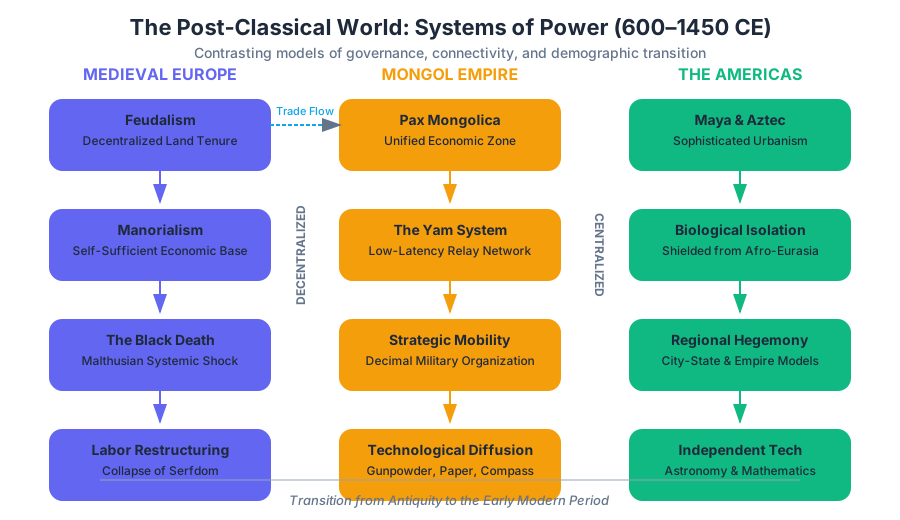
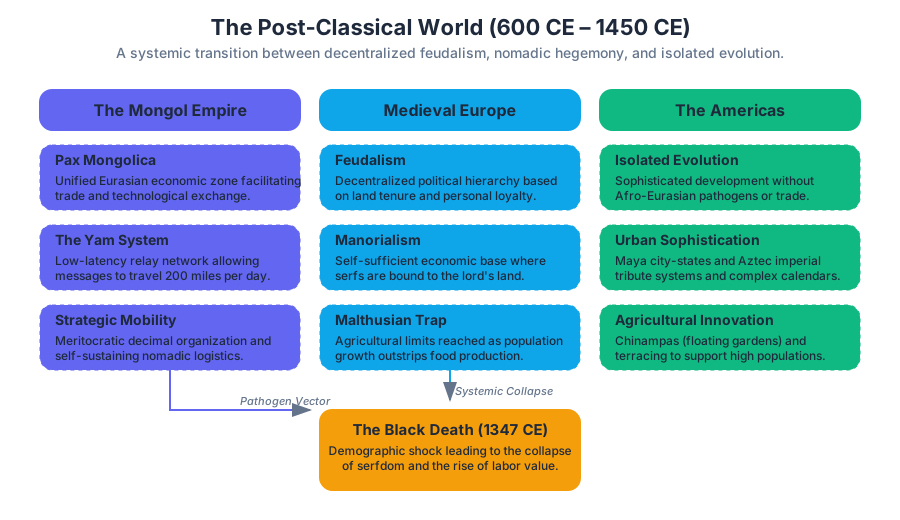
The Post-Classical era (roughly 600 CE to 1450 CE) represents a period of intense systemic transition. It is defined not by a single global hegemony, but by the tension between decentralized local structures (Feudalism) and massive, centralized nomadic expansions (The Mongol Empire), alongside the isolated but highly sophisticated evolution of the Americas. This era marks the transition from antiquity to the early modern period, characterized by the catastrophic demographic shock of the Black Death and the subsequent restructuring of labor and capital.
The Mongol Empire: The Mechanics of Universal Hegemony
The Mongol Empire (1206–1368) was the largest contiguous land empire in history. Its emergence under Temujin (Genghis Khan) disrupted the existing geopolitical order of Afro-Eurasia, creating a unified economic zone known as the Pax Mongolica.
The Logistics of Conquest
The Mongol military was not merely a "horde" but a highly disciplined, meritocratic organization based on the decimal system (units of 10, 100, 1,000, and 10,000). Their primary advantage was strategic mobility—each rider maintained a string of three to five horses, allowing for continuous movement without exhausting the mounts.
Definition: Pax Mongolica A period of relative stability across Eurasia facilitated by Mongol rule, which allowed for the unprecedented exchange of goods, ideas, and technologies (such as gunpowder, papermaking, and the compass) between the East and the West.
| Feature | Mongol Nomadic Warfare | Traditional Sedentary Warfare |
|---|---|---|
| Primary Unit | Light and Heavy Cavalry | Infantry and Heavy Cavalry |
| Logistics | Self-sustaining (herds, spare horses) | Supply trains, vulnerable to siege |
| Communication | The Yam (Relay station system) | Messengers, limited by terrain |
| Tactics | Feigned retreat, encirclement | Phalanx, static defensive lines |
| Siege Craft | Adopted from captured engineers | Traditional battering rams/walls |
The Yam System: A Low-Latency Network
The Yam was the Mongol postal and intelligence network. It functioned as a series of relay stations spaced approximately 25–30 miles apart, providing fresh horses and food to authorized messengers. This system allowed information to travel up to 200 miles per day.
Medieval Europe: Feudalism and the Manorial System
While the Mongols centralized Eurasia, Western Europe remained fractured. Following the collapse of the Carolingian Empire, power devolved into Feudalism, a decentralized political system based on land tenure and personal loyalty.
The Feudal Hierarchy
Feudalism was a reciprocal relationship between a Lord (landowner) and a Vassal (subordinate). The Lord granted a Fief (land) in exchange for military service and political counsel.
The Manorial Economy
If Feudalism was the political superstructure, Manorialism was the economic base. It was a self-sufficient system where the Lord of the Manor exercised legal and economic power over Serfs—unfree laborers bound to the land.
| Social Class | Role | Primary Obligation |
|---|---|---|
| Monarch | Nominal Ruler | Granting land to Great Lords |
| Nobles/Lords | Land Management | Military service, protection of serfs |
| Knights | Professional Soldiers | Protection of the Fief (Chivalry) |
| Serfs | Agricultural Labor | Labor rent (corvée), portion of crops |
The Malthusian Trap and the Black Death
By 1300, Europe had reached the limits of its agricultural technology, a state known as the Malthusian Trap, where population growth outstrips food production. The arrival of the Black Death (Yersinia pestis) in 1347 acted as a catastrophic "positive check" on the population.
The Malthusian Equation Let $P(t)$ be the population and $F(t)$ be the food supply. $P(t) = P_0 e^{rt}$ (Exponential Growth) $F(t) = F_0 + kt$ (Arithmetic Growth) When $P(t) > F(t)$, a "Malthusian Catastrophe" occurs.
% Mathematical representation of the SIR model for Plague Dynamics
\frac{dS}{dt} = -\beta SI \\
\frac{dI}{dt} = \beta SI - \gamma I \\
\frac{dR}{dt} = \gamma I
The plague killed an estimated 30–60% of Europe's population. Paradoxically, this led to the Collapse of Serfdom. The sudden scarcity of labor increased the bargaining power of the surviving peasantry, leading to higher wages and the transition toward a cash-based economy.
Mesoamerican Civilizations: The Maya and the Aztec
In the Americas, civilizations developed in total isolation from Afro-Eurasian pathogens and technologies (like the wheel or iron smelting), yet they achieved comparable levels of complexity in mathematics, astronomy, and urban planning.
The Maya: Masters of Time and Space
The Maya (c. 250–900 CE) were organized into competing city-states (e.g., Tikal, Palenque). They are noted for their sophisticated Hieroglyphic Writing and their use of the concept of Zero, which allowed for complex astronomical calculations.
The Aztec Empire: The Tribute State
The Aztec (Mexica) Empire (c. 1300–1521) was a militaristic confederation based in Tenochtitlan, a city built on an island in Lake Texcoco. Their economy was driven by the Tribute System, where conquered provinces sent goods (maize, beans, luxury items) to the capital.
Chinampas: High-Yield Hydroponics
To support a massive urban population, the Aztecs developed Chinampas—artificial islands created by layering mud and vegetation in shallow lake beds.
| Innovation | Purpose | Impact |
|---|---|---|
| Chinampas | Intensive Agriculture | 4+ harvests per year; supported 200k+ people |
| Macuahuitl | Weaponry | Obsidian-edged wooden sword; highly lethal |
| Tribute Codices | Administration | Detailed records of imperial taxation |
| Great Speaker | Political | The Huey Tlatoani, a semi-divine ruler |
The Andean World: The Inca Empire
The Inca Empire (Tawantinsuyu) was the largest empire in pre-Columbian America. Spanning the Andes Mountains, the Inca managed a diverse geography through a highly centralized, "vertical" administrative model.
Vertical Archipelago and the Mita System
The Inca did not have a market economy. Instead, they used the Vertical Archipelago model, where different ecological zones (coast, mountains, jungle) produced different goods that were redistributed by the state.
Labor was organized through the Mita, a mandatory public service requirement. This labor built the Qhapaq Ñan (Inca Road System), which spanned over 25,000 miles.
Quipu: Data Without Writing
Lacking a phonetic script, the Inca used Quipu—a system of knotted strings—to record census data, tax records, and historical narratives. The position, color, and type of knot represented numerical values and categories.
Comparative Analysis: State Collapse and Resilience
The Post-Classical world provides a laboratory for studying why civilizations fail or persist.
- The Mongol Collapse: The empire was too large for pre-modern communication. It fractured into four Khanates (Golden Horde, Ilkhanate, Chagatai, and Yuan) due to succession disputes and the cultural assimilation of the Mongol elite into their conquered subjects.
- The Mayan Collapse: Likely caused by a combination of environmental degradation (deforestation), prolonged drought, and endemic warfare between city-states, leading to the abandonment of the southern lowlands.
- The European Recovery: The Black Death acted as a "creative destruction" event. By breaking the feudal lock on labor, it paved the way for the Renaissance and the rise of the merchant class.
| Factor | Mongol Empire | Aztec Empire | Inca Empire | Western Europe |
|---|---|---|---|---|
| Centralization | High (Initial) | Moderate (Tribute) | Very High | Very Low |
| Primary Resource | Trade/Plunder | Tribute/Grain | Labor (Mita) | Land (Fief) |
| Decline Trigger | Succession/Plague | Spanish Conquest | Civil War/Spanish | Plague (Transformation) |
Common Pitfalls in Analysis
- The "Dark Ages" Myth: It is a mistake to view Medieval Europe as a period of stagnation. Significant technological advances (heavy plow, three-field system, universities) occurred during this time.
- Mongol Barbarism: Focusing solely on Mongol violence ignores their role as "civilization brokers" who enabled the modern world's first era of globalization.
- Americas Isolation: While isolated, the Americas were not "behind." Their agricultural yields (via Chinampas) and astronomical precision often exceeded contemporary European standards.
Source Materials
Study World History Volume 1 on Lykke
This course page is free to open: signed out, you can read its first two sections, and signing in, on any plan, opens the rest. The free Lykke Chrome extension syncs your own Canvas courses, so ChatGPT, Claude and Muse can answer from your classes and deadlines. It only reads Canvas.
Add the free extensionSign in to open every sectionAll sections of World History Volume 1 · Browse more course pages