From the free course World History Volume 1 on Lykke
Foundations of Human Society and Early Civilizations
Key concepts: Neolithic Revolution · Urbanization · Social Stratification · River Valley Civilizations
Explores the transition from foraging to farming and the rise of the first urban civilizations in Mesopotamia, Egypt, the Indus Valley, and China.
Foundations of Human Society and Early Civilizations
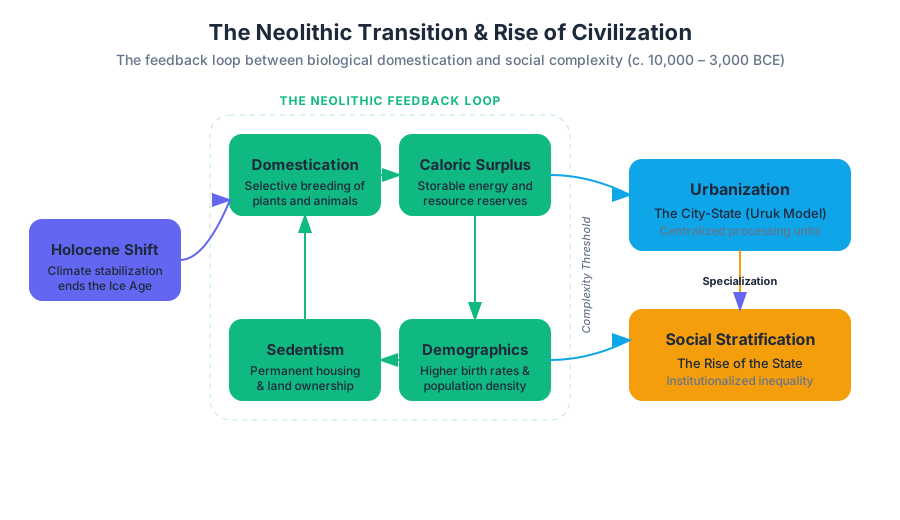
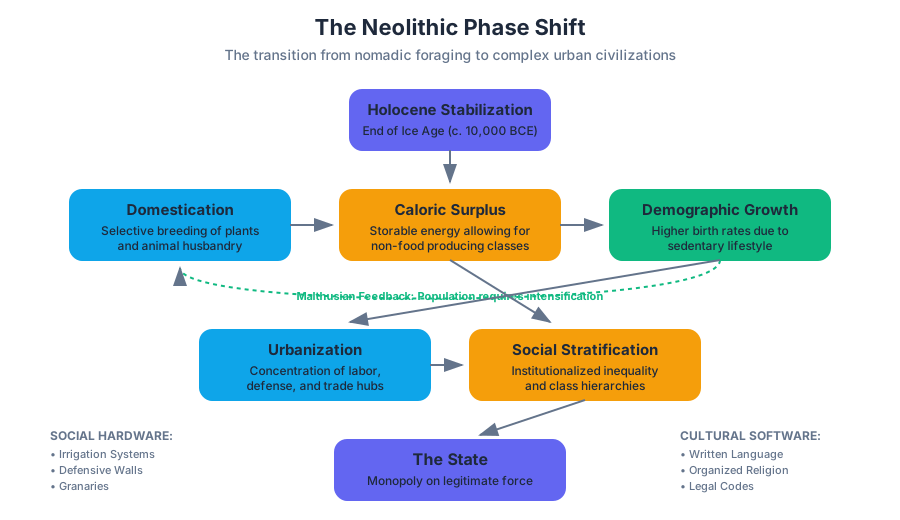
The transition from nomadic hunter-gatherer bands to settled, stratified urban societies represents the most profound "phase shift" in the human story. This process, often termed the Neolithic Revolution, was not a single event but a complex, multi-millennial feedback loop involving climatic shifts, biological domestication, and cognitive reorganization. As humans moved from a high-mobility, low-density lifestyle to a sedentary, high-density one, they created the "social hardware" and "cultural software" that define modern civilization: organized religion, centralized government, written language, and systemic inequality.
The Neolithic Revolution: From Foraging to Food Production
The Neolithic Revolution (c. 10,000 – 3,000 BCE) describes the transition from Paleolithic foraging (hunting and gathering) to Neolithic agriculture and animal husbandry. This shift was largely triggered by the end of the last Ice Age and the subsequent stabilization of the global climate during the Holocene epoch.
Mechanics of Domestication
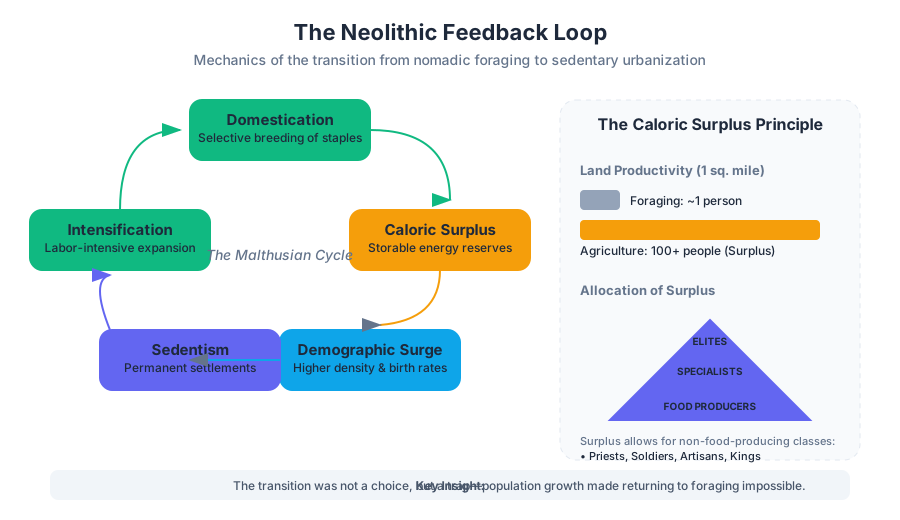
Domestication is the process of genetically modifying wild species through selective breeding to better serve human needs. This created a symbiotic relationship: humans provided protection and propagation for plants (like wheat, maize, and rice) and animals (like sheep, goats, and cattle), while these species provided a reliable, storable caloric surplus.
The Caloric Surplus Principle: Agriculture allows a single unit of land to produce significantly more calories than foraging. This surplus is the fundamental prerequisite for non-food-producing classes (priests, soldiers, artisans, and kings).
| Feature | Paleolithic (Foraging) | Neolithic (Agricultural) |
|---|---|---|
| Dietary Breadth | High (diverse wild plants/animals) | Low (reliant on 2–3 staple crops) |
| Mobility | Nomadic / Semi-nomadic | Sedentary (Permanent settlements) |
| Population Density | Very Low (< 1 person per sq. mile) | High (100+ people per sq. mile) |
| Social Structure | Egalitarian / Kinship-based | Hierarchical / Class-based |
| Property | Minimal / Communal | Land ownership / Private property |
| Health Profile | Tall, low disease, high trauma | Short, high disease (zoonotic), malnutrition |
The Demographic Transition
The shift to agriculture created a "Malthusian" feedback loop. Increased calories led to higher birth rates (sedentary life allows for shorter weaning periods), which led to higher populations, which in turn required more intensive farming to sustain.
Urbanization and the Rise of the City-State
As populations swelled, small farming villages coalesced into the first cities. Urbanization is not merely an increase in size; it is an increase in complexity. The city functioned as a "central processing unit" for the surrounding hinterlands, concentrating resources, labor, and information.
The Uruk Model
The city of Uruk (in modern-day Iraq) is often cited as the world's first true city (c. 4000 BCE). It featured monumental architecture (the Ziggurat), specialized districts for craftsmen, and a centralized bureaucracy.
Key Drivers of Urbanization:
- Hydraulic Management: In arid regions like Mesopotamia and Egypt, large-scale irrigation required coordinated labor that only a centralized authority could manage.
- Defense: Concentrated grain stores were targets for nomadic raiders, necessitating defensive walls and professional standing armies.
- Trade Hubs: Cities acted as nodes in long-distance trade networks, exchanging surplus grain for metals, timber, and luxury goods.
Social Stratification and the State
With the transition to urban life came the end of egalitarianism. Social Stratification is the institutionalization of inequality, where society is divided into layers based on wealth, power, and prestige.
The Emergence of the "State"
The State is a political entity that claims a monopoly on the legitimate use of physical force within a given territory. In early civilizations, the state was often inseparable from religion (Theocracy).
The Managerial Hypothesis: States emerged because they were the most efficient way to manage complex infrastructure (irrigation) and redistribute resources during famines.
The Gini Coefficient of History
We can quantify stratification by looking at the distribution of wealth (often measured by house size or grave goods in the archaeological record).
G = \frac{\sum_{i=1}^{n} \sum_{j=1}^{n} |x_i - x_j|}{2n^2 \bar{x}}
Where $G$ is the Gini coefficient, $n$ is the population, $x$ is the wealth of individuals, and $\bar{x}$ is the mean wealth.
| Social Class | Role / Function | Access to Resources |
|---|---|---|
| Elite (Kings/Priests) | Decision-making, religious mediation | Total (Taxation/Tribute) |
| Bureaucrats (Scribes) | Record-keeping, resource tracking | High (Salaried via state) |
| Artisans/Merchants | Specialized production, trade | Moderate (Market-based) |
| Peasant Farmers | Primary food production | Low (Subsistence + Tax) |
| Enslaved Persons | Labor, domestic service | None (Property) |
River Valley Civilizations: A Comparative Analysis
The first "pristine" civilizations (those that developed independently) all emerged in fertile river valleys. These environments provided the "Goldilocks" conditions: water for irrigation, silt for fertilization, and a transport "highway."
1. Mesopotamia (Tigris and Euphrates)
Known as the "Land Between the Rivers," Mesopotamia was a collection of competing city-states (Sumer, Akkad, Babylon). Because the rivers were unpredictable and violent, Mesopotamian religion tended to be pessimistic, viewing the gods as capricious.
2. Ancient Egypt (The Nile)
In contrast to Mesopotamia, the Nile's flooding was remarkably predictable. This led to a more stable, unified kingdom and a more optimistic worldview. The Pharaoh was not just a representative of the gods, but a god himself, responsible for maintaining Ma'at (universal balance).
3. Indus Valley (Harappa and Mohenjo-Daro)
The Indus civilization is noted for its extraordinary urban planning. Unlike the haphazard growth of Mesopotamian cities, Indus cities were built on a grid system with advanced drainage and sewage systems. Curiously, they lack the massive palaces and temples found in Egypt or Sumer, suggesting a different social organization.
4. China (Yellow River)
Early Chinese civilization (Shang and Zhou dynasties) developed in the loess-soil plains of the Yellow River. Key features included ancestor worship, the use of "oracle bones" for divination (the precursor to Chinese writing), and the Mandate of Heaven—the idea that a ruler's legitimacy was granted by divine favor and could be lost through mismanagement.
| Civilization | Primary River | Writing System | Key Innovation |
|---|---|---|---|
| Sumerian | Tigris/Euphrates | Cuneiform | The Wheel, Base-60 Math |
| Egyptian | Nile | Hieroglyphics | Papyrus, Monumental Stone |
| Indus Valley | Indus | Indus Script (Undeciphered) | Standardized Weights, Sewage |
| Shang China | Yellow River | Logographic (Oracle Bones) | Bronze Casting, Silk |
The Invention of Writing and Information Systems
Writing did not begin as a medium for literature or poetry; it began as accounting. As city-states grew, the human brain could no longer track the massive amounts of grain, livestock, and labor tax owed to the temple.
Cuneiform and the Ledger
In Sumer, writing evolved from clay tokens to wedge-shaped marks on clay tablets. This allowed the state to maintain a "permanent memory."
The Code of Hammurabi
Writing also enabled the formalization of law. The Code of Hammurabi (Babylon, c. 1750 BCE) is one of the earliest and most complete written legal codes. It established the principle of lex talionis (an eye for an eye) but applied it differently across social classes, reinforcing stratification.
"If a man has knocked out the eye of a patrician, his eye shall be knocked out. If he has knocked out the eye of a commoner, he shall pay one mina of silver." — The Code of Hammurabi
Common Pitfalls and Misconceptions
- The "Progress" Fallacy: It is a common mistake to view the Neolithic Revolution as an immediate "improvement" in human life. Archaeological evidence shows that early farmers were shorter, more diseased, and worked longer hours than their hunter-gatherer ancestors. Agriculture was a survival strategy for high-density populations, not necessarily a choice for a "better" life.
- Environmental Determinism: While geography (rivers, climate) played a massive role, it did not strictly determine culture. The difference between the Indus Valley's egalitarian-looking cities and Egypt's god-king hierarchy shows that humans made different political choices in similar environments.
- The "Sudden" Revolution: The transition took thousands of years. Many societies practiced "low-level food production" (gardening while still hunting) for millennia before committing to full-scale sedentary farming.
Summary of the Civilizational Pipeline
- Climatic Shift: Holocene stabilization makes agriculture viable.
- Domestication: Selective breeding creates caloric surplus.
- Sedentism: Permanent settlements lead to population spikes.
- Specialization: Surplus allows for non-farmers (artisans, priests).
- Stratification: Wealth accumulation creates hierarchical classes.
- State Formation: Centralized power manages infrastructure and defense.
- Information Technology: Writing emerges to manage the complexity of the State.
Source Materials
Study World History Volume 1 on Lykke
This course page is free to open: signed out, you can read its first two sections, and signing in, on any plan, opens the rest. The free Lykke Chrome extension syncs your own Canvas courses, so ChatGPT, Claude and Muse can answer from your classes and deadlines. It only reads Canvas.
Add the free extensionSign in to open every sectionAll sections of World History Volume 1 · Browse more course pages