From the free course World History Volume 1 on Lykke
The Classical Age and Imperial Consolidation
Key concepts: Hellenism · Pax Romana · Mandate of Heaven · Caste System
An analysis of the great empires of the Mediterranean, South Asia, and East Asia that established long-lasting cultural and political traditions.
The Classical Age and Imperial Consolidation
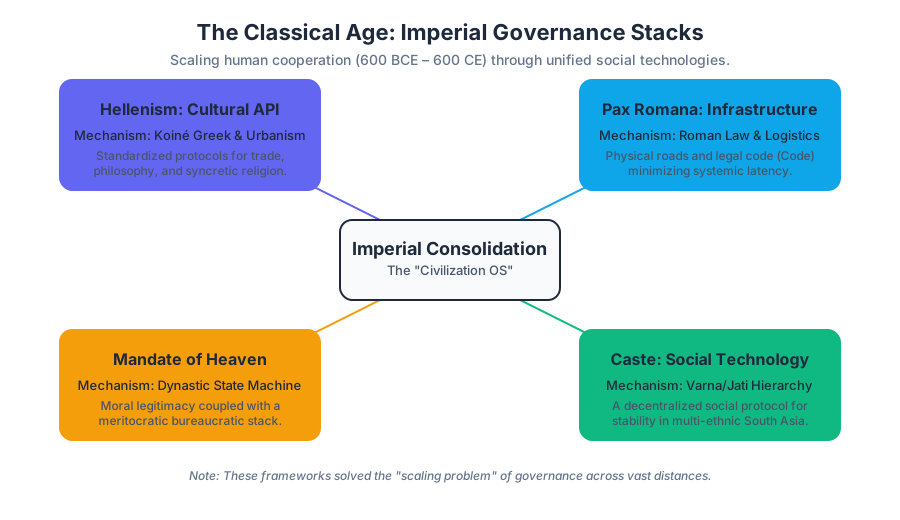
The "Classical Age" (roughly 600 BCE to 600 CE) represents a pivotal epoch in human history where the "operating systems" of modern civilization were first compiled, debugged, and deployed at scale. This era moved beyond the localized city-states of the Bronze and Iron Ages toward Imperial Consolidation—the process of integrating vast, multi-ethnic territories under a unified administrative, legal, and ideological framework.
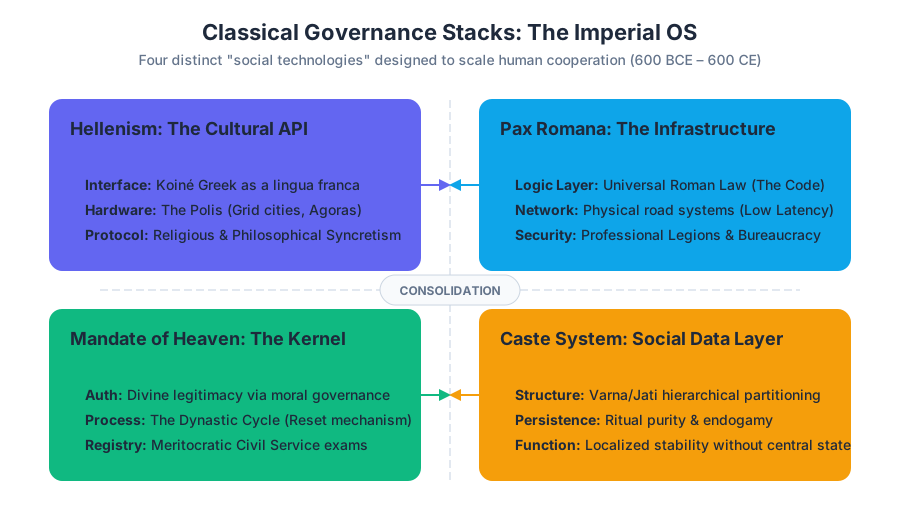
During this period, four distinct "governance stacks" emerged: the Hellenistic synthesis in the Mediterranean and Near East, the Pax Romana of the Roman Empire, the Mandate of Heaven in East Asia, and the Caste System in South Asia. These were not merely political arrangements but comprehensive social technologies designed to solve the problem of scaling human cooperation across thousands of miles and millions of people.
Hellenism: The Cultural API of the Mediterranean
Hellenism refers to the period following the conquests of Alexander the Great (323 BCE) characterized by the spread and synthesis of Greek culture with the traditions of the Near East, Egypt, and Central Asia. It functioned as a "cultural API"—a common set of protocols (language, philosophy, and urban design) that allowed diverse peoples to interact within a shared framework.
What it is
Hellenism: The synthesis of Greek (Hellenic) culture with non-Greek elements, resulting in a cosmopolitan civilization where Koiné Greek served as the lingua franca for trade, diplomacy, and scholarship.
Why it matters
Before Hellenism, the Mediterranean was a fragmented collection of "local hosts." Hellenism provided the first "globalized" network. It enabled the spread of early Christianity, the preservation of Aristotelian logic, and the scientific advancements of the Library of Alexandria.
How it works: The Hellenistic Synthesis
The consolidation of Hellenism relied on three primary mechanisms:
- Urbanization (The Polis Model): Alexander and his successors (the Diadochi) founded dozens of cities (e.g., Alexandria, Antioch) built on a grid system with Greek institutions: the gymnasium, the theater, and the agora.
- Linguistic Standardization: Koiné Greek simplified the complex dialects of Classical Greece into a streamlined version optimized for the "average user" across the empire.
- Syncretism: The merging of religious deities (e.g., Serapis in Egypt, who combined Osiris and Apis with Zeus and Helios).
| Feature | Classical Greece (Hellenic) | Hellenistic World |
|---|---|---|
| Political Unit | Independent City-State (Polis) | Absolute Monarchy / Empire |
| Scope | Local / Ethnic | Cosmopolitan / Multi-ethnic |
| Primary Language | Attic, Ionic, Doric dialects | Koiné Greek |
| Philosophy Focus | Civic duty and the "Good Life" | Individual peace (Stoicism, Epicureanism) |
| Economic Model | Local trade | Long-distance Silk Road integration |
Common Pitfalls
- The "Pure Greek" Fallacy: A common mistake is viewing Hellenism as a one-way "civilizing" mission. In reality, it was a bidirectional exchange; Greek art was profoundly influenced by Persian luxury, and Greek religion was transformed by Egyptian mysticism.
Pax Romana: The Infrastructure of Stability
Following the collapse of the Roman Republic, the rise of Augustus (27 BCE) initiated the Pax Romana (Roman Peace)—a two-century period of relative internal stability and imperial hegemony.
What it is
Pax Romana: A state of comparative tranquility throughout the Mediterranean world from the reign of Augustus to Marcus Aurelius, achieved through military dominance, administrative efficiency, and the universal application of Roman Law.
Why it matters
The Pax Romana solved the "latency problem" of ancient governance. By building a massive physical network (roads) and a logical network (law), Rome could move "data" (legions and grain) faster than any previous entity.
Variations: Auctoritas vs. Potestas
The Roman Emperor maintained control through a balance of Potestas (legal power/force) and Auctoritas (prestige/social influence). This dual-key system allowed the Empire to survive even when the individual "node" (the Emperor) was weak, provided the "system" (the Bureaucracy) remained intact.
Mandate of Heaven (Tianming): The Dynastic State Machine
In China, the transition from the warring states to the Qin and Han dynasties was governed by a unique political-theological framework known as the Mandate of Heaven.
What it is
Mandate of Heaven: The philosophical belief that Heaven (Tian) granted the right to rule to a just leader. Unlike the "Divine Right of Kings," this mandate was conditional and could be revoked if the ruler became corrupt or incompetent.
How it works: The Dynastic Cycle
The Mandate of Heaven functions like a state machine with a feedback loop. If the "Output" (social order, crop yields) falls below a certain threshold, the "System" (the people) is permitted to initiate a "Reset" (rebellion).
| State | Characteristics | Transition Trigger |
|---|---|---|
| New Dynasty | Restores peace, redistributes land, protects borders. | Time / Successive generations. |
| Aging Dynasty | High taxes, decaying infrastructure, corruption. | Neglect of duties. |
| Loss of Mandate | Floods, famines, peasant revolts, invasions. | Natural disasters / Social unrest. |
| Transition Period | Civil war, competing factions. | Emergence of a "virtuous" leader. |
Mathematical Representation of the Mandate
We can conceptualize the Mandate as a stability function $S(t)$:
$$S(t) = V(t) \cdot E(t) - (C(t) + D(t))$$
Where:
- $V$ = Virtue/Competence of the Emperor
- $E$ = Economic Prosperity
- $C$ = Corruption Level
- $D$ = Natural Disasters/External Shocks
If $S(t) < 0$ for a sustained period, the Mandate is considered "revoked," and the probability of revolution $P(R)$ approaches 1.
% Logic of the Mandate of Heaven in Pseudocode/Logic
IF (Emperor.Virtue == High && Infrastructure.Status == Optimized) {
    Mandate = Active;
    Social_Order = Stable;
} ELSE IF (Natural_Disaster == TRUE && Rebellion.Frequency > Threshold) {
    Mandate = Revoked;
    Social_Order = Chaos;
    New_Candidate = Search_For_Virtuous_Leader();
}
The Role of Confucianism
While the Mandate provided the justification for rule, Confucianism provided the implementation. It established a meritocratic bureaucracy where officials were selected based on their knowledge of classical texts rather than noble birth. This "Civil Service OS" allowed the Chinese state to maintain continuity even when dynasties changed.
The Caste System: Social Stratification as Stability
In Classical India, particularly during the Maurya and Gupta periods, social consolidation was achieved through the Caste System (Varna and Jati).
What it is
Caste System: A rigid social hierarchy in India, justified by Vedic tradition, that categorized individuals into hereditary groups determining their occupation, social circle, and religious status.
Why it matters
The Caste System acted as a "decentralized social stabilizer." Even when political empires (like the Maurya) collapsed, the social structure remained intact. It provided a predictable division of labor and social safety nets within specific Jatis (sub-castes).
The Varna Hierarchy
The system is divided into four primary Varnas, plus those outside the system (Dalits).
| Varna | Role | Symbolic Body Part |
|---|---|---|
| Brahmins | Priests, Scholars, Teachers | Mouth (Speech/Knowledge) |
| Kshatriyas | Warriors, Kings, Administrators | Arms (Protection/Force) |
| Vaishyas | Merchants, Landowners, Artisans | Thighs (Support/Production) |
| Shudras | Laborers, Servants | Feet (Foundation/Service) |
Mechanics: Dharma and Karma
The system was enforced not just by law, but by the metaphysical concepts of Dharma (duty) and Karma (action/consequence).
- Dharma: Your "API specification." Following your caste's rules was the highest moral good.
- Karma: The "execution log." Your actions in this life determined your "initialization state" (caste) in the next life.
Common Pitfalls
- Static vs. Dynamic: While the Varna categories were rigid, Jatis (occupational groups) were more fluid. Entire groups could occasionally move up the social ladder through a process called "Sanskritization"—adopting the customs of higher castes.
Synthesis: Comparing Imperial Engines
The Classical Age was a race to build the most resilient "Imperial Engine." Rome and Han China, though separated by thousands of miles, developed remarkably similar solutions to the problems of scale.
Data Management: The Census
Both empires realized that you cannot govern what you cannot measure. The Roman Census and the Han Tax Registry were the first large-scale databases.
Comparison of Rome and Han China
| Metric | Roman Empire (Pax Romana) | Han Dynasty (China) |
|---|---|---|
| Unifying Ideology | Law and Citizenship | Confucianism and Ritual |
| Social Mobility | Possible (Slavery to Freedman) | Possible (Exam System) |
| Labor Model | Heavy reliance on Slavery | Heavy reliance on Peasantry |
| Collapse Cause | Over-extension / Germanic Invasions | Internal Corruption / Nomadic Invasions |
| Legacy | Roman Law / Romance Languages | Bureaucratic State / Han Identity |
Conclusion: The Legacy of Consolidation
The Classical Age proved that human societies could scale beyond the "Dunbar Number" (the limit of stable social relationships) through the use of abstract systems. Whether it was the Hellenistic cultural blend, the Roman legal code, the Chinese moral mandate, or the Indian social hierarchy, these systems provided the stability necessary for trade, art, and science to flourish.
The "Imperial Consolidation" of this era set the stage for the post-classical world, defining the boundaries of cultural zones that persist to this day. Understanding these systems is not just an exercise in history; it is a study of the foundational code upon which modern civilization is built.
Source Materials
Study World History Volume 1 on Lykke
This course page is free to open: signed out, you can read its first two sections, and signing in, on any plan, opens the rest. The free Lykke Chrome extension syncs your own Canvas courses, so ChatGPT, Claude and Muse can answer from your classes and deadlines. It only reads Canvas.
Add the free extensionSign in to open every sectionAll sections of World History Volume 1 · Browse more course pages