World History Volume 1
Institution: MIT
1 study materials · 4 sections
OpenStax World History, Volume 1: to 1500 provides a comprehensive global narrative of human history from its earliest origins to the dawn of the modern era. The course emphasizes critical thinking and primary source analysis to help students understand the interconnectedness of diverse cultures across the globe. By highlighting underrepresented scholarship and juxtaposing different historical experiences, it offers a nuanced view of how ancient and medieval societies shaped the world.
Course Sections
Foundations of Human Society and Early Civilizations
Key concepts: Neolithic Revolution · Urbanization · Social Stratification · River Valley Civilizations
Explores the transition from foraging to farming and the rise of the first urban civilizations in Mesopotamia, Egypt, the Indus Valley, and China.
Foundations of Human Society and Early Civilizations
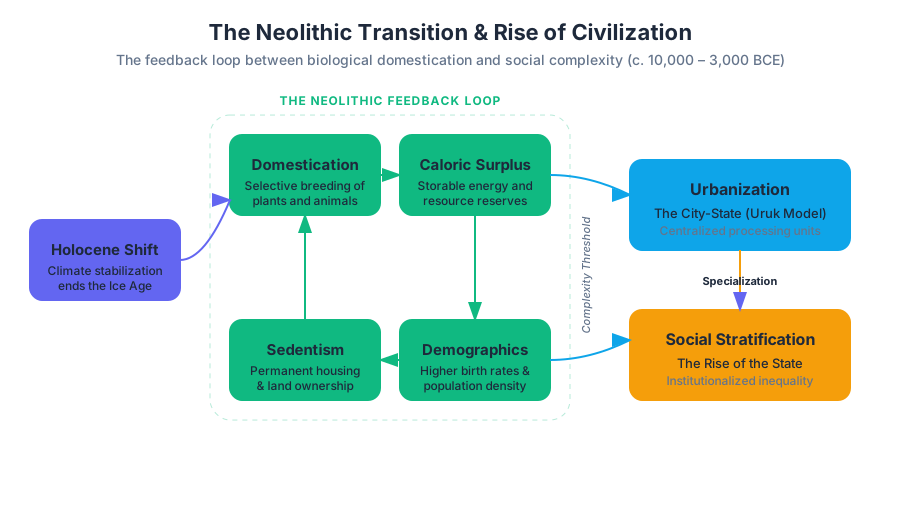
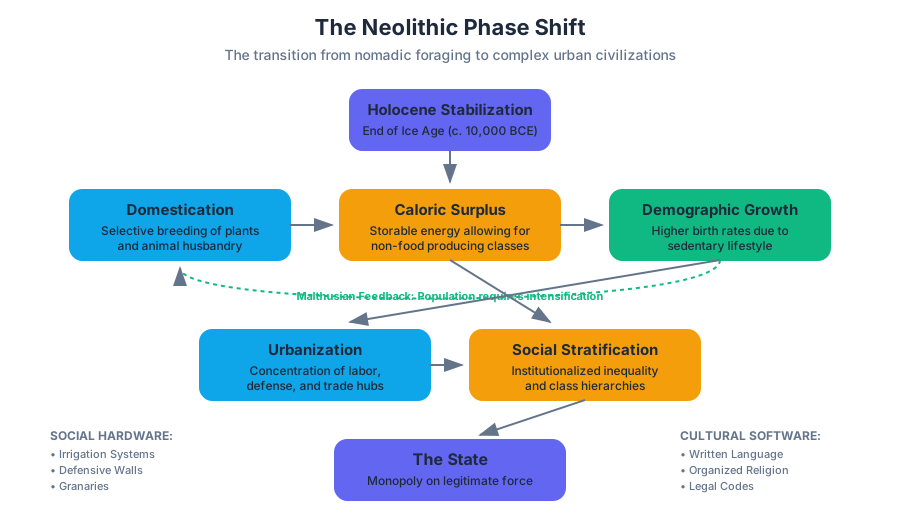
The transition from nomadic hunter-gatherer bands to settled, stratified urban societies represents the most profound "phase shift" in the human story. This process, often termed the Neolithic Revolution, was not a single event but a complex, multi-millennial feedback loop involving climatic shifts, biological domestication, and cognitive reorganization. As humans moved from a high-mobility, low-density lifestyle to a sedentary, high-density one, they created the "social hardware" and "cultural software" that define modern civilization: organized religion, centralized government, written language, and systemic inequality.
The Neolithic Revolution: From Foraging to Food Production
The Neolithic Revolution (c. 10,000 – 3,000 BCE) describes the transition from Paleolithic foraging (hunting and gathering) to Neolithic agriculture and animal husbandry. This shift was largely triggered by the end of the last Ice Age and the subsequent stabilization of the global climate during the Holocene epoch.
Mechanics of Domestication
Domestication is the process of genetically modifying wild species through selective breeding to better serve human needs. This created a symbiotic relationship: humans provided protection and propagation for plants (like wheat, maize, and rice) and animals (like sheep, goats, and cattle), while these species provided a reliable, storable caloric surplus.
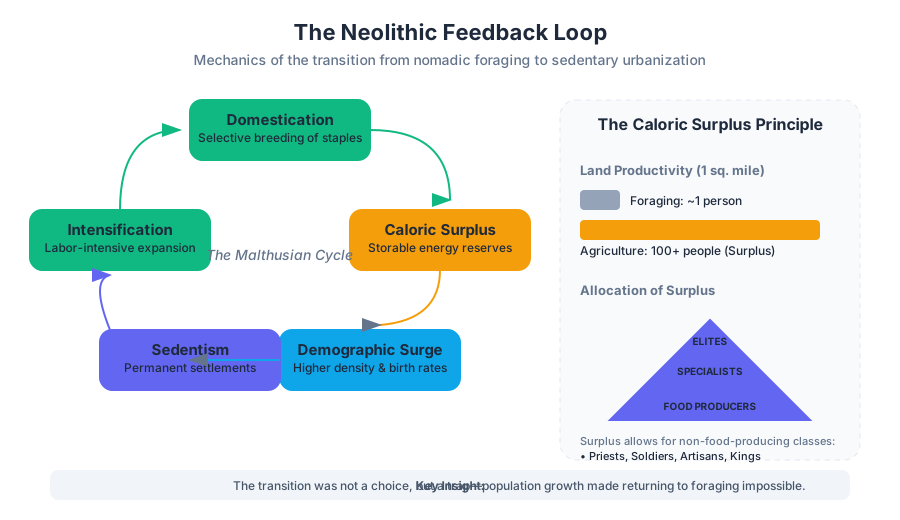
The Caloric Surplus Principle: Agriculture allows a single unit of land to produce significantly more calories than foraging. This surplus is the fundamental prerequisite for non-food-producing classes (priests, soldiers, artisans, and kings).
| Feature | Paleolithic (Foraging) | Neolithic (Agricultural) |
|---|---|---|
| Dietary Breadth | High (diverse wild plants/animals) | Low (reliant on 2–3 staple crops) |
| Mobility | Nomadic / Semi-nomadic | Sedentary (Permanent settlements) |
| Population Density | Very Low (< 1 person per sq. mile) | High (100+ people per sq. mile) |
| Social Structure | Egalitarian / Kinship-based | Hierarchical / Class-based |
| Property | Minimal / Communal | Land ownership / Private property |
| Health Profile | Tall, low disease, high trauma | Short, high disease (zoonotic), malnutrition |
The Demographic Transition
The shift to agriculture created a "Malthusian" feedback loop. Increased calories led to higher birth rates (sedentary life allows for shorter weaning periods), which led to higher populations, which in turn required more intensive farming to sustain.
import numpy as np
import matplotlib.pyplot as plt

def simulate_neolithic_population(years, initial_pop, carrying_capacity_foraging, carrying_capacity_agri):
    """
    Simulates the population shift during the transition to agriculture.
    Uses a logistic growth model with a shifting carrying capacity (K).
    """
    pop = np.zeros(years)
    pop[0] = initial_pop
    growth_rate = 0.02  # 2% annual growth potential

    for t in range(1, years):
        # Carrying capacity increases as agricultural technology 'unlocks'
        if t < 500:
            K = carrying_capacity_foraging
        else:
            # Linear increase in K during the transition phase
            K = carrying_capacity_foraging + (t - 500) * 2
            K = min(K, carrying_capacity_agri)

        # Logistic growth formula: dP/dt = rP(1 - P/K)
        change = growth_rate * pop[t-1] * (1 - (pop[t-1] / K))
        pop[t] = pop[t-1] + change

    return pop

# Parameters: 2000 years, start with 50 people, foraging K=200, Agri K=5000
timeline = simulate_neolithic_population(2000, 50, 200, 5000)
print(f"Final Population after 2000 years: {int(timeline[-1])}")
Urbanization and the Rise of the City-State
As populations swelled, small farming villages coalesced into the first cities. Urbanization is not merely an increase in size; it is an increase in complexity. The city functioned as a "central processing unit" for the surrounding hinterlands, concentrating resources, labor, and information.
The Uruk Model
The city of Uruk (in modern-day Iraq) is often cited as the world's first true city (c. 4000 BCE). It featured monumental architecture (the Ziggurat), specialized districts for craftsmen, and a centralized bureaucracy.
Key Drivers of Urbanization:
- Hydraulic Management: In arid regions like Mesopotamia and Egypt, large-scale irrigation required coordinated labor that only a centralized authority could manage.
- Defense: Concentrated grain stores were targets for nomadic raiders, necessitating defensive walls and professional standing armies.
- Trade Hubs: Cities acted as nodes in long-distance trade networks, exchanging surplus grain for metals, timber, and luxury goods.
Social Stratification and the State
With the transition to urban life came the end of egalitarianism. Social Stratification is the institutionalization of inequality, where society is divided into layers based on wealth, power, and prestige.
The Emergence of the "State"
The State is a political entity that claims a monopoly on the legitimate use of physical force within a given territory. In early civilizations, the state was often inseparable from religion (Theocracy).
The Managerial Hypothesis: States emerged because they were the most efficient way to manage complex infrastructure (irrigation) and redistribute resources during famines.
The Gini Coefficient of History
We can quantify stratification by looking at the distribution of wealth (often measured by house size or grave goods in the archaeological record).
G = \frac{\sum_{i=1}^{n} \sum_{j=1}^{n} |x_i - x_j|}{2n^2 \bar{x}}
Where $G$ is the Gini coefficient, $n$ is the population, $x$ is the wealth of individuals, and $\bar{x}$ is the mean wealth.
| Social Class | Role / Function | Access to Resources |
|---|---|---|
| Elite (Kings/Priests) | Decision-making, religious mediation | Total (Taxation/Tribute) |
| Bureaucrats (Scribes) | Record-keeping, resource tracking | High (Salaried via state) |
| Artisans/Merchants | Specialized production, trade | Moderate (Market-based) |
| Peasant Farmers | Primary food production | Low (Subsistence + Tax) |
| Enslaved Persons | Labor, domestic service | None (Property) |
River Valley Civilizations: A Comparative Analysis
The first "pristine" civilizations (those that developed independently) all emerged in fertile river valleys. These environments provided the "Goldilocks" conditions: water for irrigation, silt for fertilization, and a transport "highway."
1. Mesopotamia (Tigris and Euphrates)
Known as the "Land Between the Rivers," Mesopotamia was a collection of competing city-states (Sumer, Akkad, Babylon). Because the rivers were unpredictable and violent, Mesopotamian religion tended to be pessimistic, viewing the gods as capricious.
2. Ancient Egypt (The Nile)
In contrast to Mesopotamia, the Nile's flooding was remarkably predictable. This led to a more stable, unified kingdom and a more optimistic worldview. The Pharaoh was not just a representative of the gods, but a god himself, responsible for maintaining Ma'at (universal balance).
3. Indus Valley (Harappa and Mohenjo-Daro)
The Indus civilization is noted for its extraordinary urban planning. Unlike the haphazard growth of Mesopotamian cities, Indus cities were built on a grid system with advanced drainage and sewage systems. Curiously, they lack the massive palaces and temples found in Egypt or Sumer, suggesting a different social organization.
4. China (Yellow River)
Early Chinese civilization (Shang and Zhou dynasties) developed in the loess-soil plains of the Yellow River. Key features included ancestor worship, the use of "oracle bones" for divination (the precursor to Chinese writing), and the Mandate of Heaven—the idea that a ruler's legitimacy was granted by divine favor and could be lost through mismanagement.
| Civilization | Primary River | Writing System | Key Innovation |
|---|---|---|---|
| Sumerian | Tigris/Euphrates | Cuneiform | The Wheel, Base-60 Math |
| Egyptian | Nile | Hieroglyphics | Papyrus, Monumental Stone |
| Indus Valley | Indus | Indus Script (Undeciphered) | Standardized Weights, Sewage |
| Shang China | Yellow River | Logographic (Oracle Bones) | Bronze Casting, Silk |
The Invention of Writing and Information Systems
Writing did not begin as a medium for literature or poetry; it began as accounting. As city-states grew, the human brain could no longer track the massive amounts of grain, livestock, and labor tax owed to the temple.
Cuneiform and the Ledger
In Sumer, writing evolved from clay tokens to wedge-shaped marks on clay tablets. This allowed the state to maintain a "permanent memory."
-- A conceptual SQL schema representing a Sumerian Temple Ledger (c. 2500 BCE)
CREATE TABLE Temple_Inventory (
    item_id INT PRIMARY KEY,
    item_name VARCHAR(50),
    quantity_units DECIMAL(10, 2),
    contributor_id INT,
    date_received TIMESTAMP,
    storage_location 'Ziggurat_Level_1'
);

CREATE TABLE Tax_Obligations (
    farmer_id INT,
    expected_bushels INT,
    actual_received INT,
    status VARCHAR(20) -- 'Paid', 'Arrears', 'Exempt'
);

-- Query to find farmers who haven't met their grain quota
SELECT farmer_id
FROM Tax_Obligations
WHERE actual_received < expected_bushels;
The Code of Hammurabi
Writing also enabled the formalization of law. The Code of Hammurabi (Babylon, c. 1750 BCE) is one of the earliest and most complete written legal codes. It established the principle of lex talionis (an eye for an eye) but applied it differently across social classes, reinforcing stratification.
"If a man has knocked out the eye of a patrician, his eye shall be knocked out. If he has knocked out the eye of a commoner, he shall pay one mina of silver." — The Code of Hammurabi
Common Pitfalls and Misconceptions
- The "Progress" Fallacy: It is a common mistake to view the Neolithic Revolution as an immediate "improvement" in human life. Archaeological evidence shows that early farmers were shorter, more diseased, and worked longer hours than their hunter-gatherer ancestors. Agriculture was a survival strategy for high-density populations, not necessarily a choice for a "better" life.
- Environmental Determinism: While geography (rivers, climate) played a massive role, it did not strictly determine culture. The difference between the Indus Valley's egalitarian-looking cities and Egypt's god-king hierarchy shows that humans made different political choices in similar environments.
- The "Sudden" Revolution: The transition took thousands of years. Many societies practiced "low-level food production" (gardening while still hunting) for millennia before committing to full-scale sedentary farming.
Summary of the Civilizational Pipeline
- Climatic Shift: Holocene stabilization makes agriculture viable.
- Domestication: Selective breeding creates caloric surplus.
- Sedentism: Permanent settlements lead to population spikes.
- Specialization: Surplus allows for non-farmers (artisans, priests).
- Stratification: Wealth accumulation creates hierarchical classes.
- State Formation: Centralized power manages infrastructure and defense.
- Information Technology: Writing emerges to manage the complexity of the State.
The Classical Age and Imperial Consolidation
Key concepts: Hellenism · Pax Romana · Mandate of Heaven · Caste System
An analysis of the great empires of the Mediterranean, South Asia, and East Asia that established long-lasting cultural and political traditions.
The Classical Age and Imperial Consolidation
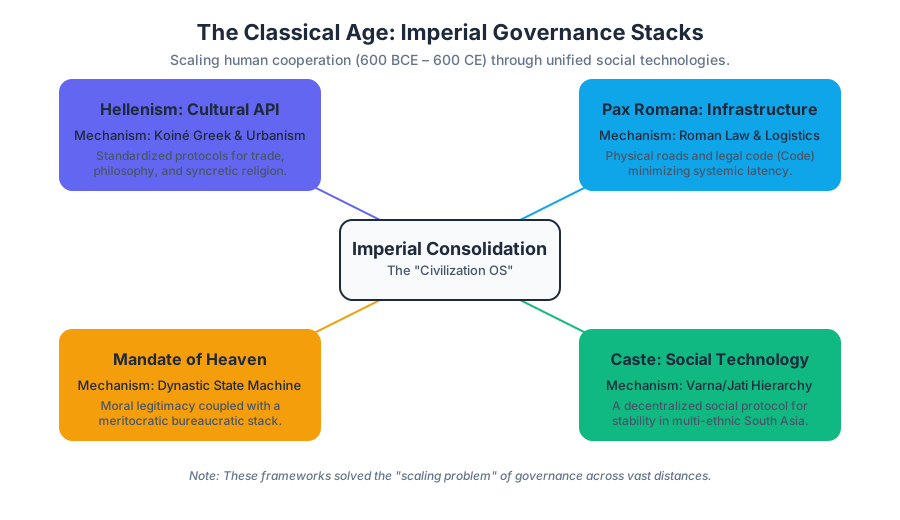
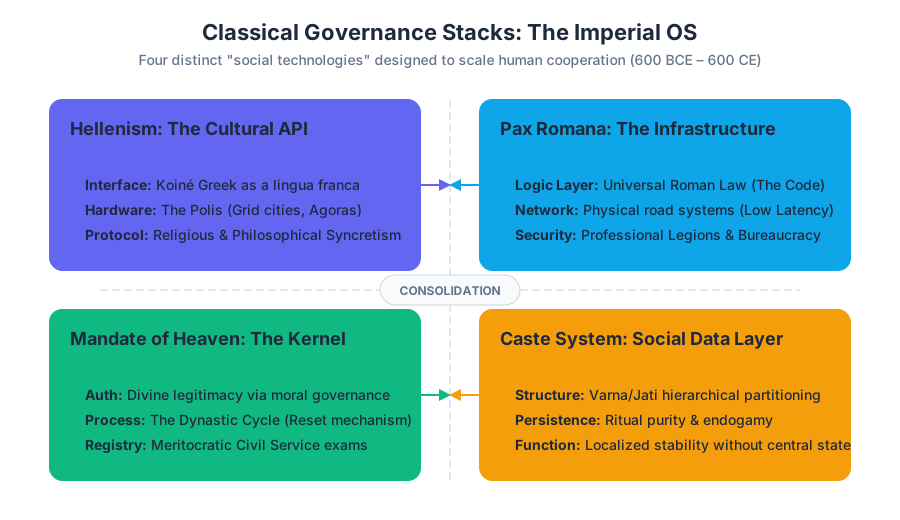
The "Classical Age" (roughly 600 BCE to 600 CE) represents a pivotal epoch in human history where the "operating systems" of modern civilization were first compiled, debugged, and deployed at scale. This era moved beyond the localized city-states of the Bronze and Iron Ages toward Imperial Consolidation—the process of integrating vast, multi-ethnic territories under a unified administrative, legal, and ideological framework.
During this period, four distinct "governance stacks" emerged: the Hellenistic synthesis in the Mediterranean and Near East, the Pax Romana of the Roman Empire, the Mandate of Heaven in East Asia, and the Caste System in South Asia. These were not merely political arrangements but comprehensive social technologies designed to solve the problem of scaling human cooperation across thousands of miles and millions of people.
Hellenism: The Cultural API of the Mediterranean
Hellenism refers to the period following the conquests of Alexander the Great (323 BCE) characterized by the spread and synthesis of Greek culture with the traditions of the Near East, Egypt, and Central Asia. It functioned as a "cultural API"—a common set of protocols (language, philosophy, and urban design) that allowed diverse peoples to interact within a shared framework.
What it is
Hellenism: The synthesis of Greek (Hellenic) culture with non-Greek elements, resulting in a cosmopolitan civilization where Koiné Greek served as the lingua franca for trade, diplomacy, and scholarship.
Why it matters
Before Hellenism, the Mediterranean was a fragmented collection of "local hosts." Hellenism provided the first "globalized" network. It enabled the spread of early Christianity, the preservation of Aristotelian logic, and the scientific advancements of the Library of Alexandria.
How it works: The Hellenistic Synthesis
The consolidation of Hellenism relied on three primary mechanisms:
- Urbanization (The Polis Model): Alexander and his successors (the Diadochi) founded dozens of cities (e.g., Alexandria, Antioch) built on a grid system with Greek institutions: the gymnasium, the theater, and the agora.
- Linguistic Standardization: Koiné Greek simplified the complex dialects of Classical Greece into a streamlined version optimized for the "average user" across the empire.
- Syncretism: The merging of religious deities (e.g., Serapis in Egypt, who combined Osiris and Apis with Zeus and Helios).
| Feature | Classical Greece (Hellenic) | Hellenistic World |
|---|---|---|
| Political Unit | Independent City-State (Polis) | Absolute Monarchy / Empire |
| Scope | Local / Ethnic | Cosmopolitan / Multi-ethnic |
| Primary Language | Attic, Ionic, Doric dialects | Koiné Greek |
| Philosophy Focus | Civic duty and the "Good Life" | Individual peace (Stoicism, Epicureanism) |
| Economic Model | Local trade | Long-distance Silk Road integration |
Common Pitfalls
- The "Pure Greek" Fallacy: A common mistake is viewing Hellenism as a one-way "civilizing" mission. In reality, it was a bidirectional exchange; Greek art was profoundly influenced by Persian luxury, and Greek religion was transformed by Egyptian mysticism.
Pax Romana: The Infrastructure of Stability
Following the collapse of the Roman Republic, the rise of Augustus (27 BCE) initiated the Pax Romana (Roman Peace)—a two-century period of relative internal stability and imperial hegemony.
What it is
Pax Romana: A state of comparative tranquility throughout the Mediterranean world from the reign of Augustus to Marcus Aurelius, achieved through military dominance, administrative efficiency, and the universal application of Roman Law.
Why it matters
The Pax Romana solved the "latency problem" of ancient governance. By building a massive physical network (roads) and a logical network (law), Rome could move "data" (legions and grain) faster than any previous entity.
Implementation: The Roman Governance Stack
Rome’s consolidation was not just about the sword; it was about the Code. The Roman legal system introduced concepts like probatio (burden of proof) and the "innocent until proven guilty" heuristic.
/*
 * Simple simulation of Roman Logistics:
 * Calculating the "Supply Chain Latency" for a Legion
 */

#include <stdio.h>

typedef struct {
    char name[20];
    float speed_km_per_day; // Speed on Roman Roads vs Off-road
    int supply_requirement; // Modius of grain per day
} Legion;

float calculate_travel_time(float distance, float road_quality_multiplier, Legion l) {
    // Roman roads increased speed by a factor of 2.0 to 3.0
    float effective_speed = l.speed_km_per_day * road_quality_multiplier;
    return distance / effective_speed;
}

int main() {
    Legion legio_x = {"Legio X Equestris", 25.0, 150};
    float distance_to_gaul = 1200.0; // km

    float time_on_roads = calculate_travel_time(distance_to_gaul, 1.5, legio_x);
    float time_off_roads = calculate_travel_time(distance_to_gaul, 0.6, legio_x);

    printf("Deployment to Gaul via Roman Roads: %.2f days\n", time_on_roads);
    printf("Deployment to Gaul via Wilderness: %.2f days\n", time_off_roads);

    return 0;
}
Variations: Auctoritas vs. Potestas
The Roman Emperor maintained control through a balance of Potestas (legal power/force) and Auctoritas (prestige/social influence). This dual-key system allowed the Empire to survive even when the individual "node" (the Emperor) was weak, provided the "system" (the Bureaucracy) remained intact.
Mandate of Heaven (Tianming): The Dynastic State Machine
In China, the transition from the warring states to the Qin and Han dynasties was governed by a unique political-theological framework known as the Mandate of Heaven.
What it is
Mandate of Heaven: The philosophical belief that Heaven (Tian) granted the right to rule to a just leader. Unlike the "Divine Right of Kings," this mandate was conditional and could be revoked if the ruler became corrupt or incompetent.
How it works: The Dynastic Cycle
The Mandate of Heaven functions like a state machine with a feedback loop. If the "Output" (social order, crop yields) falls below a certain threshold, the "System" (the people) is permitted to initiate a "Reset" (rebellion).
| State | Characteristics | Transition Trigger |
|---|---|---|
| New Dynasty | Restores peace, redistributes land, protects borders. | Time / Successive generations. |
| Aging Dynasty | High taxes, decaying infrastructure, corruption. | Neglect of duties. |
| Loss of Mandate | Floods, famines, peasant revolts, invasions. | Natural disasters / Social unrest. |
| Transition Period | Civil war, competing factions. | Emergence of a "virtuous" leader. |
Mathematical Representation of the Mandate
We can conceptualize the Mandate as a stability function $S(t)$:
$$S(t) = V(t) \cdot E(t) - (C(t) + D(t))$$
Where:
- $V$ = Virtue/Competence of the Emperor
- $E$ = Economic Prosperity
- $C$ = Corruption Level
- $D$ = Natural Disasters/External Shocks
If $S(t) < 0$ for a sustained period, the Mandate is considered "revoked," and the probability of revolution $P(R)$ approaches 1.
% Logic of the Mandate of Heaven in Pseudocode/Logic
IF (Emperor.Virtue == High && Infrastructure.Status == Optimized) {
    Mandate = Active;
    Social_Order = Stable;
} ELSE IF (Natural_Disaster == TRUE && Rebellion.Frequency > Threshold) {
    Mandate = Revoked;
    Social_Order = Chaos;
    New_Candidate = Search_For_Virtuous_Leader();
}
The Role of Confucianism
While the Mandate provided the justification for rule, Confucianism provided the implementation. It established a meritocratic bureaucracy where officials were selected based on their knowledge of classical texts rather than noble birth. This "Civil Service OS" allowed the Chinese state to maintain continuity even when dynasties changed.
The Caste System: Social Stratification as Stability
In Classical India, particularly during the Maurya and Gupta periods, social consolidation was achieved through the Caste System (Varna and Jati).
What it is
Caste System: A rigid social hierarchy in India, justified by Vedic tradition, that categorized individuals into hereditary groups determining their occupation, social circle, and religious status.
Why it matters
The Caste System acted as a "decentralized social stabilizer." Even when political empires (like the Maurya) collapsed, the social structure remained intact. It provided a predictable division of labor and social safety nets within specific Jatis (sub-castes).
The Varna Hierarchy
The system is divided into four primary Varnas, plus those outside the system (Dalits).
| Varna | Role | Symbolic Body Part |
|---|---|---|
| Brahmins | Priests, Scholars, Teachers | Mouth (Speech/Knowledge) |
| Kshatriyas | Warriors, Kings, Administrators | Arms (Protection/Force) |
| Vaishyas | Merchants, Landowners, Artisans | Thighs (Support/Production) |
| Shudras | Laborers, Servants | Feet (Foundation/Service) |
Mechanics: Dharma and Karma
The system was enforced not just by law, but by the metaphysical concepts of Dharma (duty) and Karma (action/consequence).
- Dharma: Your "API specification." Following your caste's rules was the highest moral good.
- Karma: The "execution log." Your actions in this life determined your "initialization state" (caste) in the next life.
Common Pitfalls
- Static vs. Dynamic: While the Varna categories were rigid, Jatis (occupational groups) were more fluid. Entire groups could occasionally move up the social ladder through a process called "Sanskritization"—adopting the customs of higher castes.
Synthesis: Comparing Imperial Engines
The Classical Age was a race to build the most resilient "Imperial Engine." Rome and Han China, though separated by thousands of miles, developed remarkably similar solutions to the problems of scale.
Data Management: The Census
Both empires realized that you cannot govern what you cannot measure. The Roman Census and the Han Tax Registry were the first large-scale databases.
-- Conceptual SQL Schema for a Han Dynasty Administrative Registry
CREATE TABLE Population_Registry (
    household_id INT PRIMARY KEY,
    head_of_household VARCHAR(100),
    land_area_mou DECIMAL(10, 2),
    grain_tax_paid DECIMAL(10, 2),
    corvee_labor_days_owed INT,
    confucian_exam_status BOOLEAN,
    region_id INT,
    FOREIGN KEY (region_id) REFERENCES Imperial_Provinces(id)
);

-- Query to identify regions with high "Rebellion Risk" (Low Tax Yield + High Famine)
SELECT region_id, SUM(grain_tax_paid) as Total_Revenue
FROM Population_Registry
WHERE grain_tax_paid < (SELECT AVG(grain_tax_paid) FROM Population_Registry)
GROUP BY region_id
HAVING Total_Revenue < 10000;
Comparison of Rome and Han China
| Metric | Roman Empire (Pax Romana) | Han Dynasty (China) |
|---|---|---|
| Unifying Ideology | Law and Citizenship | Confucianism and Ritual |
| Social Mobility | Possible (Slavery to Freedman) | Possible (Exam System) |
| Labor Model | Heavy reliance on Slavery | Heavy reliance on Peasantry |
| Collapse Cause | Over-extension / Germanic Invasions | Internal Corruption / Nomadic Invasions |
| Legacy | Roman Law / Romance Languages | Bureaucratic State / Han Identity |
Conclusion: The Legacy of Consolidation
The Classical Age proved that human societies could scale beyond the "Dunbar Number" (the limit of stable social relationships) through the use of abstract systems. Whether it was the Hellenistic cultural blend, the Roman legal code, the Chinese moral mandate, or the Indian social hierarchy, these systems provided the stability necessary for trade, art, and science to flourish.
The "Imperial Consolidation" of this era set the stage for the post-classical world, defining the boundaries of cultural zones that persist to this day. Understanding these systems is not just an exercise in history; it is a study of the foundational code upon which modern civilization is built.
Cross-Cultural Interactions and Religious Expansion
Key concepts: Caliphates · Silk Road · Trans-Saharan Trade · Syncretism
Focuses on the spread of major world religions and the development of trade routes like the Silk Road that connected Afro-Eurasia.
Cross-Cultural Interactions and Religious Expansion
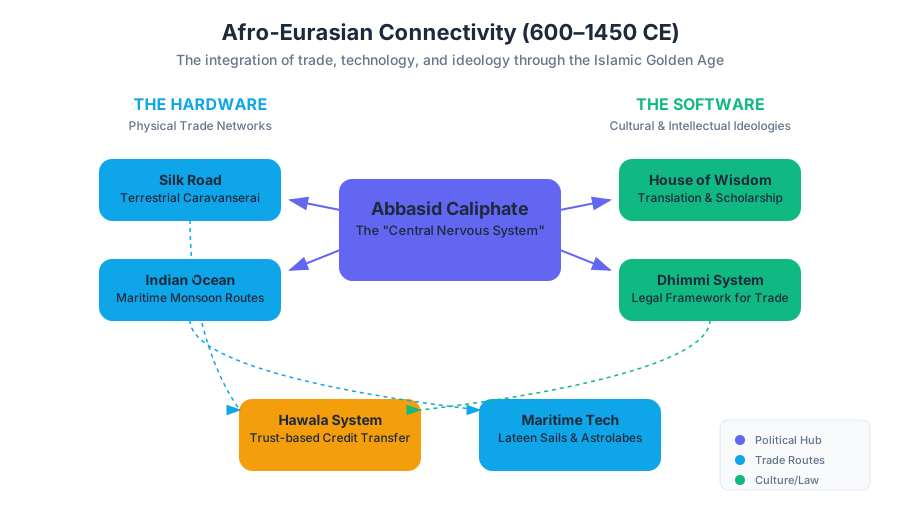
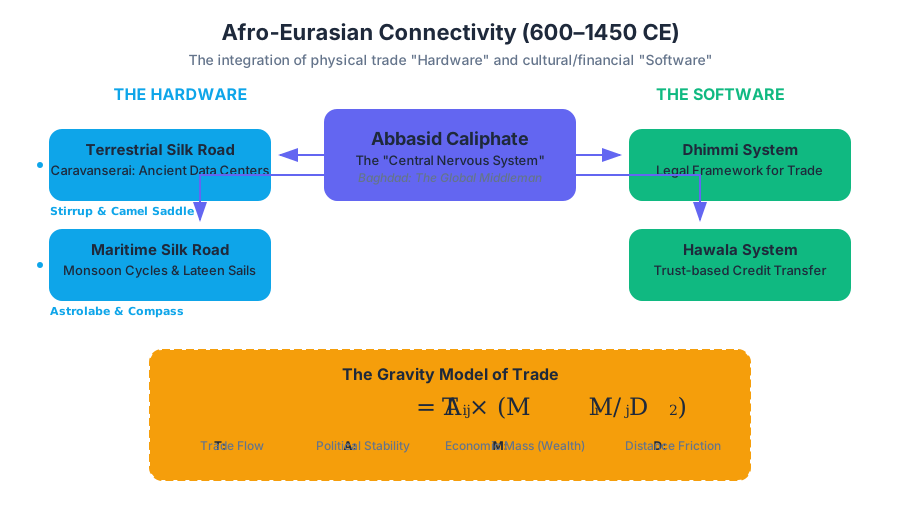
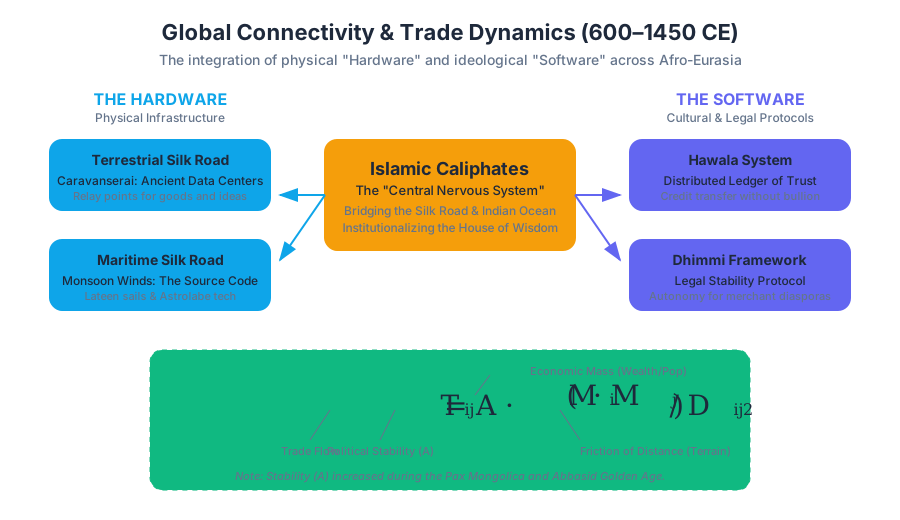
The period between 600 CE and 1450 CE represents the first era of truly "global" connectivity across Afro-Eurasia. Unlike the modern era of digital synchronization, this period relied on physical networks—the "hardware" of trade routes and the "software" of religious and cultural ideologies—to facilitate the exchange of goods, technologies, and philosophies. The expansion of the Islamic Caliphates acted as a central nervous system for this connectivity, bridging the Mediterranean, the Indian Ocean, and the Silk Roads into a singular, albeit decentralized, economic and intellectual ecosystem.
The Islamic Caliphates: Engines of Integration
The rise of Islam in the 7th century was not merely a religious event but a geopolitical shift that restructured the flow of global power. The transition from the Umayyad Caliphate (661–750 CE) to the Abbasid Caliphate (750–1258 CE) marked a move from an Arab-centric military empire to a multi-ethnic, cosmopolitan state that prioritized trade and scholarship.
The Mechanics of the Abbasid "Golden Age"
The Abbasids moved the capital to Baghdad, a circular city strategically positioned between the Tigris and Euphrates rivers. This location allowed them to act as the ultimate "middlemen" of the Silk Road. They institutionalized knowledge through the Bayt al-Hikma (House of Wisdom), where scholars translated Greek, Persian, and Indian texts into Arabic.
Definition: The Dhimmi System A legal framework within Islamic states that granted protected status to "People of the Book" (Jews, Christians, and later Zoroastrians and Hindus). While subject to the jizya (a poll tax), these groups maintained internal autonomy, which facilitated stable cross-border trade networks by allowing non-Muslim merchant diasporas to operate safely within the Caliphate.
| Feature | Umayyad Caliphate (661–750) | Abbasid Caliphate (750–1258) |
|---|---|---|
| Capital | Damascus | Baghdad |
| Administration | Arab-centric, military aristocracy | Persian-influenced, bureaucratic, meritocratic |
| Expansion Strategy | Rapid territorial conquest | Trade expansion and intellectual soft power |
| Religious Policy | Discouraged conversion (to maintain tax base) | Encouraged conversion; universalized the Ummah |
| Economic Focus | Land-based agrarian taxes | Global trade, manufacturing, and finance |
Implementation: The Hawala System
To manage the risks of long-distance trade, Islamic merchants developed the Hawala system—an informal value transfer system based on the performance and honor of a huge network of money brokers. This allowed a merchant in Cordoba to "deposit" funds and have them "withdrawn" by a partner in Baghdad without the physical movement of gold, effectively creating an early version of a distributed ledger.
# A simplified simulation of a Hawala transaction network
class HawalaNode:
    def __init__(self, location, reputation_score):
        self.location = location
        self.reputation = reputation_score
        self.ledger = 0

    def transfer_credit(self, recipient_node, amount):
        """
        Transfers credit without physical bullion movement.
        The 'trust' is the protocol's security layer.
        """
        if self.reputation > 0.8:  # Minimum trust threshold
            self.ledger -= amount
            recipient_node.ledger += amount
            print(f"Transaction verified: {amount} units from {self.location} to {recipient_node.location}")
        else:
            raise Exception("Insufficient Trust: Transaction Rejected")

# Example usage in the 9th Century Trade Network
baghdad = HawalaNode("Baghdad", 0.98)
guangzhou = HawalaNode("Guangzhou", 0.95)

baghdad.transfer_credit(guangzhou, 500) # 500 Dinars worth of silk credit
The Silk Road and Indian Ocean Trade: The Hardware of Exchange
While the Silk Road is often imagined as a single highway, it was actually a complex, adaptive network of land and sea routes. The Silk Road (terrestrial) and the Indian Ocean Trade (maritime) functioned as complementary systems.
The Terrestrial Silk Road
The land routes relied on the Caravanserai—fortified inns spaced approximately one day's journey apart (roughly 20-30 miles). These served as the "data centers" of the ancient world, where merchants exchanged not just silk and spices, but also news, linguistic nuances, and religious ideas.
The Maritime Silk Road (Indian Ocean)
Maritime trade was governed by the Monsoon Winds. Understanding these seasonal patterns was the "source code" for Indian Ocean dominance.
- Winter Monsoons: Blew from the NE (India to Africa).
- Summer Monsoons: Blew from the SW (Africa to India).
| Technology | Origin | Impact on Trade |
|---|---|---|
| Lateen Sail | Arab/Indian | Allowed ships to sail against the wind (tacking). |
| Astrolabe | Hellenistic/Islamic | Enabled precise latitude calculation at sea. |
| Sternpost Rudder | Chinese | Improved maneuverability of large vessels (Junks). |
| Magnetic Compass | Chinese | Allowed navigation in cloudy weather/open ocean. |
Mathematical Modeling of Trade Flow
The volume of trade between two nodes (cities) in this period can be roughly modeled using a Gravity Model of Trade, where the interaction is proportional to the economic "mass" (population/wealth) and inversely proportional to the "friction" of distance.
$$T_{ij} = A \times \frac{M_i \times M_j}{D_{ij}^2}$$
Where:
- $T_{ij}$ is the trade flow between city $i$ and city $j$.
- $A$ is a constant reflecting political stability (e.g., the Pax Mongolica).
- $M$ represents the economic mass (surplus goods, population).
- $D$ is the distance, adjusted for terrain (sea distance < desert distance).
Trans-Saharan Trade: The Gold-Salt Axis
The Trans-Saharan trade routes transformed West Africa from a peripheral region into a central hub of the global economy. This network was made possible by the "biological technology" of the Dromedary Camel, which could travel long distances without water.
The Mali Empire and Mansa Musa
The Mali Empire (c. 1235–1670) controlled the three largest gold mines in West Africa. The most famous ruler, Mansa Musa, demonstrated the sheer scale of this wealth during his 1324 pilgrimage to Mecca. His massive distribution of gold in Cairo was so significant that it caused hyperinflation in the Egyptian gold market for over a decade.
The Salt-Gold Exchange
The core of this trade was the exchange of West African gold for Saharan salt. In the tropical climate of West Africa, salt was a biological necessity for food preservation and human health, making it literally worth its weight in gold in some regions.
-- Conceptual Schema for a Timbuktu Customs Ledger
CREATE TABLE Caravans (
    caravan_id INT PRIMARY KEY,
    origin_city VARCHAR(50),
    arrival_date DATE,
    commodity_type ENUM('Gold', 'Salt', 'Manuscripts', 'Slaves'),
    quantity_kg DECIMAL(10, 2),
    tax_paid_dinars DECIMAL(10, 2)
);

-- Query to find total gold export volume in 1324
SELECT SUM(quantity_kg)
FROM Caravans
WHERE commodity_type = 'Gold'
AND arrival_date BETWEEN '1324-01-01' AND '1324-12-31';
Religious Diffusion and Syncretism
As merchants moved, so did their gods. Religion provided a shared moral and legal framework that lowered the "transaction costs" of trade. If two merchants shared a faith, they shared a set of ethical standards and a court system (like the Sharia in Islam or Sangha rules in Buddhism) to resolve disputes.
Syncretism: The Blending of Beliefs
Syncretism is the process by which different beliefs, cultures, or schools of thought are merged. During this era, religions rarely remained "pure" as they crossed borders.
Key Concept: Syncretism The hybridization of religious practices. For example, Mahayana Buddhism in China incorporated Daoist concepts of "The Way" (Dao), while Sufism (Islamic mysticism) often integrated local folk traditions and ascetic practices in South Asia and Africa to facilitate conversion.
Case Studies in Diffusion
- Buddhism in East Asia: Spread from India via the Silk Road. In China, it adapted to Confucian social structures, emphasizing filial piety to gain state support.
- Christianity in Ethiopia: The Kingdom of Aksum adopted Christianity in the 4th century. Isolated by the rise of Islam, Ethiopian Christianity developed unique architectural forms (rock-hewn churches of Lalibela) and maintained distinct liturgical traditions.
- Islam in SE Asia: Spread primarily via maritime trade rather than conquest. Sufi missionaries emphasized a personal, mystical connection to God, which resonated with existing Hindu-Buddhist and animist traditions in Indonesia and Malaysia.
| Religion | Primary Diffusion Vector | Key Region of Expansion | Resulting Syncretic Form |
|---|---|---|---|
| Islam | Trade/Sufi Missionaries | West Africa / SE Asia | Africanized Islam / Indonesian Sufism |
| Buddhism | Silk Road / Monasticism | China / Japan / Korea | Zen (Chan) Buddhism |
| Christianity | State Adoption / Monasticism | Northern Europe / Ethiopia | Celtic Christianity / Ge'ez Liturgy |
Cross-Cultural Intellectual Pipelines
The interaction between these cultures created a "pipeline" of technological transfer that fundamentally altered the trajectory of human history.
The Paper Trail
The Battle of Talas (751 CE) between the Abbasid Caliphate and the Tang Dynasty is a pivotal moment in the "history of technology." Captured Chinese papermakers revealed the secrets of paper production to the Arabs.
- Samarkand: First paper mills outside China.
- Baghdad: Industrialization of paper, leading to a "book revolution."
- Al-Andalus (Spain): Paper enters Europe, eventually making the Gutenberg press viable centuries later.
The Numerical Revolution
The "Arabic" numerals we use today are actually Hindu-Arabic numerals. They originated in India (including the concept of zero), were refined by Persian mathematicians like Al-Khwarizmi (the father of Algebra), and were eventually transmitted to Europe via trade in North Africa and Sicily.
# A metaphorical "Deployment" of Knowledge across the Silk Road
# Using a YAML-like structure to define the transfer of "Paper Technology"

technology_transfer:
  name: "Paper Making"
  source: "Tang China"
  destination: "Abbasid Caliphate"
  trigger_event: "Battle of Talas (751 CE)"
  nodes:
    - city: "Samarkand"
      role: "Initial processing hub"
    - city: "Baghdad"
      role: "Mass production & Library integration"
    - city: "Fez"
      role: "Western distribution"
    - city: "Jativa"
      role: "European entry point"
  impact:
    - "Decreased cost of knowledge transmission"
    - "Expansion of bureaucracy"
    - "Preservation of classical texts"
Common Pitfalls and Misconceptions
- The "Dark Ages" Myth: While Western Europe experienced a period of relative decentralization, the rest of the world (the Islamic world, Tang/Song China, the Byzantine Empire, and the Mali Empire) was experiencing a peak in scientific and economic activity.
- Religion vs. Trade: It is a mistake to view religion and trade as separate. In this era, they were inextricably linked. A merchant's religious identity was his "credit score" and his "legal jurisdiction."
- The "Silk" Road: Silk was only one of many commodities. The trade in bulk goods (spices, timber, grain) via the Indian Ocean was arguably more important for the daily lives of people than the luxury silk trade.
Summary of Interconnectedness
By 1450, the world was a "Small World" network. A plague outbreak in Central Asia (the Black Death) could travel the Silk Road and devastate Europe and North Africa within decades. A new navigational tool in China could be used by a Portuguese explorer within a century. This era proved that cultural and religious expansion is not just about "faith," but about the creation of interoperable systems—legal, linguistic, and economic—that allow humans to cooperate across vast distances.
The Post-Classical World and the Americas
Key concepts: Feudalism · Mongol Conquests · Mesoamerican Civilizations · The Black Death
Examines the late medieval period in Europe, the impact of the Mongol Empire, and the complex civilizations of the Americas prior to 1500.
The Post-Classical World and the Americas
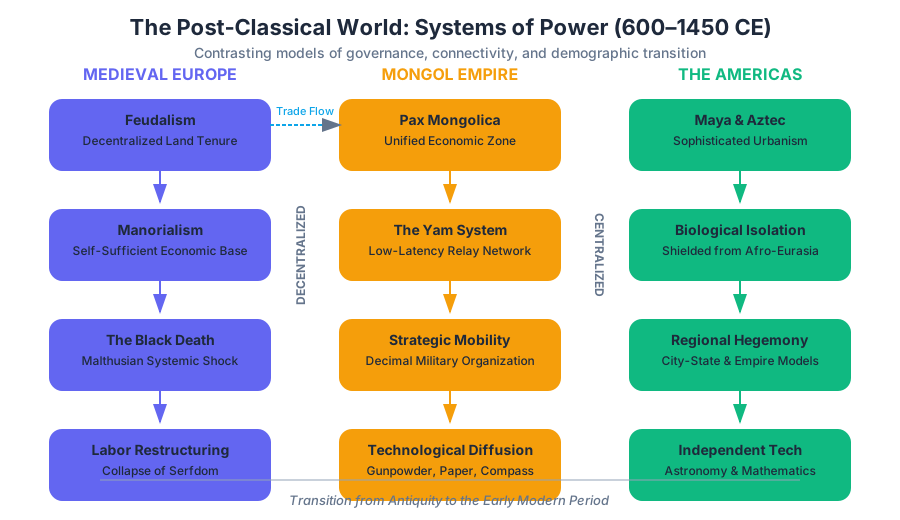
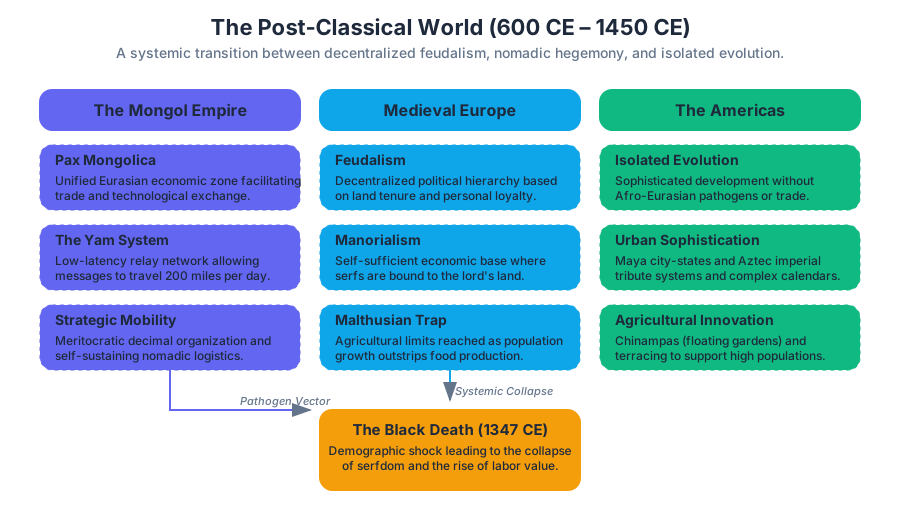
The Post-Classical era (roughly 600 CE to 1450 CE) represents a period of intense systemic transition. It is defined not by a single global hegemony, but by the tension between decentralized local structures (Feudalism) and massive, centralized nomadic expansions (The Mongol Empire), alongside the isolated but highly sophisticated evolution of the Americas. This era marks the transition from antiquity to the early modern period, characterized by the catastrophic demographic shock of the Black Death and the subsequent restructuring of labor and capital.
The Mongol Empire: The Mechanics of Universal Hegemony
The Mongol Empire (1206–1368) was the largest contiguous land empire in history. Its emergence under Temujin (Genghis Khan) disrupted the existing geopolitical order of Afro-Eurasia, creating a unified economic zone known as the Pax Mongolica.
The Logistics of Conquest
The Mongol military was not merely a "horde" but a highly disciplined, meritocratic organization based on the decimal system (units of 10, 100, 1,000, and 10,000). Their primary advantage was strategic mobility—each rider maintained a string of three to five horses, allowing for continuous movement without exhausting the mounts.
Definition: Pax Mongolica A period of relative stability across Eurasia facilitated by Mongol rule, which allowed for the unprecedented exchange of goods, ideas, and technologies (such as gunpowder, papermaking, and the compass) between the East and the West.
| Feature | Mongol Nomadic Warfare | Traditional Sedentary Warfare |
|---|---|---|
| Primary Unit | Light and Heavy Cavalry | Infantry and Heavy Cavalry |
| Logistics | Self-sustaining (herds, spare horses) | Supply trains, vulnerable to siege |
| Communication | The Yam (Relay station system) | Messengers, limited by terrain |
| Tactics | Feigned retreat, encirclement | Phalanx, static defensive lines |
| Siege Craft | Adopted from captured engineers | Traditional battering rams/walls |
The Yam System: A Low-Latency Network
The Yam was the Mongol postal and intelligence network. It functioned as a series of relay stations spaced approximately 25–30 miles apart, providing fresh horses and food to authorized messengers. This system allowed information to travel up to 200 miles per day.
# Low-level implementation: Simulating the Yam Relay System
# This script calculates the latency of a message across the Mongol Empire

class RelayStation:
    def __init__(self, station_id, has_fresh_horses=True):
        self.station_id = station_id
        self.has_fresh_horses = has_fresh_horses

def calculate_delivery_time(distance_km, avg_speed_kmh, relay_efficiency):
    """
    Calculates time to deliver a message across the empire.
    distance_km: Total distance from Karakorum to the frontier.
    avg_speed_kmh: Speed of a single horse (approx 15-20 km/h over long distances).
    relay_efficiency: Factor (0.0 to 1.0) representing station readiness.
    """
    # Without relays, a horse must rest 12 hours for every 4 hours of riding
    # With the Yam, the 'rider' is the constant, the 'horse' is the variable
    base_time = distance_km / avg_speed_kmh
    relay_overhead = (1.0 - relay_efficiency) * base_time

    return base_time + relay_overhead

# Example: Message from Karakorum to Sarai (approx 4500 km)
distance = 4500
speed = 25 # High-speed courier
efficiency = 0.95

time_hours = calculate_delivery_time(distance, speed, efficiency)
print(f"Estimated Message Latency: {time_hours / 24:.2f} days")
Medieval Europe: Feudalism and the Manorial System
While the Mongols centralized Eurasia, Western Europe remained fractured. Following the collapse of the Carolingian Empire, power devolved into Feudalism, a decentralized political system based on land tenure and personal loyalty.
The Feudal Hierarchy
Feudalism was a reciprocal relationship between a Lord (landowner) and a Vassal (subordinate). The Lord granted a Fief (land) in exchange for military service and political counsel.
The Manorial Economy
If Feudalism was the political superstructure, Manorialism was the economic base. It was a self-sufficient system where the Lord of the Manor exercised legal and economic power over Serfs—unfree laborers bound to the land.
| Social Class | Role | Primary Obligation |
|---|---|---|
| Monarch | Nominal Ruler | Granting land to Great Lords |
| Nobles/Lords | Land Management | Military service, protection of serfs |
| Knights | Professional Soldiers | Protection of the Fief (Chivalry) |
| Serfs | Agricultural Labor | Labor rent (corvée), portion of crops |
The Malthusian Trap and the Black Death
By 1300, Europe had reached the limits of its agricultural technology, a state known as the Malthusian Trap, where population growth outstrips food production. The arrival of the Black Death (Yersinia pestis) in 1347 acted as a catastrophic "positive check" on the population.
The Malthusian Equation Let $P(t)$ be the population and $F(t)$ be the food supply. $P(t) = P_0 e^{rt}$ (Exponential Growth) $F(t) = F_0 + kt$ (Arithmetic Growth) When $P(t) > F(t)$, a "Malthusian Catastrophe" occurs.
% Mathematical representation of the SIR model for Plague Dynamics
\frac{dS}{dt} = -\beta SI \\
\frac{dI}{dt} = \beta SI - \gamma I \\
\frac{dR}{dt} = \gamma I
The plague killed an estimated 30–60% of Europe's population. Paradoxically, this led to the Collapse of Serfdom. The sudden scarcity of labor increased the bargaining power of the surviving peasantry, leading to higher wages and the transition toward a cash-based economy.
Mesoamerican Civilizations: The Maya and the Aztec
In the Americas, civilizations developed in total isolation from Afro-Eurasian pathogens and technologies (like the wheel or iron smelting), yet they achieved comparable levels of complexity in mathematics, astronomy, and urban planning.
The Maya: Masters of Time and Space
The Maya (c. 250–900 CE) were organized into competing city-states (e.g., Tikal, Palenque). They are noted for their sophisticated Hieroglyphic Writing and their use of the concept of Zero, which allowed for complex astronomical calculations.
The Aztec Empire: The Tribute State
The Aztec (Mexica) Empire (c. 1300–1521) was a militaristic confederation based in Tenochtitlan, a city built on an island in Lake Texcoco. Their economy was driven by the Tribute System, where conquered provinces sent goods (maize, beans, luxury items) to the capital.
Chinampas: High-Yield Hydroponics
To support a massive urban population, the Aztecs developed Chinampas—artificial islands created by layering mud and vegetation in shallow lake beds.
| Innovation | Purpose | Impact |
|---|---|---|
| Chinampas | Intensive Agriculture | 4+ harvests per year; supported 200k+ people |
| Macuahuitl | Weaponry | Obsidian-edged wooden sword; highly lethal |
| Tribute Codices | Administration | Detailed records of imperial taxation |
| Great Speaker | Political | The Huey Tlatoani, a semi-divine ruler |
The Andean World: The Inca Empire
The Inca Empire (Tawantinsuyu) was the largest empire in pre-Columbian America. Spanning the Andes Mountains, the Inca managed a diverse geography through a highly centralized, "vertical" administrative model.
Vertical Archipelago and the Mita System
The Inca did not have a market economy. Instead, they used the Vertical Archipelago model, where different ecological zones (coast, mountains, jungle) produced different goods that were redistributed by the state.
Labor was organized through the Mita, a mandatory public service requirement. This labor built the Qhapaq Ñan (Inca Road System), which spanned over 25,000 miles.
Quipu: Data Without Writing
Lacking a phonetic script, the Inca used Quipu—a system of knotted strings—to record census data, tax records, and historical narratives. The position, color, and type of knot represented numerical values and categories.
-- Conceptual SQL representation of an Inca Census via Quipu
-- This represents how a Quipucamayoc (accountant) might aggregate data

SELECT
    Region_ID,
    SUM(Mita_Labor_Units) AS Total_Labor_Pool,
    SUM(Maize_Storage) AS Grain_Reserves,
    (SUM(Maize_Storage) / SUM(Population)) AS Food_Security_Index
FROM
    Tawantinsuyu_Records
WHERE
    Year_Cycle = '1450'
GROUP BY
    Region_ID
ORDER BY
    Food_Security_Index DESC;
Comparative Analysis: State Collapse and Resilience
The Post-Classical world provides a laboratory for studying why civilizations fail or persist.
- The Mongol Collapse: The empire was too large for pre-modern communication. It fractured into four Khanates (Golden Horde, Ilkhanate, Chagatai, and Yuan) due to succession disputes and the cultural assimilation of the Mongol elite into their conquered subjects.
- The Mayan Collapse: Likely caused by a combination of environmental degradation (deforestation), prolonged drought, and endemic warfare between city-states, leading to the abandonment of the southern lowlands.
- The European Recovery: The Black Death acted as a "creative destruction" event. By breaking the feudal lock on labor, it paved the way for the Renaissance and the rise of the merchant class.
| Factor | Mongol Empire | Aztec Empire | Inca Empire | Western Europe |
|---|---|---|---|---|
| Centralization | High (Initial) | Moderate (Tribute) | Very High | Very Low |
| Primary Resource | Trade/Plunder | Tribute/Grain | Labor (Mita) | Land (Fief) |
| Decline Trigger | Succession/Plague | Spanish Conquest | Civil War/Spanish | Plague (Transformation) |
Common Pitfalls in Analysis
- The "Dark Ages" Myth: It is a mistake to view Medieval Europe as a period of stagnation. Significant technological advances (heavy plow, three-field system, universities) occurred during this time.
- Mongol Barbarism: Focusing solely on Mongol violence ignores their role as "civilization brokers" who enabled the modern world's first era of globalization.
- Americas Isolation: While isolated, the Americas were not "behind." Their agricultural yields (via Chinampas) and astronomical precision often exceeded contemporary European standards.
Source Materials
Study World History Volume 1 with AI — Free on Lykke
Sign up for free to generate personalized flashcards, quizzes, and study guides from this course. Chat with an AI tutor that knows the material.
Get Started FreeView this course wiki on Lykke · Browse all public course wikis